

Navigating the legal landscape surrounding public safety can be a source of significant confusion and anxiety. Whether you are concerned for your community, seeking to understand the obligations of a family member or client, or simply trying to find reliable information, the system can feel overwhelming. This is particularly true when it comes to understanding the official idaho sex offender registry. Many people are unsure how to use the search tools effectively or what the state’s specific laws actually require from registrants and the public.
This comprehensive guide is designed to provide the clarity you need. In a professional and discreet manner, we will walk you through the process of searching the registry, explain the purpose behind the law, and detail the specific requirements for individuals who must register. Our goal is to offer an authoritative overview, empowering you with the knowledge to use this public resource correctly and understand its role in community safety. You will leave with a clear understanding of the system’s functions, rules, and limitations.
What Is the Idaho Sex Offender Registry and Its Purpose?
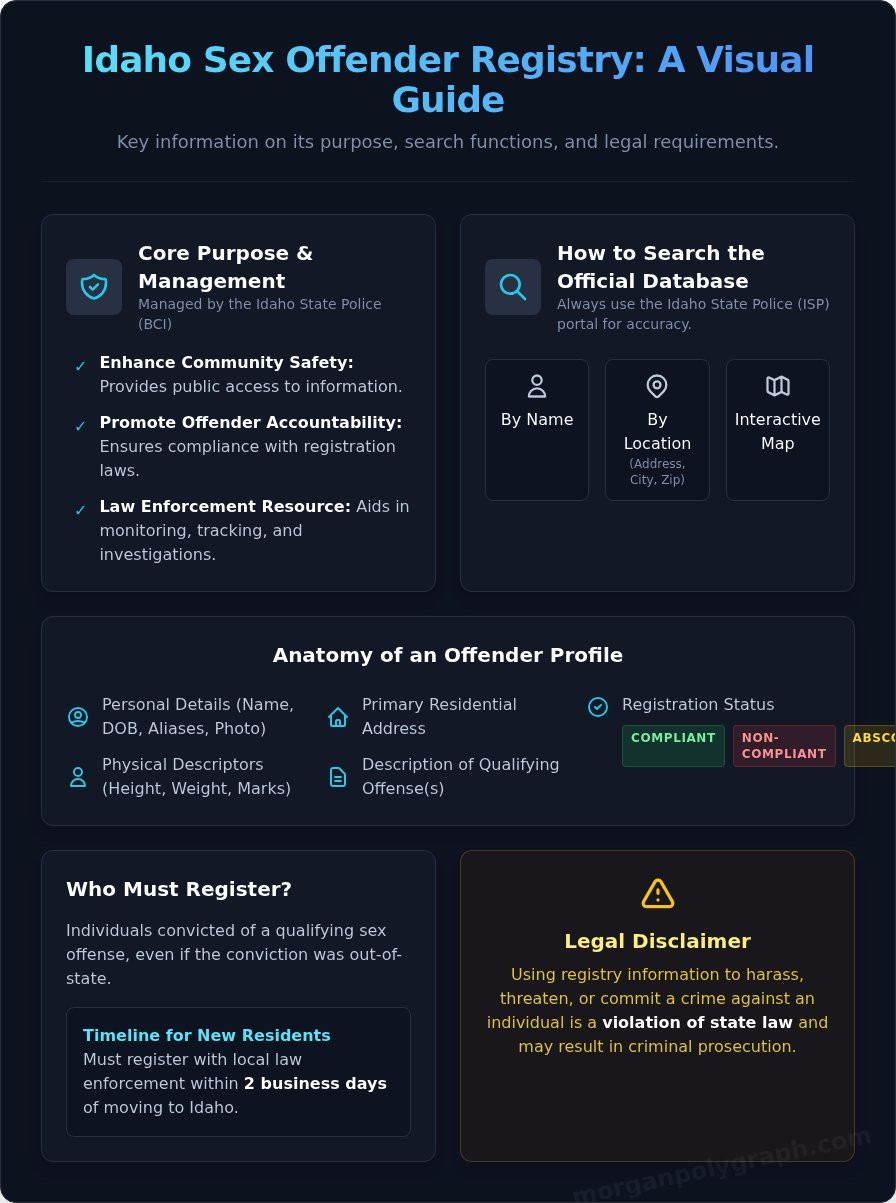
The Idaho Sex Offender Registry is a critical public safety database maintained and managed by the Idaho State Police, Bureau of Criminal Identification (BCI). Its fundamental purpose is to provide an accessible and centralized resource for both law enforcement agencies and the general public. By compiling and disseminating information about individuals convicted of specific sex offenses, the registry aims to enhance community safety, prevent future victimization, and provide a clear framework for offender accountability.
This system operates with a dual focus: it equips law enforcement with the necessary tools for monitoring and tracking registered individuals, while also empowering citizens to make informed decisions to protect themselves and their families. It is a structured and regulated tool designed to balance public awareness with the legal requirements of offender management.
The Legal Foundation of the Registry
The requirement for registration is grounded in state law, specifically Idaho Code, Title 18, Chapters 83 and 84. These state statutes implement federal standards, as the history of Sex offender registries in the United States shows a nationwide effort to create consistent public safety tools, largely shaped by the federal Adam Walsh Child Protection and Safety Act (SORNA). It is essential to understand that the registry is a civil, regulatory system designed for public information and safety, not an additional criminal punishment.
Primary Goals: Public Safety and Offender Accountability
The registry serves two primary and interconnected goals: enhancing public safety and promoting offender accountability. These objectives are achieved through several key functions:
- Law Enforcement Resource: It provides law enforcement agencies with accurate, up-to-date information on the location, status, and compliance of registered individuals, which is vital for investigations and proactive monitoring.
- Public Awareness: The registry empowers the public with access to information that allows them to make informed decisions for their personal and family safety. Citizens can identify registered offenders living or working in their communities.
- Deterrence and Monitoring: It serves as a component of an offender’s long-term management plan. The requirement to register and regularly verify information promotes accountability and acts as a deterrent against future offenses.
How to Search the Official Idaho SOR Database: A Step-by-Step Guide
For accurate and up-to-date information, it is essential to use the official source maintained by the Idaho State Police (ISP). Third-party websites may contain outdated or incomplete data. The official idaho sex offender registry is a public safety tool designed to provide communities with verified information as part of a comprehensive offender management strategy. You can access the official search portal directly through the ISP.
Official Resource: Idaho State Police Sex Offender Registry Search
Searching by Name or Location
The ISP portal offers several straightforward methods for finding information. Users can perform a search based on specific criteria to identify registered individuals in their community. The primary search functions include:
- Name Search: If you know the individual’s name, you can enter their first and last name to pull up a specific profile.
- Location Search: Enter a specific street address, city, or zip code to view a list of registered offenders within a one-, three-, or five-mile radius.
- Map Search: This interactive feature allows you to view a geographical map of an area, with icons indicating the registered addresses of offenders.
Understanding the Information on an Offender’s Profile
Each public profile on the registry provides a standardized set of details to help with identification and awareness. This data, combined with ongoing supervision methods like Post-Conviction Sex Offender Polygraph Testing, provides a framework for community safety. Key information includes:
- Personal Details: The offender’s full name, any known aliases, a date of birth, and a recent photograph.
- Physical Descriptors: Height, weight, eye and hair color, and any unique identifying marks such as scars or tattoos.
- Address Information: The primary residential address where the offender is registered to be living.
- Offense Details: A description of the qualifying offense(s) that require the individual to register.
- Registration Status: This indicates their current standing. Compliant means they are following registration requirements, while Absconded or Non-Compliant means they have failed to meet their legal obligations.
Disclaimer: The information on the Idaho Sex Offender Registry is provided for public safety and notification purposes only. It is a violation of state law to use this information to harass, threaten, or commit any crime against a registered individual. Such actions may result in criminal prosecution.
Idaho’s Registration Laws: Who Must Register and For How Long?
In Idaho, the legal requirement to register as a sex offender is a direct consequence of a criminal conviction. This mandate is not arbitrary; it is a structured system designed to enhance public safety and provide a framework for offender management. An individual must register if they have been convicted of a qualifying sex offense, regardless of whether the conviction occurred in Idaho or another state. Upon moving to Idaho, individuals with out-of-state convictions must register with local law enforcement within two business days.
The registration process is initiated immediately following sentencing or release from incarceration. While both adults and juveniles may be required to register, the specifics of juvenile registration, including confidentiality and public access to information, are handled with different protocols to reflect the distinct legal status and rehabilitative goals for minors.
Qualifying Offenses Under Idaho Code
The specific crimes that trigger registration are explicitly defined within Idaho’s Sexual Offenders Registration Notification and Community Right-to-Know Act. These offenses cover a wide spectrum of conduct and are not limited to violent crimes. General categories include, but are not limited to, sexual abuse of a child, lewd conduct, sexual exploitation of a minor, and video voyeurism. The nature and severity of the specific offense are critical, as they directly determine the duration of the registration period.
Duration of Registration: From 10 Years to a Lifetime
Idaho utilizes a tier-based system that dictates how long an individual must remain on the idaho sex offender registry. This structured approach ensures that the registration period is proportional to the severity of the offense. The primary durations are:
- 10-Year Registration: Typically required for individuals convicted of lower-level offenses.
- 25-Year Registration: Mandated for those convicted of more serious offenses.
- Lifetime Registration: Reserved for the most severe offenses, repeat offenders, and individuals adjudicated as “sexually violent predators.”
For those not subject to lifetime registration, a pathway to removal exists. After successfully completing the mandated registration period without new offenses and fulfilling all treatment requirements, an individual may petition the court for their removal from the registry. This process provides a clear end-point for compliant individuals while ensuring long-term monitoring for high-risk cases.
Ongoing Requirements and Restrictions for Registered Individuals
Placement on the idaho sex offender registry is not a one-time event; it is an ongoing legal responsibility with strict and complex compliance rules. These regulations are designed to ensure the information available to the public and law enforcement remains accurate and current for community safety. In Idaho, supervision of these requirements is typically managed by the Department of Correction, Probation and Parole Division. Failure to comply with any registration requirement is not a minor infraction-it is a felony offense that can result in significant prison time.
Address Verification and Reporting Changes
Individuals on the registry must maintain constant contact with law enforcement. This includes periodic, in-person check-ins with their local county sheriff, often on an annual or semi-annual basis, to verify their information and be photographed. Any change in residence must be reported in advance or within an extremely short timeframe, typically two business days. This is not the only required update; registrants must promptly report numerous other life changes, including:
- Any change in employment or school enrollment status.
- Acquisition or change of a vehicle, including license plate numbers.
- All online identifiers, such as email addresses, screen names, and social media profiles.
- Changes to a legal name.
Residency, Employment, and Travel Rules
Beyond reporting, an individual’s daily life is subject to significant restrictions. Idaho state law imposes residency limitations, often prohibiting registered individuals from living within a certain distance (e.g., 500 feet) of schools, daycares, or other locations where children frequently gather. Similarly, there are stringent rules against any employment or volunteer work that involves unsupervised contact with minors. Even personal travel is regulated; any plan to travel outside of the state, even for a short period, requires advance notification to their supervising officer, detailing the destination, duration, and purpose of the trip.
Navigating these stringent requirements is a critical part of an individual’s supervision plan. For those required to undergo Post-Conviction Sex Offender Testing (PCSOT), demonstrating consistent truthfulness and compliance is essential. Professional testing provides a verified measure of adherence to these complex rules.
The Role of Polygraphs in Post-Conviction Supervision (PCSOT)
While the idaho sex offender registry serves as a public notification tool, it is only one component of a comprehensive offender management strategy. True risk reduction relies on active supervision, mandatory treatment, and strict probation terms. To ensure these measures are effective, professionals require specialized tools to verify compliance and encourage accountability. This is where Post-Conviction Sex Offender Testing (PCSOT), a highly specialized polygraph application, plays a critical and confidential role.
What is PCSOT and Why Is It Used?
PCSOT is a specific type of polygraph examination designed for individuals under community supervision for a sex offense. It is not an interrogation to re-litigate the original crime. Instead, its purpose is to provide probation officers and treatment providers with a reliable tool to verify an offender’s compliance with court-ordered rules. This professional process focuses exclusively on behavior and activities during the supervision period, creating a framework for accountability and therapeutic honesty.
How Polygraphs Support Treatment and Public Safety
By promoting truthfulness, PCSOT directly supports the goals of both treatment and public safety. An expertly administered polygraph exam provides objective insight that goes far beyond the static information available on a public list like the idaho sex offender registry. Key benefits include:
- Verifying Compliance: Exams can specifically address adherence to critical supervision rules, such as no-contact orders, internet and device restrictions, travel limitations, and avoidance of high-risk situations.
- Encouraging Truthful Disclosure: The polygraph process serves as a powerful incentive for individuals to be honest with their treatment providers and supervising officers, which is essential for therapeutic progress.
- Informing Risk Assessment: Verified information about an individual’s behavior allows professionals to form a more accurate and dynamic assessment of their risk, enabling them to adjust supervision intensity accordingly.
This structured approach to truth verification is a cornerstone of modern, evidence-based offender management. For agencies, providers, or legal professionals seeking to integrate this vital tool, it is crucial to work with certified examiners. Learn about professional PCSOT services for legal and treatment needs.
Navigating Compliance with Expert Guidance
Understanding the intricacies of the idaho sex offender registry-from its public search function to the stringent registration laws and ongoing supervision requirements-is the first step toward navigating the legal system effectively. For individuals under Post-Conviction Sex Offender Treatment (PCSOT), polygraph examinations are a critical and mandatory component of this process, demanding the highest level of professionalism and accuracy.
When facing these requirements, partnering with a trusted expert is essential. Morgan Polygraph provides confidential, court-recognized PCSOT polygraph services for legal, treatment, and government professionals in Boise and across the state. Our nationally certified examiners bring over 40 years of combined polygraph experience to every session, ensuring a process that is both respectful and precise. For confidential, court-recognized PCSOT polygraph services in Idaho, contact Morgan Polygraph.
Taking the right steps with a qualified professional can provide the clarity and confidence needed to move forward.
Frequently Asked Questions About Offender Management and Registration
What is the difference between the Idaho Sex Offender Registry and a criminal background check?
The Idaho Sex Offender Registry is a specific public database mandated for individuals convicted of certain sexual offenses, designed primarily for community safety and notification. In contrast, a criminal background check is a much broader inquiry into an individual’s entire recorded criminal history, including various felonies and misdemeanors. While a sex offense may appear on a background check, the registry serves the distinct public-facing purpose of tracking and monitoring a specific class of offender.
Can a person be removed from the Idaho Sex Offender Registry?
Removal from the Idaho Sex Offender Registry is possible under specific legal circumstances but is not an automatic process. An individual may petition the court for removal after a mandated period, typically 10 years of compliance for adults, depending on the offense. The court evaluates the petition based on the original crime, the individual’s conduct since conviction, and risk assessment results. The process requires a formal legal filing and is subject to a judge’s final approval based on public safety considerations.
What happens if a registered individual fails to update their information in Idaho?
Failing to comply with registration requirements in Idaho is a serious crime. Under state law, a knowing failure to register or update information-such as a change of address, employment, or vehicle details-constitutes a felony offense. This can result in new criminal charges, leading to significant prison time and fines, entirely separate from the sentence for the original conviction. Strict and timely adherence to all update protocols is a critical and non-negotiable component of an individual’s registration duties.
Are there restrictions on how I can use information from the sex offender registry?
Yes, there are strict legal restrictions on the use of this information. The data is provided for the express purpose of public safety and awareness. It is illegal to use information from the sex offender registry to harass, threaten, intimidate, or commit any crime against a registered individual. Misusing registry data for vigilantism, unlawful discrimination, or personal retribution can lead to severe criminal charges and civil penalties. The registry is a tool for safety, not a license for unlawful action.
Does the Idaho registry show the specific risk level of an individual?
The public-facing Idaho registry does not assign or display specific risk levels (e.g., Level 1, 2, or 3) for registrants. While law enforcement and corrections professionals use comprehensive risk assessment tools for internal supervision and management, this classification is not disclosed to the public. The registry provides verified factual information about the individual and their offense, allowing the public to make their own informed assessments based on the details provided, rather than a state-assigned label.
Who should I contact if I believe information on the registry is inaccurate?
If you believe information on the registry is incorrect or outdated, you should contact the law enforcement agency responsible for that individual’s registration. This is typically the county sheriff’s office where the person resides. You may also report inaccuracies to the Idaho State Police Bureau of Criminal Identification (BCI), which maintains the central database. Providing specific details regarding the error will assist authorities in conducting a professional and timely investigation to ensure the registry’s accuracy.