

Discovering internal theft is a deeply unsettling and costly experience for any business owner. It not only impacts your bottom line but also erodes the trust you have in your team, leaving you to navigate a complex and sensitive situation. You may be wondering how to pinpoint the responsible party without risking a wrongful termination lawsuit or damaging company morale. While a polygraph examination can be an effective tool, understanding the strict legal framework governing the use of an employee theft polygraph Idaho is absolutely critical to protect your business. This is not a step to be taken lightly or without expert guidance.
This comprehensive guide is designed to provide that clarity and confidence. We will walk you through the specific federal and state legal requirements for administering a polygraph in an ongoing theft investigation. You will learn the correct, step-by-step process to ensure your actions are lawful, professional, and effective. Our goal is to empower you with the knowledge to stop the ongoing loss, deter future incidents, and handle this difficult situation with the professional discretion it requires, safeguarding both your assets and your company’s integrity.
Key Takeaways
- Confirm the specific legal conditions under which you are permitted to request a polygraph for an ongoing theft investigation.
- Follow a compliant, step-by-step process for the employee theft polygraph Idaho allows, without exposing your business to legal risk.
- Discover how a professionally administered polygraph can help you resolve internal theft issues quickly and with confidentiality.
- Understand why selecting a certified, expert examiner is the most critical factor for obtaining an accurate and legally defensible employee theft polygraph Idaho result.
The Critical Question: Is It Legal to Polygraph an Employee for Theft in Idaho?
When you suspect an employee of theft, the desire for clear answers is immediate. This leads many Idaho business owners to a critical question: is it legal to use a polygraph? The answer is direct: yes, but only under specific, strictly regulated conditions.
While private employers are generally prohibited from using lie detector tests for pre-employment screening or random testing, a crucial exception exists for internal theft investigations. This landscape is governed by a single, powerful piece of federal legislation. The entire legal framework for an employee theft polygraph in Idaho rests on understanding and meticulously following the rules set forth by the federal Employee Polygraph Protection Act (EPPA) of 1988.
This act was designed to protect employees from indiscriminate or coercive testing, but it provides a clear, legal pathway for employers who have suffered a tangible loss and have a legitimate reason to investigate.
Understanding the EPPA ‘Ongoing Investigation’ Exception
The EPPA’s exception for an ongoing investigation is the primary legal gateway for testing a current employee. To use this exception, you cannot act on a vague feeling; you must meet several criteria. The situation must involve a specific “economic loss or injury” to your business, such as theft, embezzlement, or industrial espionage. Furthermore, the employee you wish to test must have had access to the property in question, and most importantly, you must have a “reasonable suspicion” that they were involved. Reasonable suspicion requires objective facts, not just a hunch-for example, the employee was the only one with access to the cash register when the money went missing.
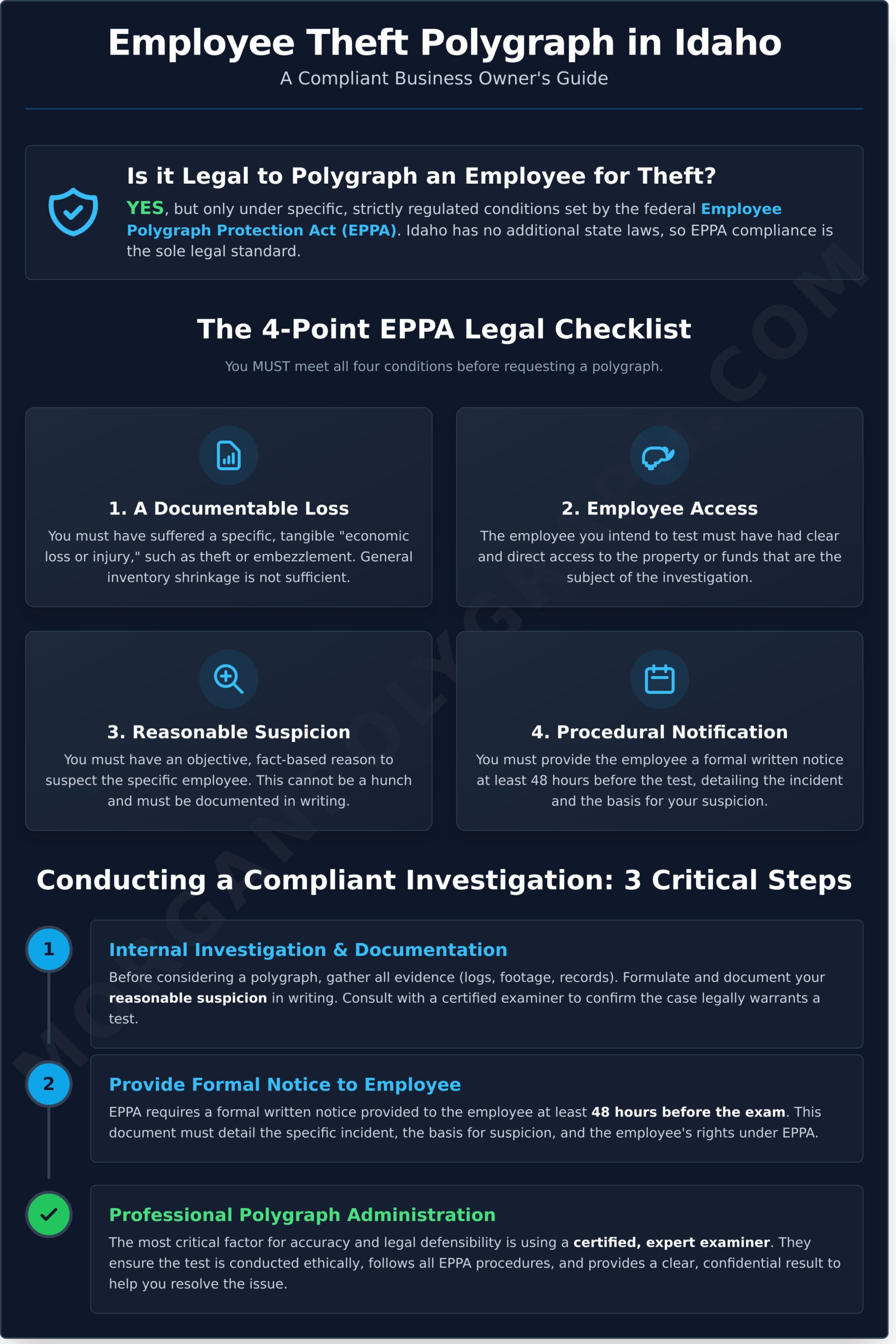
Your Legal Checklist: 4 Conditions You MUST Meet
To ensure full compliance with the EPPA before proceeding with a polygraph examination, your business must be able to affirm the following four points. Failure to meet even one of these conditions can expose your company to significant legal liability.
- A Documentable Loss: You must have suffered an actual, specific business loss. A general inventory shrinkage is not enough; you need to identify a particular incident of theft or loss.
- Employee Access: The employee being considered for testing must have had clear access to the property or funds that are the subject of the investigation.
- Reasonable Suspicion: You must establish and articulate a basis for reasonable suspicion that specifically points to the employee. This must be documented in writing.
- Procedural Notification: You are required to provide the employee with a written statement detailing the specific incident being investigated and the basis for your suspicion before the test occurs.
Idaho State Law Considerations
It is important for business owners to know that Idaho does not have any additional state laws that further restrict or regulate the use of polygraphs in employment. This means that compliance with the federal EPPA is the primary and sole legal standard you must meet. Because the requirements are so precise, navigating them correctly is paramount. Seeking professional guidance from a certified polygraph examiner is the most effective way to ensure your investigation is conducted ethically, legally, and effectively.
A Step-by-Step Guide for Idaho Businesses: Conducting a Compliant Investigation
When faced with potential employee theft, a methodical and well-documented investigation is your company’s most critical defense against both financial loss and legal liability. A polygraph examination is a powerful tool within this process, but it must be deployed correctly and lawfully. This guide provides a clear, actionable roadmap to ensure your investigation is compliant, professional, and effective.
Step 1: Before the Polygraph – Internal Investigation & Documentation
The foundation of any defensible action is a thorough internal investigation conducted before a polygraph is even considered. Begin by gathering all tangible evidence related to the specific loss, such as inventory records, cash logs, security footage, and access reports. You must then formulate and document your reasonable suspicion in writing, clearly articulating why a particular employee is suspected. Consulting with a certified examiner at this stage is a crucial step to review the case facts and confirm the situation legally warrants an examination.
Step 2: Providing Formal Notice to the Employee
The federal Employee Polygraph Protection Act (EPPA) mandates a strict notification procedure. You must provide the employee with a written notice at least 48 hours before the scheduled exam. This notice must adhere to strict federal requirements, as detailed in the U.S. Department of Labor guidance on the EPPA, and must include:
- Details of the specific incident or activity being investigated.
- A statement explaining the basis for your reasonable suspicion of the employee.
- A comprehensive list of the employee’s rights, including their right to terminate the examination at any time.
Step 3: The Examination by a Certified Professional
A professional polygraph examination is a structured, multi-phase process. It begins with a pre-test interview, where the examiner discusses the case facts with the employee and reviews the carefully constructed questions. During the in-test phase, physiological data is collected using validated instrumentation. Finally, the examiner conducts a post-test analysis of the data to form a professional opinion, which is then delivered in a confidential report.
Step 4: Using Polygraph Results Lawfully
This is the most critical legal point: an employer cannot take adverse action (such as termination or discipline) based solely on the results of a polygraph test. The results of an employee theft polygraph Idaho businesses conduct must be supported by additional evidence. The examination is best used to corroborate other evidence, focus the investigation, or, importantly, to exonerate innocent staff members and help restore workplace trust. Navigating this process requires expertise.
Ensure your investigation is compliant. Contact our experts today.
Benefits of Using a Polygraph in Theft Investigations
When employee theft occurs, your primary goal as a business owner is to resolve the situation quickly, discreetly, and effectively. While adhering to federal regulations is non-negotiable-as outlined in resources like Boston University’s summary of the Polygraph Protection Act-the practical advantages of using a polygraph extend far beyond legal compliance. A professionally administered test is a strategic tool that saves time, protects assets, and restores workplace integrity.
Quickly Identify or Eliminate Suspects
Internal theft investigations can be resource-intensive and damaging to morale. Instead of conducting broad, disruptive interviews with your entire team, a polygraph allows you to narrow the focus with precision. This process is not only efficient but also fair. It provides a confidential and structured opportunity for innocent employees to be exonerated, allowing you to concentrate your investigative efforts where they matter most and avoid wrongly suspecting loyal team members.
Act as a Powerful Deterrent
Utilizing a professional employee theft polygraph in Idaho sends a clear and powerful message: your company takes the protection of its assets seriously. The knowledge that you are willing to use expert truth verification methods discourages future incidents of theft. This decisive action helps re-establish a culture of accountability and trust, assuring honest employees that their integrity is valued and that misconduct will be addressed head-on.
Encourage Confessions and Recover Assets
The polygraph process is often misunderstood as only the in-test portion. However, a significant number of resolutions occur during the pre-test interview conducted by a certified examiner. Faced with a serious, structured process, many individuals choose to confess. This admission can provide critical leverage for negotiating the return of stolen property or funds, often allowing for a complete resolution without the immediate need for law enforcement involvement.
By resolving theft swiftly, you not only recover assets but also demonstrate strong leadership, which has a lasting positive impact on your entire workforce. To discuss how our confidential services can help protect your business, visit morganpolygraph.com.
Why Choose a Certified Idaho Examiner for Your Business?
Understanding the laws and procedures for an employee theft polygraph is crucial, but the single most critical decision you will make is who you hire to conduct the examination. The right examiner is more than just an operator; they are your partner in navigating a complex legal and emotional landscape. Their qualifications, methods, and professionalism directly impact the accuracy of the results and, most importantly, the legal protection of your business.
Expertise in EPPA-Compliant Procedures
An experienced examiner’s primary value lies in their comprehensive understanding of the federal Employee Polygraph Protection Act (EPPA). Navigating these strict legal protocols is non-negotiable. A certified professional ensures every required document, written notice, and procedural step is handled with meticulous care. This expertise is your company’s best defense against potential litigation and wrongful termination claims, transforming a high-risk situation into a well-managed, defensible process.
Court-Recognized Credentials and Advanced Training
The credibility of the polygraph results is directly tied to the examiner’s qualifications. At Morgan Polygraph, our experts hold court-recognized credentials and maintain active memberships in leading professional organizations like the American Polygraph Association (APA). This commitment means we adhere to the industry’s highest ethical standards and use only validated, scientifically-backed techniques. When you need a reliable employee theft polygraph Idaho businesses can depend on, choosing a certified expert adds undeniable weight to the findings.
A Professional, Discreet, and Confidential Process
We recognize the sensitive nature of internal investigations. From your initial confidential consultation to the final report, your case is handled with the utmost discretion and professionalism. Examinations are conducted in a controlled, private office environment designed to be respectful to all parties involved. Our unwavering commitment to confidentiality protects your business’s reputation and the privacy of your employees, ensuring the situation is managed with integrity. Trust your investigation to Idaho’s leading polygraph experts.
Partner with Idaho’s Leading Experts in Truth Verification
Navigating the complexities of an internal theft investigation requires precision and legal expertise. As we’ve covered, using a polygraph for employee theft is permissible under specific circumstances in Idaho, but it demands strict adherence to federal regulations. A compliant, methodical approach is not just recommended-it is essential for protecting your business and finding definitive answers.
When you need an employee theft polygraph Idaho businesses can trust, the examiner’s credentials are a critical factor. At Morgan Polygraph, we provide that assurance. With over 40 years of combined professional experience, our court-recognized experts are certified by the American Polygraph Association and operate in strict compliance with federal EPPA regulations, ensuring every examination is handled with the utmost discretion and integrity.
Protect your business. Schedule a confidential consultation with Morgan Polygraph.
Take the definitive step toward clarity and security today.
Frequently Asked Questions
Can an employee be fired for refusing to take a polygraph test in Idaho?
Generally, no. The federal Employee Polygraph Protection Act (EPPA) prohibits most private employers from taking adverse action, such as firing or demoting an employee, based solely on their refusal to take a polygraph test. There are specific exceptions for ongoing investigations where reasonable suspicion exists, but this is a legally complex area. We always advise consulting with legal counsel to ensure full compliance with federal and state regulations before proceeding with any testing request.
What happens if a polygraph test for employee theft is inconclusive?
An inconclusive result simply means the physiological data collected was not sufficient to render a definitive opinion of truthful or deceptive. It is not an indication of guilt or innocence. Factors like anxiety, medication, or physical discomfort can sometimes lead to this outcome. An employer cannot use an inconclusive result as the sole basis for disciplinary action. A professional examiner will review the data and may recommend a re-examination after addressing potential contributing factors.
Can I polygraph all my employees to find out who stole from the company?
No, this practice is strictly prohibited by the EPPA. Employers cannot use polygraph examinations in a “dragnet” fashion to test large groups of employees in hopes of finding a culprit. Testing is only permissible when it is part of an ongoing investigation into a specific economic loss or injury to the business. Furthermore, you must have reasonable suspicion that the specific employee being tested was involved in the incident in question.
How accurate is a polygraph test in an employee theft investigation?
When administered by a certified, expert examiner using modern, validated techniques, polygraph examinations are a highly accurate tool for truth verification. Studies validated by organizations like the American Polygraph Association consistently show accuracy rates exceeding 90%. The precision of the test is directly tied to the examiner’s expertise in question formulation, pre-test interview techniques, and data analysis. This is why choosing a court-recognized expert is essential for obtaining reliable results.
How much does an employee theft polygraph cost in the Boise area?
The cost for a professional employee theft polygraph in Idaho, specifically within the Boise metropolitan area, generally ranges from $500 to $800 per test. The final price depends on the complexity of the specific incident being investigated, the number of issues that need to be covered, and the required depth of the post-test report. We provide a clear, firm quote during a confidential consultation once we understand the unique details of your case.
What are some alternatives to polygraph testing for employee theft?
While polygraph testing is a powerful tool, it should complement other investigative methods. Effective alternatives include conducting structured, non-accusatory interviews with relevant staff, reviewing security and surveillance footage, and performing a detailed audit of financial records, inventory, or digital access logs. In more complex cases, engaging a professional private investigator or a forensic accountant can uncover crucial evidence and provide a clear path toward resolution.