

Receiving a negative polygraph result is a disorienting and stressful experience. Whether it has cost you a job opportunity, complicated a legal matter, or created personal turmoil, the feeling of being misunderstood or falsely accused is profound. We understand the anxiety and uncertainty that follows, leaving you with one overwhelming question: what happens if you fail a polygraph test? The implications can feel immense, but it is crucial to know that you are not without options. This is not the end of the road, but rather the beginning of understanding your next steps.
In this comprehensive guide, our certified, expert examiners provide the professional and compassionate insight you need. We will explain the real-world consequences of a failed polygraph test across employment, legal, and private matters. You will learn about the factors that can influence results, understand your rights, and discover if challenging the outcome or retaking the examination is a viable path forward. Our goal is to replace confusion with clarity, empowering you with the knowledge to navigate this challenging situation with confidence and control.
Key Takeaways
- Learn why a “failed” polygraph result is not a simple verdict and what the examiner is actually measuring in your physiological responses.
- Understanding what happens if you fail a polygraph test requires knowing the context, as consequences vary significantly between employment, legal, and personal situations.
- Discover the crucial first steps to take in the moments after receiving your results to protect your interests and manage the situation professionally.
- Explore the potential avenues for challenging a deceptive result, which focus on the examiner’s procedure and qualifications rather than a formal appeal process.
Decoding the Results: What Does ‘Failing’ a Polygraph Actually Mean?
One of the most common misconceptions about truth verification is that a polygraph test produces a simple ‘pass’ or ‘fail’ result, like a red or green light. The reality is far more nuanced. A polygraph instrument records physiological data-such as changes in heart rate, blood pressure, respiration, and skin conductivity-in response to a structured series of questions. For a complete Polygraph overview, it’s important to understand these fundamentals. The outcome is not determined by the machine itself, but by a certified examiner’s expert analysis of this data. Therefore, understanding what happens if you fail a polygraph test begins with understanding what ‘failing’ truly signifies.
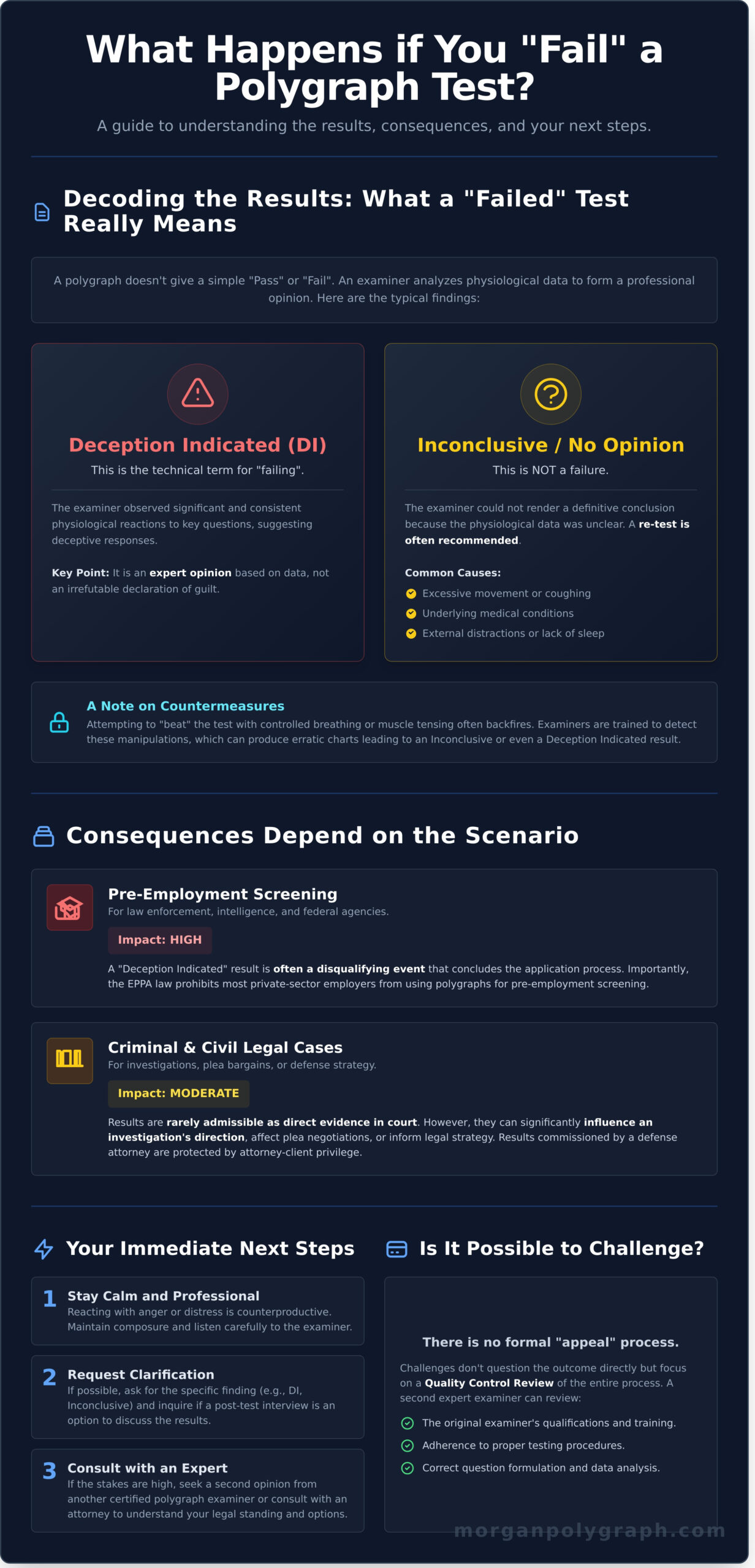
A ‘failed’ test is not a definitive verdict of guilt. Rather, it is an expert assessment indicating that a person’s involuntary physiological responses to key questions are consistent with those of a deceptive individual. The final report will fall into one of several distinct categories.
Deception Indicated (DI)
In the professional polygraph community, the technical term for what most people consider ‘failing’ is “Deception Indicated” or DI. This result means the examiner observed timely, significant, and consistent physiological reactions to the relevant questions of the test. Based on their training and the data collected, the examiner concludes that these reactions are indicative of deception. It is crucial to remember that a DI finding is a professional, expert opinion based on the recorded data; it is not an irrefutable declaration of guilt.
No Opinion / Inconclusive
An inconclusive result, sometimes termed “No Opinion,” means the examiner could not render a definitive conclusion from the collected data. This is not a failure. It simply means the physiological recordings were not clear enough for a proper evaluation. Common causes for an inconclusive result include:
- Excessive or unintentional movement
- Erratic breathing patterns or coughing
- An underlying medical condition affecting responses
- External distractions or insufficient sleep
In these situations, a re-test is often recommended to obtain a clear and reliable result.
The Role of Countermeasures
Some individuals attempt to influence the test’s outcome by using “countermeasures”-deliberate actions to create misleading physiological responses. Certified examiners are extensively trained to detect these attempts, such as controlled breathing, muscle tensing, or mental diversions. Employing countermeasures often produces unnatural and erratic charts that are easily identified. This can lead to an inconclusive result or, in some cases, a Deception Indicated finding, as the attempt to deceive is itself a significant response.
The Consequences of a Failed Polygraph in Different Scenarios
A primary concern for anyone facing truth verification is, “what happens if you fail a polygraph test?” The answer is not a single, straightforward outcome. The consequences depend entirely on the specific context of the examination. Understanding who requested the test and why is crucial, as the implications in a federal employment screening are vastly different from those in a private, personal matter. The impact is most significant in pre-employment and criminal contexts, as the results are rarely legally binding in most civil or private disputes.
Here is a professional breakdown of the potential outcomes in the most common scenarios.
Pre-Employment Screening (Law Enforcement, Federal Agencies)
For applicants to law enforcement, intelligence, and other federal agencies, a failed polygraph is often a disqualifying event that concludes the application process. Some departments may offer a post-test interview to discuss ambiguous responses, but this is not guaranteed. It is important to note that under the Employee Polygraph Protection Act (EPPA), most private-sector employers are prohibited from using polygraphs for pre-employment screening. Furthermore, a failed test for one agency does not automatically prevent you from applying to another, as each has its own standards and review process.
Criminal and Civil Legal Cases
In the legal arena, polygraph results are rarely admissible as direct evidence in court. This is due to judicial skepticism and ongoing scientific debate, as detailed in reports like the Office of Justice Programs’ compendium on the Validity and Reliability of Polygraph Testing. However, a failed test can significantly influence an investigation, potentially guiding law enforcement’s focus or affecting plea bargain negotiations. Conversely, when a defense attorney commissions a test and the client fails, those results are protected by attorney-client privilege and will almost certainly never be shared with the prosecution.
Private and Relationship (Infidelity) Testing
When a polygraph is used to resolve private matters, such as questions of infidelity, the consequences are entirely personal and not legal. The outcome depends on the pre-established agreement between the parties involved. A result indicating deception can further damage trust, while a truthful result may provide reassurance. In these sensitive situations, a professional polygraph examination should be viewed as a tool to facilitate an honest conversation and provide clarity, not as a final, absolute judgment of a person’s character or the relationship’s future.
What Are Your Immediate Next Steps After a Failed Test?
Receiving a “Deception Indicated” (DI) result is a serious and often stressful moment. Your immediate reaction is important, and maintaining composure is your first priority. Avoid an emotional outburst or becoming argumentative. A calm, measured response allows you to think clearly and navigate the next steps effectively. Understanding what happens if you fail a polygraph test in the moments that follow can significantly influence the outcome, whether it’s for employment, legal, or personal matters.
Participate in the Post-Test Interview
A professional examiner will almost always conduct a post-test interview to discuss the results. This is not an interrogation but a critical opportunity for clarification. Listen carefully to the examiner’s explanation of which questions indicated a deceptive response. You may be able to provide context or explain a physiological reaction that was misinterpreted. While honesty is crucial, be aware that any admissions made can be documented and used, so speak precisely and thoughtfully.
Consult with Your Attorney (Legal & Criminal Cases)
If your polygraph examination was part of a criminal investigation or civil litigation, your first call should be to your legal counsel. Do not speak further with investigators, law enforcement, or the opposing party without your attorney present. Your lawyer is the only one qualified to advise you on the legal standing of the polygraph results in your jurisdiction and how they will impact your case strategy. Acting without legal guidance can be detrimental to your case.
Consider a Second Opinion or Re-Test
While polygraph science is highly accurate when conducted by a certified expert, no test is infallible. The complexity of truth verification is well-documented, as seen in a comprehensive National Academy of Sciences report on the scientific evidence of polygraphs. In many private or civil matters, seeking a second opinion from a different, highly reputable examiner is a valid option. This can help confirm or contest the initial findings. However, it is important to note that most government and law enforcement agencies will not permit a re-test after a conclusive DI result during a pre-employment screening.
For confidential guidance on private matters, it is wise to consult with an expert firm. A certified examiner can provide clarity on your specific situation and discuss potential next steps. To learn more, contact the professionals at morganpolygraph.com.
Challenging the Results: Is It Possible to Appeal a Failed Polygraph?
When you receive a “deception indicated” result, your immediate question is often about the next steps. It is crucial to understand that there is no formal, court-like “appeal” process for a polygraph examination. Instead, a challenge focuses on the validity and integrity of the test itself. The goal is not to simply disagree with the outcome but to demonstrate that the procedure, the examiner, or the analysis was flawed. Understanding this distinction is a key part of knowing what happens if you fail a polygraph test.
A successful challenge is built on facts and standards, centering on whether the examination was conducted professionally and in accordance with established best practices.
Reviewing Examiner Qualifications and Methods
A credible polygraph result is entirely dependent on the expert who administered it. A challenge, therefore, must begin by scrutinizing the examiner’s credentials and methodology. A test conducted by an uncertified individual using improper methods holds little to no evidentiary weight. Key areas to investigate include:
- Examiner Certification: Was the examiner certified by a nationally recognized professional organization, such as the American Polygraph Association (APA)?
- Validated Techniques: Did the examiner use an established, validated testing technique recognized within the scientific community?
- Proper Procedure: Was the pre-test interview, question formulation, and data collection handled correctly and without bias?
The Importance of Quality Control
In the professional polygraph community, quality control (QC) is a standard practice for ensuring accuracy and objectivity. This process involves having a second, equally qualified examiner independently review the test data-the physiological charts, questions, and scoring-to verify the original conclusion. You have the right to ask if a QC review was conducted on your examination. This commitment to verifiable accuracy is why Morgan Polygraph uses only nationally certified, court-recognized examiners whose work consistently meets the highest professional benchmarks.
Legal and Administrative Hurdles
The context of your test heavily influences your ability to challenge it. In pre-employment screening, there is typically no formal appeal channel; an employer’s decision may be final. In legal proceedings, a challenge is a formal motion made by an attorney to have the results suppressed or deemed inadmissible by the court. The burden of proof in these situations is exceptionally high, requiring a strong, evidence-based argument that the test was fundamentally unreliable and failed to meet professional standards.
Navigating Your Next Steps with Confidence and Clarity
Understanding what happens if you fail a polygraph test is the first step toward regaining control. A ‘failed’ result is not a definitive judgment of guilt but a complex outcome indicating deceptive responses to specific questions. The consequences vary significantly based on your unique situation-from employment screening to legal matters-and it is crucial to remember that you have options for moving forward.
In these critical moments, professional guidance is paramount. At Morgan Polygraph, our Nationally Certified & Court-Recognized Examiners bring over 40 years of combined experience to every case, ensuring you receive expert analysis and support. We provide a strictly confidential and professional service designed to bring clarity to your situation. To discuss your results and explore your options with an expert who understands the nuances of truth verification, we invite you to Schedule a Confidential Consultation with Our Expert Examiners.
You do not have to navigate this uncertainty alone. Take the next step toward resolution and peace of mind today.
Frequently Asked Questions
Does failing a polygraph mean I’m a liar?
A result of “Deception Indicated” does not automatically mean you are a liar. A professional polygraph examination measures and records specific physiological responses to a structured series of questions. A certified examiner analyzes this data to determine if the responses are indicative of deception. The test is a highly accurate diagnostic tool used for truth verification, but it is the comprehensive analysis by an expert, not the machine alone, that leads to the final conclusion.
Will a failed polygraph test go on my permanent record?
There is no centralized, permanent record for polygraph examinations. The results of your test are confidential and belong to the entity that requested it, such as a potential employer or legal counsel. This information is not part of a public or criminal record. The consequences of what happens if you fail a polygraph test are typically limited to the specific situation for which the test was administered, like a job application or a private matter.
Can I be forced to take a polygraph test?
For most private-sector employment, you cannot be forced to take a polygraph. The federal Employee Polygraph Protection Act (EPPA) largely prohibits private employers from requiring applicants or employees to undergo a lie detector test. However, this protection does not apply to government employees at the federal, state, and local levels. Certain private-sector roles involving security or handling controlled substances may also be exempt, but participation is still typically voluntary.
What if I failed because I was extremely nervous or have anxiety?
A common concern is failing due to nervousness, but professional examiners are trained to account for this. The pre-test interview and the use of control questions help the examiner establish your unique physiological baseline, including your normal anxiety levels. The test is designed to distinguish the specific reactions associated with deception from the general stress of the examination process. An experienced examiner can accurately interpret the data within the context of your individual nervous state.
Can I retake a polygraph test for the same job application?
Whether you can retake a polygraph test for the same job application is determined entirely by the hiring organization’s policy. Some agencies may permit a retest, particularly if the initial results were inconclusive, while many others have a strict policy against it. There is no universal standard for re-examinations. The decision rests solely with the entity that requested the test, so you must inquire directly with them to understand their specific procedures and options.
Are polygraph results admissible in court in Idaho?
In Idaho, polygraph results are generally not admissible as evidence in court proceedings without a prior agreement, or stipulation, from both the prosecution and the defense. This means that unless both sides agree to allow the results to be presented, they cannot be used to prove guilt or innocence during a trial. Their primary function in the legal system remains as a valuable and confidential investigative tool used by attorneys and law enforcement.