

In the high-stakes environment of civil litigation, every piece of evidence matters. Yet, the polygraph examination often exists in a grey area of legal strategy, leaving many respected Idaho attorneys to question its value. Is it a powerful tool for truth verification, or a costly gamble with no legal weight? This uncertainty can lead to missed opportunities for leveraging a client’s credibility or challenging an opponent’s claims. The strategic landscape of using polygraph results in civil court Idaho is nuanced, governed by specific rules of evidence and procedural requirements that can make or break their impact.
This definitive guide is designed to provide clear, actionable answers. We will move beyond the myths to deliver a professional framework for Idaho attorneys seeking a strategic advantage. You will learn the precise legal standing of polygraph evidence, the critical importance of a properly stipulated agreement, and how to select a court-recognized expert whose findings will be respected. We provide the expert insights needed to use polygraph results to validate testimony, strengthen your position in settlement negotiations, and confidently guide your clients through this complex process.
Key Takeaways
- Understand the nuanced rules for polygraph admissibility in Idaho civil court, as the standards are distinct from those in criminal proceedings.
- Discover how polygraph results can provide powerful leverage in settlement negotiations and mediation, often without ever being presented to a judge.
- Learn effective strategies for using polygraph results in civil court Idaho to verify facts and strengthen your position in disputes over contracts, fidelity, or personal injury claims.
- Recognize why the credibility and certification of your polygraph examiner are just as critical as the test results for achieving your legal objectives.
The Legal Status of Polygraph Evidence in Idaho Civil Courts
When considering the use of polygraph results in civil court Idaho, the answer is nuanced and requires a professional understanding of state-specific rules. Unlike criminal proceedings where the standards can be more rigid, Idaho civil courts may permit the introduction of polygraph evidence, but only under very specific circumstances. Admissibility almost always hinges on a prior legal agreement, transforming the polygraph from a simple truth verification tool into a powerful strategic asset for negotiation, settlement, and litigation.
The General Rule: Why Polygraphs Are Typically Inadmissible
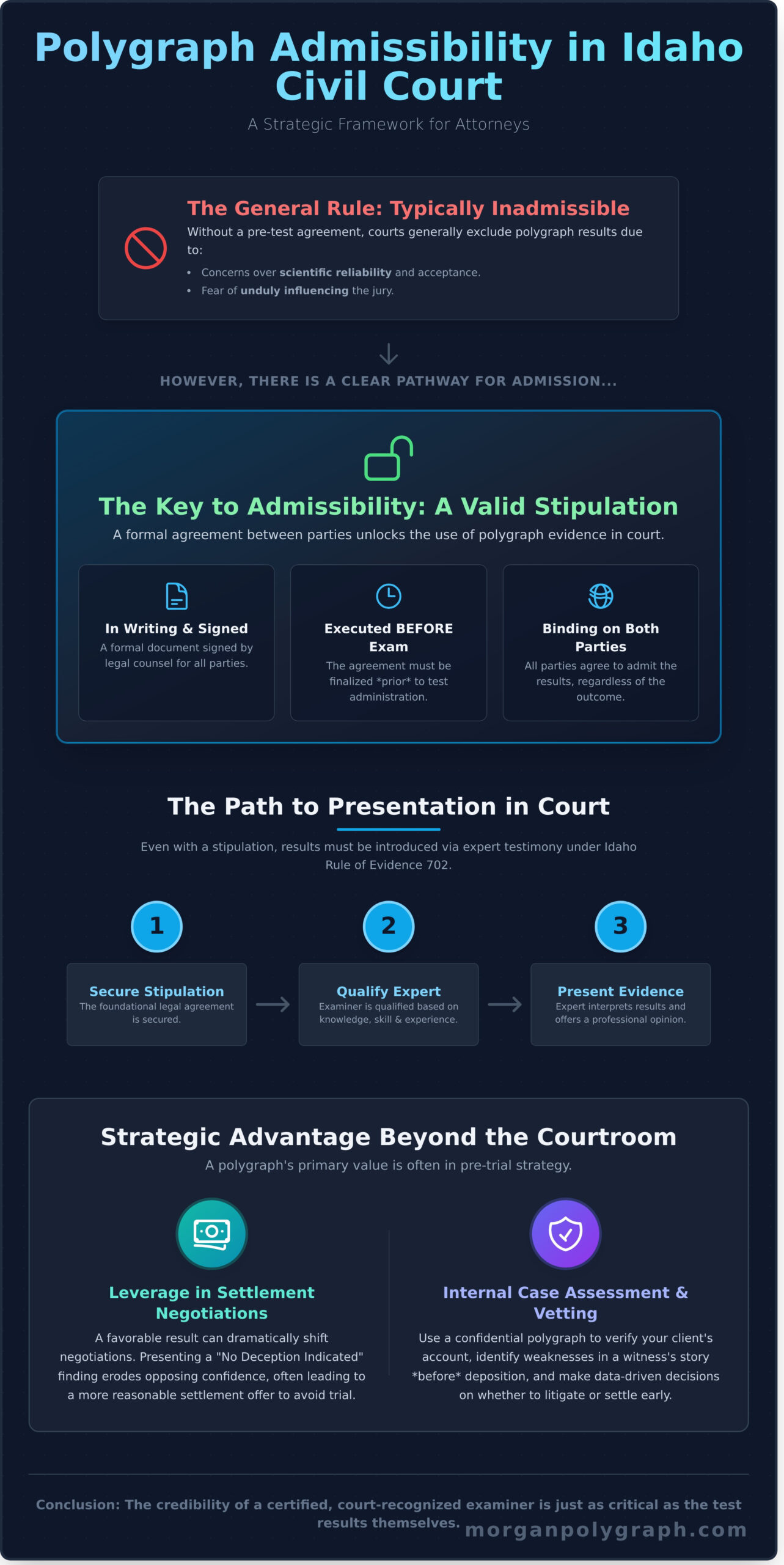
Historically, courts in Idaho and across the nation have approached polygraph examinations with significant skepticism. The primary objection stems from a long-standing debate over the scientific acceptance and reliability of the technique. To gain a foundational understanding of the methodology and the controversy surrounding it, it can be helpful to review what a polygraph test is and how it functions. Courts often exclude unstipulated polygraph evidence to prevent it from unduly influencing a jury, who may assign the results more definitive weight than legally permissible.
The Power of Stipulation: The Key to Using Polygraphs in Court
The primary gateway for admitting polygraph evidence in an Idaho civil case is a legal instrument known as a stipulation. A stipulation is a formal, written agreement between the legal counsel of both opposing parties. For polygraph results to be admissible under this exception, the agreement must typically meet several conditions:
- It must be in writing and signed by both parties’ counsel.
- It must be executed before the polygraph examination is administered.
- It must agree that the results, regardless of the outcome, can be presented as evidence in court.
This pre-test agreement ensures that neither party can object to an unfavorable outcome after the fact.
Idaho Rules of Evidence and Expert Witness Testimony
Even with a valid stipulation, the results are not simply handed to the court. They must be introduced through expert witness testimony, a process governed by Idaho Rule of Evidence 702. The polygraph examiner must first be qualified by the court as an expert based on their specialized knowledge, skill, training, and experience. A court-recognized expert can then interpret the physiological data and test results, offering a professional opinion on the subject’s truthfulness regarding the relevant questions. This testimony is a critical component for effectively using polygraph results in civil court Idaho.
Strategic Use of Polygraphs in Civil Litigation (Beyond the Courtroom)
While the formal admissibility of polygraph examinations is governed by stringent criteria, often referencing the Federal Legal Standards for Polygraph Evidence, their most significant impact in civil litigation often occurs long before a trial begins. Experienced legal professionals understand that a polygraph’s primary value is not necessarily as courtroom evidence, but as a powerful strategic tool for risk management and information gathering. The strategic value of using polygraph results in civil court Idaho extends far beyond the witness stand, directly influencing pre-trial outcomes.
Gaining Crucial Leverage in Settlement Negotiations
A favorable polygraph result, professionally administered and documented in a certified report, can dramatically shift the dynamics of settlement talks. Presenting opposing counsel with a “No Deception Indicated” finding regarding the core issues of a case introduces a powerful element of doubt into their position. This tangible demonstration of your client’s veracity can erode the other party’s confidence, prompting them to re-evaluate their risk and extend a more reasonable settlement offer to avoid a costly and uncertain trial.
Internal Case Assessment: Vetting Clients and Key Witnesses
One of the most powerful, yet often overlooked applications of polygraph testing is for internal case validation. Before investing significant time and resources, a confidential polygraph can confirm the veracity of your own client’s account. This process allows you to:
- Verify critical facts from the outset.
- Identify weaknesses or inconsistencies in a key witness’s story before deposition.
- Make an informed, data-driven decision on whether to proceed with litigation or pursue an early settlement.
This internal verification is a critical step when considering using polygraph results in civil court Idaho, as it allows you to proceed with confidence or adjust your strategy accordingly.
Influencing Mediation and Arbitration Proceedings
In less formal Alternative Dispute Resolution (ADR) settings like mediation or arbitration, the strict rules of evidence do not always apply. While a mediator or arbitrator may not accept a polygraph as formal evidence, presenting the results can still be highly influential. It serves as a strong signal of your client’s conviction in their position and their willingness to subject their statements to objective scrutiny. A skilled mediator can use this information to guide discussions and challenge the assumptions of the opposing party, helping to bridge gaps toward a resolution.
Common Idaho Civil Cases Where a Polygraph Provides an Advantage
In many Idaho civil disputes, the case hinges not on physical evidence but on the conflicting testimony of the parties involved. These “he said, she said” scenarios create ambiguity that can be difficult for judges or mediators to navigate. A professional polygraph examination, understood through its Legal Definition of a Polygraph as a method for truth verification, can provide a significant strategic advantage. The value of using polygraph results in civil court Idaho is most apparent in its ability to bolster credibility, clarify intent, and influence out-of-court negotiations, even when not formally admitted as evidence.
Breach of Contract and Business Disputes
When a verbal agreement or the intent behind a contract is disputed, a polygraph can cut through the conflict. Consider a dispute between business partners where one claims a crucial promise was made and the other denies it. A professionally administered polygraph can verify each party’s statements regarding their understanding and actions. This is an invaluable tool in cases involving alleged fraud or misrepresentation, helping to establish a factual baseline about what was said and done in confidence.
Family Law: Custody, Infidelity, and Hidden Asset Cases
Family law matters are intensely personal and often fraught with emotion. When allegations of conduct that could affect parental fitness arise in a custody battle, a polygraph offers a confidential and respectful way to verify or refute those claims. In divorce proceedings, it can be used to address allegations of infidelity that may impact a settlement or to compel truthfulness about hidden financial assets or undisclosed debts. This ensures a more transparent and equitable resolution for all parties involved.
Personal Injury and Insurance Fraud Claims
In personal injury claims, the credibility of the claimant’s account is paramount. A polygraph can be used to validate the details of an accident or the subjective experience of an injury, thereby strengthening a legitimate claim. Conversely, insurance companies utilize expert polygraph testing to investigate suspected fraudulent claims, protecting their interests from deception. The strategic application of using polygraph results in civil court Idaho also extends to assessing the truthfulness of key witness statements, which can be pivotal in accident reconstructions and settlement discussions.
The Professional Polygraph Process for Civil Litigation
When considering the use of a polygraph in a legal setting, it is crucial to understand that the process is far more than a simple Q&A session. A professional, legally-defensible examination is a methodical, multi-stage procedure designed to maximize accuracy and withstand scrutiny. This structured approach, conducted by a certified and experienced examiner, is fundamental when using polygraph results in civil court Idaho. The entire process is handled with complete confidentiality and professional discretion.
Step 1: Confidential Attorney-Examiner Consultation
The process begins not with the examinee, but with a confidential and strategic consultation between your legal counsel and the polygraph examiner. In this critical first step, the specific facts of the case are reviewed to isolate the precise issue for testing. Together, they establish clear, realistic goals for the examination and discuss how the findings can best support your legal strategy.
Step 2: Scientific and Neutral Question Formulation
Accuracy hinges on the quality of the questions. A certified examiner works meticulously to construct relevant, non-ambiguous, and unbiased questions focused on the core issue. Crucially, the examinee is given the opportunity to review and agree to the exact wording of every question before the test begins. This transparent step eliminates surprises and ensures the examination is fair and scientifically valid.
Step 3: The Examination and Data Analysis
The examination itself is a controlled and respectful process with three distinct phases: a pre-test interview to prepare the examinee, the in-test data collection, and a post-test discussion. During the test, the examiner measures and records physiological data from multiple systems, including:
- Cardiovascular activity (blood pressure and heart rate)
- Respiratory activity (breathing patterns)
- Electrodermal activity (sweat gland responses)
A certified examiner then analyzes this data using validated, computerized scoring algorithms to reach a professional conclusion.
Step 4: The Formal Report for Legal Counsel
Following the analysis, the examiner prepares a comprehensive, formal report exclusively for your attorney. This professional document details the methodology, the questions asked, the physiological data, and the examiner’s expert findings-typically stated as Deception Indicated, No Deception Indicated, or Inconclusive. This report is a confidential tool intended to inform your legal team’s strategy and decision-making. To learn more about this professional process, you can consult with an expert at morganpolygraph.com.
Selecting a Certified, Court-Recognized Examiner in Idaho
When considering using polygraph results in civil court Idaho, the credibility of the examiner is as critical as the results themselves. The weight given to polygraph evidence often hinges directly on the examiner’s qualifications, experience, and professional standing. A test administered by a highly respected, certified professional provides a foundation of authority, while one from an unqualified individual can be easily dismissed and may even damage your case’s credibility. The examiner doesn’t just conduct a test; they provide expert analysis that must withstand intense legal scrutiny.
Essential Credentials: What to Look For
To ensure the polygraph examination and its results are defensible, your chosen examiner must possess a specific set of qualifications. Vetting a professional’s background is a crucial step. Look for these non-negotiable credentials:
- APA-Accredited Education: The examiner must be a graduate of a school accredited by the American Polygraph Association (APA), the leading professional body setting standards for training and ethics.
- Relevant Experience: Inquire about their specific experience with legal matters, particularly civil litigation cases similar to yours. An examiner who primarily handles pre-employment screenings may not have the nuanced expertise required for court-related testing.
- Modern, Validated Techniques: A commitment to continuing education is vital. The field of truth verification evolves, and a top examiner will use the most current, scientifically validated techniques and equipment.
Key Questions to Ask a Potential Examiner
A confident, experienced examiner will welcome your diligence. Before engaging their services, be prepared to ask direct questions to gauge their suitability for your case. Your legal counsel should ask:
- Have you previously testified as an expert witness in Idaho civil or criminal courts?
- What percentage of your professional work is dedicated to civil litigation and attorney-client cases?
- Can you provide professional references from other attorneys in the Boise area who have used your services?
Why Attorneys Trust Morgan Polygraph for Civil Cases
For legal professionals in Boise and throughout Idaho, the choice is clear. Morgan Polygraph, led by court-recognized expert Chip Morgan, provides the unimpeachable credibility required when using polygraph results in civil court Idaho. With decades of experience and a deep understanding of legal proceedings, Mr. Morgan is not just a technician but a trusted expert witness.
We adhere to the strictest APA standards of practice and professional ethics, ensuring every examination is conducted with precision, discretion, and integrity. Our track record is built on providing clear, defensible, and confidential results that empower attorneys to build stronger cases, facilitate settlements, and advocate effectively for their clients. When your case requires absolute confidence in your expert, turn to the trusted name in Idaho. Schedule a confidential consultation for your civil case.
Gain Clarity and Leverage in Your Idaho Civil Case
Navigating the complexities of civil litigation requires every available advantage. While polygraph evidence has specific limitations regarding direct admissibility, its strategic power remains undeniable. As we’ve explored, professionally administered polygraph examinations can significantly influence settlement negotiations, verify crucial facts, and provide your legal team with invaluable leverage. The key to successfully using polygraph results in civil court Idaho lies not in courtroom presentation, but in their strategic application beforehand. This requires an examiner whose credibility and expertise are beyond reproach.
At Morgan Polygraph, our Court-Recognized Expert Examiners bring over 40 years of combined polygraph experience to your case. We provide a strictly confidential and professional service designed to deliver the truth verification you need to strengthen your position. Don’t leave the outcome of your case to chance. Take a decisive step towards clarity and control.
Contact Morgan Polygraph for a confidential consultation on your civil case. Let our expertise become your strategic advantage.
Frequently Asked Questions About Polygraphs in Idaho Civil Cases
Can a judge in Idaho order a party to take a polygraph in a civil case?
No, a judge in an Idaho civil court cannot compel any party to undergo a polygraph examination. Participation in a polygraph test is entirely voluntary. For the results to be considered by the court, all parties involved must agree in advance-a process known as stipulation. Without this mutual consent, a person cannot be forced to submit to a polygraph test, and they cannot be penalized for refusing to do so.
What happens if my client takes a stipulated polygraph and fails?
If a client fails a stipulated polygraph, the results are admissible as evidence in court. A “stipulation” is a formal agreement between all parties that the outcome, whether favorable or not, can be presented. A result of “Deception Indicated” can be a significant setback, as opposing counsel will be permitted to use it to challenge your client’s credibility. It is critical to consult with legal counsel and a certified examiner before agreeing to a stipulated exam.
Are the results of a non-stipulated polygraph test confidential?
Yes, the results of a non-stipulated polygraph are strictly confidential. In this scenario, an attorney typically retains an examiner to test their own client. The findings are protected by attorney-client privilege. This allows your legal team to privately assess your client’s truthfulness regarding the case. The results will only be shared with the opposing party or the court if they are favorable and your attorney strategically decides to disclose them.
How much does a polygraph examination for a civil case typically cost?
The cost for a professional polygraph examination in a civil case generally ranges from $500 to $1,500. The final price depends on several factors, including the complexity of the issue, the number of relevant questions required, and the extent of pre-test consultation. At Morgan Polygraph, we provide a detailed quote after an initial, confidential discussion to ensure transparent and competitive pricing for our expert services.
Can a person use countermeasures to ‘beat’ a polygraph test?
While many websites claim to teach countermeasures, a certified and experienced examiner is specifically trained to detect such attempts. Physical movements, controlled breathing, or mental exercises often create physiological responses that are inconsistent with truthful answers. Attempting to manipulate the test can result in an “inconclusive” result or even be interpreted as a sign of deception, ultimately damaging the subject’s credibility more than an honest examination would have.
How is a civil polygraph different from a criminal or pre-employment test?
The primary difference is the scope and focus. A civil polygraph is narrowly tailored to a specific issue in a lawsuit, such as a breach of contract or an infidelity allegation in a family law case. In contrast, criminal tests focus on involvement in a specific crime, while pre-employment screenings are much broader. The legal standards for using polygraph results in civil court Idaho are unique and require an examiner with specific expertise in these matters.