
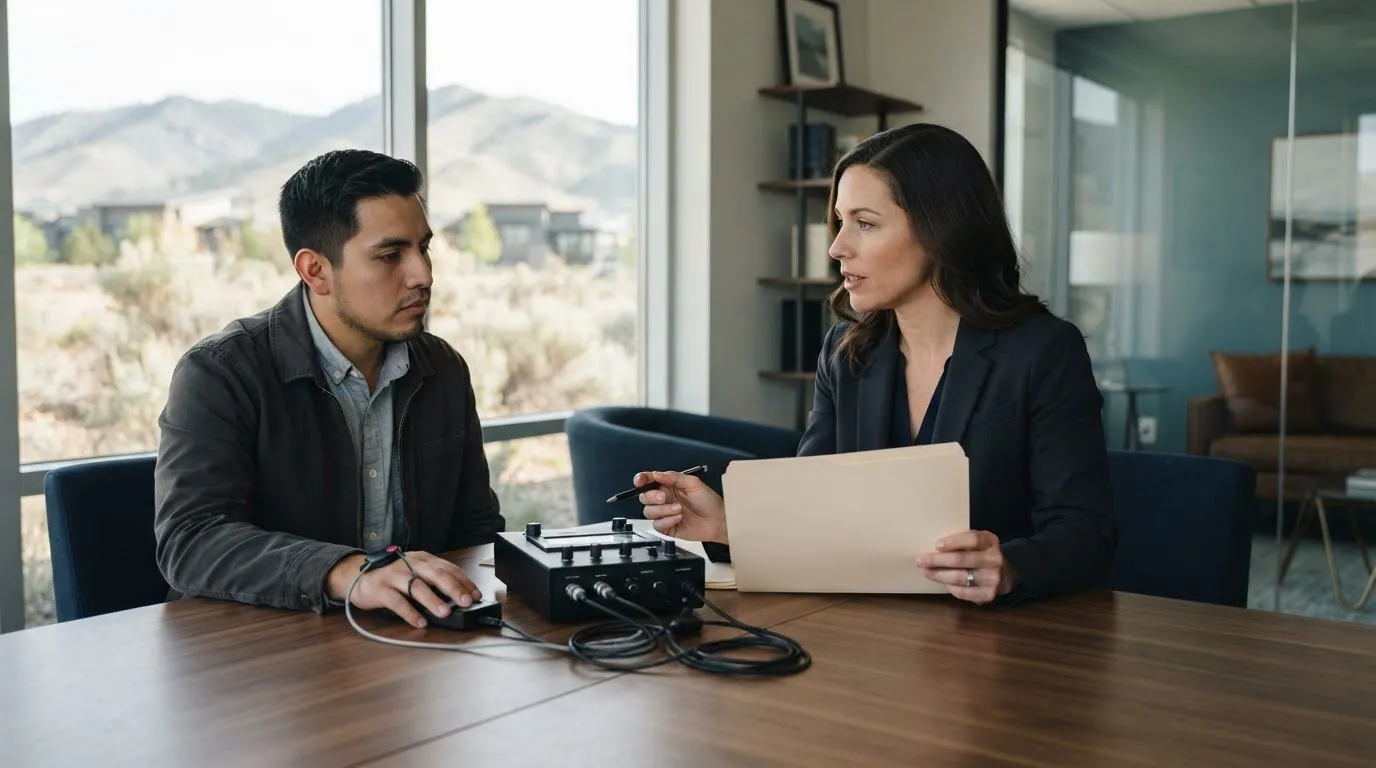
Could a polygraph intended to support your account create complications instead? If you’re considering a Meridian polygraph for probation violation defense, that concern is reasonable. An examination may inform a defense strategy, but it can’t establish compliance on its own or guarantee a favorable decision. Before scheduling, discuss the potential risks and value with your attorney.
This guide explains what a polygraph may and may not establish in a probation violation matter, why the alleged violation and examination questions matter, and what to discuss with defense counsel before proceeding. It also covers what to verify when looking for an examiner serving Meridian and Boise, including current qualifications, reporting, and case-specific requirements.
Morgan Polygraph is based in Boise and offers legal and criminal case polygraph testing, including examinations for defense attorneys. Confirm current Meridian service availability and whether the examiner’s qualifications and report format fit your case. An examiner conducts the examination and reports findings, but does not provide legal representation. Your Idaho defense attorney can help determine whether testing fits your strategy and how to handle the results.
Key Takeaways
- A Meridian polygraph for probation violation defense may inform a strategy, but it is not a legal defense or a guarantee of an outcome.
- Before scheduling, ask your Idaho defense attorney whether an examination fits the specific allegation and which questions should be addressed.
- Clarify the examination’s scope, process, information-sharing arrangements, and report expectations before proceeding.
- Ask counsel how the decision-maker may treat polygraph results in your case instead of assuming they will be accepted.
- When evaluating an examiner, verify current credentials and relevant legal-case experience. Morgan Polygraph is based in Boise, and Meridian availability should be confirmed.
Meridian probation violation defense: where a polygraph may fit
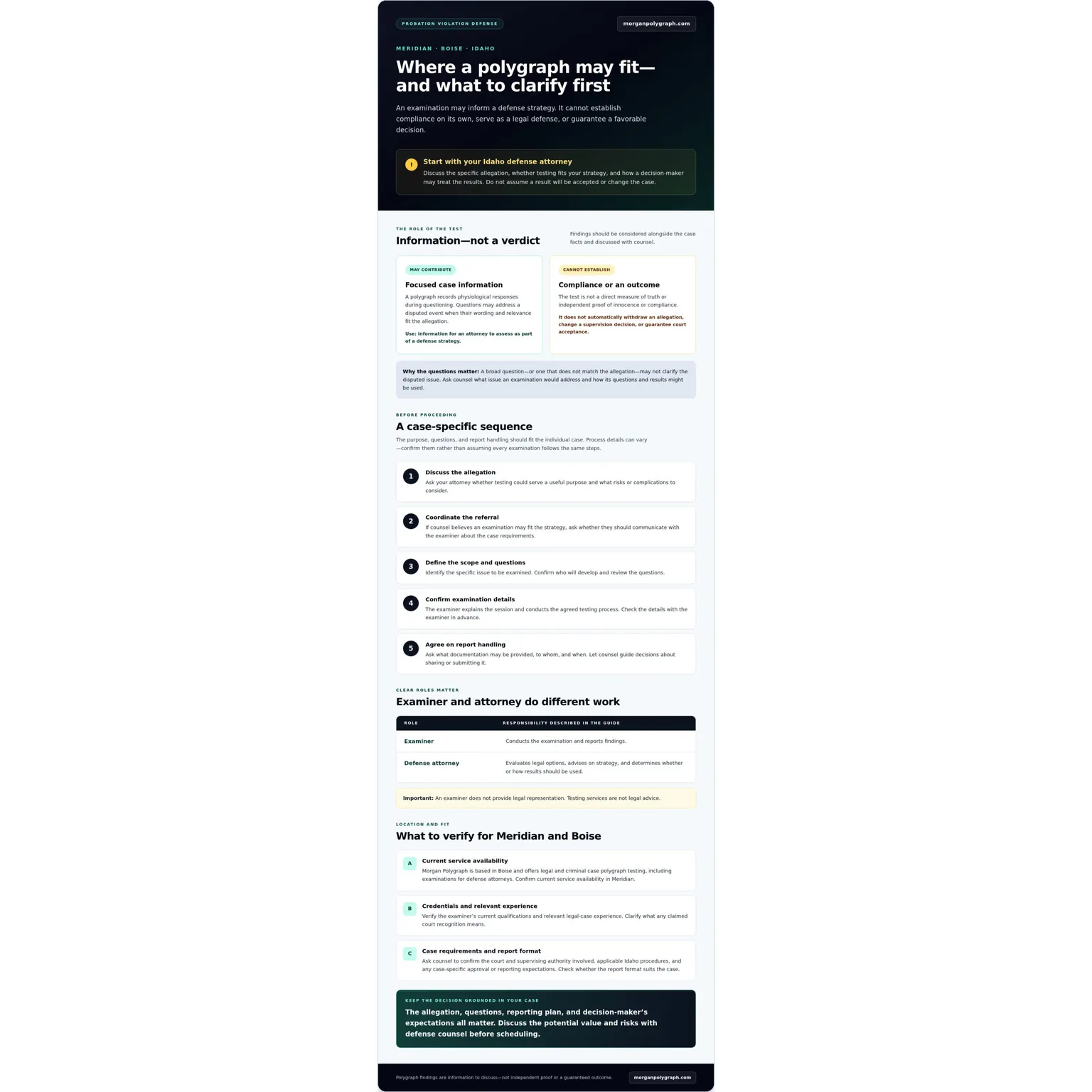
A polygraph result cannot guarantee that a probation violation allegation will be withdrawn, that a supervising authority will change its decision, or that a court will accept the result. An examination may provide information for a defense attorney to assess alongside the facts of the case. It is not a legal defense, so understand how testing could affect your situation before scheduling.
A probation-violation polygraph focuses on specific questions agreed upon for the case. Those questions might address a disputed event, but their wording and relevance matter. The examiner conducts the test and prepares findings or a report. An attorney evaluates legal options, advises on strategy, and determines whether or how the results should be used. These roles are distinct.
What a polygraph can, and cannot, contribute
A polygraph records physiological responses during questioning. The Polygraph overview explains the method and its questioning approaches. The test should not be treated as a direct measure of truth. Findings are information to discuss, not independent proof of innocence or compliance. A result also does not automatically change an allegation or supervision decision.
Before testing, ask your defense attorney whether an examination is appropriate, what issue it would address, and how the questions and results might be used. A broad question, or one that does not match the allegation, may not clarify the disputed issue. Counsel can also assess whether testing could introduce concerns or complications in your case.
Why Meridian location and case context matter
Meridian and Boise are the relevant local context, but location alone does not determine the rules or decision-maker for a case. Alleged violations, available responses, and applicable Idaho procedures depend on the circumstances. Ask your attorney to confirm which court and supervising authority are involved, what requirements apply, and whether any case-specific approval or reporting expectations should be addressed before an examination.
Morgan Polygraph is based in Boise and offers legal and criminal case polygraph testing, including examinations for defense attorneys. Confirm whether it currently serves Meridian. Also verify the examiner’s current credentials, what any claimed court recognition means, and whether the report format suits your case. These details do not establish that a result will be accepted or affect an outcome.
If you’re considering a Meridian polygraph for probation violation defense, the practical first step is a private discussion with Idaho defense counsel. Ask your attorney to assess the allegation and whether to coordinate with an examiner. A careful, case-specific approach can help clarify the examination’s possible role without confusing testing services with legal advice.
How a probation-related polygraph examination is scoped and conducted
A probation-related examination should begin with a legal discussion, not an appointment. Its purpose, questions, and report handling need to fit the specific case. The process varies with the examiner, referral, agreed scope, and circumstances, so confirm the steps directly rather than assuming every examination follows the same procedure.
A practical sequence is:
- Discuss the allegation with your attorney. Ask whether testing could serve a useful purpose and whether there are risks to consider.
- Coordinate a referral. If counsel believes an examination may fit the strategy, ask whether they should communicate with the examiner about the case and its requirements.
- Clarify the scope. Identify the specific issue to be examined and confirm who will develop and review the questions.
- Attend the examination. The examiner explains the session and conducts the agreed testing process. Confirm the details with the examiner in advance.
- Review the report plan. Ask what documentation may be provided, to whom, and when. Let counsel guide decisions about sharing or submitting it.
For a general overview of pre-test discussion, question review, and examination stages, read this polygraph examination process guide. A general guide can explain common concepts, but it cannot determine what is appropriate for an individual probation matter.
Agreeing on examination scope and questions
Before scheduling, counsel and the examiner should clarify the issue the examination is meant to address. Questions should be understandable, relevant to that issue, and not expanded casually to cover unrelated conduct. Don’t draft or rehearse questions on your own. Ask your attorney to review the proposed scope and explain whether it aligns with the defense strategy.
Understanding the examination and report
The examiner conducts the session and documents findings according to the examination process. A report is not a court ruling, legal opinion, or promise about how a court or supervising authority will respond. The United States Courts discusses polygraphs in a specific federal sex-offender supervision context, including circumstances in which a probation officer may use one to satisfy statutory requirements. That federal material should not be assumed to govern every Idaho probation case.
Before proceeding, confirm the examiner’s current qualifications, process, and report expectations. Morgan Polygraph offers legal and criminal case testing from its Boise location. Ask about current Meridian availability and whether the service can address your case’s requirements. For information about its legal and criminal case polygraph testing, coordinate with the examiner only after discussing the proposed examination with your attorney.
Will a polygraph help or hurt a probation violation defense?
A polygraph could inform a defense discussion, but it could also create uncertainty or complications. Whether testing is useful depends on the alleged violation, the questions, your attorney’s strategy, and the person or authority evaluating the matter. A result is not a shortcut to resolving the allegation.
Discuss potential value and risks with defense counsel before scheduling. An examination might address a specific disputed issue, but its findings have limitations and require careful interpretation. Morgan Polygraph’s factual review of polygraph accuracy offers additional context. No examination result can decide a probation case or guarantee how a court or supervising authority will respond.
What the result does not establish
A polygraph result does not determine whether a probation condition was violated. It is not infallible, conclusive, or automatically admissible. Idaho’s administrative rule, as reproduced by Cornell’s Legal Information Institute, states that polygraph evidence is not admissible unless all parties stipulate. Read the Idaho rule on polygraph admissibility, then ask counsel to confirm its current status and how it applies to the specific court or supervision proceeding. Don’t assume the same evidentiary treatment applies in every case.
Results may also be interpreted in light of the questions asked, examination conditions, and the limits of the method. Even a result someone views as favorable may not address the full allegation or resolve other evidence. An unfavorable or inconclusive result could raise concerns. Your attorney can assess these possibilities against the facts and decide whether testing fits the defense strategy.
Questions to raise with defense counsel first
Before contacting an examiner or agreeing to an examination, ask your attorney:
- Does testing address the specific issue in dispute, and does it align with the defense strategy?
- Who may receive the report, and could the results be shared, submitted, or discussed with a court or supervising authority?
- What court, supervision, and evidentiary requirements apply to this case?
- Could testing or disclosure create risks that outweigh its potential value?
Get clear guidance before authorizing any report sharing. The examiner conducts testing and documents findings. Legal advice about use and disclosure belongs to your attorney. If you’re gathering information about legal and criminal case testing, you can review Morgan Polygraph’s services, but consult defense counsel about whether an examination is appropriate for your case.
How to prepare and coordinate an Idaho probation polygraph
Preparation starts with your defense attorney, not with trying to influence the examination. Counsel should guide decisions about the proposed issue, question scope, deadlines, and any report-sharing plan. Clear coordination can help you understand what to expect, but preparation cannot ensure a favorable result or determine how an authority will respond.
Before contacting an examiner
Ask your attorney whether an examination fits the facts and defense strategy before scheduling. Clarify the alleged violation, the specific issue a test might address, who would refer or coordinate it, and whether case deadlines affect the timing. Don’t assume an examination is appropriate simply because the allegation is disputed.
If counsel agrees that contacting an examiner makes sense, confirm practical and case-specific details directly. Morgan Polygraph is based in Boise and offers legal and criminal case testing. Ask whether it currently serves Meridian, what the process involves, and what information or referral details are needed. Verify the examiner’s current credentials and ask what report format and expectations apply to your situation.
Before the appointment and after the report
Before proceeding, review the agreed scope with your attorney and confirm that you understand the examiner’s instructions. Be accurate and complete during the process. Don’t withhold relevant information from counsel, rehearse misleading responses, or try to manipulate the examination. If you’re unsure how to answer a question or understand an instruction, raise that concern rather than guessing.
Discuss questions about medication, health, or other factors that may affect your ability to participate directly with both your attorney and the examiner. Don’t change medication or assume a condition matters without appropriate guidance. The examiner can explain the examination process; your attorney can advise you about legal implications.
Before receiving or sharing any report, ask counsel to clarify who may see it and how it could be used. A report is not a court decision, and its meaning depends on the case and applicable requirements. Let your attorney determine whether further action is appropriate and whether the report should be discussed with a court or supervising authority.
For information about legal and criminal case testing, contact Morgan Polygraph about examination details. Confirm Meridian availability and case requirements, and coordinate any next steps with your Idaho defense attorney.
Choosing a Meridian-area examiner and taking the next step
Selecting an examiner for a probation-related matter calls for more than checking distance. The examination should address a clearly defined issue, and the examiner’s experience, procedures, and reporting should suit the circumstances. Discuss the proposed examiner and examination with your defense attorney before deciding. Testing services are not a substitute for legal advice or representation.
What to verify when selecting a polygraph examiner
Ask about the examiner’s experience with legal and criminal cases similar to yours. Confirm current credentials directly, including the issuing organization and what any stated recognition means in practice. Morgan Polygraph describes its examiners as nationally certified and court-recognized, but verify current qualifications and ask your attorney whether they are relevant to your case.
Before scheduling, clarify how the examination’s scope and questions will be set, what the process involves, and what kind of report may be prepared. Ask how confidential information and reports are handled, including who may receive them. Confirm these details rather than assuming confidentiality or a particular report format. Your attorney can assess whether the examiner, proposed questions, and reporting arrangements fit the case and applicable requirements.
- Confirm the examiner’s current credentials and relevant legal-case experience.
- Discuss question scope, examination procedures, confidentiality, and reporting.
- Ask defense counsel to evaluate the examiner and proposed examination before proceeding.
Contact Morgan Polygraph about a legal examination
Morgan Polygraph is based in Boise, Idaho, and offers legal and criminal case polygraph testing, including examinations for defense attorneys. If you’re considering a Meridian polygraph for probation violation defense, first discuss the idea with your attorney. Then confirm directly with Morgan Polygraph whether it currently serves Meridian, what examination logistics apply, and whether its process and report expectations can address your case’s needs.
Approach the conversation as an information-gathering step, not a commitment to test. An examiner can explain testing services and logistics. Your attorney should guide legal strategy and decisions about whether to proceed or share a report.
Contact Morgan Polygraph about a legal polygraph examination to ask about Meridian availability and examination logistics after discussing your case with counsel.
Make Your Next Step a Counsel-First Decision
A polygraph may offer information for discussion, but it can’t decide whether a probation condition was violated or guarantee a legal or supervision outcome. For a Meridian polygraph for probation violation defense, start by asking your Idaho defense attorney whether an examination fits the allegation and strategy. Confirm the proposed scope, how any report may be handled, and which case-specific requirements apply before scheduling.
Morgan Polygraph is based in Boise and offers legal and criminal case polygraph testing. The company describes its examiners as nationally certified and court-recognized, but verify current credentials and their relevance to your case with counsel. Confirm Meridian service availability and examination logistics directly. An examiner provides testing services, not legal advice or representation.
If your attorney agrees that contacting an examiner is appropriate, contact Morgan Polygraph to discuss a legal examination and ask about current Meridian availability. A careful, informed approach can help you move forward with greater clarity.
Frequently Asked Questions
Can a polygraph help with a probation violation defense?
It may provide information for a defense attorney to consider, depending on the allegation, the agreed examination questions, and the case strategy. A result doesn’t determine whether a violation occurred or guarantee a particular outcome. Before scheduling a Meridian polygraph for probation violation defense, ask counsel whether testing is appropriate, who may receive the results, and whether the relevant decision-maker could consider them.
Will a polygraph result be admissible in an Idaho probation violation case?
Don’t assume a polygraph result will be admitted, accepted, or used in a particular way. The answer depends on the case and applicable legal requirements. Ask your defense attorney to assess the proposed examination and intended use before scheduling. An examiner can explain testing and reporting procedures, but can’t provide legal advice or decide whether a court or supervising authority will accept the results.
Where can I get a polygraph test near Meridian, Idaho?
Morgan Polygraph is located in Boise and offers legal and criminal case polygraph testing. Contact the company directly to confirm whether it currently serves Meridian residents and whether an examiner can address the issue in your case. Before booking, speak with your defense attorney about the examination’s scope, timing, and report handling so those decisions fit your legal situation.
Should I talk to my probation officer or my attorney before taking a polygraph?
Speak with your defense attorney first for advice about your individual case. Counsel can help assess whether testing is appropriate, how it relates to your defense, and who should receive any report. Don’t rely on a general article or an examiner for legal advice. Ask your attorney how to address any instructions or obligations before taking action or contacting a supervising authority.
What happens during a probation-related polygraph examination?
The examiner generally discusses the process and questions to be addressed before conducting the examination and preparing a report. The precise steps depend on the examiner, referral, agreed scope, and case circumstances. Ask in advance about the questions, instructions, confidentiality, and report expectations. Your attorney should guide decisions about the disputed issue and advise you on whether or how to handle the results.
Can a polygraph guarantee that a probation violation allegation will be dismissed?
No. An examination can’t guarantee dismissal, a favorable ruling, or a change to supervision conditions. Legal decisions depend on the specific facts and applicable procedures, and a polygraph is only one possible source of information. Before arranging testing, ask your defense attorney to weigh potential benefits and risks in your case. Don’t treat an examination result as a substitute for legal representation.
How do I choose a polygraph examiner for a probation violation case?
Ask about current credentials, experience with legal examinations, question scope, confidentiality, and report procedures. Confirm that the examiner can address the specific issue and serves your location. Have your defense attorney assess whether the examiner and examination fit the case. Check general claims about accuracy or court recognition carefully, and ask counsel whether those credentials or claims are relevant to your circumstances.