
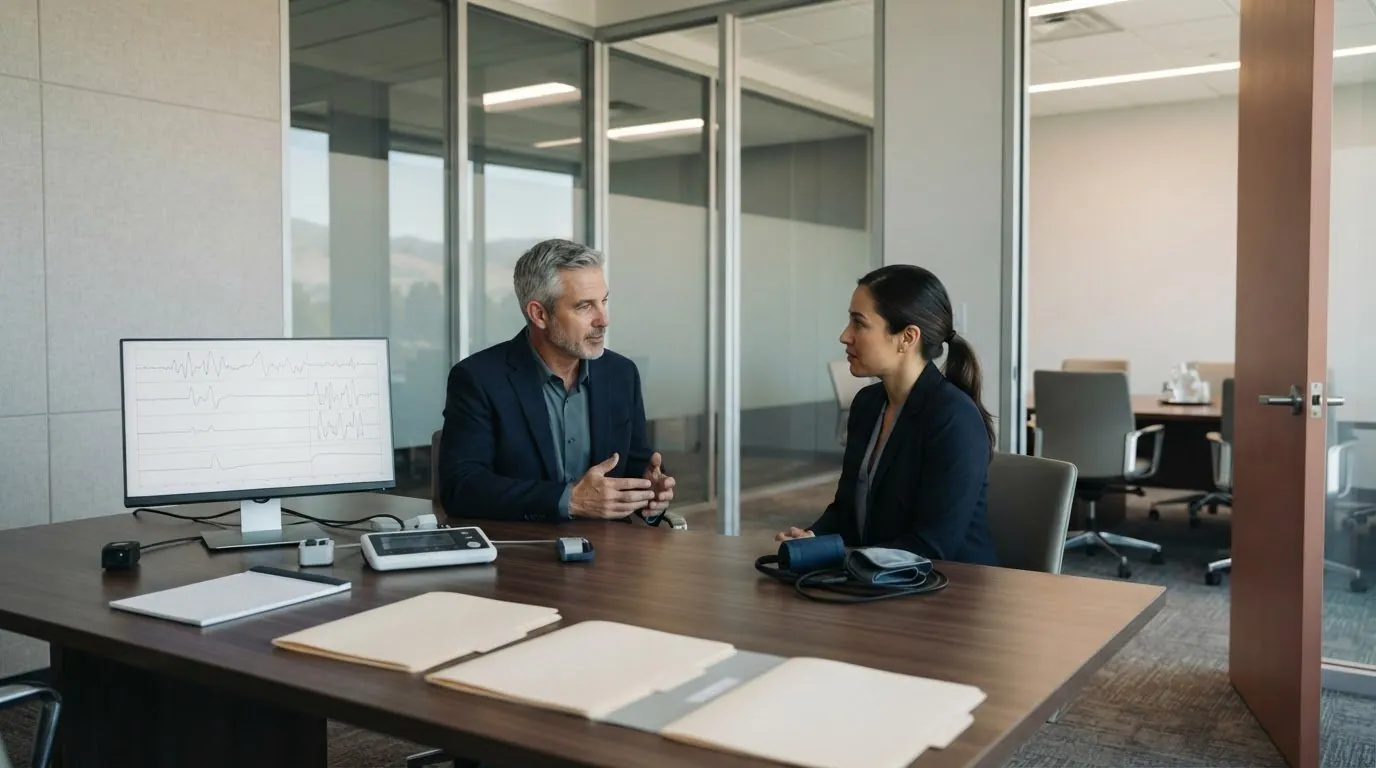
Can a polygraph help prepare for a deposition without taking the place of one? In a civil dispute, uncertainty about a specific account can make it difficult to assess what to do next. A Boise civil case polygraph for depositions may provide structured information for case assessment, but it is not deposition testimony, proof of truth, or a decision the court must follow.
Before considering an examination, it helps to understand what it can contribute and where its limits are. This article explains how a civil polygraph differs from sworn deposition testimony, how findings may fit into case preparation, and why they do not guarantee courtroom use or a particular outcome.
You’ll also learn what to expect from preparation, the examiner’s role, privacy and reporting considerations, and how findings may inform discussions with your legal counsel. Morgan Polygraph provides civil examinations in Boise, including private and court-ordered testing, with professional reports intended for legal proceedings. The goal is a practical understanding of the process and its limits.
Key Takeaways
- A polygraph examination is separate from a deposition and does not establish truth or determine a legal outcome.
- A Boise civil case polygraph for depositions may provide information for case assessment, but it does not replace testimony.
- A practical sequence is to define the disputed issue, coordinate with counsel, schedule the examination, and review the report.
- Prepare by clarifying the issue and following examiner instructions, not by rehearsing answers.
- Morgan Polygraph conducts Boise civil examinations and prepares professional reports intended for legal proceedings.
What a Boise civil case polygraph can, and cannot, do for deposition preparation
A civil polygraph is a structured examination, not a deposition, legal finding, or direct determination of truth. In a civil dispute, it may offer one source of information for assessing a specific factual issue. Counsel can consider that information alongside documents, testimony, and other case materials, but it should not be treated as proof on its own.
This distinction matters when considering a Boise civil case polygraph for depositions. An examination does not replace sworn testimony, dictate what happens at a deposition, or resolve a case. It cannot guarantee that a court will admit or accept its results, make a particular credibility finding, or influence a settlement or outcome.
How a civil polygraph differs from a deposition
A deposition gathers testimony as part of a legal process. A witness answers questions under oath, typically with attorneys participating, and the testimony is recorded for potential use in the case. An examiner has a different role: during a structured examination, the examiner asks relevant questions and records physiological responses. For a general overview of the instrument and how it is used, see Polygraph.
The two processes have different purposes, participants, and records. A deposition creates a record of a witness’s answers; a polygraph examination produces information for assessment. An examination result does not change what a witness said under oath.
When examination information may help assess a civil matter
Examination information may help frame discussion about a clearly defined factual disagreement. For example, if parties dispute whether a particular event occurred, an examination may provide another point for counsel to consider. It does not independently establish what happened or settle the disagreement.
The examiner provides structured examination information, not legal strategy. Counsel determines whether and how that information fits the case, including whether it has practical relevance to deposition planning. Keeping those roles distinct helps prevent an examination from being mistaken for evidence that resolves the dispute or for legal judgment.
- It may inform assessment: Treat findings as one input, not a conclusion about the entire dispute.
- It doesn’t replace testimony: Deposition answers remain part of the legal record, separate from the examination.
- Its legal use isn’t assured: Applicable rules and case circumstances matter. No result guarantees admissibility or impact.
A measured approach is most useful. Morgan Polygraph provides civil examinations in Boise, including private and court-ordered testing. Its nationally certified, court-recognized examiners prepare professional reports intended for legal proceedings. A report can support case assessment, but it does not determine how counsel or a court will evaluate the dispute.
How a civil polygraph examination connects to deposition planning
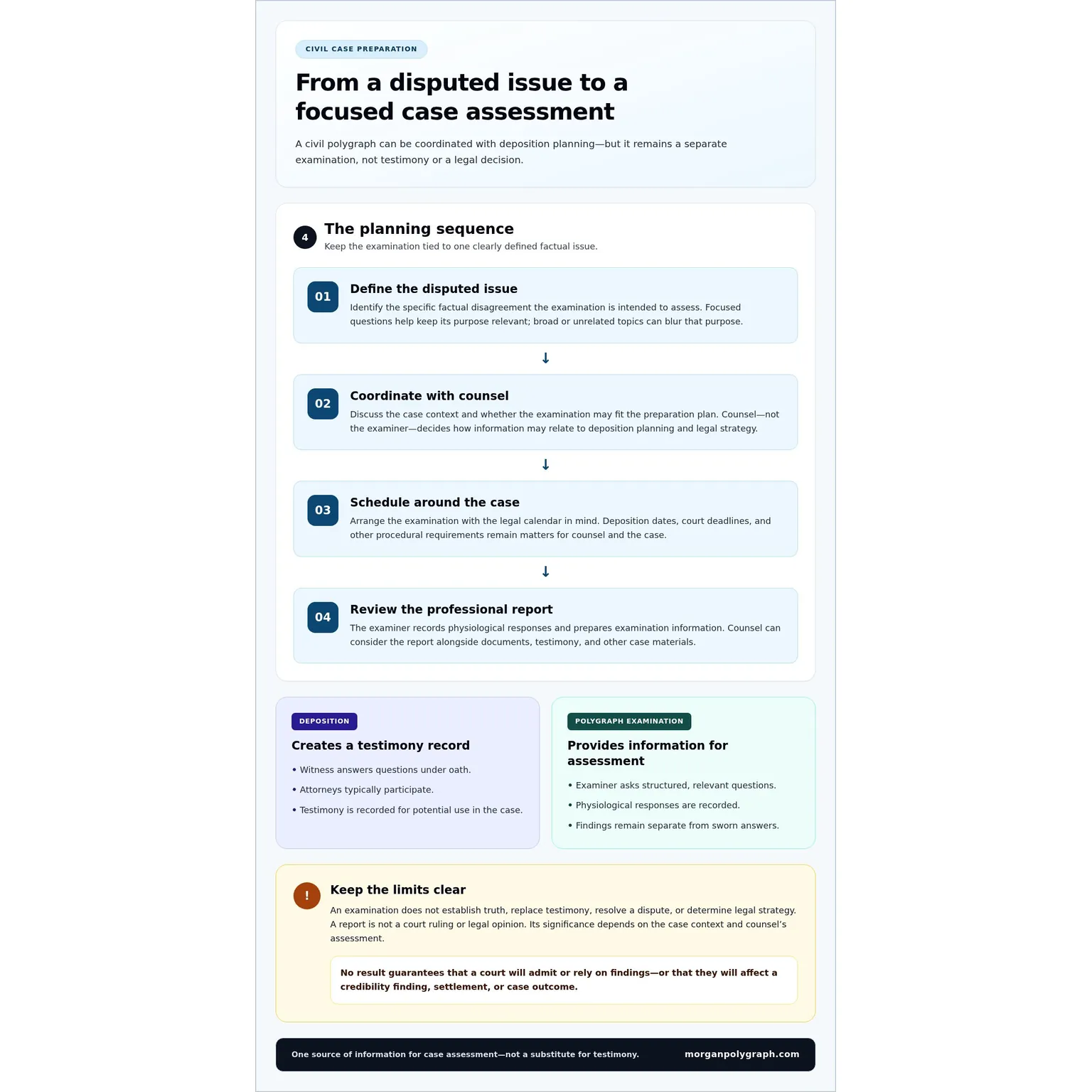
A civil examination can be coordinated with case preparation, but it should have a defined purpose rather than being treated as part of the deposition. For a Boise civil case polygraph for depositions, a practical sequence is to identify the factual issue, coordinate with counsel, schedule the examination, and review the resulting report. This keeps the examination focused while leaving legal decisions with the people responsible for the case.
- Define the issue: Identify the specific disputed matter the examination is intended to assess.
- Coordinate with counsel: Discuss the case context and how the examination may fit the preparation plan.
- Schedule the examination: Arrange it with the legal calendar in mind.
- Review the report: Consider the documented examination information as one input to case assessment.
Focused questions help keep the examination relevant to the issue under consideration. Broad or unrelated topics can blur its purpose. General information about the stages of an examination is available in this guide to the polygraph examination process.
What counsel and the examiner coordinate
Counsel can identify the case question and consider procedural context, including how the examination fits alongside upcoming case preparation. The examiner conducts the examination and prepares a professional report. The examiner does not direct litigation strategy, set deposition topics, or determine legal deadlines. Counsel remains responsible for legal decisions and deposition planning.
Plan scheduling around the case calendar. Deposition dates, court deadlines, and other procedural requirements are matters for counsel and the case, not the examiner. Coordinating early can help keep the examination from disrupting legal timelines or being mistaken for a substitute for case preparation.
What to expect from a professional report
Morgan Polygraph’s examiners prepare professional reports intended for legal proceedings. A report documents examination information; it is not a court ruling, legal opinion, or guarantee that a court will admit or rely on the findings. Its practical significance depends on the case context and counsel’s assessment.
Keep expectations measured when reviewing the report. It may be one element in a broader assessment, but it does not answer every factual or legal question in a dispute. Counsel can consider its relevance to case discussions or deposition preparation without treating it as a replacement for testimony or other case materials.
Morgan Polygraph’s civil polygraph service includes private and court-ordered testing in Boise. A clearly defined question, coordinated scheduling, and thoughtful report review help keep the process organized and its purpose clear.
Polygraph results, reliability, and legal use: realistic expectations
A polygraph result is not a guaranteed measure of truth, a prediction of a case outcome, or independent confirmation that a disputed event occurred. The examination records physiological responses to structured questions, which an examiner interprets in the context of the examination. Findings should be considered carefully, not presented as conclusive proof that a witness is truthful or untruthful.
If you’re considering a Boise civil case polygraph for depositions, separate three questions: what the examination records, what the examiner assesses, and whether the information may be used in a legal proceeding. These questions are related, but not interchangeable. National certification and court recognition speak to examiner credentials; they do not determine admissibility or compel a court to accept a report.
Does a civil polygraph result prove a witness is truthful?
No. An examination result is an interpretation of physiological responses, not independent corroboration of the facts in a case. For instance, a result cannot by itself establish that a document is accurate or that a particular event happened. Those questions require assessment of the broader record. For a deeper discussion of research and limitations, see this factual review of polygraph accuracy.
Accuracy claims should be handled with care. No universal percentage can guarantee what an individual examination will show. The issue, examination process, and examiner’s interpretation all matter. A professional report may provide structured information, but it should not be mistaken for certainty about a person’s honesty or the merits of a civil claim.
Can a polygraph report be used in an Idaho civil case?
Whether a report may be used in a proceeding is a legal question, not something the examiner can guarantee. Admissibility and procedural treatment depend on applicable law, the facts of the case, and relevant court decisions. Because rules can be case-specific and may change, a general statement should not be treated as a conclusion about a particular dispute.
Discuss legal-strategy questions with your attorney, including whether an examination is appropriate and how resulting information could be handled. The examiner conducts the examination and prepares a report, not legal advice or a prediction of a judge’s decision. Even a credentialed, court-recognized examiner cannot promise admission, a particular credibility finding, settlement, or a favorable outcome.
Consider credentials and legal use separately. Examiner qualifications matter when assessing who conducts the examination; they do not settle what a court will do with the results. Keeping that distinction clear helps prevent findings from being overstated during case discussions or deposition preparation.
How to prepare for a Boise civil case polygraph
Preparation for a civil examination is about clear communication and practical coordination, not trying to produce a particular result. If you’re considering a Boise civil case polygraph for depositions, keep the examination separate from deposition planning. Your attorney remains responsible for legal deadlines and deposition logistics, while the examiner provides instructions for the examination.
Use this checklist to approach the appointment in an organized, professional way:
- Clarify the disputed issue. Be ready to identify the specific civil matter you understand is being examined.
- Organize relevant context. Note the basic timeline and circumstances that may help explain the issue accurately.
- Coordinate with counsel. Discuss case-related questions through your attorney where appropriate, especially those involving legal strategy or procedural timing.
- Follow examiner instructions. Use the direct guidance provided for your appointment rather than relying on assumptions or generic advice.
Information to organize before the appointment
Organize your understanding of the disputed issue and its relevant timeline before the examination. The aim is not to create a script, but to help you communicate complete, accurate information about relevant circumstances. If a question belongs with counsel, raise it with your attorney rather than asking the examiner to make a legal judgment.
Keep examination scheduling distinct from deposition dates, filing deadlines, and other legal obligations. Those timelines depend on the case and should be managed with counsel. Follow the examiner’s instructions about the examination and ask the examiner if you need clarification about those directions.
What not to expect from preparation
Preparation is not a way to control or manipulate examination results. Don’t seek coaching, rehearse answers, or try techniques intended to influence the outcome. Instead, listen carefully, answer accurately, and share relevant circumstances plainly. A calm, professional approach supports clear communication, but cannot guarantee a particular result, a court’s treatment of a report, or an effect on the case.
There is a difference between ordinary organization and over-preparation. Reviewing your understanding of a timeline is different from memorizing responses. If you don’t recall a detail, don’t guess to make an answer sound complete. Be candid about what you remember and follow the examiner’s directions during the appointment.
Preparation can make the process more orderly, but it does not replace legal guidance or turn an examination into a deposition. Morgan Polygraph conducts private and court-ordered civil testing through nationally certified, court-recognized examiners. Learn about the process through Morgan Polygraph’s civil case polygraph service.
Arrange a civil case polygraph with Morgan Polygraph in Boise
Morgan Polygraph provides civil polygraph examinations in Boise for private and court-ordered matters. For a Boise civil case polygraph for depositions, start by identifying the issue you want assessed and discussing the examination process with the examiner. If you’re represented, involve your attorney in legal-strategy and procedural questions so the examination fits the broader case context.
What happens when you get started
Begin with a concise outline of the civil matter and the specific question you want the examination to address. An examination is not a way to prove an entire case. A clear description of the issue gives the examiner context for discussing the process and keeps the conversation focused on the matter being assessed.
The examiner can discuss the examination process and relevant case context. Counsel can address how the examination relates to case strategy, deposition planning, and procedural considerations. Keeping those responsibilities distinct helps clarify what the examination is designed to provide without confusing it with legal advice.
- Identify the matter: Summarize the civil dispute and the point you want assessed.
- Include counsel where appropriate: Discuss legal strategy and timing with your attorney.
- Discuss the examination: Review the process and relevant context with the examiner.
- Understand the report’s role: Treat it as examination information, not a legal conclusion.
Why Boise clients choose a professional civil examiner
A civil matter can involve sensitive facts and significant personal or business concerns. Morgan Polygraph provides Boise civil examinations for private and court-ordered matters, conducted by nationally certified, court-recognized examiners. Examinations are handled professionally and with discretion.
Examiners prepare professional reports intended for use in legal proceedings. A report documents examination information; it does not replace legal advice, establish a court’s view, or guarantee that findings will be accepted or affect the case. Counsel remains responsible for legal strategy and assessing how information may fit the matter.
Morgan Polygraph’s office is located at 6126 W. State Street, Suite 208, Boise, Idaho 83703. To discuss a civil examination, start with the issue you want assessed and any relevant case context or questions about the examination process.
Make your next step a focused one
When considering a Boise civil case polygraph for depositions, begin with a clear question: what specific uncertainty are you hoping to assess? Defining the issue can make it easier to discuss timing, case context, and the examination’s possible role with your attorney. Keep expectations measured. An examination may provide information for consideration, but it cannot predict what a court or another party will conclude.
Morgan Polygraph provides a professional setting to discuss a civil examination and the issue you want assessed. Share the relevant context and questions about the examination, and coordinate legal-strategy decisions with your attorney.
Discuss a Boise civil case polygraph with Morgan Polygraph.
Frequently Asked Questions
Can a polygraph help prepare for a civil deposition?
It may give counsel another source of information when assessing a focused factual dispute before a deposition. For example, if the parties disagree about a particular conversation, examination information may help identify issues to discuss during preparation. A Boise civil case polygraph for depositions does not determine what questions an attorney should ask or what a witness will say. Its value depends on the case context and counsel’s judgment.
Is a polygraph part of a deposition?
No. A polygraph examination is a separate appointment, not a stage of a deposition. A deposition is conducted through the legal process and creates a record of testimony; the examiner is not the deposition officer and does not produce that testimony record. Keep examination materials and deposition materials organized separately to avoid confusing the two processes.
Can a polygraph result be used in an Idaho civil case?
Idaho rules generally make polygraph results inadmissible in civil cases unless all parties agree in a written stipulation. The applicable rule is Idaho Administrative Code r. 62.01.01.484. Whether a particular report can be used depends on current rules, case circumstances, and court decisions. Ask your attorney to assess those legal questions; an examiner cannot guarantee admission or how a court will treat the information.
What happens during a civil case polygraph examination?
The examiner first discusses the issue to be assessed and the relevant context, then conducts a structured examination using questions focused on that issue. A polygraph instrument records physiological responses while questions are asked. The examiner evaluates the examination information and prepares a report. Follow the instructions provided for your appointment rather than assuming every examination follows identical details.
Should my attorney be involved before a deposition-related polygraph?
If you have an attorney, involve them before arranging an examination connected to a deposition. Counsel can consider whether the examination fits the case, how it relates to procedural requirements, and how examination information should be handled. This is especially relevant if other parties’ agreement or a court process may matter. The examiner handles the examination, while your attorney addresses legal strategy and deadlines.
Where can I get a civil case polygraph in Boise?
Morgan Polygraph provides private and court-ordered civil examinations at 6126 W. State Street, Suite 208, Boise, Idaho 83703. Its nationally certified, court-recognized examiners conduct examinations and prepare professional reports intended for legal proceedings. To discuss an examination, be ready to describe the civil matter and the specific issue you want assessed.
Does a civil polygraph prove that someone is telling the truth?
No. A polygraph result is not conclusive proof of honesty or proof that a disputed fact occurred. It reflects an examiner’s interpretation of physiological responses during a structured examination, not independent verification of events. Consider it separately from records, witness accounts, and other case information. It is not a final credibility judgment or a substitute for evidence evaluated through the legal process.