

Facing a polygraph examination can be an intimidating prospect, whether for legal, private, or employment reasons. Understanding the process is the first step toward alleviating anxiety and ensuring you are properly prepared. This expert guide demystifies the entire procedure, explaining every step from the initial interview to the final results, so you can approach the situation with clarity and confidence.
What is a Polygraph Examination? More Than a ‘Lie Detector’
First, it’s essential to move beyond the dramatic portrayals seen in movies. A professional polygraph examination is not simply a “lie detector.” It is a structured, methodical process designed to verify truthfulness by measuring and recording a person’s physiological responses to a carefully constructed series of questions. These responses include changes in breathing, heart rate, blood pressure, and skin conductivity (sweating). The instrument itself does not detect lies; it records data. It is the highly trained, certified examiner who analyzes this data to form a professional opinion. This process serves as a valuable investigative tool for legal professionals, therapists, and government agencies seeking to establish factual information.
The Three Phases of Every Professional Polygraph Examination
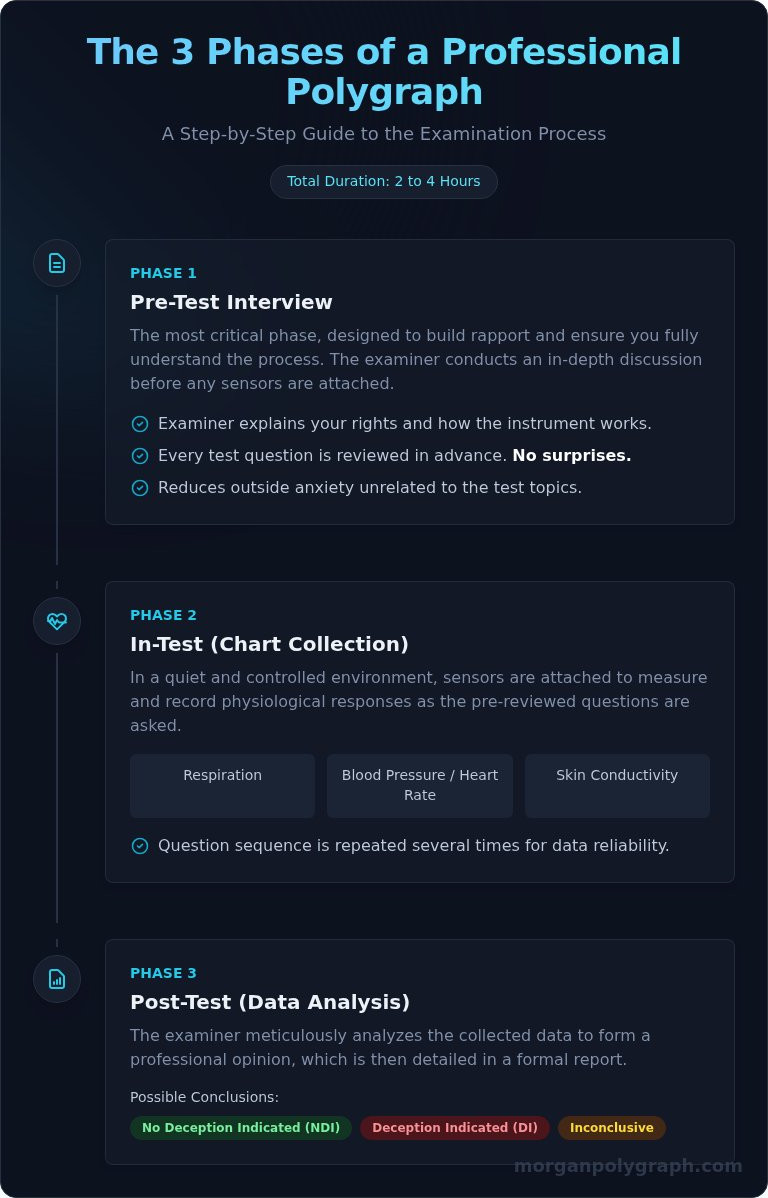
To ensure fairness, accuracy, and replicable results, every professional polygraph examination follows a standardized three-phase structure. Each phase has a distinct and crucial purpose, contributing to the overall integrity of the test. A client should expect the entire process to take between two and four hours to complete thoroughly and professionally.
Phase 1: The Pre-Test Interview
This is arguably the most critical phase of the examination. Before any sensors are attached, the examiner will sit down with you for an in-depth discussion. During this interview, the examiner explains your rights, details how the polygraph instrument works, and answers any questions you may have. You will discuss your background and the specific issue being tested. Most importantly, the examiner will review every single question that will be asked during the in-test phase. There are no surprises. This phase is designed to build rapport, ensure you fully understand the vocabulary and meaning of each question, and reduce outside anxiety that is unrelated to the test topics.
Phase 2: The In-Test (Chart Collection)
Once the pre-test interview is complete and you have agreed to the questions, the in-test phase begins. The examiner will comfortably attach several sensors to your body to measure your physiological responses. This typically includes two tubes around your torso to measure respiration, a blood pressure cuff on your arm, and sensors on your fingertips to measure skin conductivity. You will be asked to sit still in a quiet, controlled, and professional environment. The examiner will then ask the questions that were reviewed with you earlier, repeating the sequence several times to ensure a reliable data sample is collected. Your responses are recorded on charts for later analysis.
Phase 3: The Post-Test (Data Analysis)
After the in-test is concluded, the examiner removes the sensors and begins the final phase. They will meticulously analyze the physiological data recorded on the charts, looking for significant and timely reactions to the relevant questions compared to the control questions. Based on this analysis, the examiner will reach a conclusion, which can be: Deception Indicated (DI), No Deception Indicated (NDI), or Inconclusive. In some cases, a brief post-test interview may be conducted to clarify certain responses. Finally, you or the requesting party will receive a formal report detailing the examination process and the examiner’s professional opinion.
Common Types of Polygraph Examinations
The purpose of an examination dictates the structure of the questions and the focus of the interview. A certified examiner possesses the specialized knowledge required to conduct tests for various sensitive situations.
Criminal & Civil Legal Examinations
In the legal arena, polygraph examinations are often used by defense attorneys to validate a client’s account of events or to guide an investigation. They can also be stipulated by all parties in civil litigation, such as business disputes or family law cases, to verify information. These situations demand an examiner with extensive experience in legal procedures and the ability to serve as an expert witness in court if required.
Relationship & Infidelity Testing
For individuals facing painful uncertainty in their personal lives, a polygraph can provide definitive clarity on issues of trust and fidelity. These examinations are handled with the utmost discretion and compassion to address sensitive questions in a private, respectful manner. The goal is to help couples move forward, whether together or apart, based on verified facts rather than suspicion. If you are struggling with doubt, you can Seek confidential answers for your relationship.
Pre-Employment & Government Screening
Federal, state, and local government agencies, particularly in law enforcement and national security, use polygraph examinations to screen candidates for sensitive roles. These tests verify background information, past conduct, and suitability for a position of public trust. The use of polygraphs in the private sector is heavily restricted by the Employee Polygraph Protection Act (EPPA), with specific exceptions for certain security and pharmaceutical industry roles.
Post-Conviction Sex Offender Testing (PCSOT)
PCSOT is a highly specialized type of examination used as a tool in the supervision and treatment of individuals on probation or parole for sex offenses. It is designed to monitor compliance with court-ordered treatment and probation requirements, helping therapists and probation officers manage risk and encourage accountability. This testing requires an examiner who is specifically trained and certified in PCSOT standards and practices.
How to Prepare for a Polygraph Examination
Proper preparation is not about learning tricks to “beat” the test; it is about ensuring you arrive in a physical and mental state that allows for an accurate examination. The most reliable results are obtained when the examinee is rested and focused.
What You Should Do Before Your Exam
- Get a full night’s sleep before the day of your examination.
- Eat a normal meal before you arrive to maintain stable blood sugar levels.
- Continue taking any prescribed medication as directed by your doctor.
- Arrive for your appointment on time to avoid unnecessary stress.
- Be prepared to be completely honest and cooperative with the examiner.
What to Avoid: Myths and Countermeasures
It is critical to ignore misinformation found online about how to pass a polygraph. Attempting to manipulate the test is a poor strategy that experienced examiners can easily detect.
- Do not consume alcohol or any illicit drugs prior to your test.
- Avoid trying physical or mental “countermeasures” like controlled breathing or inflicting pain. These create unnatural physiological patterns that are easily identified.
- Attempting to manipulate the test often results in an “Inconclusive” finding, which does not help your situation.
- Your best strategy is to remain calm, follow the examiner’s instructions, and be truthful.
Frequently Asked Questions
How long does a polygraph examination take?
A professional, thorough examination typically takes between two to four hours from start to finish. This includes the pre-test interview, the in-test data collection, and the post-test analysis.
Will being nervous affect my polygraph results?
No. It is completely normal to be nervous, and examiners are trained to expect this. The process is designed to differentiate between general anxiety and the specific physiological reactions associated with deception.
Are polygraph examinations admissible in court?
The admissibility of polygraph results varies by state and jurisdiction. In many places, including Idaho, they may be admissible if agreed upon beforehand by both the prosecution and the defense through a legal document known as a stipulation.
What are the possible results of a polygraph exam?
There are three primary outcomes: No Deception Indicated (the examinee was truthful), Deception Indicated (the examinee was not truthful), and Inconclusive (the data was not sufficient to form a professional opinion, sometimes due to attempted countermeasures).
Can you fail a polygraph for a crime you did not commit?
While no process involving human factors is 100% infallible, the standardized polygraph procedure contains numerous safeguards to prevent false positives. The pre-test interview, where all questions are reviewed, is a key safeguard ensuring that your reactions are based on the actual questions, not a misunderstanding.
Is the entire polygraph examination recorded?
Yes. Adherence to the standards of practice of the American Polygraph Association requires that all examinations be recorded via audio and video to ensure quality control and protect both the examiner and the examinee.
How much does a professional polygraph examination cost?
The cost can vary depending on the type of case, its complexity, and the location. It is best to contact a certified examiner directly to discuss your specific situation and receive an accurate quote.
When you need clear, factual answers to difficult questions, a professional polygraph examination provides a path to the truth. Our court-recognized experts in Idaho are nationally certified and insured, bringing over 40 years of combined experience to every case. We handle each situation with the confidentiality and professionalism it deserves. Schedule a Confidential Consultation with Our Expert Examiner today to discuss your needs and find the clarity you seek.