

When trust has been shattered by repeated deception, the ground beneath you can feel like it’s disappeared. You’re left questioning every word, wondering if you can ever find a solid foundation of truth again. For many couples navigating the complexities of sex addiction, this uncertainty is the most painful part of the journey, leading them to ask a critical question: how accurate is a sex addiction polygraph test? Is it a reliable instrument for finding clarity, or just another source of potential doubt in an already overwhelming situation?
In this professional guide, we provide clear, compassionate answers. We move beyond simple percentages to explore the real-world application of polygraph examinations as a therapeutic tool for recovery. You will understand the factors that ensure a reliable result, how a properly conducted test can establish a baseline of truth, and what to look for in a certified examiner who handles these sensitive matters with the discretion and respect they deserve. Our goal is to empower you with the expert knowledge needed to begin the difficult but necessary work of rebuilding trust.
The Role of a Polygraph in Sex Addiction Recovery
In the difficult journey of sex addiction recovery, the polygraph examination serves not as a weapon for punishment, but as a specialized therapeutic tool. Its primary purpose is to establish a verified baseline of truth, creating a solid foundation upon which trust can be rebuilt. While many clients understandably want to know how accurate is a sex addiction polygraph test, it’s crucial to first recognize its role within a comprehensive, therapist-guided recovery plan. It is a professionally administered procedure designed to break through denial and begin the process of healing for both partners.
This process is not about assigning blame but about creating a clear, undisputed historical record. Before delving into its therapeutic uses, it is helpful to have a foundational grasp of what a polygraph test is and its methodology. By using a certified examiner, couples can move past the cycle of questioning and suspicion, allowing therapeutic work to focus on recovery and rebuilding the relationship.
Beyond the Acts: Why Deception Causes the Deepest Wounds
For the betrayed partner, the discovery of sex addiction often triggers what is known as betrayal trauma. The deepest wounds are frequently caused not by the sexual acts themselves, but by the complex web of lies, secrets, and gaslighting that concealed them. This sustained deception shatters a partner’s sense of reality and intuition. A professionally conducted polygraph provides external validation of their experience, confirming that their suspicions were real. It draws a definitive line between past deception and a commitment to future honesty, which is an essential step in healing.
A Tool for Accountability and Honesty
For the individual struggling with addiction, the polygraph is a powerful tool for breaking through denial. It creates an environment of absolute accountability, making it difficult to minimize or rationalize past behaviors. The goal is not to shame, but to bring hidden actions into the light so they can be addressed constructively in therapy. By facilitating a full disclosure, the examination ensures that the therapist and both partners are working with the complete picture, allowing the recovery process to address the full scope of the addiction and its consequences. The question of how accurate is a sex addiction polygraph test becomes tied to its ability to foster this level of honesty.
What Determines the Accuracy of a Sex addiction Polygraph?
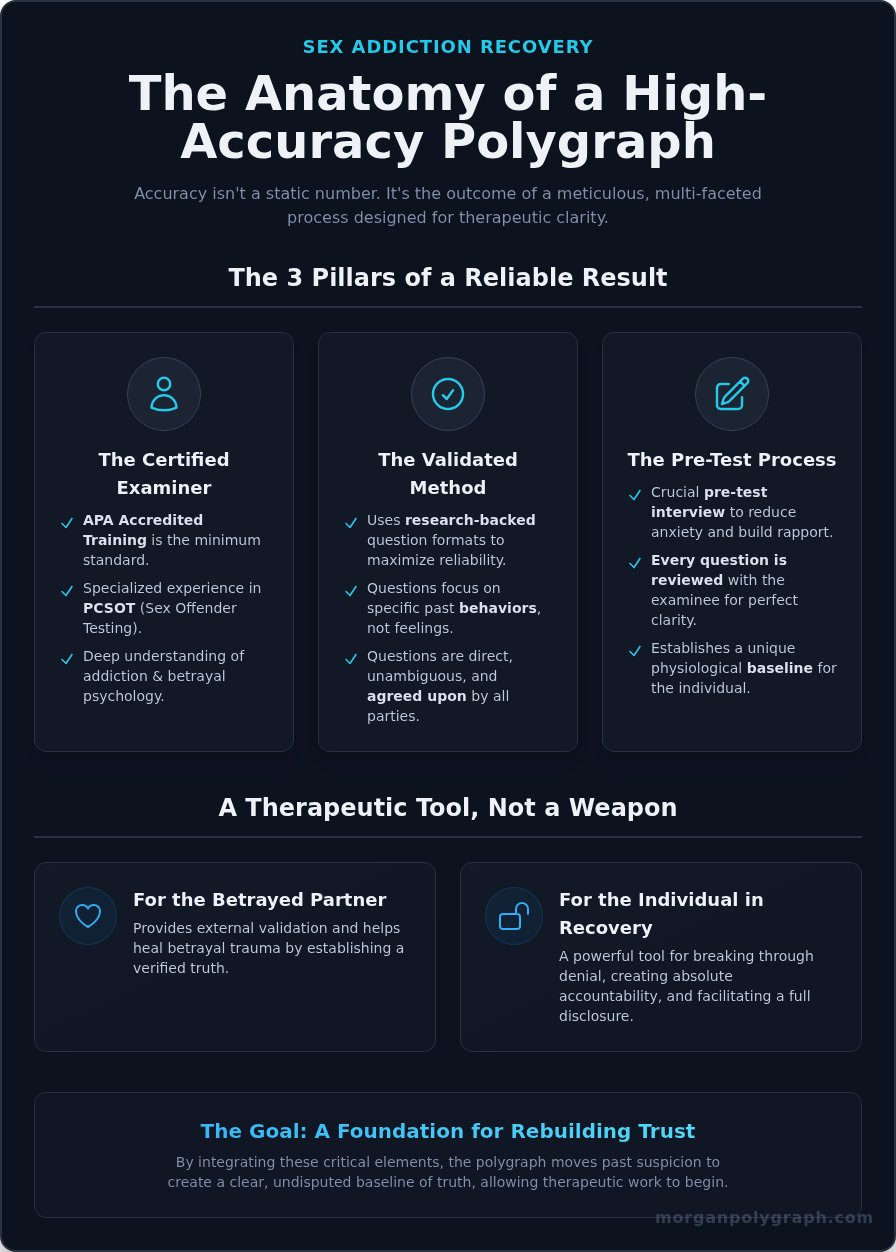
When individuals ask, “how accurate is a sex addiction polygraph test?”, they are often looking for a single percentage. However, the reality is that accuracy is not a static number; it is the outcome of a meticulous, multi-faceted process. The validity of a sex addiction polygraph is directly tied to the professional execution of several critical components, where expertise and methodology are paramount.
The Examiner’s Specialized Training and Experience
The single most critical factor influencing a polygraph’s accuracy is the examiner. A certified examiner with American Polygraph Association (APA) accredited training is the minimum standard. For sensitive matters like sex addiction, this must be supplemented with extensive experience in clinical and Post-Conviction Sex Offender Testing (PCSOT). This specialized skill set involves a deep understanding of the psychology of addiction, denial, and betrayal-a world apart from standard pre-employment or criminal testing.
Validated Testing Formats and Question Design
A professional polygraph examination relies on specific, research-backed question formats to maximize reliability. Questions are not arbitrary; they are carefully developed in collaboration with the client, their partner, and their therapist to be direct and unambiguous. While scientific evidence suggests polygraph testing has a high rate of accuracy in specific-incident investigations, the structure of the test is paramount. The focus is always on specific past behaviors (“Did you…”) rather than subjective feelings or future intentions (“Do you love…”). This structured approach removes ambiguity and minimizes the potential for inconclusive results.
The Importance of the Pre-Test Interview
Before any sensors are attached, a comprehensive pre-test interview is conducted. This phase is crucial for establishing rapport, reducing the examinee’s natural anxiety, and ensuring they are in a suitable physical and emotional state for testing. During this interview, the examiner reviews every single question with the examinee to guarantee perfect clarity. This process not only prevents confusion but also helps the examiner establish a reliable physiological baseline unique to that individual, which is essential for accurately interpreting the subsequent data.
When these elements-a highly qualified examiner, a validated testing format, and a thorough pre-test interview-are properly integrated, the reliability of the results increases dramatically. The answer to how accurate is a sex addiction polygraph test lies not in a number, but in the quality and integrity of the entire process.
The Therapeutic Polygraph Process: A Step-by-Step Breakdown
Understanding the polygraph process is essential for reducing the anxiety that can surround truth verification. Far from the intimidating portrayals in media, a therapeutic polygraph is a structured, confidential, and professional procedure designed to provide clarity and facilitate healing. The entire process is handled with compassion and respect for all individuals involved. To fully appreciate how accurate is a sex addiction polygraph test, it’s crucial to see how its methodical, multi-phase approach ensures precision and fairness from start to finish.
Phase 1: Consultation and Question Formulation
The foundation of an effective polygraph is built long before the examination begins. This initial phase is a collaborative effort, often guided by the couple’s therapist, to identify the specific issues that require resolution. Together, the therapist, partners, and sometimes the examiner work to craft clear, factual, and non-ambiguous questions about behaviors. For example, a vague question like “Have you been unfaithful?” is replaced with a precise one, such as, “Since January 1st, 2023, have you had sexual contact with anyone other than your partner?” Both partners must agree on the final set of questions, ensuring the test directly addresses the core concerns and that there are no surprises.
Phase 2: The Examination Environment
The polygraph examination itself is conducted in a controlled, private, and quiet setting to eliminate distractions and promote focus. A certified examiner begins by explaining the procedure in detail and answering any questions the examinee may have. The examiner then attaches several painless sensors to the body to record physiological data. These typically monitor:
- Respiratory activity (breathing patterns)
- Electrodermal activity (sweat gland responses)
- Cardiovascular activity (heart rate and blood pressure)
The examiner conducts a pre-test interview and an acquaintance test to establish a baseline, then proceeds to ask the pre-agreed-upon questions multiple times over several charts. The entire process is designed to be calm and professional, allowing for the most accurate data collection possible.
Phase 3: Data Analysis and Reporting
After the in-test portion is complete, the physiological data is meticulously analyzed. This is not a subjective judgment call; the data is scored using validated, computerized algorithms that identify significant and timely reactions associated with deception. These scientific methodologies are a key reason why professionals rely on this tool, and their effectiveness is a subject of ongoing study, as detailed in resources like the landmark 2003 National Academy of Sciences report. A certified examiner also conducts an independent analysis of the charts to confirm the algorithmic findings. This dual approach is central to understanding how accurate is a sex addiction polygraph test. Finally, a detailed, confidential report is prepared and delivered to the client and their therapist, presenting the results clearly and without moral speculation or judgment.
Addressing Common Concerns About Accuracy and Fairness
In any discussion about truth verification, questions regarding accuracy and fairness are not only common but essential. A professional polygraph examination is a methodical process designed to be objective and reliable. We believe that addressing your concerns directly is a cornerstone of a confidential and respectful client experience. Below, we provide clear, fact-based answers to the most frequent questions we encounter.
Myth: ‘You can easily beat a polygraph test.’
While online articles may claim to teach “countermeasures” like controlled breathing or inducing a pain response, these attempts are often ineffective against a trained, certified examiner. A professional is trained to identify the specific physiological signatures of these tactics. Often, the effort to manipulate the results creates erratic and unnatural responses on the polygraph charts, which can be interpreted as an indication of deception. The structured, multi-faceted nature of a professional exam is specifically designed to detect and account for such attempts, ensuring a more reliable outcome.
Fear: ‘My nervousness will make me fail.’
This is perhaps the most common and understandable concern. It is completely normal to be nervous when taking a polygraph test, and examiners expect it. The polygraph instrument does not measure nervousness itself; it measures changes in physiological responses from your unique baseline. During the pre-test interview and calibration phase, the examiner establishes how your body responds when telling the truth and when under general stress. Control questions are used to differentiate the body’s natural anxiety from the distinct reaction that typically accompanies deception.
Question: ‘How reliable are the results?’
When clients ask how accurate is a sex addiction polygraph test, the answer is rooted in extensive research and professional standards. For specific-issue tests conducted by a certified examiner following validated protocols, accuracy rates are consistently over 90%. A polygraph examination yields one of three possible outcomes:
- No Deception Indicated (NDI): The data shows no significant, timely, and specific reactions to the relevant questions, indicating truthfulness.
- Deception Indicated (DI): The charts reveal significant, timely, and specific reactions, indicating deception.
- Inconclusive: The data is inconsistent, and a definitive conclusion cannot be reached. This is not a failure but indicates that more testing may be necessary.
Ultimately, the value and accuracy of any test are directly tied to the expertise of the person administering it. To ensure the highest degree of reliability, always choose a qualified and experienced professional. For a confidential consultation, you can learn more at morganpolygraph.com.
How to Choose a Qualified Examiner for a Sex Addiction Polygraph
The validity of a polygraph test, especially for a sensitive issue like sex addiction, is not solely dependent on the technology. When clients ask, “how accurate is a sex addiction polygraph test,” the answer is directly tied to the skill, training, and integrity of the examiner. Choosing the right professional is the single most important step you can take to ensure a meaningful and reliable result. This checklist will empower you to ask the right questions and identify a truly qualified expert.
Verify Certifications and Professional Memberships
A credible examiner’s qualifications are non-negotiable. Begin by verifying their educational background and professional affiliations, which serve as proof of their commitment to the highest industry standards. These credentials ensure the examiner adheres to a strict code of ethics and stays current with validated testing techniques.
- APA-Accredited Education: Ensure they are a graduate of a polygraph school accredited by the American Polygraph Association (APA), the leading professional body in the field.
- Professional Memberships: Confirm active membership in respected organizations like the APA or the American Association of Police Polygraphists (AAPP).
Inquire About Experience with Clinical and Therapeutic Testing
Polygraph testing is not one-size-fits-all. An examiner who only conducts pre-employment screenings will not have the nuanced skill set required for complex therapeutic cases. You need an expert in interpersonal deception. Specifically ask about their experience with sex addiction, infidelity, and relationship issues. An examiner certified in Post-Conviction Sex Offender Testing (PCSOT) demonstrates an exceptionally high level of relevant expertise.
Assess for Professionalism and Confidentiality
The environment and the examiner’s conduct are crucial indicators of their credibility. A true professional operates from a permanent, private office, not a temporary or shared space. They should clearly explain the entire process, your rights as an examinee, and the limitations of the test before beginning. Most importantly, they must provide an unequivocal guarantee of absolute confidentiality for all parties involved. Schedule a confidential consultation to discuss your needs with an expert who meets these exacting standards.
By using these criteria as your guide, you take active control in ensuring the process is handled by a competent, ethical, and experienced professional. This due diligence is essential for achieving the clarity and truth verification you seek.
Navigating Recovery with Clarity and Confidence
Ultimately, the answer to how accurate is a sex addiction polygraph test lies not in a single percentage, but in the integrity of the entire process. As we’ve explored, the accuracy and therapeutic value of a polygraph depend heavily on the examiner’s expertise and its role as a tool for fostering honesty within a structured recovery plan. It is far more than a simple test; it is a professionally guided step toward rebuilding trust and establishing a baseline for truth.
Choosing the right professional is paramount. At Morgan Polygraph, our nationally certified, court-recognized examiners bring extensive experience in Post-Conviction Sex Offender Testing (PCSOT) to every consultation. We are committed to a compassionate, discreet, and professional process designed to support your journey toward healing and transparency.
If you are ready to take a definitive step forward, we are here to provide the clarity you need. Contact Morgan Polygraph for a confidential consultation about your situation. Your path to recovery deserves a foundation of undeniable truth.
Frequently Asked Questions
Is a sex addiction polygraph test admissible in court?
In most jurisdictions, polygraph results are generally not admissible as direct evidence in court proceedings due to varying standards of reliability. However, they are often utilized in therapeutic settings, probation and parole compliance, or private civil agreements where both parties stipulate to their use. It is essential to consult with a legal professional to understand how the results may be applied within the specific context of your situation, as rules can differ significantly.
What kind of questions will be asked during a sex addiction polygraph?
The questions are highly specific and focus on behaviors, not thoughts or feelings. They are developed to address the unique circumstances of the case, such as adherence to a recovery plan. Examples include direct, yes-or-no questions like, “Since your last test, have you had any sexual contact with anyone other than your spouse?” or “Have you viewed any pornography prohibited by your treatment agreement?” This ensures the examination is focused, professional, and directly relevant.
How long does the entire polygraph process take?
A complete, professional polygraph examination typically lasts between two and four hours. This comprehensive time frame includes a thorough pre-test interview to review health history and the test questions, the in-test phase where physiological data is collected, and a post-test analysis and discussion of the results. This methodical process is critical to ensuring the validity of the exam and is a key factor when clients ask how accurate is a sex addiction polygraph test.
What happens if the polygraph results are ‘Inconclusive’?
An ‘Inconclusive’ result means the physiological data was not clear enough to render a definitive opinion of either truthfulness or deception. This is not an indication of guilt or innocence. It can be caused by various factors, such as excessive movement, anxiety, or certain un-disclosed medical issues. A certified examiner will analyze the data to identify the cause. Depending on the circumstances, a re-test may be recommended to seek a conclusive outcome.
Can medication or a medical condition affect the polygraph results?
Yes, certain medications and pre-existing medical conditions can influence the physiological responses that a polygraph measures. It is imperative that the examinee discloses all medications and health issues to the examiner during the pre-test interview. An expert examiner is trained to evaluate these factors and determine if an individual is a suitable candidate for testing. This full disclosure is vital to understanding how accurate is a sex addiction polygraph test for a specific person.
Who decides what questions are asked on the test?
The development of test questions is a collaborative process. Typically, the referring party-such as a therapist, partner, or probation officer-provides the key areas of concern. The certified polygraph examiner then works directly with the examinee to formulate these concerns into clear, specific, and unbiased yes-or-no questions. The final questions are reviewed and agreed upon by the examinee before the test begins, ensuring complete transparency and fairness.