

Hearing a professional say, “The results are inconclusive because you manipulated the test,” is a deeply distressing experience. You entered the examination with the intent to be truthful, yet now you face an accusation that could jeopardize your career, a legal case, or your personal integrity. When a polygrapher says I manipulated examination results, it’s common to feel unfairly judged and confused. Was it just nerves? Did a deep breath at the wrong moment get misinterpreted as a deliberate countermeasure? The uncertainty is overwhelming, leaving you with more questions than answers.
This article is designed to provide the professional clarity and direction you need. As court-recognized experts in truth verification, we will demystify this serious accusation. You will understand the technical indicators examiners look for, learn the critical difference between involuntary anxiety responses and intentional efforts to distort results, and gain a clear, actionable plan to address the situation. Our goal is to empower you with the knowledge to understand your options and regain control of your circumstances.
What a ‘Manipulation’ Finding Actually Means: An Examiner’s Perspective
Receiving a report that states you attempted to manipulate a polygraph examination can be confusing and distressing. If you’re searching for answers because a “polygrapher says i manipulated examination,” it is crucial to understand what this finding technically means. In the field of truth verification, ‘manipulation’ refers to the use of deliberate techniques, known as countermeasures, to consciously interfere with the physiological data being recorded. This is a finding about your actions during the test, not a conclusion about your truthfulness.
A manipulation finding is fundamentally different from a result of ‘Deception Indicated’ (DI). A DI result means your natural, involuntary physiological responses showed a significant reaction to the relevant questions. In contrast, a manipulation finding means the examiner observed purposeful efforts to distort those responses, making the data unreliable. The entire test is thereby invalidated.
Countermeasures vs. Deception Indicated (DI): A Critical Distinction
It is essential to distinguish between a test result and a procedural observation. A DI finding is a result based on analyzing your physiological data. A finding of countermeasures, however, is an expert observation that you were actively trying to interfere with the collection of that data. An examiner’s official report will clearly state one or the other. This finding focuses on your behavior during the examination, not the veracity of your answers to the questions asked.
Why This Invalidation Occurs
The sole purpose of countermeasures is to defeat the accuracy of the polygraph instrument. These actions can include controlled breathing, muscle tensing, or mental exercises designed to create artificial reactions. Certified examiners are extensively trained to detect the specific signatures of various Polygraph countermeasures, which produce unnatural and inconsistent patterns in the data. When an examiner detects these deliberate distortions, the integrity of the test is compromised. As a result, no professional conclusion about truthfulness can be drawn, and the examination must be reported as inconclusive due to manipulation.
Innocent Anxiety vs. Intentional Countermeasures: How Examiners Tell the Difference
A primary concern for nearly every individual undergoing a polygraph test is that their natural nervousness will be misinterpreted as deception. It is essential to understand that certified examiners not only expect anxiety but are specifically trained to differentiate it from deliberate attempts to skew the results. The process begins by establishing your unique physiological baseline during the pre-test interview and with control questions, creating a benchmark against which all subsequent reactions are measured.
If a polygrapher says I manipulated examination results, it is almost never due to general anxiety. It is because they have detected specific, inconsistent physiological data that points toward deliberate actions rather than authentic emotional responses.
Common Signs of General Nervousness
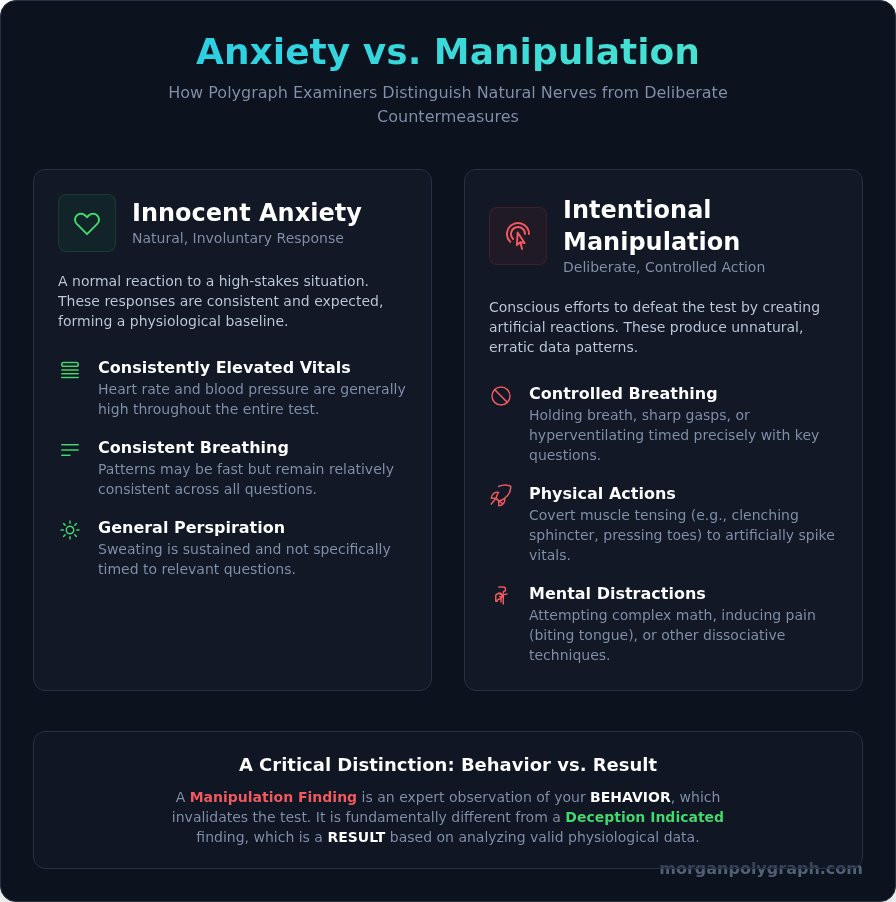
An honest person’s anxiety is a normal human response to a high-stakes situation. An examiner anticipates seeing physiological signs that remain relatively constant throughout the entire test. These expected reactions include:
- A consistently elevated heart rate and blood pressure.
- Breathing patterns that may be slightly irregular but are consistent across all questions.
- General perspiration that is not timed to specific, relevant questions.
Because these reactions are sustained, they are recognized as part of your baseline anxiety level and are factored into the final analysis by the examiner.
Red Flags for Intentional Manipulation
Intentional manipulation, or the use of countermeasures, produces physiological data that is erratic and unnatural. Unlike general nervousness, these reactions are typically timed precisely with relevant questions to either suppress or artificially spike a response. Examiners are trained to identify these tell-tale signs, which are well-documented in professional research on polygraph countermeasures. Common red flags include:
- Controlled Breathing: Suddenly holding your breath, hyperventilating, or taking sharp, deep breaths only when a key question is asked.
- Physical Actions: Covert muscle contractions, such as clenching your sphincter or pressing your toes against the floor, to cause an artificial spike in blood pressure.
- Mental Distractions: Attempting to dissociate, perform complex mental math, or even induce pain (like biting your tongue) to disrupt the data.
Can Medical Conditions Be Mistaken for Countermeasures?
Certain medical conditions, such as respiratory ailments, chronic pain, or neurological disorders, can produce physiological responses that might interfere with polygraph data. This is precisely why full disclosure during the pre-test interview is critical. You must inform your examiner of any diagnosed medical conditions, injuries, or medications you are taking. A professional, certified examiner will use this information to properly conduct the test and differentiate involuntary physiological artifacts from intentional manipulation, ensuring a fair and accurate assessment.
Types of Countermeasures Examiners Are Trained to Detect
A common concern for individuals undergoing a polygraph is the idea of countermeasures-deliberate actions taken to distort the results. It is critical to understand that certified polygraph examiners are extensively trained to detect these very tactics. Modern polygraph instrumentation, combined with advanced scoring algorithms, is exceptionally sensitive to artificial and non-spontaneous physiological responses. Attempting to use countermeasures is one of the most common reasons a client might hear their polygrapher says I manipulated examination, which ultimately undermines the goal of truth verification.
Successfully navigating a polygraph exam depends on cooperation and honesty, not on attempts to outsmart the process. These efforts are categorized into two primary types, both of which professionals are equipped to identify.
Physical Countermeasures
These are conscious efforts to alter the body’s natural reactions by creating physiological “noise.” The goal is to mask or mimic the body’s response to deception, but these attempts produce data patterns that are inconsistent with genuine reactions. Common examples include:
- Altering Breathing: Deliberately holding one’s breath, taking short, shallow breaths, or hyperventilating during key questions.
- Muscle Tensing: Subtly clenching the jaw, pressing feet against the floor, contracting abdominal muscles, or biting the tongue.
- Inducing Pain: Using a hidden object, like a tack in a shoe, or digging a fingernail into the skin to create a sharp pain response intended to skew the readings.
These actions create abrupt, artificial spikes in the data that a trained examiner can readily identify as deliberate manipulation.
Mental Countermeasures
Mental countermeasures involve attempts to control or distract the mind to suppress or create emotional responses. While often perceived as more sophisticated, these tactics are generally less effective and can still be detected. The cognitive load required to perform these mental gymnastics often produces its own set of detectable physiological responses. Examples include trying to dissociate from the process, solving complex mathematical problems, or concentrating intensely on an unrelated emotional memory to block reactions to the relevant questions.
The attempt to employ such tactics is a high-risk endeavor that almost always backfires. The scientific community has extensively reviewed these methods, and as detailed in publications like The National Academies of Sciences on Polygraph Countermeasures, the data distortions they create are often obvious to a qualified professional. Ultimately, if a polygrapher says I manipulated examination, it is because the physiological data collected showed clear signs of purposeful interference, not because the examinee successfully “beat” the test. The most effective path to a conclusive and accurate result is to remain calm, follow instructions, and be truthful throughout the process.
Your Professional Response Plan: What to Do Immediately After the Accusation
Hearing the words, “The polygrapher says I manipulated the examination,” can be a deeply unsettling experience. Your immediate reaction may be to defend yourself, but a calm, methodical approach is far more effective. The goal is not to argue, but to gather information and ensure that all professional standards were met. This step-by-step plan will guide you through the process with clarity and confidence.
Step 1: Remain Calm and Request Clarification
The most critical first step is to manage your emotional response. Do not argue with the examiner. Instead, professionally seek to understand their conclusion. Ask a direct, non-confrontational question, such as, “Can you please explain what you observed that led to this finding?” Listen carefully to their response without interruption. You can also inquire specifically, “Is the official result ‘inconclusive due to countermeasures’?” This demonstrates your desire for precise, factual information.
Step 2: Document Everything
As soon as you leave the examination, write down every detail you can remember while it is fresh in your mind. This documentation is crucial for any future review. Be sure to record:
- The examiner’s full name and credentials.
- The date, time, and location of the test.
- The specific questions you were asked, especially those flagged as problematic.
- The examiner’s exact explanation for the manipulation finding, using their words as closely as possible.
Step 3: Formally Request a Copy of the Report
Your personal notes are important, but the official report is the key document. You must formally request a copy from the entity that commissioned the test (e.g., your potential employer, law enforcement agency, or attorney). This report contains the examiner’s written findings and the specific rationale for their conclusion. Review it carefully to see if the written explanation matches what you were told verbally.
Step 4: Consider Seeking a Second Opinion
If you believe the conclusion is incorrect, you may have the right to seek a second opinion. This can take two forms: a completely new examination with a different, independent examiner, or a Quality Control (QC) review of your original test charts and report by another certified expert. A QC review can identify procedural errors or alternative interpretations of the data. When a polygrapher says I manipulated examination, an expert second opinion provides the most robust path to truth verification.
If you are facing this situation, it is vital to have an expert on your side. Consult with a certified examiner to review your case.
Secure Your Professional Future After a Manipulation Finding
Receiving a manipulation finding can be a disorienting and high-stakes experience. It is vital to remember that such a result is not a final verdict but a complex interpretation that demands a professional response. Understanding the critical distinction between innocent anxiety and deliberate countermeasures, and knowing how to react immediately, are your most powerful assets. When a polygrapher says I manipulated examination, the path forward can seem uncertain, but a measured, informed strategy is the key to protecting your reputation.
You do not have to navigate this challenge alone. An independent, expert review of your case can provide the clarity and credibility you need. The court-recognized expert examiners at Morgan Polygraph conduct confidential and professional case reviews, adhering strictly to the highest American Polygraph Association standards. We offer a discreet and compassionate analysis to help you understand your results and plan your next steps.
Take control of the narrative. Schedule a Confidential Consultation to Discuss Your Polygraph Results. A challenging outcome is not the end of the road; it is an opportunity to seek expert guidance and move forward with confidence.
Frequently Asked Questions About Inconclusive Polygraph Results
Is being accused of manipulation the same as failing the polygraph?
No, these are two distinct outcomes. A “Deception Indicated” result, or a failure, means your physiological responses were indicative of lying. When a polygrapher says you manipulated the examination, it means they believe you intentionally used countermeasures to distort the test data. This renders the results “Inconclusive” because your true responses could not be accurately measured. An accusation of manipulation is about process interference, not a definitive conclusion of dishonesty on the relevant questions.
Can I be re-tested by the same agency or for the same job?
This depends entirely on the policy of the specific agency or employer. Some organizations have a strict policy that disqualifies any applicant with an inconclusive result due to suspected manipulation. Others may, at their discretion, offer a single re-test with a different examiner or after a waiting period. The most direct course of action is to professionally inquire with the hiring or requesting party about their specific policies regarding re-examination under these circumstances.
Will this accusation appear on my permanent record or in background checks?
A pre-employment or private polygraph result is not part of a criminal record and will not appear on standard background checks run by unrelated employers. However, the agency that administered the test will maintain an internal file on the examination. If you are applying for another position within the same government body (e.g., a different federal agency), it is possible that this internal record could be accessible during their comprehensive security and suitability screening processes.
If I was just nervous, what can I do to prove it wasn’t intentional?
If a polygrapher says I manipulated examination charts due to what you believe was just severe anxiety, your best option is transparent communication. You can professionally request to discuss the specific physiological data with the examiner and explain your state of nervousness. While not always granted, you may ask for a re-test and be explicitly clear about your anxiety during the next pre-test interview. Demonstrating a willingness to cooperate can sometimes help clarify the situation.
Can medication I’m taking cause a false manipulation result?
Certain medications can significantly affect the physiological responses measured by a polygraph. Prescription drugs for blood pressure (like beta-blockers), anxiety, or other neurological conditions can alter heart rate, respiration, and sweat gland activity. It is critical to disclose all medications, supplements, and medical conditions to your examiner during the pre-test interview. An experienced examiner can account for these factors when analyzing the data, preventing potential misinterpretation of your results.
What are my legal options if I feel the accusation was unprofessional or biased?
If you believe the examiner acted unprofessionally or the accusation was unfounded, you may consider several steps. First, document every detail of the interaction immediately. You can verify the examiner’s credentials and check if they are a member of a professional organization like the American Polygraph Association (APA), which has a code of ethics. For matters of employment, consulting with an attorney who specializes in employment law is the most appropriate step to understand your specific rights and options.