
When you are facing a sensitive situation that requires absolute truth-be it a question of infidelity, a family dispute, or a breach of trust-the need for definitive answers can feel overwhelming. The prospect of an in-person examination can seem intimidating or costly, which makes the promise of a quick, private, and affordable solution compelling. But as you navigate a confusing digital landscape of apps and websites, a critical question emerges: can you take a real lie detector test online in 2025 that delivers the accuracy you need for a serious matter?
In this professional guide, we provide the expert clarity you are searching for. We will meticulously examine the technology behind today’s online ‘lie detectors’ and compare their methods directly against the standards of a certified polygraph examination. By exploring the fundamental differences in science, procedure, and reliability, you will gain a clear understanding of which option can provide the certainty your situation demands. Our objective is to empower you with the facts to make a confident and informed decision, helping you find a reliable path toward the truth.
The Search for Truth Online: Why People Want Digital Lie Detectors
Facing uncertainty in a personal or professional relationship is a deeply stressful experience. When trust is broken, the need for clear, definitive answers can feel overwhelming. It is this urgent search for truth that leads many individuals to look for a real lie detector test online. The internet promises immediate solutions for complex human problems, and the idea of a digital polygraph appears to offer a straightforward path to clarity.
The primary appeals of these online services are compelling. They offer a layer of perceived privacy and discretion that is highly attractive when dealing with sensitive issues. The ability to conduct a test from the comfort of one’s own home, on a personal schedule, removes the logistical and emotional barriers of scheduling a professional appointment. Furthermore, there is a common assumption that a web-based or app-based test will be significantly cheaper than a certified examination, with many options even advertised as free.
Common Scenarios Driving the Search
The circumstances that prompt someone to seek out a lie detector are often emotionally charged. While every situation is unique, most fall into several distinct categories:
- Relationship Doubts: Suspicions of infidelity or other forms of deception between partners are a primary motivator for seeking truth verification.
- Family Disputes: Accusations of theft, dishonesty about personal matters, or other internal conflicts can create rifts that families hope to resolve with an impartial test.
- Informal Disagreements: Conflicts between friends, roommates, or even small business partners over money or broken agreements can lead individuals to seek a simple method of establishing the facts.
Privacy vs. Accuracy: The Core Trade-off
The initial comfort of an anonymous-seeming online test is understandable. It feels like a low-risk way to gather information without direct confrontation. However, this convenience introduces a critical trade-off that is often overlooked. The methods used by professional examiners are based on decades of scientific protocol; before evaluating any digital alternative, it is vital to understand what a polygraph is and the controlled conditions required for a valid test. The central question you must ask is: can an algorithm on a screen truly provide the certainty you need when the stakes are this high?
What is a Real Polygraph? The Science of Deception Detection
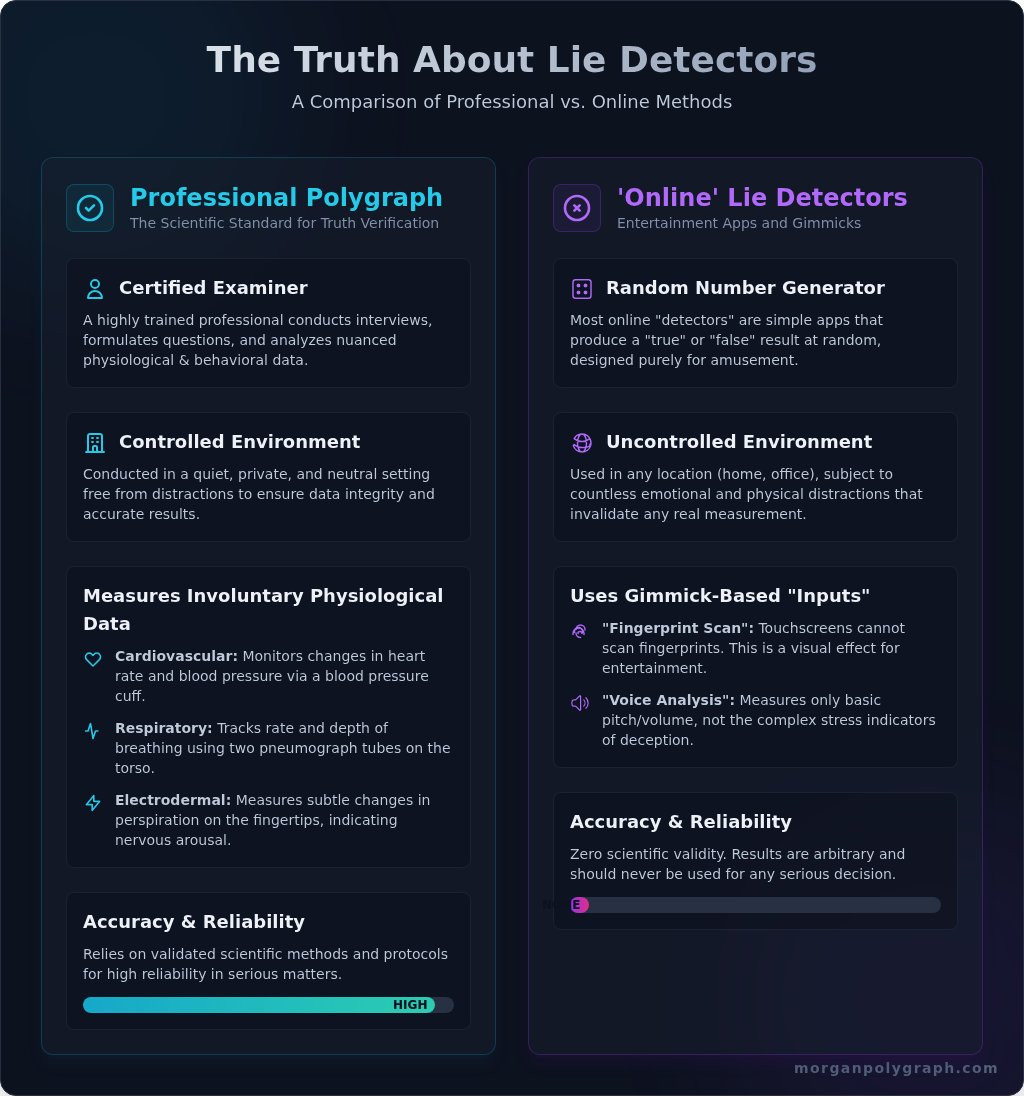
To understand the fundamental flaws of any supposed real lie detector test online, one must first appreciate what a professional polygraph examination truly entails. It is not an app, a game, or a piece of consumer software. A genuine polygraph is a sophisticated, medical-grade instrument designed to precisely record involuntary physiological changes in the human body. The accuracy of a polygraph test rests on three inseparable pillars: a certified examiner, a controlled process, and the precise measurement of specific biological data.
The Role of the Certified Examiner
The most critical component of any valid polygraph is the examiner. This is not merely an operator but a highly trained and certified professional with extensive education in interview techniques, physiology, and chart analysis. The examiner conducts a detailed pre-test interview to establish a subject’s baseline emotional state and carefully formulate questions specific to the case. Their expertise is paramount in interpreting the nuanced data from the polygraph charts in conjunction with observed behavior to arrive at a professional opinion.
The Controlled Examination Process
A professional polygraph is conducted in a quiet, private setting, free from distractions that could compromise the results. This controlled environment is non-negotiable for accuracy, a stark contrast to the unpredictable variables of a home where someone might attempt an online test. The examination follows a structured format using irrelevant, control, and relevant questions designed to isolate reactions associated with deception from general anxiety. The validity of this methodical process is a key focus when evaluating the scientific evidence on polygraph accuracy for use in legal and private matters.
Physiological Data: What is Being Measured?
The polygraph instrument does not detect lies; it detects the physiological stress that often accompanies deception. A certified examiner monitors and records data from at least three different systems in the body simultaneously:
- Cardiovascular Activity: Changes in heart rate and blood pressure are monitored via a standard blood pressure cuff.
- Respiratory Activity: Two pneumograph tubes placed around the chest and abdomen track the rate and depth of breathing.
- Electrodermal Activity: Small sensors attached to the fingertips measure subtle changes in perspiration, a direct indicator of nervous system arousal.
These involuntary “fight or flight” responses provide the raw data that only a trained expert can professionally analyze to form a valid conclusion, something no real lie detector test online can ever replicate.
Analyzing ‘Online Lie Detectors’: Apps, AI, and Accuracy Claims
When searching for a real lie detector test online, you will encounter a wide spectrum of tools, from simple mobile apps to sophisticated-sounding AI platforms. It is crucial for anyone seeking truth verification to understand the fundamental differences between these offerings and a professional polygraph examination. These online services can be broadly grouped into two distinct categories, each with significant and disqualifying flaws for any serious application.
Category 1: Entertainment Apps (Fingerprint/Voice Scanners)
The most common online “lie detectors” are designed purely for entertainment. Apps that claim to analyze a fingerprint on a touchscreen or the tone of a voice are not performing any real analysis. Instead, they employ simple random number generators to produce a “true” or “false” result. These applications have zero scientific validity and should never be used for anything other than a party game or prank.
Category 2: AI-Based Technologies (Eye-Tracking, Micro-expressions)
A more serious category of online tests leverages AI to analyze secondary behavioral traits. The theory is that involuntary indicators, such as eye movement or fleeting facial micro-expressions, can betray deception. While this field of research is advancing, these technologies are far from being accepted as reliable tools by the professional community. Even established methods have well-documented limitations of polygraph testing, and these AI tools suffer from a critical flaw: the complete lack of a controlled environment. A professional exam measures direct physiological responses; these tools only guess at intent based on indirect visual cues.
Why These Methods Fall Short for Serious Matters
Ultimately, any attempt at a real lie detector test online fails because it cannot replicate the controlled, methodical process of a certified examination. Unlike a professional polygraph conducted by an expert, these online tools have critical deficiencies:
- No Pre-Test Interview: A professional examiner spends crucial time establishing a baseline, understanding the subject’s context, and carefully formulating questions. Online tests skip this essential diagnostic step entirely.
- Inability to Account for Variables: Nerves, anxiety, medical conditions, medication, or simple distractions in the room can all create false positives. Online algorithms cannot differentiate these factors from genuine deception.
- No Legal or Professional Recognition: The results from any online app or AI service are not admissible in court and are not recognized by legal, corporate, or therapeutic professionals for decision-making.
In-Person vs. Online: Why a Professional Polygraph is Irreplaceable
In the search for truth, many are tempted by the convenience of a “real lie detector test online.” However, this convenience comes at a steep price: the complete loss of accuracy, credibility, and the most critical component of any valid examination-the certified polygraph examiner. The difference between a professional, in-person test and an online algorithm is not just a matter of degree; it is a fundamental difference in process, standards, and reliability.
The Examiner’s Insight
A professional polygraph is an interactive human process, not a passive software program. A certified examiner is expertly trained to observe subtle non-verbal cues, adapt questioning based on the subject’s real-time physiological and behavioral responses, and ensure every question is phrased with unambiguous clarity. This expert oversight is crucial for establishing a proper psychological baseline and ensuring the subject fully comprehends the process, which is essential for an accurate outcome.
Accuracy and Reliability
The contrast in proven effectiveness is stark. According to industry research, including studies validated by the American Polygraph Association, professionally administered polygraph examinations achieve accuracy rates of approximately 90%. In stark contrast, online tools offer no verifiable data on their accuracy. Furthermore, a trained examiner can detect and address countermeasures-techniques used to “beat” the test-while an automated system is easily deceived, rendering its results completely unreliable.
Credibility of Results
The final report is another critical distinction. A professional examination concludes with a detailed, expert analysis that can be presented and defended in legal, therapeutic, or corporate settings. Online results are anonymous, unverified, and hold no weight in any professional context; they are simply data without expert interpretation or accountability. For results you can trust, schedule a confidential consultation.
Ultimately, the validity of a polygraph test rests on three pillars: a controlled, distraction-free environment; the adaptive intelligence of a human expert; and adherence to strict legal and professional standards. The search for a legitimate real lie detector test online is fruitless because the technology itself is only one part of a complex, human-driven process of truth verification. For a definitive and professional outcome, an in-person examination is the only credible option.
Your Next Steps: Choosing the Right Path to the Truth
After understanding the significant limitations and risks of online tools, your path forward depends entirely on the gravity of your situation. The search for truth is important, but the method you choose must match the stakes. A clear distinction must be made between harmless entertainment and serious, life-altering inquiries.
If your goal is a party game or simple curiosity, a lie detector app can be a source of fun with no real-world consequences. However, if you are facing a critical issue involving a relationship, a legal dispute, or a financial matter, relying on any form of real lie detector test online is a dangerous gamble. For these moments, the accuracy, confidentiality, and professional standards of an in-person polygraph examination are essential.
Checklist for Finding a Certified Examiner
When the stakes are high, the expertise of the examiner is paramount. Not all practitioners are equally qualified. Use this checklist to vet a potential examiner:
- Accredited Education: Verify that the examiner is a graduate of a polygraph school accredited by the American Polygraph Association (APA), the globally recognized standard.
- Professional Memberships: Confirm their active membership in leading professional organizations, such as the APA or the American Association of Police Polygraphists (AAPP).
- Relevant Experience: Ask about their specific experience related to your needs, whether it’s for infidelity, family disputes, or pre-employment screening.
Preparing for a Professional Examination
A professional polygraph is a methodical process focused on truth verification, not a confrontational interrogation. To ensure the most accurate results, it is crucial that you arrive for your appointment well-rested and in good health. The most vital part of the process is the pre-test interview, where you must be completely honest with the examiner. This collaborative phase allows for the formulation of clear, unambiguous questions, setting the foundation for a valid and reliable test.
Making the right choice is paramount when the truth matters most. By engaging a certified, experienced examiner, you are investing in a professional, discreet, and accurate process. If you require expert guidance for a sensitive matter, we invite you to learn more about the professional polygraph process at morganpolygraph.com.
Finding Truth Beyond the Screen: The Final Verdict
As we’ve explored, the digital landscape is filled with apps and AI promising instant truth verification. However, these tools fundamentally lack the scientific rigor, controlled environment, and human expertise of a genuine polygraph examination. The search for a legitimate real lie detector test online reveals a critical gap between convenient technology and credible results. For matters of personal, legal, or professional significance, the accuracy and nuance provided by a trained examiner analyzing physiological data remain irreplaceable.
When the truth matters, don’t rely on an app. At Morgan Polygraph, you receive more than a test; you gain clarity from a nationally certified and court-recognized examiner with over 40 years of combined professional experience. We utilize state-of-the-art polygraph technology within a completely confidential setting to ensure the highest standards of accuracy and discretion. Contact Morgan Polygraph for a confidential and professional examination.
Taking the step to uncover the truth can be challenging, but you don’t have to navigate it alone. Find the certainty you deserve.
Frequently Asked Questions About Online Lie Detectors
Are any online lie detector tests accurate at all?
No, online lie detector tests, which often function as apps or web-based games, are not scientifically validated and should not be considered accurate. A professional polygraph examination is a complex process involving a certified examiner, calibrated equipment, and a controlled environment to measure physiological responses. Online tools cannot replicate these critical components and are designed for entertainment purposes only, not for reliable truth verification in serious matters.
What is the difference between a polygraph and an AI eye-tracking test like VerifEye?
A traditional polygraph is a comprehensive examination that measures multiple physiological indicators of deception, including heart rate, blood pressure, respiration, and electrodermal activity. In contrast, an AI-powered tool like VerifEye focuses on a narrower set of data points, primarily analyzing involuntary eye movements and pupil dilation. While eye-tracking is an innovative field, it is distinct from the multi-channel data collection method used in a standard, professionally administered polygraph test.
Can the results from an online lie detector test be used in court?
Absolutely not. The results generated by any online lie detector application have no legal standing and are not admissible as evidence in a court of law. The legal system requires that any scientific evidence meet rigorous standards for reliability and validity, known as the Daubert Standard. Online tests fail to meet these criteria, as they are not administered by certified experts in a controlled setting and lack scientific backing for their accuracy.
How much does a real, in-person polygraph test cost compared to an online app?
Online lie detector apps are typically free or cost a very small fee, which reflects their value as entertainment. A professional, in-person polygraph examination is a comprehensive service that can cost from several hundred to over a thousand dollars. This fee covers the highly specialized equipment, the certified examiner’s extensive time for the pre-test interview, test administration, and detailed post-test analysis of the results. The cost reflects an expert-led process, not a simple algorithm.
Why can’t a real polygraph be administered over Zoom or video call?
A valid polygraph examination requires the precise attachment of sensitive sensors to the examinee’s body to accurately record physiological data. This physical connection is impossible to achieve remotely. Furthermore, the examiner must maintain a strictly controlled environment to eliminate outside distractions that could corrupt the data. The concept of a real lie detector test online via video call is not feasible because it fails to meet these fundamental requirements for accuracy and procedural integrity.
What is a voice stress analysis test and is it available online?
Voice Stress Analysis (VSA) is a technology intended to detect deception by measuring microscopic frequency changes in the human voice. While some applications claim to offer a real lie detector test online using this method, their reliability is highly contested among experts. Professional-grade VSA requires high-fidelity audio equipment and a controlled acoustic environment, which cannot be guaranteed through a standard computer or phone microphone, making online versions fundamentally unreliable for serious use.