
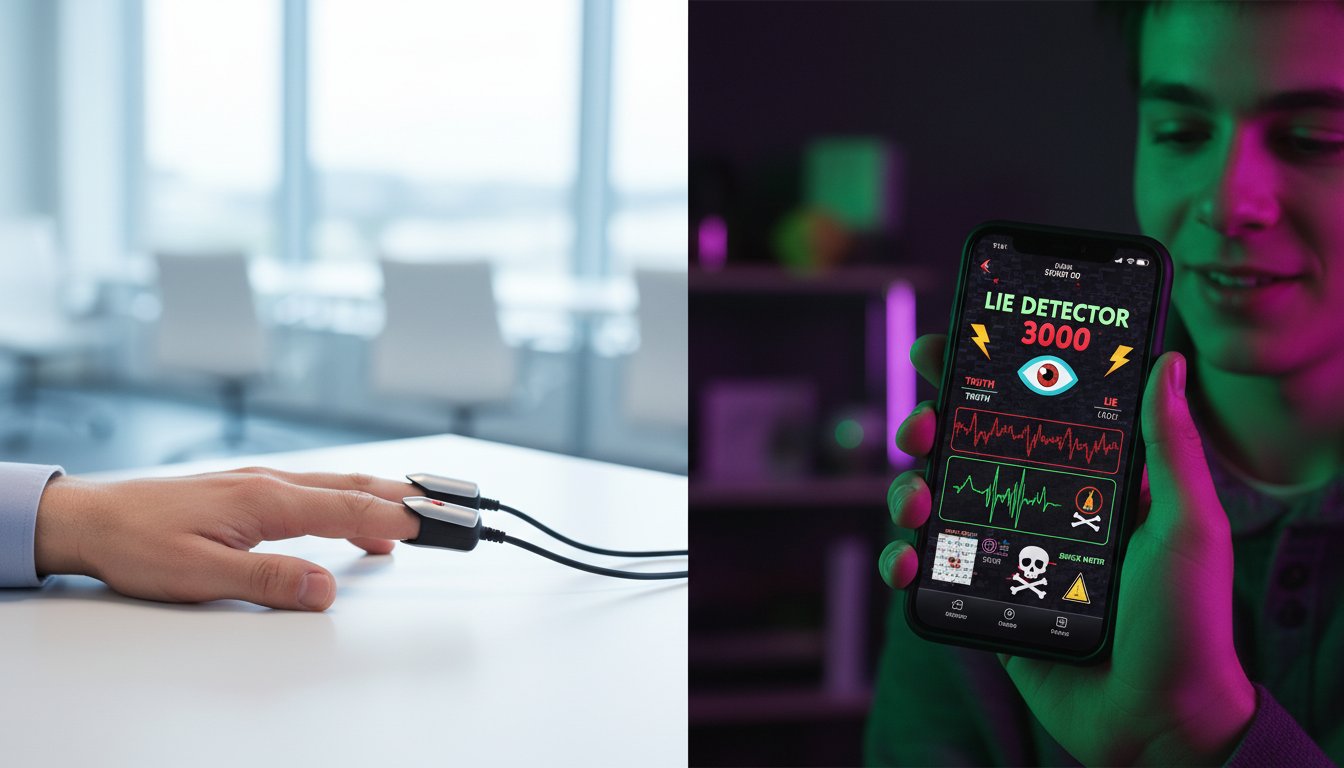
When you urgently need answers but a professional polygraph seems financially out of reach, the search for a free lie detector test can lead you down a confusing path of smartphone apps and online quizzes. You may be wondering: are any of these options legitimate, or are they just for entertainment? In situations where the truth is critical-whether for a personal, legal, or family matter-making the wrong choice can have serious consequences. The uncertainty and lack of clear, professional guidance can be overwhelming when you feel vulnerable and need to know who to trust.
This guide is designed to provide the clarity you need. We will professionally and discreetly examine the world of free truth verification, from the novelty apps to the rare but legitimate pro bono services offered by certified examiners. You will learn to distinguish between entertainment and evidence, understand the significant risks of inaccurate online tests, and discover if your situation might qualify for a confidential, no-cost professional polygraph. Our goal is to empower you with expert knowledge so you can make an informed, confident decision when the truth truly matters.
The World of ‘Free’ Lie Detectors: Entertainment Apps & Online Quizzes
When individuals seek immediate answers to questions of truthfulness, a common first step is a search for a free lie detector test online. This search typically leads to a vast marketplace of smartphone applications and web-based quizzes, all promising to reveal deception with a tap or a click. However, it is imperative for users to understand the profound difference between these digital novelties and a professional, certified polygraph examination. These apps and quizzes are designed exclusively for entertainment and have no basis in the established science of deception detection.
How Prank Lie Detector Apps Function
The majority of lie detector apps available for smartphones are sophisticated pranks, not diagnostic tools. Their operation has nothing to do with the science of psychophysiology. Unlike a professional instrument, which, as the Polygraph on Wikipedia explains, meticulously measures and records physiological responses like heart rate and respiration, these apps do not measure any valid biological data. Their mechanisms are simple:
- Random Result Generators: Most apps use a simple algorithm to randomly output “Truth” or “Lie” after a user places their finger on the screen.
- Secret User Control: Many popular apps allow the person administering the “test” to secretly control the outcome by pressing a hidden button (like a volume key) to pre-determine the result.
- Gimmick-Based Analysis: Some claim to analyze voice stress or finger temperature, but these are simulations without any scientific backing or reliable technology.
Online Quizzes: Testing Your Skills, Not Others
A separate category of online tests are not designed to test another person but to evaluate your own lie-spotting abilities. These quizzes often present video clips of individuals telling stories and challenge the user to determine who is being deceptive. While they can be an interesting exercise in observing body language and human behavior, their purpose is self-education and amusement. They are not a valid method for truth verification and their results are not indicative of any certified skill.
Ultimately, these applications serve a purpose limited to parties, games, and practical jokes. Their complete lack of scientific accuracy means their results are meaningless. Furthermore, users should be cautious about the privacy risks involved, as many of these free apps require access to your device’s microphone, contacts, and personal data in exchange for a fabricated result.
Legitimate Pro Bono Polygraph Services: The Rare Exception
While the concept of a truly professional and completely free lie detector test seems appealing, it is a significant rarity in the field of truth verification. In certain, highly specific circumstances, some certified examiners and professional organizations do offer their services at no cost. However, these are not commercial promotions; they are pro bono services, a Latin term meaning “for the public good.” This is a critical distinction. Pro bono work is a professional courtesy extended to serve the cause of justice, not a tool for resolving personal disputes or satisfying curiosity.
These services are reserved almost exclusively for grave legal situations where an individual’s freedom is at stake and they lack the financial means to mount an effective defense. They are a function of the legal system, not a public utility for relationship or family matters.
Who Qualifies for a Pro Bono Polygraph?
The criteria for receiving a pro bono polygraph examination are exceptionally strict and non-negotiable. The purpose is to prevent a potential miscarriage of justice, a serious matter that government bodies and legal professionals monitor closely. The strict protocols for using polygraphs in legal settings are well-documented, with resources like the Department of Justice on Polygraphs outlining their specific applications and limitations. Generally, an applicant must meet all the following conditions:
- Formally Charged: The individual must be an indigent defendant who has been formally charged with a serious criminal offense, typically a felony.
- Exculpatory Purpose: The sole purpose of the examination must be to aid in the legal exoneration of the accused, not for pre-trial negotiation or sentencing mitigation.
- Attorney Referral: The request must come directly from the defendant’s legal counsel, such as a public defender or a court-appointed attorney who can verify the case details.
- Waived Confidentiality: The examinee and their attorney must agree that the test results will not be confidential and can be shared with the relevant legal parties, including the prosecution.
How to Find and Apply for Pro Bono Services
Reputable organizations, such as the Global Polygraph Network (GPN), occasionally facilitate pro bono examinations through their network of certified members. The process is not simple; it involves a formal application submitted by legal counsel, a thorough verification of the criminal case, and an assessment of the defendant’s financial status. It is important to understand that availability is extremely limited, dependent on the voluntary participation of specific examiners and restricted to certain geographic locations. This is a world away from the instant access promised by an online free lie detector test, underscoring the gravity and professionalism of authentic polygraph services.
Why Free Online Tests Fail When Accuracy Is Critical
In situations where the truth is paramount, it is crucial to understand the profound difference between a professional polygraph examination and a so-called free lie detector test found online or in an app store. The former is a complex diagnostic process rooted in psychophysiology, while the latter is designed purely for entertainment. They are not comparable in method, accuracy, or intent.
An online test generates a random or predetermined outcome with no connection to the user’s actual physiological state. A professional polygraph, conversely, uses sophisticated, calibrated instruments to record and measure specific bodily responses to a structured series of questions. Relying on an app for a serious matter is not just ineffective; it can be dangerously misleading.
Lack of Scientific Method
A professional polygraph examination is a methodical, scientific process. It involves a pre-test interview to establish a baseline, carefully formulated questions, and the use of validated scoring systems to analyze physiological data. The complexity of this process is why organizations like the American Psychological Association have extensively studied the topic; you can review the APA on Polygraph Accuracy to understand the scientific standards involved. Online tests bypass every critical step, offering conclusions with no scientific basis whatsoever.
The Inadmissibility of Unprofessional Results
The results from any online quiz or mobile app hold zero weight in any professional or legal setting. They are universally inadmissible in court and will be dismissed by any serious party in a corporate or civil dispute. Attempting to use these results not only fails to prove a point but can severely damage your credibility. On a personal level, the stakes are just as high. A false positive or negative from an unreliable app can inflict irreparable harm on trust and relationships.
The Critical Role of a Certified Examiner
Perhaps the most significant failure of any automated free lie detector test is the complete absence of a certified examiner. The polygraph instrument is a tool; the examiner is the expert who designs the test, interprets the complex data, and ensures the integrity of the process. A trained examiner is essential for:
- Formulating precise and non-biased questions.
- Identifying subject countermeasures or attempts to manipulate results.
- Distinguishing deceptive responses from anxiety or medical issues.
This nuanced, human expertise is impossible for an algorithm to replicate. For confidential matters requiring definitive and accurate truth verification, the expertise of a certified professional is not just recommended-it is essential. When the stakes are high, trust a proven professional process, not a program.
Investing in Certainty: When a Professional Polygraph Is Necessary
While the allure of a free lie detector test is understandable for quick curiosity, critical life decisions demand absolute certainty. When the truth has significant consequences for your relationships, freedom, or career, a professional polygraph examination is not an expense-it is an investment in truth and peace of mind. The cost reflects the comprehensive value you receive: a meticulously structured examination conducted by a certified expert in a controlled, discreet environment, followed by a detailed, confidential report of the findings.
Unlike an anonymous online quiz, a professional service provides a definitive, defensible result. This level of accuracy is non-negotiable in many high-stakes scenarios.
Relationship and Infidelity Issues
For deeply personal matters like suspected infidelity, a professional polygraph provides a neutral, fact-based foundation to resolve disputes. Our examiners handle these sensitive situations with the utmost compassion and discretion, giving you the clarity needed to either begin rebuilding trust or make difficult, informed decisions about your future. The process is entirely confidential, ensuring your privacy is protected.
Legal, Criminal, and Civil Cases
In legal, criminal, or civil cases, the stakes are immeasurably higher. A professionally administered polygraph can be a critical component of a legal defense strategy, help verify statements for civil litigation, or provide clarity during internal corporate investigations. The findings from a court-recognized expert carry significant weight and provide credible, powerful evidence that a simple online test could never offer.
The Morgan Polygraph Standard
When you choose Morgan Polygraph, you are investing in a proven standard of excellence. We understand that you are often facing a difficult and stressful situation, which is why we guarantee a professional and respectful interaction from start to finish. Our commitment includes:
- Expert Examiners: Our specialists are nationally certified and recognized by the courts as experts in truth verification.
- Validated Technology: We use only state-of-the-art, validated polygraph instrumentation to ensure the highest degree of accuracy.
- Complete Confidentiality: Every examination and its results are treated with the highest level of confidentiality.
When you cannot afford to be wrong, don’t settle for the uncertainty of a free lie detector test. Contact us for a confidential consultation about your situation.
The Verdict on Free Lie Detector Tests: When Certainty Matters Most
As we’ve explored, the digital landscape offers many options for a free lie detector test, but these are overwhelmingly designed for entertainment, not accuracy. For matters of personal, legal, or professional importance, relying on unscientific apps and quizzes is a significant risk. True pro bono polygraph services are exceedingly rare, making professional, certified testing the only reliable path to truth verification when the stakes are high.
When you need definitive answers, you need proven expertise. Morgan Polygraph provides the highest standard of service, with Nationally Certified and Court-Recognized Examiners backed by over 40 years of combined experience. We operate with strict confidentiality, ensuring your sensitive situation is handled with the professional and compassionate respect it deserves. Don’t leave your peace of mind to chance.
Find the clarity you need to move forward. Schedule a Confidential & Professional Polygraph Examination Today.
Frequently Asked Questions
Are free online lie detector tests accurate?
No, free online lie detector tests are not accurate. They are designed for entertainment and lack the scientific foundation of a professional polygraph. A real polygraph measures physiological responses like heart rate, respiration, and electrodermal activity using specialized sensors. Online tests and apps cannot replicate this process, making their results completely unreliable for any serious purpose. They are essentially novelty games with no basis in deception detection science.
Can I use a lie detector app on my phone to see if my partner is cheating?
Using a phone app to test a partner is strongly discouraged. These apps are not capable of detecting deception and often produce random or misleading results. Relying on such a tool can lead to false accusations, irreparable damage to your relationship, and significant emotional distress. For a sensitive issue like infidelity, a confidential and professional examination is the only way to approach the matter with the seriousness and accuracy it requires. Phone apps are for entertainment only.
What is the most reliable way to get a lie detector test?
The only reliable way to get a lie detector test is to hire a certified and experienced polygraph examiner. Look for professionals who are members of accredited organizations like the American Polygraph Association (APA). A professional test is conducted in a controlled setting using calibrated, medical-grade instruments to measure physiological data. The examiner’s expertise in question formulation and chart analysis is crucial for achieving the high accuracy rates associated with modern polygraph examinations.
How can I get a free polygraph test for a court case?
It is generally not possible to get a professional polygraph test for free, especially for a court case. Polygraph examinations are a professional service requiring extensive training, certified equipment, and significant time from an expert examiner. In some specific criminal cases, a court-appointed public defender may be able to petition the court for funds to hire an examiner for an indigent defendant. However, this is not a guaranteed or widely available option for the general public.
What are the risks of using a free lie detector test for a serious family matter?
The risks of using a free lie detector test for a serious family matter are immense. These tools produce arbitrary results that can lead to false accusations, destroy trust, and escalate conflict beyond repair. Imagine wrongly accusing a loved one of theft or dishonesty based on a game-like app. The emotional damage can be permanent. Sensitive family issues demand a professional, discreet, and compassionate approach that only a certified examiner can provide, ensuring fairness and accuracy.
Do lie detector voice analysis apps actually work?
No, voice analysis apps that claim to detect lies based on vocal stress are not considered reliable or scientifically validated. The underlying theory of voice stress analysis (VSA) is highly controversial and lacks the empirical support of polygraphy. A professional polygraph measures multiple, involuntary physiological responses simultaneously. Relying solely on vocal pitch or frequency is an inaccurate and unproven method for determining truthfulness, making these apps unsuitable for any serious application.