

Few experiences are as terrifying as being accused of a crime you did not commit. The initial shock can be paralyzing, leaving you feeling powerless and isolated. In this high-stakes situation, the immediate, critical question is: if you are falsely accused of a crime what to do? Your first actions are the most important, as they can set the foundation for your entire defense. Acting out of fear or confusion can unfortunately cause irreparable harm to your case, making a clear, methodical plan absolutely essential to protecting your future.
This guide was created to provide that professional, step-by-step plan. We will walk you through the immediate measures you must take to protect your rights, preserve crucial evidence, and avoid common pitfalls that can weaken your position. Our purpose is to replace that feeling of panic with a sense of control, giving you the knowledge to navigate the legal system with confidence. By following these steps, you can begin the vital work of building a robust defense designed to prove your innocence and clear your name for good.
Key Takeaways
- The initial 48 hours following an accusation are the most critical; understand the immediate actions required to protect your fundamental legal rights.
- Learn how to systematically document your account and gather essential information, transforming your memory into a powerful asset for your defense.
- For those wondering when falsely accused of a crime what to do, this guide explains how proactive measures, such as a polygraph test, can play a strategic role in verifying your truthfulness.
- Prepare for the journey ahead by gaining a clear understanding of the legal process, which can help manage stress and reduce uncertainty.
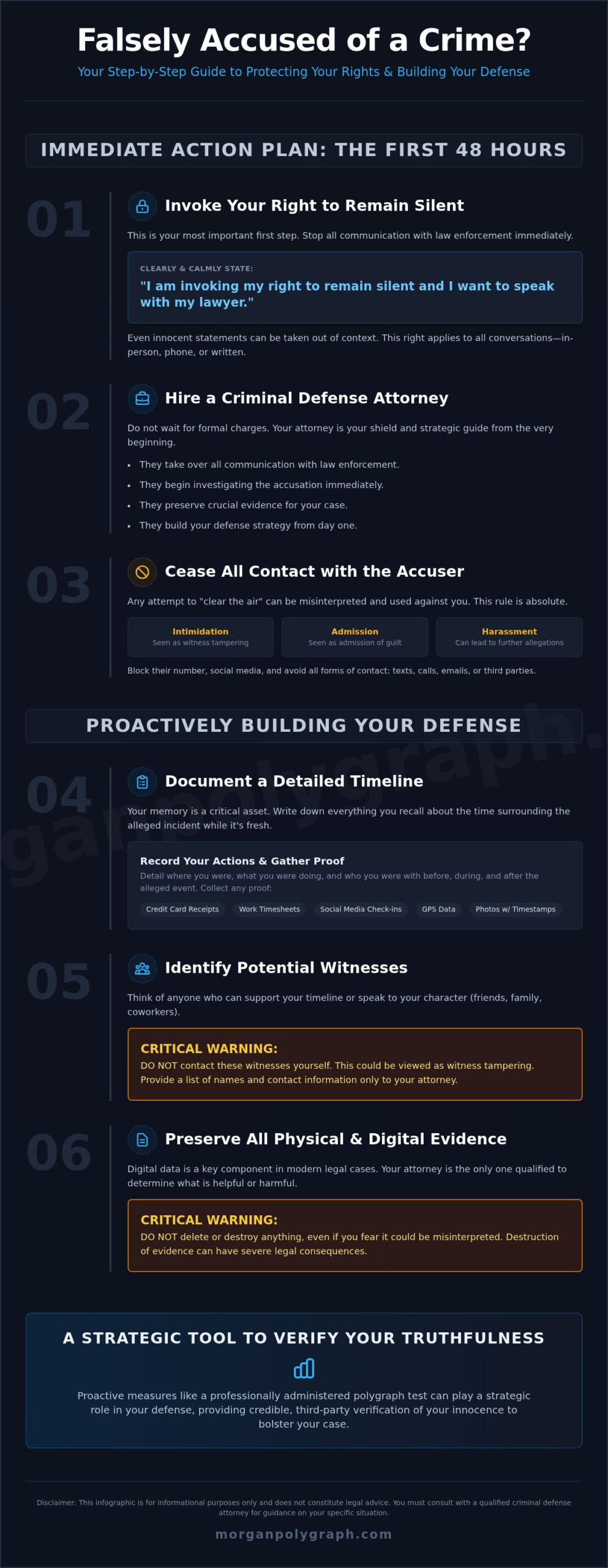
Your Immediate Action Plan: The First 48 Hours
Being falsely accused of a crime is a shocking and terrifying experience. Your first instinct may be to panic, but the next 48 hours are absolutely critical. Calm, deliberate, and strategic action is your most powerful defense. If you find yourself wondering, when falsely accused of a crime what to do, this immediate action plan is your starting point. The steps you take now can profoundly impact the outcome of your case and protect your future.
Please note: This article is for informational purposes only and does not constitute legal advice. You must consult with a qualified criminal defense attorney for guidance on your specific situation.
Step 1: Invoke Your Right to Remain Silent
Your first and most important action is to stop talking. You must clearly and calmly state, “I am invoking my right to remain silent and I want to speak with my lawyer.” Do not try to explain your side of the story or prove your innocence to law enforcement. Police officers are professionally trained to elicit information, and even innocent statements can be twisted or taken out of context, potentially leading to a miscarriage of justice. This right applies to all forms of communication: in-person conversations, phone calls, and written correspondence.
Step 2: Hire a Criminal Defense Attorney Immediately
Do not wait until formal charges are filed. An experienced criminal defense attorney is your advocate, your shield, and your strategic guide through the complex legal system. The moment you suspect you are under investigation, you need professional legal counsel. Your attorney will immediately take over all communication with law enforcement, preventing you from making any accidental missteps. They can begin investigating the accusation, preserving evidence, and building your defense strategy from day one, placing you in the strongest possible position.
Step 3: Cease All Contact with the Accuser
You may feel a strong urge to contact the person who accused you to “clear the air” or understand their motives. Do not do this. Any attempt at contact can be misinterpreted and used against you. It could be framed as:
- Intimidation or witness tampering
- An admission of guilt
- Harassment
This rule is absolute and includes text messages, phone calls, emails, social media interactions, and any communication through third parties. Block their phone number and social media profiles to remove any temptation and protect yourself from further allegations.
Building Your Defense: How to Gather Evidence and Information
Once you have secured professional legal counsel, your role shifts from reacting to the accusation to proactively building your defense. This is a critical phase where your memory and personal records become invaluable assets. When you are falsely accused of a crime what to do first is methodically organize information. Your attorney will guide this process, but the initial work you do can provide the foundational facts and timelines needed to challenge the prosecution’s narrative and establish your innocence.
Document a Detailed Timeline
Your memory is the first and most critical piece of evidence. While events are still fresh, write down everything you can recall about the time surrounding the alleged incident. Be as specific as possible. This detailed account will serve as the backbone of your defense and help your attorney identify inconsistencies in the accusations against you. This documentation forms the basis of a potential alibi.
- Record Your Actions: Detail where you were, what you were doing, and who you were with, not just at the time of the alleged event, but for the hours before and after.
- Gather Corroborating Proof: Collect any items that can verify your location and activities. This includes credit card receipts, work time-sheets, social media check-ins, GPS data from your phone, or photos with timestamps.
Identify Potential Witnesses
Think carefully about anyone who can support your timeline or speak to your character. This list may include friends, family, coworkers, or even acquaintances who saw you at a specific time and place. It is imperative that you do not contact these potential witnesses yourself. Discussing the case could be misconstrued as witness tampering. Instead, provide a comprehensive list of names and contact information to your attorney. Your legal team is trained to interview them in a legally sound manner that preserves their credibility for trial.
Preserve All Physical and Digital Evidence
In today’s digital world, electronic data is often a key component of any legal case. It is essential that you preserve everything, even if you fear it could be misinterpreted. Your attorney is the only person qualified to determine what is helpful or harmful to your case. The most important rule when falsely accused of a crime what to do with evidence is to not destroy it. This meticulous preservation is a cornerstone of a sound legal strategy and protects your fundamental rights, which are upheld by federal bodies such as the Department of Justice Civil Rights Division. Make sure to:
- Avoid Deletions: Do not delete any text messages, emails, voicemails, or social media posts and direct messages.
- Save Everything: Keep all relevant documents, photos, and videos. Make complete backups of your phone and computer data to a separate hard drive.
Proving Your Innocence: The Strategic Role of a Polygraph Test
When you are falsely accused of a crime, what to do next can feel overwhelming. While your legal team builds a defense, you may want to take proactive steps to demonstrate your truthfulness. A professional polygraph examination is a powerful, confidential tool used to measure and record physiological responses to a series of questions, providing a clear indication of deception or truthfulness. It is a strategic decision that should only be made in close consultation with your attorney.
How a Polygraph Supports Your Case
A passed polygraph test does more than just confirm your story; it becomes a strategic asset for your defense. It provides your attorney with objective confidence in your account, allowing them to sharpen their focus on the strongest aspects of your case. Furthermore, your legal counsel can leverage these favorable, confidential results in pre-trial negotiations with prosecutors. This can often be the catalyst needed to encourage a dismissal of charges, resolving the matter before it ever reaches a courtroom.
Addressing Polygraph Accuracy and Admissibility
Modern, computer-based polygraph examinations, when conducted by a certified and experienced examiner, are highly accurate. While it is true that polygraph results are often not admissible as direct evidence in many courtrooms, their influence extends far beyond the trial itself. The goal is frequently to prevent a trial altogether. Organizations like The Innocence Project have shown the devastating impact of wrongful convictions, underscoring the need to use every credible tool to establish the truth early. Favorable polygraph results are regularly used in:
- Plea negotiations with the prosecution
- Sentencing recommendations
- Internal investigations by law enforcement or employers
Choosing a Certified and Professional Examiner
The credibility of your polygraph results is directly tied to the qualifications of the examiner. Not all practitioners are equal. It is essential to seek an expert with extensive experience in criminal defense cases who holds national certifications. A court-recognized expert provides an added layer of authority that prosecutors respect. The process must be professional, discreet, and completely confidential to protect your legal interests. Consult with our certified examiners to support your legal strategy.
Navigating the Process: What to Expect Legally and Emotionally
Facing a false accusation is a marathon, not a sprint. The legal process can be lengthy and complex, creating significant uncertainty. When you are falsely accused of a crime, what to do extends beyond legal strategy; it involves managing the immense emotional and social pressure. Understanding the road ahead is the first step toward regaining control.
Interacting with Law Enforcement (Through Your Lawyer)
Once you have retained legal counsel, all communication with investigators must be filtered through them. This creates a professional barrier that protects your rights and prevents misinterpretation. Your lawyer is your sole spokesperson. Follow these professional guidelines without exception:
- Defer All Questions: Direct any and all inquiries from law enforcement to your attorney. Simply state, “I am not answering any questions without my lawyer present.”
- Deny All Searches: Never give consent to a search of your home, vehicle, person, or electronic devices. Law enforcement must produce a valid warrant.
- Consult on All Requests: If asked for DNA, fingerprints, or other samples, do not agree. Your lawyer will advise you on the legal requirements and appropriate response.
- Remain Calm and Silent: Maintain a respectful demeanor, but exercise your right to remain silent. Firm, quiet confidence is your strongest position.
Managing the Emotional and Social Fallout
The personal toll of a false accusation can be devastating. It is crucial to proactively manage your well-being to endure the stress of the legal battle. Feelings of anger, betrayal, fear, and isolation are normal and should be acknowledged. A deliberate strategy for your mental health is non-negotiable.
- Limit Your Circle: Confide only in a small, trusted group of individuals. Discussing the case details widely can be harmful to your defense and your emotional state.
- Avoid Social Media: Completely refrain from posting about the accusation, your case, or your feelings online. Anything you post can be used against you.
- Seek Professional Support: Consider speaking with a therapist or counselor. A neutral, professional expert can provide invaluable coping strategies for the immense stress you are under.
Successfully navigating a false accusation requires a dual focus: a robust legal defense and a resilient personal support system. Your legal team will handle the official proceedings, but proactively protecting your mental health is a critical part of knowing what to do when falsely accused of a crime. For those seeking to add a layer of truth verification to their defense strategy, a confidential polygraph examination can be a powerful tool. Learn more about our professional, compassionate services at morganpolygraph.com.
Your Next Steps Toward Proving Your Innocence
Being wrongly accused is a daunting experience. The most critical takeaways are to remain calm, exercise your right to silence, and immediately begin documenting everything. Understanding the steps for when you are falsely accused of a crime what to do transforms fear into focused action, empowering you to build a strong defense from day one.
As part of your proactive defense strategy, verifying your truthfulness can be a powerful tool. A professionally administered polygraph test provides credible, compelling evidence of your innocence, offering clarity to your legal team and the authorities.
With over 40 years of combined experience, our court-recognized polygraph experts at Morgan Polygraph offer a completely confidential and professional service. When you need to prove your truthfulness, contact Morgan Polygraph for a confidential consultation.
You are not alone in this fight. By taking deliberate, informed steps, you can navigate this challenge and work towards clearing your name. The truth is a powerful asset; let us help you demonstrate it.
Frequently Asked Questions
Can I be arrested based on an accusation alone?
Yes, an accusation can be sufficient for law enforcement to establish “probable cause,” which is the legal standard required to make an arrest. While an accusation by itself is not enough to secure a conviction, it is a serious matter that can initiate the criminal justice process. It is critical to treat any accusation with the utmost seriousness from the very beginning, as it can quickly lead to formal charges and a challenging legal battle.
What should I do if the police show up at my home or workplace?
You must remain calm, be polite, and do not physically resist. You have the right to remain silent; clearly and respectfully state, “I am exercising my right to remain silent and I wish to speak with an attorney.” Do not answer questions, offer explanations, or consent to any searches of your property without a warrant. Politely ask if you are free to leave. If not, say nothing more until your legal counsel is present.
How much does it cost to hire a criminal defense attorney?
The cost of a criminal defense attorney varies significantly based on the complexity of your case, the attorney’s level of experience, and your geographic location. Attorneys may charge a flat fee, an hourly rate, or require an upfront retainer that they bill against. Many respected defense attorneys offer a confidential, no-cost initial consultation to discuss the specifics of your case and provide a clear fee structure, which is essential for understanding your financial commitment.
Is a polygraph test admissible as evidence in an Idaho court?
In Idaho, the results of a polygraph examination are generally not admissible as direct evidence in court proceedings to prove guilt or innocence. However, a professionally administered polygraph test is a powerful strategic tool. Favorable results can be used by your attorney during negotiations with prosecutors, potentially influencing a decision to reduce or dismiss charges before a trial ever begins. It serves as a critical component of a proactive and comprehensive defense strategy.
How can I prove my alibi if I was alone at the time?
When you’re falsely accused of a crime what to do to prove an alibi can feel daunting if you were alone. Your attorney can help uncover indirect, corroborating evidence. This includes digital footprints like phone GPS data, social media timestamps, or credit card and ATM records showing transactions elsewhere. We also investigate potential surveillance footage from nearby businesses, traffic cameras, or doorbells that might place you away from the scene at the critical time.
Can I sue the accuser for defamation or malicious prosecution after I’m exonerated?
Yes, pursuing a civil lawsuit for defamation or malicious prosecution is a potential option after you are fully exonerated of all charges. However, the legal standards for these claims are exceptionally high. You must prove the accuser knowingly made false statements that caused harm (defamation) or initiated the case with malice and without probable cause (malicious prosecution). You should consult a civil litigation attorney to evaluate the specific merits of your potential case.