

A false accusation is one of the most frightening and isolating experiences a person can face. The legal system, with its complex rules and intimidating procedures, can feel like an insurmountable obstacle, leaving you feeling powerless and overwhelmed. When the thought, “I need to prove my innocence in court,” becomes an all-consuming weight, the fear that your side of the story will be lost is very real and understandable.
However, it is crucial to understand that you are not without power. Taking control of your situation begins with knowledge and a methodical strategy. This professional guide is designed to cut through the confusion and provide you with the expert guidance you need. We will walk you through clear, actionable steps to navigate the legal process, understand your fundamental rights, and build a strong, credible defense. Our goal is to empower you with the information necessary to fight the accusation, successfully clear your name, and restore your reputation.
The First Principle: Understanding ‘Innocent Until Proven Guilty’
When you are accused of a crime, the immediate emotional response is often panic. The feeling that you need to prove my innocence in court right away can be overwhelming. However, the first and most critical step in building a defense is to understand that this feeling, while completely natural, is not how the American legal system operates. The entire structure is built upon a principle designed to protect the accused.
This foundational legal concept, often referred to as the presumption of innocence, is a shield. The core tenet of Innocent Until Proven Guilty dictates that the government-the prosecution-carries the full responsibility of proving its case against you. Your initial role is not to prove your innocence, but to hold the prosecution to its high standard of proof. Understanding this shifts your mindset from one of panic to one of strategic defense.
What ‘Burden of Proof’ Really Means
The “burden of proof” rests entirely on the prosecution’s shoulders. This is a fundamental right that ensures the state, with all its resources, cannot secure a conviction on weak or incomplete evidence. For you, this means:
- The prosecution must present credible, convincing evidence for every element of the crime they allege you committed.
- You are not required to testify, present evidence, or prove anything at all. Your silence cannot be used against you.
- The primary job of your legal team is to challenge, question, and scrutinize the prosecution’s evidence to expose weaknesses and create doubt.
Defining ‘Beyond a Reasonable Doubt’
The prosecution must not only present evidence but must prove your guilt “beyond a reasonable doubt.” This is the highest standard of proof in the legal system and is intentionally difficult to meet. It does not mean a faint or imaginary doubt; it means a doubt based on reason and common sense after careful and impartial consideration of all the evidence. A mere suspicion or a high probability of guilt is not enough. Your defense strategy will be expertly designed to highlight any gaps, inconsistencies, or alternative explanations that create this level of doubt in the mind of a juror.
Your Immediate Action Plan: The First 72 Hours
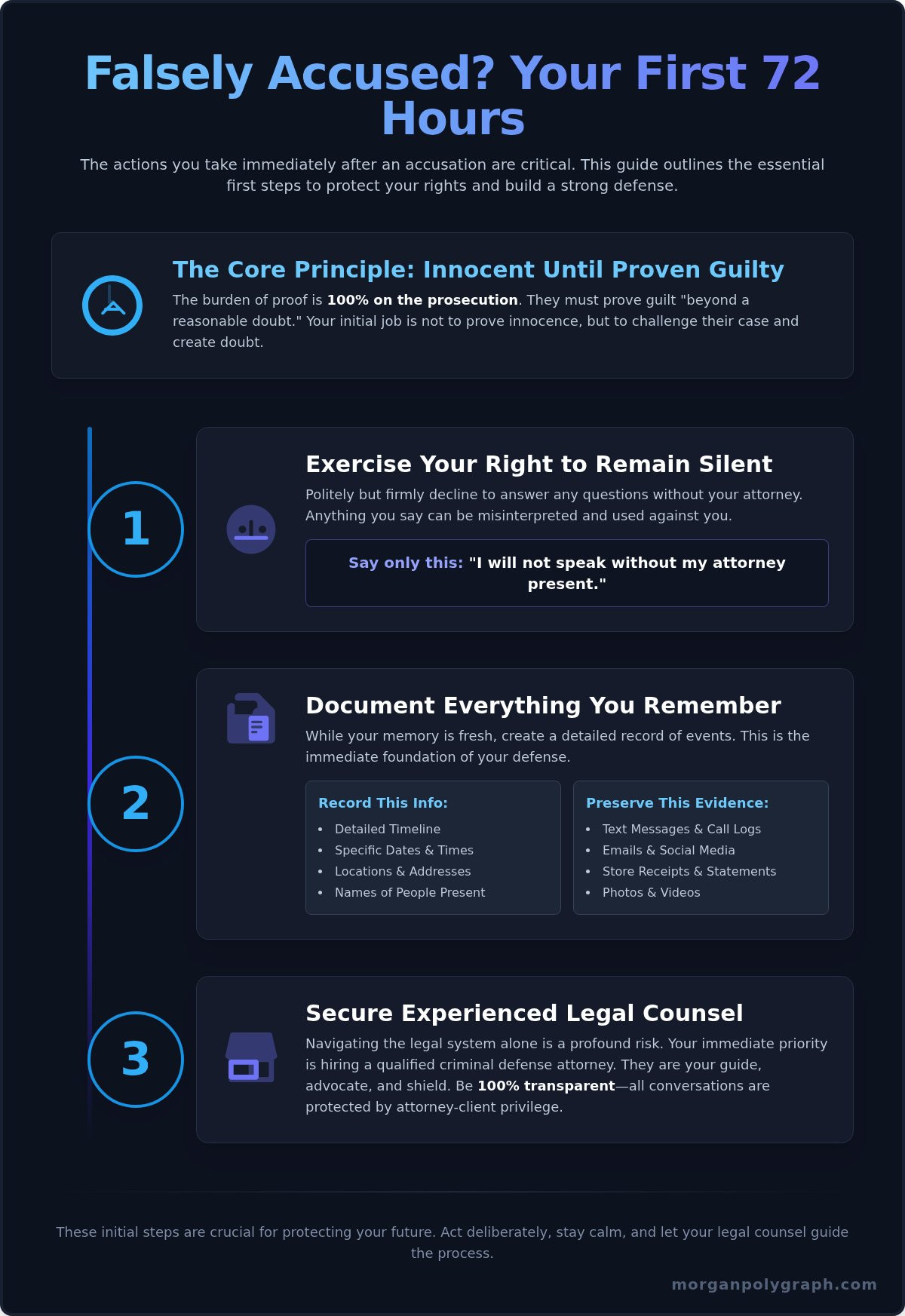
When you are faced with a serious accusation, the actions you take in the first 72 hours are critically important. This is not the time for emotional reactions or panicked decisions. Instead, it is a period for calm, deliberate action focused on two primary goals: protecting your legal rights and preserving crucial information. How you navigate this initial phase can significantly impact the entire legal process. The common mistakes people make at this stage often stem from a desire to explain themselves, but this can unintentionally harm their case. Following a structured plan is your best defense from the very beginning.
Step 1: Exercise Your Right to Remain Silent
Your most fundamental right upon being questioned by law enforcement is the right to remain silent. You must exercise it. Politely but firmly decline to answer any questions, provide a statement, or engage in informal conversation without your attorney present. Anything you say, no matter how innocent your intentions, can be misinterpreted, taken out of context, and used against you. This applies to formal interrogations and casual chats alike. The only thing you need to say is, “I will not speak without my attorney present.”
Step 2: Document Everything You Can Remember
While your memory is fresh, write down a detailed timeline of events related to the accusation. Be as specific as possible with dates, times, locations, and the names of anyone you were with. This personal record is the immediate foundation of your defense. Your attorney will later handle the formal legal process of Gathering Evidence to Create Doubt from the prosecution, but your own records are invaluable. Preserve any physical or digital evidence you have, including:
- Text messages and call logs
- Emails and social media messages
- Store receipts or credit card statements
- Photos or videos with timestamps
This information is vital for establishing an alibi and providing your legal team with the facts they need.
Step 3: Secure Experienced Legal Counsel
If you feel you need to prove my innocence in court, attempting to navigate the criminal justice system alone is a profound risk. Your immediate priority must be to hire a qualified criminal defense attorney with experience in cases like yours. A good lawyer is more than just a representative; they are your guide, your advocate, and your shield. Be completely honest and transparent with your attorney, as everything you discuss is protected by attorney-client privilege. They cannot build the strongest possible defense without all the facts.
Building Your Defense: Gathering Evidence to Create Doubt
In the American legal system, the burden of proof rests entirely on the prosecution. However, waiting passively for them to fail is a high-risk strategy. A proactive defense is your most powerful tool. When you are in a position where you feel you need to prove my innocence in court, the first steps you take are critical. Collaborating closely with your legal counsel to gather evidence is essential, and following Your Immediate Action Plan can set the stage for a successful outcome. The objective is clear: to systematically dismantle the prosecution’s narrative and introduce reasonable doubt at every turn.
Establishing an Alibi
An alibi is a definitive piece of evidence proving you were physically elsewhere when the crime occurred. Work with your attorney to compile any proof of your whereabouts, such as time-stamped receipts, GPS data from your phone or vehicle, social media check-ins, photographs, and witness accounts. Even a partial alibi that contradicts the prosecution’s timeline can create significant doubt. It is imperative to provide all potential alibi information to your lawyer immediately.
Identifying Favorable Witnesses
Think carefully about anyone who can support your version of events or attest to your character. This can include individuals who were with you at the time of the alleged crime or character witnesses who can speak to your integrity and reputation. Your legal team is professionally trained to vet, interview, and prepare these potential witnesses for court. To preserve the integrity of their testimony, you must not contact them yourself; let your attorney manage all communication.
Challenging the Prosecution’s Evidence
A cornerstone of a strong defense is scrutinizing the evidence presented against you. Your attorney will meticulously examine the police investigation for any flaws, such as improper evidence handling, chain of custody errors, or other procedural violations. They may also work to discredit the prosecution’s witnesses by exposing inconsistencies in their testimony or questioning their motives. Contradictory physical or forensic evidence is an exceptionally powerful tool when you need to prove my innocence in court.
Ultimately, building a robust defense is about creating a compelling counter-narrative supported by credible evidence. In certain cases, a professionally administered polygraph exam can be a valuable tool used by your attorney to add a layer of verification to your statements or alibi. To learn more, contact a certified expert at morganpolygraph.com.
A Proactive Strategy: The Role of a Polygraph Examination
When facing the justice system, the feeling that “I need to prove my innocence in court” can be overwhelming. While evidence and testimony are the cornerstones of any defense, sometimes you need a powerful tool to proactively signal your truthfulness. A voluntary, confidential polygraph examination, conducted in coordination with your attorney, is not a magic bullet but a strategic asset. It demonstrates a profound confidence in your innocence and a willingness to submit your statements to objective, professional scrutiny.
How a Polygraph Can Support Your Case
Passing a professionally administered polygraph examination can provide significant advantages, particularly before a trial ever begins. The results serve as a powerful tool for your legal team, offering concrete benefits that can fundamentally alter the course of your case.
- Leverage in Negotiations: A favorable result provides your attorney with compelling evidence of your truthfulness, which can be used as leverage in plea negotiations or discussions with the prosecution.
- Influencing Prosecutorial Decisions: Presented correctly by your counsel, a passed polygraph can introduce doubt and may persuade prosecutors to reconsider the strength of their case, potentially leading to reduced or even dismissed charges.
- Guiding Defense Strategy: The verified results confirm your account of events, allowing your defense team to build its strategy with a higher degree of confidence and focus.
- Adding Weight to Your Testimony: While the results themselves may not be presented to a jury, they add significant weight to your personal testimony and statements in all pre-trial phases.
The Process of a Professional Polygraph
A credible polygraph is a precise and methodical procedure. The examination is always conducted by a certified and experienced examiner in a controlled, professional setting. Critically, this is a completely confidential process between you, your attorney, and the examiner, ensuring the results are protected by attorney-client privilege. Before the test, the examiner will review every question with you, ensuring they are clear, specific, and directly focused on the core issues of the case. Discuss a confidential polygraph with a court-recognized expert to understand how this process can be tailored to your specific situation.
Admissibility in Court and Strategic Use
It is important to understand that polygraph results are not automatically admissible as evidence in most U.S. courts. However, they can sometimes be admitted if both the prosecution and defense agree to it beforehand-a legal arrangement known as a stipulation. The primary power of a polygraph, therefore, is often pre-trial. It is a strategic tool used to influence case direction and negotiations. This is a critical decision that should never be made without the thorough guidance and consent of your legal counsel.
Your Path Forward: Proving Your Innocence with Confidence
Facing a false accusation is a daunting experience, but your defense begins with understanding your rights and taking immediate, strategic action. Remember the key takeaways: act swiftly in the first 72 hours, diligently gather all evidence that supports your case, and consider proactive measures to demonstrate your truthfulness. When you feel the overwhelming pressure that you need to prove my innocence in court, a decisive strategy is your strongest ally.
A confidential polygraph examination can be a pivotal element of this strategy, providing credible, third-party verification to support your testimony. At Morgan Polygraph, our nationally certified and court-recognized examiners bring over 40 years of combined experience to your case. We provide a professional, compassionate, and discreet service designed to give you a powerful tool for your defense.
Facing a false accusation? Contact Morgan Polygraph for a confidential consultation.
You do not have to navigate this challenge alone. Taking control of your narrative is the first step toward clearing your name and securing your future.
Frequently Asked Questions
What if I can’t afford a criminal defense attorney?
The U.S. Constitution guarantees your right to legal representation. If you cannot afford an attorney, you can request a court-appointed lawyer, often called a public defender. During your first court appearance, you will have an opportunity to inform the judge of your financial situation. The court will typically require you to complete a financial affidavit to verify your eligibility. This process ensures everyone has access to professional legal defense regardless of their ability to pay.
Can the court force me to take a lie detector test?
No, a court cannot compel you to undergo a polygraph examination. The Fifth Amendment protects your right against self-incrimination, meaning you cannot be forced to provide evidence that could be used against you. The decision to take a polygraph test is entirely voluntary. It is a strategic tool that you and your legal team may choose to utilize as part of your defense, but it is never a mandatory procedure imposed by the court.
How do I find a reputable polygraph examiner for my case?
To find a credible examiner, verify their credentials and specific experience. Look for certification from respected organizations like the American Polygraph Association (APA) or the National Polygraph Association (NPA). Inquire about their background in criminal defense cases and whether they are recognized as an expert witness in court. A reputable professional will use validated testing techniques and provide a transparent, confidential process. Always consult your attorney before scheduling an examination to ensure it aligns with your legal strategy.
What’s the difference between being ‘charged’ and being ‘convicted’?
Being ‘charged’ with a crime is a formal accusation by the prosecution, indicating they believe enough evidence exists to proceed to trial. It is the start of the legal process, during which you are presumed innocent. A ‘conviction’ is the final outcome where a judge or jury has found you guilty beyond a reasonable doubt, or you have entered a guilty plea. Understanding this distinction is fundamental to navigating the criminal justice system effectively.
How long does the process of proving innocence in court typically take?
The timeline varies significantly based on the case’s complexity, the court’s schedule, and the specific jurisdiction. A simple misdemeanor might be resolved in a few months, while a complex felony can take over a year. Factors like evidence discovery, pre-trial motions, and trial scheduling all impact the duration. There is no standard timeframe when you need to prove my innocence in court, but your attorney can provide a more accurate estimate based on your specific circumstances.
Should I talk to friends or post on social media about my case?
It is critically important that you do not discuss your case with anyone or post details on social media. Any statement you make can be discovered by the prosecution and potentially used against you in court, even if it is taken out of context. The only person you should discuss the specific details of your case with is your attorney. Maintaining strict confidentiality is a key part of a strong defense strategy and protects you from unintentional self-incrimination.