

When trust has been broken or a critical truth remains hidden, the thought of a polygraph test can feel like the only path to certainty. You’re facing a difficult situation, weighed down by suspicion and the fear that a wrong move could shatter a relationship permanently. This uncertainty leads to the critical question you are now considering: should I ask for a polygraph test? The idea offers a promise of clarity, but it also introduces a new layer of anxiety about the process, the accuracy of the results, and the potential fallout.
Making this decision requires more than an impulse; it demands careful, professional consideration. This comprehensive guide is designed to provide a clear, methodical framework for that process. We will help you navigate the complexities by exploring the pros and cons, outlining the crucial questions you must ask yourself first, and preparing you for the conversation. Our goal is to provide the expert insight needed to make a confident, informed choice and find a path toward resolution, with or without a polygraph.
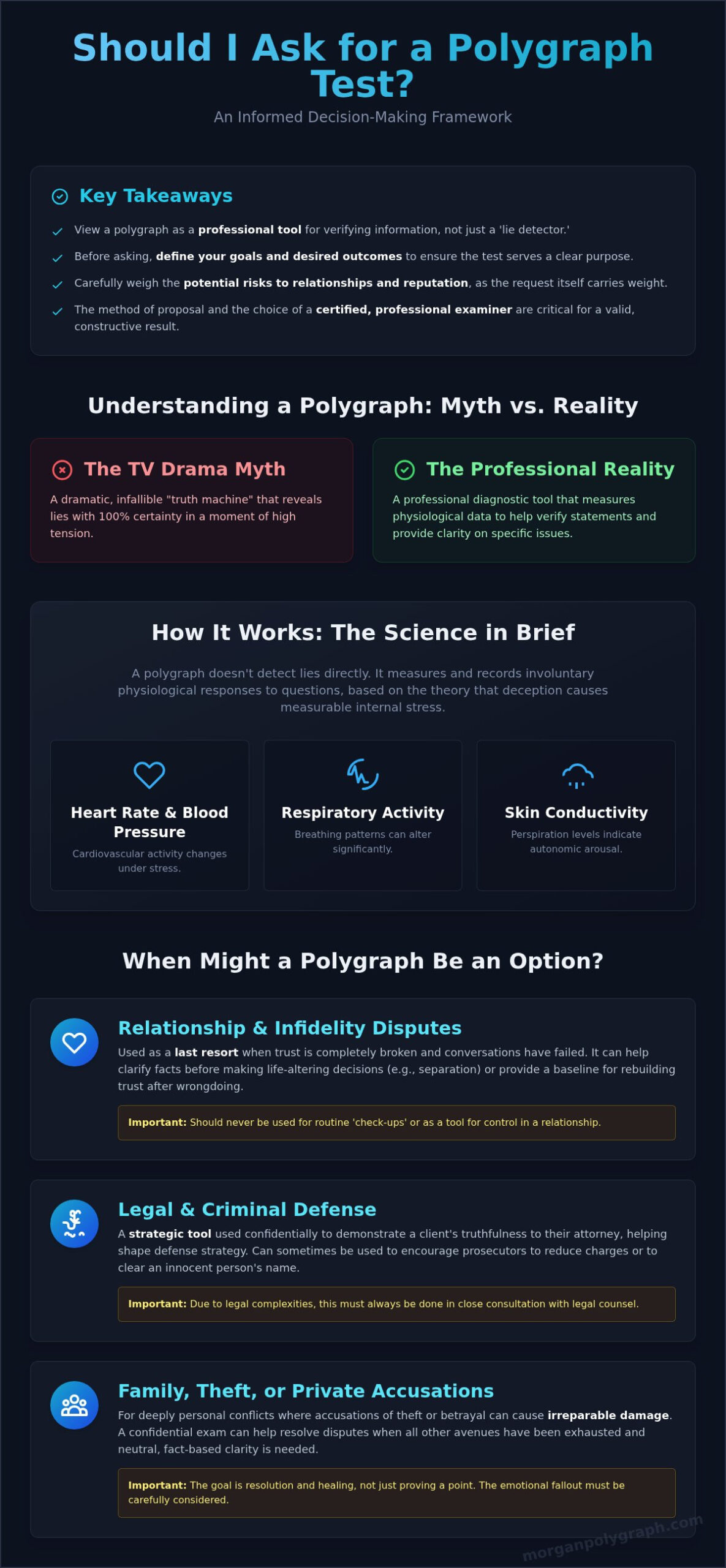
Key Takeaways
- Learn to view a polygraph not as a ‘lie detector,’ but as a professional tool that measures physiological responses to help verify information.
- Before deciding ‘should I ask for a polygraph test,’ work through a clear set of questions to define your goals and desired outcomes.
- Carefully weigh the potential risks to your relationships and reputation, as the request itself can have serious consequences.
- Discover how the way you propose the test and your choice of a certified examiner are critical for achieving a valid and constructive result.
Understanding the Purpose of a Polygraph Test (Beyond TV Dramas)
On television, a polygraph examination is often portrayed as a dramatic, infallible moment of truth. In reality, it is a professional diagnostic tool designed to verify statements and provide clarity on specific issues. It is not an absolute “truth machine,” but rather a highly effective method for assessing deception. The decision of whether you should I ask for a polygraph test requires moving beyond these cinematic depictions to understand its real-world application and limitations.
A polygraph provides a structured way to get closer to the truth, whether for legal, professional, or deeply personal reasons. Its value lies in its ability to corroborate information, narrow the focus of an inquiry, and provide data-driven insights where there was previously only suspicion or uncertainty. Setting realistic expectations is the first step toward using this tool effectively.
The Science in Brief: How It Works
A polygraph instrument does not detect lies; it measures and records involuntary physiological responses to a structured series of questions. A detailed overview of what a polygraph measures shows it tracks several key indicators simultaneously, including:
- Heart rate and blood pressure
- Respiratory activity
- Skin conductivity (perspiration)
The core theory is that the act of deception creates internal conflict and stress, which in turn causes distinct, measurable changes in these physiological systems. A certified and experienced examiner carefully designs the questions, conducts the examination, and then analyzes the resulting data charts to form a professional, expert opinion on the truthfulness of the answers provided.
Investigative Tool vs. Relationship Clarifier
The application of a polygraph test differs based on the context, but the fundamental goal of truth verification remains the same. In legal and official settings, it serves as a powerful investigative tool used by law enforcement, attorneys, and government agencies to validate claims, screen candidates, or focus an investigation. In these cases, the results help corroborate other evidence and guide strategic decisions.
In private matters, such as resolving accusations of infidelity or settling family disputes, the polygraph acts as a relationship clarifier. It offers a neutral, fact-based path to confirming suspicions or, just as importantly, rebuilding trust. Understanding these fundamentals is crucial when considering if you should ask for a polygraph test to resolve your specific situation.
Key Scenarios: When Asking for a Polygraph Might Be an Option
Deciding to use a polygraph is a significant step, often taken during periods of high stress and uncertainty. This section explores the most common situations where a professional polygraph examination is considered. It is not an endorsement for every case but rather an objective analysis of each context. Our goal is to help you identify if your circumstances fit a typical use case, as every scenario has unique considerations and potential outcomes.
For Relationship and Infidelity Disputes
When trust within a relationship is completely broken and all attempts at conversation have failed, a polygraph can serve as a final tool for truth verification. It is most appropriately used as a last resort to clarify specific facts before making life-altering decisions, such as separation or divorce. A professionally administered test can help confirm fidelity after a period of intense suspicion or an admission of past wrongdoing, providing a baseline for rebuilding trust. However, it is crucial to understand that a polygraph should never be used as a routine ‘check-up’ or a mechanism for control in a relationship.
For Legal and Criminal Defense Matters
In the legal arena, a polygraph examination is a strategic tool that must be handled with expert precision. It is often used confidentially to demonstrate a client’s truthfulness to their own attorney, helping to shape a robust defense strategy. The results can sometimes be used to encourage prosecutors to drop or reduce charges or to help clear an innocent person’s name during an investigation. Given the complexities of the legal system and the ongoing debate over the scientific basis of polygraph tests, any decision in this area must be made in close consultation with your legal counsel.
For Family, Theft, or Private Accusations
Within families or small businesses, accusations of theft or other betrayals can cause irreparable damage. In these deeply personal conflicts, the question of should I ask for a polygraph test often arises when all other avenues for resolution have been exhausted. A confidential exam can help resolve disputes over stolen money or property, refute a damaging false accusation, or bring clarity to sensitive issues like hidden substance abuse. It offers a structured, impartial method to address a specific, factual question when emotions are running high and objective truth is needed.
The Critical Questions to Ask Yourself Before You Ask Them
Before you ask someone to verify their truthfulness, you must first verify your own intentions. The decision to request a polygraph is significant, and the central question-should I ask for a polygraph test?-demands careful consideration of your own motivations first. This self-assessment serves as a professional framework for clear-headed decision-making. Answering these questions honestly will reveal if the test is a constructive step toward resolution or a destructive one, saving you from unintended emotional and relational damage.
What Is My Ultimate Goal?
A polygraph provides data, but your interpretation of that data is shaped by your objective. As certified experts, we advise clients to be clear about what they truly hope to achieve before scheduling an examination. Ask yourself:
- Are you seeking the objective truth, or are you looking for confirmation of what you already suspect?
- Is your primary goal to repair a damaged relationship with newfound trust, or is it to find justification to end it?
- Do you genuinely want clarity to move forward, or do you want to ‘win’ a dispute and be proven right?
Am I Prepared for Any Outcome?
A professional polygraph examination can produce one of three outcomes. You must have a clear and rational plan for each possibility before proceeding. A lack of preparation can lead to more conflict, regardless of the results.
- If they pass: Can you accept a “Deception Not Indicated” result and let the issue go completely? Lingering doubt after a pass will defeat the purpose of the test.
- If they fail: What are your next steps? A “Deception Indicated” result requires a pre-determined, thoughtful response, not an immediate emotional reaction.
- If results are inconclusive: This is a possibility. Will you be back at square one, potentially with more suspicion than before?
Have All Other Options Been Exhausted?
A polygraph should never be the first step in resolving a personal conflict. It is a tool for truth verification, not a substitute for difficult conversations. Before considering this option, ensure you have made a genuine effort with other methods like open communication, professional counseling, or mediation. Even in highly structured environments, the limitations of the tool are acknowledged; for instance, congressional hearings on polygraph use in employee screening have highlighted scientific skepticism, underscoring that it is a serious measure, not a simple solution. Using a polygraph as a shortcut to avoid a painful discussion is often counterproductive.
The Potential Risks and Downsides of Requesting a Polygraph
Deciding to request a polygraph is a significant act with serious implications. While it can be a powerful tool for truth verification, it is not without potential negative outcomes. As professional, certified examiners, we believe that transparency about the limitations of polygraph testing is essential for our clients. Understanding these risks is a critical step in answering the question, “should I ask for a polygraph test?” This section addresses the most common concerns and potential downsides you must consider before proceeding.
The Possibility of Inaccurate Results
The first and most critical point to understand is that no polygraph examination is 100% accurate. While modern techniques conducted by an expert examiner yield high accuracy rates, errors can occur. It is vital to discuss the specific statistical accuracy with your examiner beforehand. Key possibilities include:
- False Positives: This occurs when a truthful individual fails the test. Factors like extreme anxiety, medical conditions, or even the fear of being disbelieved can sometimes influence physiological responses.
- False Negatives: This is a situation where a deceptive person passes the test. While less common with modern methods, it remains a possibility.
For these reasons, a polygraph result should always be considered one powerful piece of evidence, not the sole determinant of truth in any situation.
Irreparable Damage to Relationships
In personal matters, the very act of asking someone to take a polygraph can signal a complete and final loss of trust. Regardless of the outcome, the other person may feel deeply hurt, judged, and accused. This request can create a wound that may not heal, even if the individual agrees to the test and subsequently passes. The underlying trust issue that prompted the question may remain, as the relationship dynamic has been permanently altered from one of faith to one of verification.
Handling a Refusal
You must also prepare for the possibility that the other person will refuse. It is crucial to recognize that a refusal is not an automatic admission of guilt. There are many valid reasons a truthful person might decline, from resenting the accusation to fearing an inaccurate result. Before you decide if you should ask for a polygraph test, you must determine how you will interpret and react to a ‘no.’ A pre-planned, measured response is far better than an emotional reaction in the moment.
How to Propose a Polygraph Test Constructively
If you have moved past the initial question of should I ask for a polygraph test and have decided to proceed, your approach is paramount. The way you introduce the idea can determine whether it is perceived as an accusation or a genuine tool for resolution. The goal is to frame the test not as a confrontation, but as a mutual path toward clarity and rebuilding trust. This requires a calm demeanor, clear communication, and a significant degree of empathy for the other person’s perspective.
Framing the Conversation
Timing and tone are critical. Choose a private, calm moment for the discussion where neither of you feels rushed or cornered; ambushing someone will only create defensiveness. Frame your concerns using “I” statements to express your feelings, rather than “you” statements that sound like accusations. For example, say, “I am struggling with uncertainty and need help finding peace of mind,” instead of, “You are not being honest with me.” Explain that your goal is to find a way to clear the air for both of you, so you can move forward together.
Presenting it as a Neutral Process
To remove any sense of bias, it is essential to present the polygraph as an objective, third-party instrument for truth verification. When you are considering if you should ask for a polygraph test, planning for a neutral process can make the suggestion more acceptable. Propose a structured and fair approach that prioritizes integrity and respect for everyone involved.
Emphasize that you want to ensure the process is completely impartial by committing to the following steps:
- Using a Certified Examiner: Suggest engaging a certified, independent examiner who is respected in the professional community and has no connection to either party.
- Agreeing on Questions: Offer to have all test questions agreed upon by both of you beforehand to ensure they are fair, relevant, and focused on the specific issue at hand.
- Ensuring Confidentiality: Reassure the person that the process is entirely voluntary and that the results will be handled with absolute discretion.
A professional examination is designed to be a transparent and respectful experience. Learn about our confidential testing process to see how a structured, expert-led examination can provide the clarity you need.
Why a Certified, Professional Examiner Is Non-Negotiable
When you arrive at the decision, “should I ask for a polygraph test,” your focus must immediately shift to the most critical factor determining the outcome: the examiner. A polygraph instrument is merely a tool; its data is meaningless without the interpretation of a highly skilled, certified professional. The accuracy and validity of a truth verification exam rest almost entirely on the examiner’s training, experience, and ethical conduct.
Opting for an unqualified or inexperienced tester is a significant risk. It can produce inconclusive, inaccurate, or damaging results that undermine the very reason for seeking a test. This is not a service where you should look for the cheapest option. Investing in a proven expert protects the integrity of the process and ensures that all parties are treated with fairness and respect, leading to a result you can trust.
What to Look for in an Examiner
To ensure you receive a valid and professional examination, verify that your potential examiner meets these essential criteria:
- Accredited Certification: They must hold current membership and certification from nationally recognized organizations like the American Polygraph Association (APA) or the National Polygraph Association (NPA).
- Relevant Experience: The examiner should have extensive experience in your specific type of case, whether it involves legal matters, private family issues, or pre-employment screening.
- Modern Methodologies: They must use modern, computerized polygraph equipment and employ only validated, evidence-based testing techniques recognized within the industry.
The Morgan Polygraph Standard
At Morgan Polygraph, we provide an unparalleled level of expertise and professionalism. Our examiners are not only nationally certified but are also court-recognized experts in the field of truth verification. We adhere to the strictest ethical guidelines to ensure absolute confidentiality and integrity in every examination. We are committed to creating a professional, compassionate, and respectful environment for all clients. Verify our credentials and expertise to understand why individuals, attorneys, and businesses trust us to handle their most sensitive matters with precision and care.
Making Your Decision with Confidence and Clarity
Deciding to request a polygraph is a significant step that extends far beyond what is seen in media. It requires a clear understanding of your objectives, a careful weighing of the potential relational risks, and a commitment to a professional process. Ultimately, the answer to the question, should I ask for a polygraph test, rests on a thoughtful and informed evaluation of your specific circumstances and desired outcome.
You do not have to make this decision alone. When you need absolute certainty, leaning on proven expertise is critical. At Morgan Polygraph, our court-recognized, Nationally Certified Examiners bring over 40 years of combined professional experience to every case, guaranteeing strict confidentiality for all private matters.
Find the clarity you deserve. Schedule a Confidential Consultation to Discuss Your Situation and let our experts provide the professional guidance you need. Taking this step is a powerful move toward resolution and peace of mind.
Frequently Asked Questions
What happens if the person I ask refuses to take the polygraph test?
A refusal to take a polygraph test is not an admission of guilt, as an individual may have various personal or legal reasons for declining. You cannot legally compel someone to undergo testing in a private matter. However, the refusal can be an important factor in your personal or business decision-making process. A professional examiner can provide a confidential consultation to help you understand the implications of a refusal and discuss alternative paths to establishing the truth.
Are the results of a private polygraph test admissible in court?
In most jurisdictions, polygraph results are not automatically admissible as evidence in court proceedings. However, they can sometimes be admitted if both the prosecution and defense agree to it beforehand in what is known as a stipulation. Even when not used as direct evidence, the results can be a powerful strategic tool for plea negotiations, internal corporate investigations, or guiding legal strategy. Always consult with your legal counsel for advice specific to your case.
How accurate is a modern polygraph test when done by a certified examiner?
When conducted by a certified and experienced examiner using validated techniques, a modern polygraph is a highly accurate instrument. Extensive research validated by organizations like the American Polygraph Association consistently places the accuracy rate between 90% and 95%. This high degree of reliability is achieved through a combination of precise instrumentation, proper question formulation, and expert analysis of the physiological data, making it a trusted tool for verification.
Can someone who is telling the truth fail a polygraph test?
While uncommon, it is possible for a truthful person to fail a test, often due to extreme anxiety or other physiological factors. This is why the role of the examiner is critical. A professional examiner conducts a thorough pre-test interview to build rapport, reduce nervousness, and properly calibrate the instrument to the individual’s unique baseline responses. This meticulous process is designed to ensure that an examinee’s nervousness is not misinterpreted as deception, thereby minimizing the risk of an inaccurate result.
How much does a private polygraph test typically cost?
The cost for a professional private polygraph examination typically ranges from $400 to over $1,500. The final price is determined by factors such as the complexity of the case, the number of relevant questions required, the location, and the examiner’s credentials. This fee covers the extensive pre-test interview, the in-test data collection, professional analysis, and a confidential report of the findings. Be cautious of unusually low prices, as they may reflect a lack of experience or certification.
Who gets to decide the questions that are asked during the test?
The formulation of test questions is a collaborative process guided by the expertise of the certified examiner. You, the client, provide the specific incident or issue that needs to be resolved. The examiner then works with you to develop a set of clear, direct, and unambiguous questions. These questions must be structured according to strict scientific and professional standards to ensure the test is fair and produces a valid, interpretable result for accurate truth verification.
Is it better to take a private polygraph before agreeing to a police-administered one?
If you are debating should I ask for a polygraph test before a police-administered one, it is often a wise strategic decision. A private test is completely confidential; the results belong only to you and your attorney. This allows you to know the likely outcome in a controlled, low-pressure environment. It provides you and your legal counsel with invaluable information, empowering you to make a more informed decision about how to proceed with any law enforcement requests.