

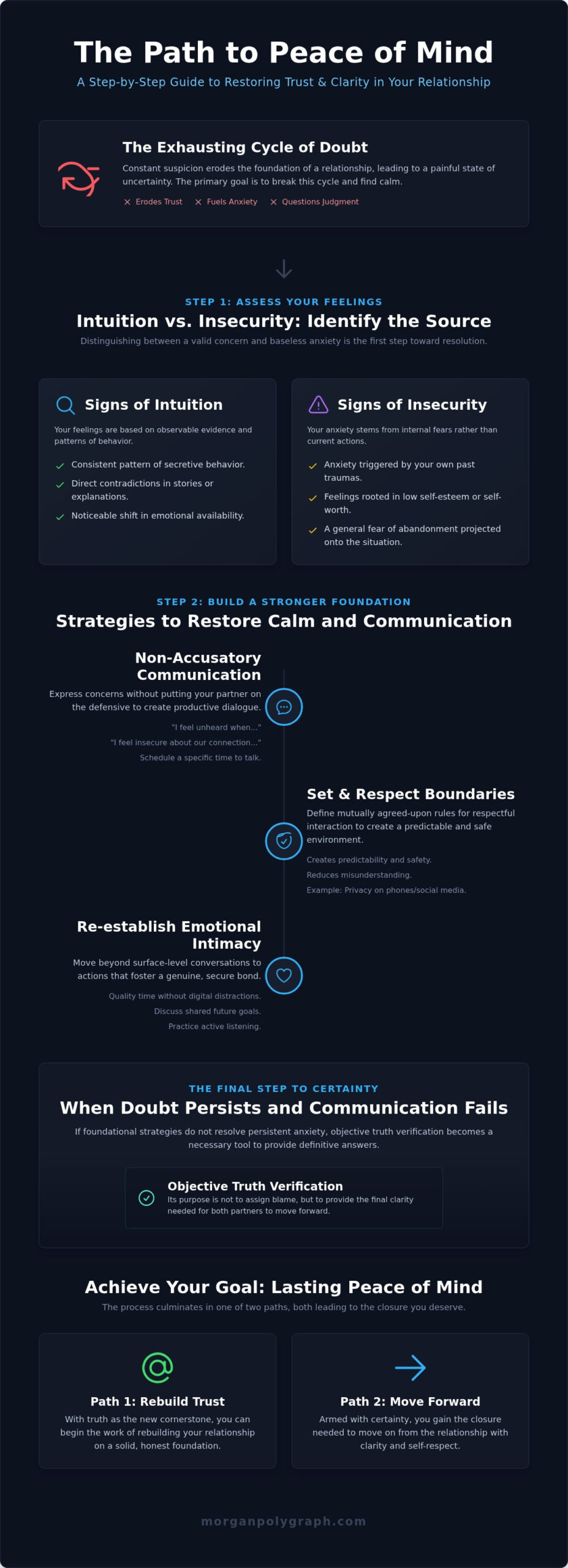
The constant cycle of doubt and suspicion in a relationship can be exhausting. It erodes trust, fuels anxiety, and can make you question your own judgment. For many, this state of uncertainty is more painful than knowing a difficult truth, and the primary goal becomes getting peace of mind in a relationship-a state that may currently feel unattainable.
This guide is designed to provide a clear, professional path forward. We understand the sensitive nature of these situations and will outline actionable steps to help you move from a state of constant overthinking to one of calm and clarity. You will learn how to approach difficult conversations, validate your feelings, and find the definitive answers you need. Our objective is to empower you with the tools to either rebuild trust on a solid foundation or move forward with the closure you deserve.
Key Takeaways
- Understand that true peace of mind is built on a foundation of trust, which must first be addressed through direct and honest communication.
- Discover the critical steps to take when communication alone fails to resolve persistent anxiety and suspicion about deception.
- Follow a structured guide for getting peace of mind in a relationship, moving methodically from interpersonal work to objective resolution.
- Recognize when objective truth verification becomes a necessary tool, not to assign blame, but to provide the final clarity needed to move forward.
What is ‘Peace of Mind’ in a Relationship and Why Is It So Fragile?
Peace of mind in a relationship is a state of profound emotional calm, security, and unwavering trust. It is the quiet confidence that you are safe, respected, and valued by your partner, free from persistent worry or suspicion. This state of emotional stability is central to understanding what relationship quality means and is a critical component for long-term satisfaction. However, this peace is exceptionally fragile. It can be eroded by triggers like past betrayals, ongoing secrecy, or unresolved conflicts, making the process of getting peace of mind in a relationship a deliberate and ongoing effort.
The Role of Trust as the Bedrock of Peace
Trust is the non-negotiable foundation upon which emotional security is built. When you trust your partner, you can be vulnerable without fear of being hurt or judged. This eliminates the exhausting need for constant verification, monitoring of communications, or questioning of their actions. Conversely, when trust is broken, it creates a destructive cycle of suspicion and anxiety. Every late text or changed plan becomes a potential threat, replacing calm with constant unease and preventing any genuine connection.
Differentiating Intuition from Insecurity
Distinguishing between a valid concern and baseless anxiety is a critical skill for maintaining your mental well-being. Your feelings may be rooted in intuition or insecurity, and identifying the source is the first step toward resolution. Consider the origin of your doubt:
- Signs of Intuition: Your feelings are often based on observable data, such as a consistent pattern of secretive behavior, direct contradictions in your partner’s stories, or a noticeable shift in their emotional availability.
- Signs of Insecurity: Your anxiety may stem from your own past traumas, low self-esteem, or a fear of abandonment that is not directly caused by your partner’s current actions.
To assess the source of your doubt, ask yourself: Is there concrete evidence supporting my fear, or am I projecting a past hurt onto my present situation? An honest answer is essential for getting peace of mind in a relationship and addressing the true problem, whether it lies with your partner’s behavior or your own internal struggles.
Foundational Strategies to Restore Calm and Communication
Before seeking external verification of trust, the essential first step is to strengthen the relationship’s internal framework. The process of getting peace of mind in a relationship begins not with suspicion, but with a commitment to improving communication and re-establishing a secure emotional base. This section provides a methodical approach to these foundational elements. By creating an environment where honesty and vulnerability can thrive, many doubts can be resolved professionally and respectfully before they escalate into significant issues.
Mastering Non-Accusatory Communication
Productive dialogue is the cornerstone of a healthy partnership. The objective is to express your concerns without putting your partner on the defensive. This requires a shift from blame to vulnerability. Key techniques include:
- Using ‘I feel’ statements: Instead of saying, “You never listen,” try, “I feel unheard when we discuss this topic.” This frames the issue around your emotional response, not an accusation of their intent.
- Expressing fear directly: Clearly state your anxieties without attacking. For example, “I feel insecure about our connection,” is more constructive than, “You are being distant.”
- Scheduling conversations: Set a specific, neutral time and place for difficult discussions. This ensures both partners are prepared and can engage without distractions or emotional escalation.
Setting and Respecting Healthy Boundaries
Boundaries are not barriers; they are mutually agreed-upon rules that define respectful interaction. They create a predictable and safe environment, which reduces opportunities for misunderstanding and resentment. Clearly communicating your boundaries is a critical step. For example, define what is and isn’t acceptable regarding personal privacy on phones or social media accounts. Respecting these lines is a fundamental component of many expert-backed strategies for building trust and demonstrates a commitment to your partner’s comfort and security.
Re-establishing Emotional Intimacy
A loss of peace often stems from a breakdown in emotional connection. Rebuilding this requires moving beyond surface-level conversations about daily logistics. Focus on actions that foster genuine intimacy. This includes dedicating quality time without digital distractions, discussing shared future goals, and actively listening to your partner’s deeper thoughts and feelings. Remember that small, consistent actions-like a meaningful compliment or a gesture of support-are often more powerful for restoring a secure bond than infrequent grand gestures.
When Doubt Persists: Addressing the Unspoken Fear of Deception
You have tried to talk. You have attempted to apply effective communication strategies, but the gnawing feeling of anxiety remains. This is a critical juncture in any partnership-the point where unresolved suspicion begins to erode the foundation of your connection. Living with this constant uncertainty takes an immense emotional and physical toll, and it is a clear signal that, in some situations, words alone are not enough to restore trust.
Recognizing the Subtle Signs of Dishonesty
When intuition conflicts with a partner’s words, it is often because you are subconsciously observing behaviors that signal a problem. These are not definitive proof, but they are valid reasons for concern:
- Behavioral Changes: Sudden secrecy with phones or computers, unexplained alterations in daily routines, or unusual defensiveness when asked simple, direct questions.
- Inconsistent Narratives: Stories that do not add up, a persistent lack of specific details when recounting events, or key facts that change with each telling.
- Gaslighting Tactics: A partner’s attempts to make you question your own memory, perception, or sanity, often with dismissive phrases like, “You’re imagining things” or “You’re being too sensitive.”
The High Cost of Living in Limbo
The chronic stress of not knowing the truth is profoundly damaging. This state of limbo can manifest in anxiety, depression, sleeplessness, and a weakened immune system. For the relationship itself, unresolved suspicion is a corrosive force that destroys intimacy, respect, and emotional safety for both individuals. In many cases, the persistent fear of what you might discover causes more profound suffering than confronting the reality, whatever it may be. The path to getting peace of mind in a relationship requires confronting this limbo directly.
Moving Beyond ‘Just Trust Me’
When your intuition is screaming that something is wrong, the phrase “Just trust me” can feel deeply invalidating. While you may have taken expert-recommended steps to improve communication in your relationship, verbal reassurances become hollow when they are not supported by transparent actions. When trust has been severely compromised, it is entirely valid to require more than words to rebuild a stable foundation. True peace of mind cannot be built on promises that conflict with observable reality. When a partner’s reassurances fail to align with the evidence, a professional, confidential truth verification process can provide the clarity needed for genuine resolution.
The Final Step to Certainty: How Truth Verification Can Provide Peace
You have communicated, sought counseling, and tried to rebuild trust, but a persistent, painful doubt remains. When all other methods have been exhausted, the path to peace may require a definitive, objective answer. Truth verification, when approached as a collaborative tool for resolution rather than an accusation, can provide the finality needed to move forward. The goal is not to assign blame, but to end the exhausting cycle of suspicion and uncertainty, which is the ultimate barrier to getting peace of mind in a relationship.
What is a Relationship Polygraph Test?
A relationship polygraph is a professional, fact-finding process designed to resolve specific, lingering doubts with clarity and discretion. It is not an interrogation, but a carefully structured examination focused on confirming truthfulness. Key aspects include:
- Confidential Process: The entire examination, from consultation to results, is held in the strictest confidence to protect your privacy.
- Agreed-Upon Questions: The test focuses only on specific, pre-determined questions that both partners have agreed upon beforehand.
- Certified Administration: A certified, impartial examiner conducts the test to ensure professional standards and maximum accuracy.
The Process: Creating a Path to Clarity Together
A successful truth verification test is built on transparency and mutual agreement. The process is designed to be a controlled, respectful, and non-confrontational experience. Both partners work with the examiner to formulate the questions, ensuring there are no surprises. This collaborative approach provides the honest partner with a concrete opportunity to demonstrate their integrity, while giving the questioning partner the reassurance they need. The focus remains squarely on resolution, not recrimination.
After the Test: Rebuilding on Truth or Moving on with Closure
Regardless of the outcome, a professional polygraph examination provides a definitive end to uncertainty. If truthfulness is confirmed, it lays a solid, verified foundation upon which trust can be genuinely rebuilt. If deception is detected, it provides the painful but necessary clarity to make informed decisions about the future. Either result empowers you to stop guessing and start healing. Ending the unknown is the most critical step toward getting peace of mind in a relationship, allowing you to either repair your bond or move on with closure. Learn more about our confidential relationship testing process.
Your Path to Certainty and Peace of Mind
The journey toward getting peace of mind in a relationship is a profound one. It starts with building a foundation of trust through open communication and honest self-reflection. However, when persistent doubt takes root, it can overshadow everything, making true connection feel impossible. When you have exhausted all other avenues and require a definitive answer to either rebuild or move forward with confidence, a final step toward truth may be necessary.
At Morgan Polygraph, our professional truth verification process is designed to provide that clarity with the utmost integrity. The examinations are conducted by nationally certified and court-recognized examiners in a completely confidential and discreet environment. We are committed to ensuring every client is treated with compassion and respect, providing a supportive experience during a sensitive time.
You do not have to live with the weight of uncertainty. End the uncertainty. Schedule a confidential consultation to find your peace of mind. Taking this step is a powerful move toward reclaiming your emotional well-being and future happiness.
Frequently Asked Questions
Is it a sign of a toxic relationship if I feel the need for a lie detector test?
The need for a polygraph indicates a severe breakdown of trust, which is a critical issue for any partnership. While not an automatic sign of toxicity, it shows that communication has failed to resolve a significant doubt. A professional polygraph examination should be viewed as a tool for truth verification. It is a structured method to provide clarity when all other attempts to establish the facts and restore confidence have been exhausted.
How can a relationship possibly recover after one partner asks for a polygraph?
Recovery is possible when both partners view the polygraph as a step toward resolution, not an accusation. The test can provide a factual baseline, removing uncertainty and allowing for honest conversation about the underlying issues. For a relationship to heal, the results must be used as a foundation for rebuilding trust, often with the help of professional couples counseling to improve communication and address the root cause of the breach.
What if my partner refuses to take a polygraph test?
A refusal to take a polygraph test is not an admission of guilt. Your partner may have valid reasons, including anxiety about the process or a principled objection. However, a refusal leaves the core issue of mistrust unresolved. This situation often requires professional mediation or counseling to explore the reasons for the refusal and find an alternative path forward. Without resolution, the doubt will likely continue to damage the relationship.
Are there alternatives to a polygraph for getting concrete answers?
While couples therapy is essential for improving communication, it may not yield the specific, factual answers needed to resolve a breach of trust. For verifying the truth about a specific past event, a professionally administered polygraph test remains the most direct and established method. While we utilize cutting-edge AI-powered tools for behavioral analysis, a certified polygraph examination provides the highest level of accuracy for definitive answers regarding specific incidents.
Can anxiety or stress affect the results of a polygraph test?
It is normal for any individual to feel nervous about a polygraph examination. Our certified examiners are highly trained to distinguish the physiological responses of general anxiety from those associated with deception. During the crucial pre-test interview, the examiner establishes a baseline and ensures the individual is comfortable. This professional process ensures that normal stress or anxiety does not compromise the accuracy and integrity of the test results.
How do we decide on the right questions to ask during a relationship polygraph?
Crafting the right questions is a critical, collaborative process managed by the examiner. Before the test, you will have a confidential consultation to define the specific issue. The examiner then helps formulate clear, direct, and non-ambiguous yes-or-no questions. For instance, “Have you had sexual contact with anyone else since your wedding date?” This precision is vital for obtaining accurate results and for getting peace of mind in a relationship.