

The weight of constant suspicion is suffocating. When you feel like you are walking on eggshells, where every word is scrutinized and every action is questioned, the emotional stress can become unbearable. Feeling unheard and invalidated by a partner who has seemingly already decided you are guilty is a painful and isolating experience. A clear, professional strategy for resolving infidelity accusations is not just about ending the arguments; it is about reclaiming your peace of mind and establishing a path forward based on facts, not fears.
This comprehensive 2026 guide provides a compassionate, step-by-step framework to navigate this profound relationship crisis. Here, you will find expert communication strategies designed to foster understanding and break through defensive walls. We will also outline definitive, modern methods for truth verification, offering a concrete way to prove your innocence and provide the clarity your relationship needs. Our objective is to empower you with a foundation of truth, from which you can either begin to rebuild trust or move toward an amicable separation with confidence and closure.
Key Takeaways
- Understand the common psychological roots of false accusations to help you navigate the emotional turmoil and respond with compassion instead of anger.
- Master a step-by-step communication framework for your initial response, using specific language to de-escalate conflict and open a path for healing.
- Identify the signs that you are stuck in a denial-accusation loop, a key step in successfully resolving infidelity accusations when words are no longer effective.
- Learn how a professional polygraph test can serve as a neutral tool for truth verification, providing the objective clarity needed to rebuild your relationship.
Understanding the Pain of False Accusations
Facing a false accusation of infidelity is an emotionally draining and deeply painful experience. The frustration, anger, and exhaustion you feel are valid responses to having your character and commitment questioned. This situation creates a destructive cycle of accusation and defense that can erode the very foundation of your relationship. It is crucial to understand that this is a shared problem, not just one person’s fault. The first step toward resolving infidelity accusations is to compassionately examine the root causes of the suspicion.
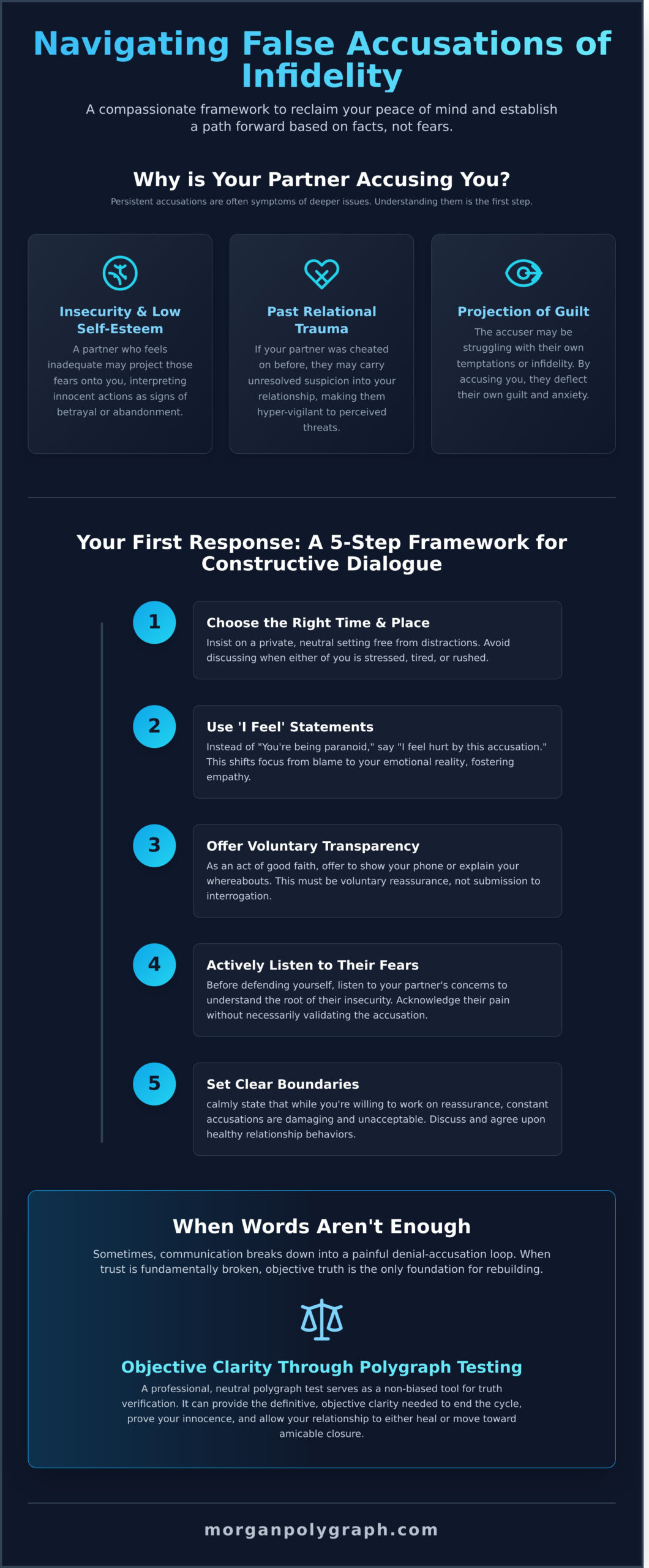
Why is Your Partner Accusing You?
Persistent accusations rarely arise from a vacuum. They are often symptoms of deeper issues within the accuser or the relationship itself. Understanding these drivers is essential for finding a path forward. Common sources include:
- Insecurity and Low Self-Esteem: A partner who feels inadequate may project those fears onto you, interpreting innocent actions as signs of betrayal.
- Past Trauma: If your partner was cheated on in a previous relationship, they may carry that unresolved trauma and suspicion into your partnership, making them hyper-vigilant to perceived threats.
- Projection: In some cases, the accuser may be struggling with their own temptations or infidelity. By accusing you, they deflect their own guilt and anxiety. The very definition of What Constitutes Infidelity can be a source of conflict if partners have different expectations or one is projecting their own behavior.
The Destructive Impact on Trust and Intimacy
Trust is the bedrock of any healthy partnership, and constant, baseless accusations systematically destroy it. A relationship should be a safe harbor, but incessant questioning transforms it into an environment of fear and anxiety. You may find yourself altering your behavior, avoiding friends, or hiding your phone simply to prevent another confrontation. This defensive posture is unsustainable and toxic.
The long-term effects are severe, eroding both emotional and physical intimacy. It is difficult to feel close to someone who views you as a suspect. Over time, this dynamic can escalate into a form of emotional abuse, where accusations are used to control and manipulate. Recognizing this pattern is critical for protecting your well-being and determining the necessary steps for resolving infidelity accusations with clarity and confidence.
Your First Response: A Framework for Constructive Dialogue
When faced with an accusation of infidelity, your immediate reaction can either escalate the crisis or lay the groundwork for resolution. The initial conversation is a pivotal moment. A calm, methodical approach is essential for navigating this sensitive issue and is the first professional step toward resolving infidelity accusations. The goal is not to “win” an argument but to open a channel for honest communication and truth verification.
Follow this structured framework to foster a constructive dialogue:
- Step 1: Choose the Right Time and Place. Insist on a private, neutral setting where you both can speak without interruption or distraction. Avoid discussing the issue late at night, in the car, or when either of you is stressed or tired.
- Step 2: Use ‘I Feel’ Statements. Replace accusatory language like “You’re being paranoid” with expressions of your own feelings, such as, “I feel hurt and confused by this accusation because my commitment to you is strong.” This shifts the focus from blame to emotion.
- Step 3: Offer Voluntary Transparency. To demonstrate good faith, you might offer to show your phone or explain your recent whereabouts. This should be a voluntary act to provide reassurance, not a submission to interrogation.
- Step 4: Set Clear Boundaries. Discuss and agree upon what behaviors are acceptable within the relationship. This could involve defining appropriate communication with others or expectations about shared time.
- Step 5: Listen to Their Fears. Before defending yourself, listen actively to your partner’s concerns. Understanding the root of their insecurity-whether it stems from past events or recent changes in behavior-is critical to addressing the core problem.
De-escalating the Conflict
Maintain a calm tone and open, non-confrontational body language. If emotions run high, agree to take a 20-minute break to cool down. It is often productive to begin the conversation by affirming your commitment to the relationship. Stating, “I love you, and I want to work through this with you,” can create a foundation of security before tackling the specific accusation.
Building Transparency to Rebuild Trust
True transparency is about willingly sharing your life to foster connection, not about surrendering your right to privacy under duress. Proactively mentioning your plans for the day or sharing a funny story from work can help close the gaps where suspicion might grow. Suggesting shared activities, like a weekly date night or a weekend trip, is also a powerful tool for reconnection. These proactive steps are fundamental to the process of rebuilding your relationship and demonstrating a commitment to its future health.
When Words Aren’t Enough: The Limits of Communication
You have explained, clarified, and denied. You have offered reassurances and expressed your commitment, yet the cycle of suspicion continues. This is a deeply frustrating reality for many couples; sometimes, communication fails. When a relationship becomes trapped in a loop of accusation and denial, words lose their power to heal. The conversation no longer moves toward resolution but circles the same painful point, eroding trust with every rotation.
Recognizing this stalemate is the first step toward breaking free. The process of resolving infidelity accusations can stall when one partner’s suspicion becomes an immovable belief, impervious to any explanation you provide.
Are You in a ‘No-Win’ Scenario?
A ‘no-win’ scenario occurs when your efforts to be transparent are used as further ‘evidence’ of deceit. The emotional toll of constantly having to prove a negative-to demonstrate that something did not happen-is immense and unsustainable. Consider if you are experiencing these signs:
- Your phone records, timelines, and explanations are scrutinized and reinterpreted to fit a narrative of guilt.
- Every conversation on the topic ends in the same unresolved state of suspicion and frustration.
- You feel emotionally exhausted, anxious, and perpetually on the defensive.
When these patterns emerge, the issue has likely moved beyond simple miscommunication. It can become a dynamic where one partner’s refusal to believe you is a form of control, trapping you in a state of perpetual justification.
Exploring Third-Party Help: Counseling vs. Verification
Couples counseling is an invaluable resource for improving communication and addressing the root causes of mistrust. A professional therapist can help partners develop healthier ways to interact and express their feelings. However, counseling is predicated on both individuals being open to exploring different perspectives.
If one partner has a fixed, false belief about infidelity, therapy can become unproductive. It may simply provide another venue for the same accusations. In such cases, resolving infidelity accusations requires more than a discussion of feelings; it requires establishing a baseline of fact. You need an impartial, objective tool that can introduce verifiable truth into the conversation, creating a foundation upon which genuine communication and healing can be rebuilt.
Objective Clarity: How a Polygraph Test Can End the Cycle
When trust is fractured, the cycle of suspicion and denial can be exhausting. Accusations are met with defensive answers, and doubt lingers, poisoning the relationship. A professional polygraph examination offers a way to break this cycle. It should not be viewed as an act of suspicion, but rather as a profound commitment to truth-an act of love designed to restore the foundation of your partnership. Suggesting a test is not an admission of guilt; it is a statement of unwavering commitment to transparency and a desire to heal.
Modern, professionally administered polygraph exams are a neutral, scientific process designed for truth verification. They provide objective data that can definitively answer specific questions, offering a clear path forward when communication alone is not enough. For couples serious about resolving infidelity accusations, this can be the critical step toward rebuilding.
What Is an Infidelity Polygraph Test?
A relationship or infidelity polygraph is a confidential examination focused on a set of specific, agreed-upon questions regarding a person’s past actions. The goal is not to “catch” someone, but to validate the truth and provide closure for both partners. The process is methodical and respectful:
- Pre-Test Interview: The certified examiner discusses the questions and the process with the examinee to ensure full understanding and reduce anxiety.
- Data Collection: The test is administered in a controlled, professional setting while physiological responses are recorded.
- Post-Test Analysis: The examiner analyzes the data charts to determine the results with a high degree of accuracy.
Proposing the Test to Your Partner
Approaching this conversation requires compassion and a focus on the shared goal: healing the relationship. Frame it as a collaborative effort. Consider language like, “I am committed to us, and I want to remove this doubt between us for good. Let’s find a certified examiner we both trust and agree on the questions together, so we can finally put this to rest and move forward.” The emphasis should always be on creating a future, not punishing the past.
Ensuring a Fair and Accurate Result
The validity of a polygraph test is entirely dependent on the examiner’s expertise. It is critical to use a nationally certified and experienced professional who adheres to strict ethical standards. Avoid online tests, apps, or unqualified practitioners, as they are unreliable and can produce inaccurate results. A professional test is unbiased; the examiner’s role is simply to administer the test correctly and report on the physiological data. This commitment to accuracy is the cornerstone of effectively resolving infidelity accusations. To learn more about the certified process, visit morganpolygraph.com.
The Path Forward: Scheduling a Test & Rebuilding Your Relationship
When communication has reached an impasse, the only path forward is one built on undeniable truth. Taking decisive action through a professional polygraph examination provides the clarity needed to end the cycle of suspicion and doubt. This final step isn’t about winning an argument; it’s about establishing a factual foundation upon which you can both build your future, whether that is together or apart.
How to Schedule a Confidential Examination
Arranging a polygraph test is a straightforward, private process designed to respect your sensitive situation. A professional firm will guide you through each step with complete discretion. The process typically involves:
- Step 1: Contact a Professional Firm. Reach out to a certified examiner to discuss your circumstances privately. This initial consultation allows you to ask questions and ensure the test is structured to address your specific concerns.
- Step 2: Understand the Fee Structure. The examiner will clearly explain the fees, the examination process, and exactly what is included in the service. Transparency is key to building trust.
- Step 3: Prepare for the Examination. The most important preparation is to be well-rested and, above all, committed to being completely honest during the pre-test interview and examination.
After the Test: Using the Results to Heal
The results of a polygraph are not a verdict but a powerful tool for truth verification. How you use this information is crucial for successfully resolving infidelity accusations and beginning the healing process. The outcome provides a clear, factual basis for your next steps.
- If results show ‘No Deception Indicated,’ it provides a powerful opportunity for the accusing partner to release their suspicions and begin the work of rebuilding trust. It is a chance to close this painful chapter for good.
- If results show ‘Deception Indicated,’ the conversation can shift from speculation to reality. It provides a factual starting point to discuss the situation honestly and decide on the future of the relationship.
Ultimately, the test results provide the clarity needed to move forward and create a future built on honesty.
Your Boise, Idaho Resource for Clarity
At Morgan Polygraph, we provide compassionate and completely confidential infidelity testing for couples in Boise and throughout Idaho. Our court-recognized, expert examiners deliver definitive, unbiased results to help you find the truth and the peace of mind you deserve. When you are ready to move past uncertainty, we are here to help. Call us for a confidential consultation and take the first step toward resolution.
Your Next Step Towards Truth and Reconciliation
Navigating the turmoil of an infidelity accusation demands a measured, compassionate approach. While constructive dialogue is the essential first step, words alone cannot always mend the deep wounds of doubt. When trust is fractured and communication reaches its limit, seeking objective, verifiable truth becomes the most effective path forward for both partners.
For couples committed to resolving infidelity accusations, a professional polygraph examination provides a definitive way to cut through uncertainty and establish a factual foundation for healing. At Morgan Polygraph, we provide a professional, compassionate, and completely discreet service. With over 40 years of combined experience, our nationally certified and court-recognized examiners are experts in truth verification, helping you find the clarity you need.
Do not let suspicion continue to erode your relationship. Contact Morgan Polygraph for a confidential consultation and take the most important step toward finding the certainty you both deserve. The truth is the necessary foundation for rebuilding trust and moving forward, together.
Frequently Asked Questions About Resolving Infidelity Accusations
Will suggesting a polygraph test make my partner think I’m guilty?
Suggesting a polygraph is often a definitive step toward transparency and truth. While your partner’s initial reaction may vary, framing it as a mutual tool to restore trust can be highly effective. It demonstrates a serious commitment to proving your innocence and moving past the accusation. An innocent person often welcomes the opportunity to be vindicated by a professional, objective process, viewing it as the fastest path to resolution and healing for the relationship.
How accurate is a polygraph test for infidelity issues?
When administered by a certified and experienced examiner using modern, computerized equipment, polygraph testing demonstrates a high degree of accuracy, often exceeding 90%. The validity of the test relies heavily on the examiner’s skill in formulating specific questions and professionally interpreting the physiological data. For single-issue infidelity tests, the focused nature of the inquiry allows for precise and reliable results, making it a powerful tool for truth verification in sensitive personal matters.
What kind of questions are asked during an infidelity lie detector test?
The questions are carefully constructed and reviewed with you before the examination begins. They are direct, yes-or-no questions specifically related to the infidelity allegation. Examples include “Have you had sexual contact with anyone other than your partner since [date]?” or “Have you lied to your partner about [specific incident]?”. Irrelevant and control questions are also used to establish a baseline for your unique physiological responses, which is critical to ensuring the test’s accuracy and integrity.
Can anxiety or nervousness make me fail a polygraph test even if I’m innocent?
It is completely normal for any person, innocent or not, to feel nervous during a polygraph test. Our professional examiners are trained to account for this. The test measures distinct physiological responses to specific questions, not your overall level of anxiety. A thorough pre-test interview helps establish your baseline, allowing the examiner to differentiate between general nervousness and the specific reactions associated with deception. Your baseline anxiety will not cause a truthful person to fail the test.
Is the polygraph test process confidential?
Absolutely. Confidentiality is a cornerstone of our professional practice. From your initial inquiry to the final report, all information is handled with the utmost discretion and security. The results of the examination are released only to the person who contracted for the service, or to other parties as designated in writing by the client. We are committed to protecting your privacy throughout this sensitive process, ensuring your personal matters remain strictly private.
What happens if my partner refuses to accept the results of the test?
A polygraph provides objective, scientific data, but it cannot force emotional acceptance. If your partner refuses to accept a result that indicates no deception, it may suggest deeper trust issues that exist beyond the specific accusation. While the test is a powerful tool for resolving infidelity accusations, it is one part of a larger process. The results can serve as a firm foundation for further communication, professional counseling, or making difficult decisions about the relationship’s future.
How much does a private infidelity polygraph test cost?
The cost for a private, professional infidelity polygraph test typically ranges from $400 to $800. The final price can vary based on the complexity of the case, the location, and the examiner’s specific credentials and experience. This fee covers a comprehensive process, including a detailed pre-test consultation, the examination itself using state-of-the-art equipment, and a post-test review of the results. Be wary of significantly lower prices, which may indicate an uncertified or inexperienced examiner.
What’s the difference between a professional polygraph and an online lie detector test?
A professional polygraph is a scientifically validated procedure conducted in-person by a certified examiner using medical-grade sensors to measure physiological responses. It is a rigorous, controlled process. In contrast, online or app-based “lie detectors” are not reliable and should be considered entertainment. They often use voice stress analysis or other unproven methods that lack scientific backing and cannot be used for seriously resolving infidelity accusations or any other critical matter.