

An accusation can turn your world upside down, leaving you feeling powerless and unheard. When your word alone isn’t enough, the fear that no one-from authorities to your own loved ones-believes you can be overwhelming. In these critical moments, many individuals consider using a lie detector test to prove innocence. But how can a tool that is often inadmissible in court actually help your case? The answer lies in a strategic, confidential approach that empowers you and provides your legal team with a powerful asset.
This strategic guide for 2026 is designed to demystify the process and restore your sense of control. We will provide a clear, professional roadmap for how a modern polygraph examination, conducted by a certified expert, can serve as a pivotal tool for truth verification. You will discover how the results can be used discreetly with your attorney to influence negotiations, guide case direction, and re-establish your credibility, even if the test is never presented in a courtroom. It’s time to learn how to make the truth your strongest defense.
Key Takeaways
- Understand the critical difference between a police-administered polygraph and a confidential test commissioned by your attorney.
- Learn how a favorable polygraph result, even if inadmissible in court, can be strategically presented to prosecutors by your legal team.
- Discover how to properly leverage a lie detector test to prove innocence by ensuring the examiner’s credentials can withstand prosecutorial scrutiny.
- Find out how commissioning your own polygraph exam allows you and your attorney to control the results and the narrative.
The Innocent Person’s Dilemma: Why Police Polygraphs Are a Gamble
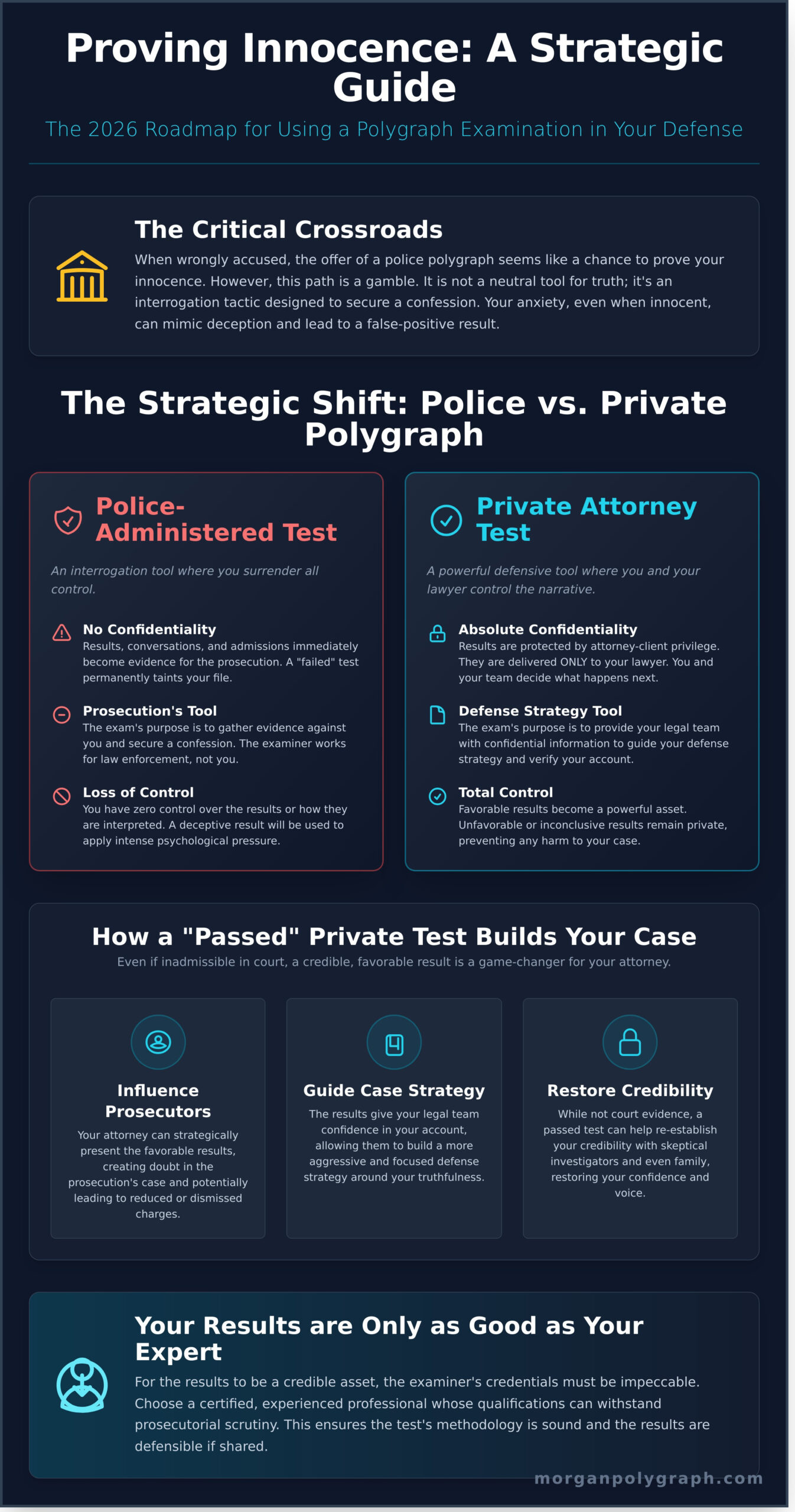
When you are wrongly accused of a crime, your first instinct is to do everything possible to clear your name. So when law enforcement offers you a polygraph exam, it can feel like the perfect opportunity. The desire to take a lie detector test to prove innocence is powerful and completely understandable. However, it is crucial to recognize that a police-administered polygraph is not a neutral tool for truth verification; it is primarily an instrument of interrogation designed to secure a confession.
The fundamental issue lies in the test’s reliability and how it is interpreted. Courts are skeptical because polygraphs do not detect lies, but rather the physiological stress responses associated with them. Understanding what a polygraph measures-subtle changes in heart rate, blood pressure, respiration, and skin conductivity-reveals the problem. The intense anxiety an innocent person feels while being questioned about a serious crime can produce the exact same physiological reactions as a guilty person’s deception, leading to a false-positive or “deceptive” result.
Understanding Court Admissibility
This inherent unreliability is why most courts, including those in Idaho, strictly limit or completely bar the admission of polygraph results as evidence in a trial. They fail to meet the rigorous scientific standards required for evidence. While rules vary by jurisdiction, the principle of inadmissibility is widespread. However, do not mistake “inadmissible” for “harmless.” Any statements or admissions you make during the pre-test interview or the exam itself can often be used against you in court.
The Risks of a Police-Administered Test
When you agree to a polygraph with law enforcement, you are taking a significant gamble where the odds are not in your favor. The primary risks include:
- No Confidentiality: The results and everything you say are immediately given to investigators. A “failed” test becomes a permanent part of their file against you.
- Examiner Allegiance: The polygraph examiner is an agent of law enforcement. Their professional duty is to the investigation, not to you or your claim of innocence.
- Intense Psychological Pressure: If the results are deemed “deceptive,” investigators will use this to increase pressure, insisting they have scientific proof you are lying in an attempt to break you down and elicit a confession.
Ultimately, submitting to a police polygraph surrenders control of your narrative to the very people trying to build a case against you. While the motivation to take a lie detector test to prove innocence is strong, this particular path is fraught with risks that can complicate, rather than resolve, your legal situation.
The Strategic Shift: Private vs. Police Polygraph Examinations
When facing a serious accusation, law enforcement may ask you to take a polygraph test to “clear your name.” This invitation can feel like a lifeline, but it is a critical strategic juncture. The most important decision you and your legal counsel can make is not if you take a polygraph, but for whom. A confidential, attorney-commissioned examination is a fundamentally different tool than one administered by the police, especially when considering a lie detector test to prove innocence.
The distinction boils down to control, purpose, and privilege. One path puts your fate in the hands of the prosecution, while the other empowers your defense team with vital, confidential information.
Who Controls the Information?
The primary difference between a police and private polygraph lies in one crucial question: who owns the results? The answer determines whether the test serves your interests or the prosecution’s.
- Police-Administered Test: The results-whether truthful, deceptive, or inconclusive-are immediately sent to detectives and prosecutors. You have zero control over how this information is used. Any result that is not clearly “truthful” can be interpreted as a sign of guilt and used to increase pressure on you.
- Private, Attorney-Commissioned Test: The results are delivered exclusively to your attorney and are protected by attorney-client privilege. They are confidential work product for your defense. This gives you and your legal team complete control to decide the next steps. Favorable results can be shared strategically; unfavorable or ambiguous results remain private, allowing your team to adjust its strategy without harming your case.
Purpose of the Examination
A test administered by law enforcement is an investigative tool designed to gather evidence, identify inconsistencies, and elicit confessions. It is an offensive weapon used by the prosecution to build its case against you. The examiner, though professional, is working for the police department.
In contrast, a private polygraph is a defensive shield. Its purpose is to provide your legal team with an expert, confidential assessment of your account. It allows your attorney to independently verify your statements, anticipate the prosecution’s tactics, and plan a robust defense. By understanding the polygraph’s recognized usefulness and practical accuracy, your counsel can use the results internally to build the strongest possible case on your behalf. This transforms the polygraph from a high-stakes gamble into a calculated element of your legal defense.
How a ‘Passed’ Private Polygraph Strategically Builds Your Case
While polygraph results are often inadmissible in court, their strategic value in the pre-trial phase cannot be overstated. When conducted by a certified and respected examiner, a passed lie detector test to prove innocence becomes a powerful, confidential tool for your legal defense. It shifts the dynamic from a simple accusation to a case with credible, conflicting evidence, providing your attorney with significant leverage long before a jury is ever selected.
Leverage in Prosecutorial Negotiations
Prosecutors manage heavy caseloads and must prioritize cases they are confident they can win. When your defense attorney presents them with a professionally administered polygraph report showing no deception, it introduces a critical element of doubt. This report signals that you have a credible defense and are prepared to fight the charges. For a prosecutor, this transforms a potentially straightforward case into a more complex and resource-intensive trial, making them far more receptive to negotiating a favorable outcome, such as reducing the charges or dropping them entirely.
Guiding Your Defense Strategy
Beyond influencing the prosecution, a passed polygraph has profound benefits for your own legal team. It provides objective validation of your account, allowing your attorney to proceed with greater confidence and aggression. This confirmation helps in several key ways:
- Validates Your Account: It gives your legal team confidence that they are defending a truthful client.
- Focuses the Investigation: Resources can be directed toward finding exculpatory evidence or identifying alternative suspects, rather than verifying your own story.
- Boosts Morale: It reinforces your own confidence and resolve, better preparing you for the mental and emotional challenges of the legal process.
What if the Results Are Inconclusive or Deceptive?
Because you commissioned the test privately through your attorney, the results are protected by attorney-client privilege. If the outcome is not favorable, it remains confidential and cannot be used against you. Far from being a waste, this information becomes a valuable diagnostic tool. It can help your attorney understand potential weaknesses in your testimony and pinpoint areas where your narrative may seem inconsistent under pressure. Understanding these vulnerabilities, and knowing what psychological science says about polygraphs and their complexities, allows your team to better prepare you for a rigorous cross-examination.
Choosing a Credible Examiner: Your Results Are Only as Good as Your Expert
When you decide to take a polygraph, the single most critical factor influencing its strategic value is the credibility of the examiner you choose. In a legal context, prosecutors, judges, and defense attorneys will not be influenced by the findings of just any test; they will only consider results from a highly respected, certified, and experienced professional. A test administered by an examiner with a questionable background or subpar credentials is, for all intents and purposes, worthless and will not help your case.
The reputation of the polygraph examiner is paramount. Their professional history, ethical standards, and recognized expertise are what lend weight and authority to the final report. Without this foundation of credibility, the results of a lie detector test to prove innocence will likely be dismissed before they are even reviewed.
Essential Credentials Checklist
Before engaging an examiner, ensure they meet these non-negotiable professional standards. Vetting your expert is the first and most important step in the process.
- Accredited Education: The examiner must have graduated from a polygraph school accredited by a major professional organization, such as the American Polygraph Association (APA).
- Professional Memberships: Look for active membership in organizations like the APA or the American Association of Police Polygraphists (AAPP), which enforce strict codes of ethics and continuing education requirements.
- Extensive Criminal Case Experience: An examiner’s background should include substantial experience conducting tests specifically for criminal cases, as these require a different level of precision than routine screenings.
- Court-Recognized Expert Status: The most credible examiners have a history of being qualified as expert witnesses and providing testimony in court proceedings.
The Consultation Process
A professional examiner’s process is methodical and transparent. They will insist on consulting with your attorney first to gain a comprehensive understanding of the legal specifics and to formulate questions that are precise, unbiased, and directly relevant to the case. Be cautious of any examiner who makes unrealistic guarantees, promises a certain outcome, or uses visibly outdated equipment. A true professional focuses on accuracy and ethical procedure, not on selling a result.
Ultimately, investing in a lie detector test to prove innocence is an investment in the expert who conducts it. At Morgan Polygraph, our court-recognized experts adhere to the highest industry standards to ensure every examination is professional, confidential, and conducted with the utmost integrity.
How Morgan Polygraph Confidentially Assists Your Legal Defense
When you are facing serious allegations, the path to proving your innocence can feel overwhelming. At Morgan Polygraph, a nationally certified and court-recognized expert service based in Boise, Idaho, we provide a critical tool for your legal defense. Our entire process is structured to work within the attorney-client privilege framework, ensuring that the results of your examination remain confidential and are used strategically by your legal counsel.
We conduct professional, compassionate, and discreet examinations for both criminal and civil cases, with the singular goal of providing your legal team with the factual clarity needed to build the strongest possible defense.
Our Commitment to Confidentiality and Professionalism
Our practice is built on a foundation of unwavering professional ethics and strict client confidentiality. We work directly with attorneys across Idaho, providing strategic polygraph services that serve as a private, investigative tool. This collaboration ensures that the examination is properly structured and the results are protected. When your legal team engages us for a lie detector test to prove innocence, they can be confident that we employ only state-of-the-art, validated polygraph techniques and technology. This commitment to accuracy provides your attorney with reliable data to inform their legal strategy.
Taking the Next Step to Clear Your Name
The first step toward using a polygraph to support your case is for your attorney to contact our office. To maintain privilege, all communication and scheduling must be initiated by your legal counsel. During this initial, confidential consultation, we will discuss the specific details of your case with your attorney to determine if a polygraph examination is a suitable and strategically sound tool for your situation. This careful vetting process ensures that a lie detector test is used effectively and ethically to support your case.
If you and your legal team believe a professional examination can help, have your attorney contact Morgan Polygraph to schedule a professional consultation.
Your Strategic Path to Vindicating the Truth
As we’ve explored, the landscape for proving your innocence in 2026 requires a calculated, strategic approach. While a police-administered polygraph is a high-stakes gamble, a private examination allows you to take control of your narrative. A passed test from a credible expert becomes a powerful, confidential asset for your legal team, demonstrating your truthfulness without the inherent risks of a law enforcement setting. The value of a lie detector test to prove innocence is directly tied to the unimpeachable expertise of the examiner administering it.
At Morgan Polygraph, we provide that critical level of expert authority. With over 40 years of combined experience, our Nationally Certified and Court-Recognized Examiner serves Boise, ID, and the surrounding region with professional services protected by strict attorney-client confidentiality. If you and your attorney believe a polygraph could strengthen your case, contact us for a confidential consultation.
Taking this proactive step is a powerful move towards reclaiming your story and securing your future. The truth is your greatest asset; we can help you present it with clarity and confidence.
Frequently Asked Questions About Polygraph Testing
Are polygraph results admissible in court in Idaho?
In Idaho, polygraph results are generally not admissible as direct evidence in a trial unless both the prosecution and defense agree to their admission beforehand through a legal stipulation. While not typically used to prove guilt or innocence in court, they are often a valuable tool in pre-trial negotiations, plea agreements, and to guide investigative strategies. It is essential to consult with your attorney to understand how a polygraph might be utilized in your specific legal situation.
What happens if I fail a private polygraph test I arranged with my lawyer?
When a polygraph examination is conducted at the request of your attorney, the results are protected by attorney-client privilege. This ensures complete confidentiality. If the outcome is unfavorable (“Deception Indicated”), your lawyer is under no obligation to disclose the results to the prosecution or law enforcement. This privileged arrangement allows you to explore this option as a strategic tool for your defense without the risk of the results being used against you.
Can being nervous or anxious make me fail the test even if I’m innocent?
It is completely normal to feel nervous during a polygraph examination, and a certified examiner is trained to account for this. The test measures physiological changes in response to specific questions, not just general anxiety. During the pre-test interview, the examiner establishes a baseline to differentiate your normal nervous reactions from the distinct responses associated with deception. An innocent person’s anxiety will not cause them to fail a properly administered test.
How much does a private lie detector test cost for a legal case?
The cost for a professional polygraph examination for a legal matter typically ranges from $500 to $1,500. The final price depends on the complexity of the case, the number of issues being tested, and the specific expertise of the examiner. A comprehensive criminal defense test is a detailed, multi-hour process that includes extensive case review, question formulation, and in-depth analysis. We provide a clear fee structure during your confidential consultation.
What kind of questions are asked in a polygraph test for a criminal case?
Questions in a criminal case are specific, direct, and designed to address the core issue of the investigation. You will review and agree to the exact wording of every question before the test begins. Questions are “yes” or “no” and fall into three main types: irrelevant (e.g., “Are the lights on in this room?”), control (broader questions to establish a baseline), and relevant (e.g., “Did you take the missing item on Tuesday?”).
How long does a polygraph examination take?
A professional polygraph examination is a thorough process that should not be rushed. You can expect the entire session to last between two and four hours. This time is divided into three critical phases: the detailed pre-test interview, the in-test phase where data is collected while you are connected to the instrument, and the post-test analysis of the physiological data. This comprehensive approach is essential for ensuring the accuracy and validity of the results.
Is it possible to ‘beat’ a polygraph test?
Attempting to use countermeasures to manipulate a polygraph is highly inadvisable. Certified examiners are trained to identify the physical and mental tactics people use to try and alter test results. The detection of such attempts often leads to an “inconclusive” result and can be interpreted as consciousness of guilt. Using a lie detector test to prove innocence is most effective when you are fully cooperative and committed to the process.
Why should I choose a certified examiner like Morgan Polygraph?
Choosing a certified, court-recognized expert is crucial for the credibility of your test results. An examiner’s qualifications, experience, and adherence to professional standards are scrutinized by legal professionals. Chip Morgan is a respected expert in the polygraph community, ensuring your test is conducted properly. When you take a lie detector test to prove innocence, the reputation of the examiner is as vital as the outcome itself for it to be considered a serious, credible tool.