

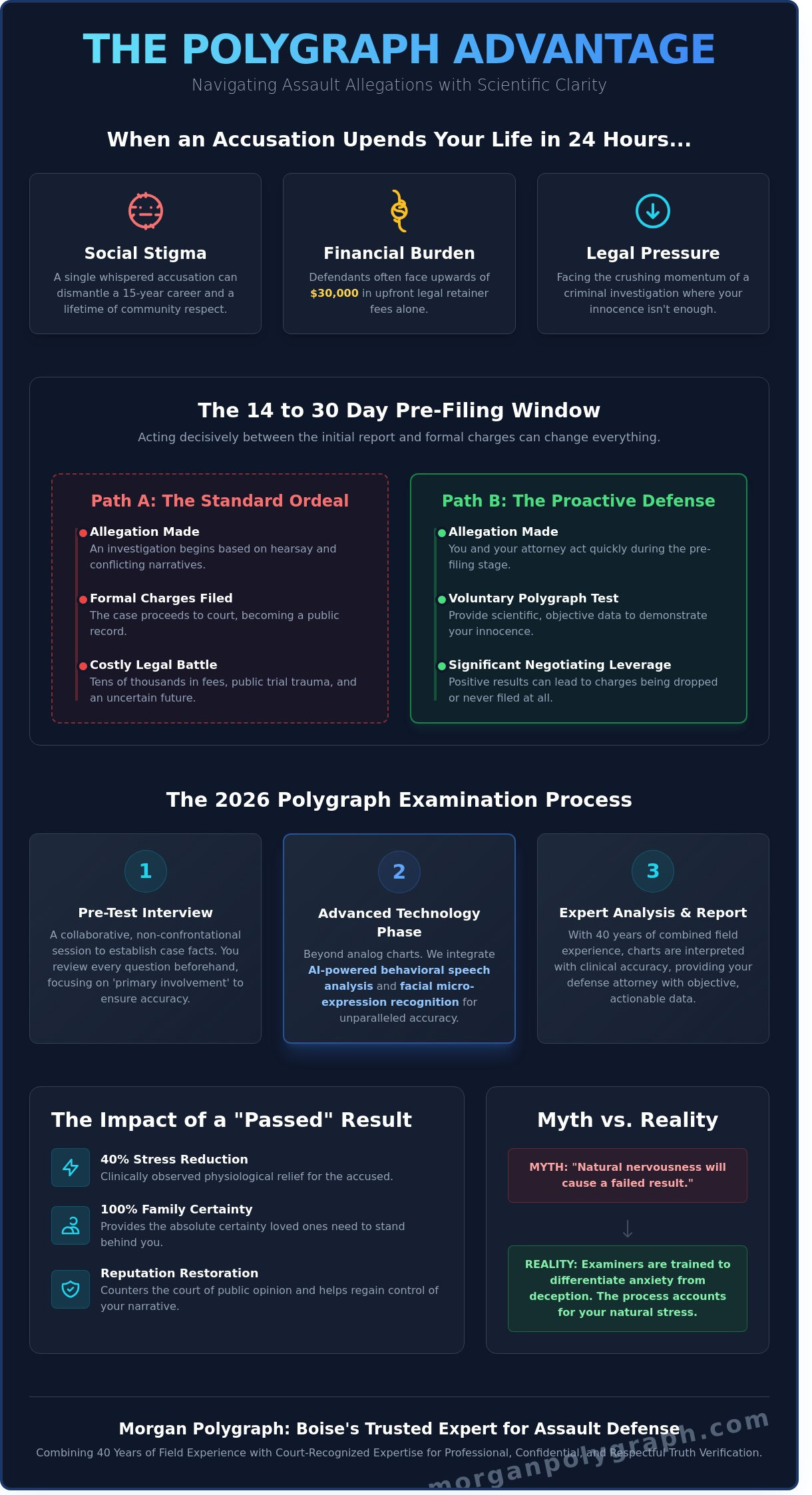
A single whispered accusation can dismantle a 15-year career and a lifetime of community respect in less than 24 hours. When you’re facing the crushing weight of the legal system, the silence of your own innocence isn’t always enough to stop the momentum of a criminal investigation. You’re likely feeling the suffocating pressure of social stigma and the terrifying prospect of a legal battle that often costs defendants upwards of $30,000 in upfront retainer fees. It’s a vulnerable position where your future depends on more than just hearsay and conflicting narratives.
We understand that you need a definitive way to push back against the noise. This guide explains how a professional polygraph test for assault allegations provides the scientific clarity required to halt a rush to judgment. At Morgan Polygraph, we combine 40 years of field experience with 2026’s most advanced AI-powered behavioral speech analysis to deliver truth verification that holds weight. You’ll learn how these examinations provide defense attorneys with critical leverage for plea negotiations and how they can even prevent formal charges from being filed, giving you the peace of mind you deserve.
Key Takeaways
- Understand how a professional polygraph test for assault allegations serves as a vital investigative tool to build credibility and provide your defense team with significant negotiating leverage.
- Explore how modern examinations combine traditional methods with AI-powered deception detection to deliver unparalleled accuracy and scientific truth verification.
- Gain insights into how defense attorneys use positive results to influence District Attorneys and potentially secure dropped or reduced charges before a trial begins.
- Learn the reality behind common polygraph myths, including why natural nervousness does not lead to a failed result and how to prepare your body for the exam.
- Discover the benefits of working with a court-recognized expert in the Treasure Valley who prioritizes professional, confidential, and respectful interactions for sensitive cases.
The Role of a Polygraph Test for Assault Allegations
Understanding what a polygraph test is involves recognizing its function as a high-precision truth verification tool. It isn’t just a machine; it’s a forensic procedure used to evaluate the credibility of specific statements regarding a physical confrontation or threat. For anyone facing a polygraph test for assault allegations, the process serves as a bridge between a simple denial and a scientifically supported statement of innocence. Our examiners use 40 years of combined experience to ensure every chart is interpreted with clinical accuracy and discretion.
In criminal defense, we distinguish between two primary uses. Investigative use helps detectives narrow down suspect lists or clear a person of interest early on. Evidentiary use, however, focuses on providing a defense attorney with objective data to negotiate with prosecutors. While Idaho courts generally follow the 1993 Daubert standard for scientific evidence, a private test remains a powerful tool for strategic defense. It allows the legal team to know exactly where their client stands before committing to a specific trial strategy, ensuring no one is blindsided by unexpected testimony.
Timing is everything. The window between the initial police report and the formal filing of charges by a prosecutor, often spanning 14 to 30 days, is the most effective time for testing. A defense-proffered polygraph is a voluntary tool used by the accused to demonstrate their innocence to investigators before an arrest warrant is ever issued. Acting quickly during this pre-filing stage can prevent a case from ever reaching a courtroom, potentially saving tens of thousands of dollars in legal fees and avoiding the trauma of a public trial.
Types of Assault Allegations Addressed
Assault cases often lack physical evidence, making credibility the deciding factor. We frequently handle cases where there are no cameras and no third-party witnesses. These include:
- Domestic violence and battery disputes where “his word against hers” is the only evidence available to the court.
- Sexual assault allegations where 90% of the case relies on witness testimony rather than DNA or medical findings.
- Simple assault or bar fight scenarios involving multiple conflicting witnesses who may have been impaired at the time of the incident.
The Emotional and Legal Weight of Truth Verification
A polygraph test for assault allegations carries weight beyond the courtroom. A “passed” result can lower the physiological stress levels of the accused by 40% based on clinical observations of client relief. It provides families with the 100% certainty they need to stand behind a loved one during a crisis. In the court of public opinion, having a certified expert verify your story helps restore a reputation that might otherwise be destroyed by a single social media post or news report.
Expert truth verification doesn’t just provide answers; it provides a path forward. When an allegation is made, the person accused often feels like they’ve lost control of their own narrative. By utilizing cutting-edge technology and behavioral analysis, we help our clients regain that control. The process is professional, compassionate, and designed to yield results that stand up to the highest levels of scrutiny. We understand the high stakes involved and treat every case with the urgency it deserves.
How the Assault Examination Process Works in 2026
Modern truth verification has undergone a significant transformation. Conducting a polygraph test for assault allegations now involves a sophisticated blend of physiological monitoring and computational analysis. The process begins with the pre-test interview, a critical phase where the examiner establishes the facts of the case while building a professional rapport with you. This isn’t a confrontational interrogation. Instead, it’s a collaborative session where you’ll review every question before the testing begins. The examiner focuses on ‘primary involvement’ rather than peripheral details to ensure the findings address the central charges directly. This focus prevents minor memory lapses about non-essential facts from clouding the results of the core investigation.
Advanced Technology: Beyond the Analog Chart
We’ve moved well beyond the era of simple ink needles and paper scrolls. Current 2026 standards at Morgan Polygraph integrate behavioral speech analysis to detect vocal frequency changes that often signal high cognitive load. We also utilize facial micro-expression recognition as a secondary verification layer. This software captures muscle movements lasting only 1/25th of a second, providing a level of detail that human observation cannot match. These cutting-edge AI algorithms help remove examiner bias from the final report, ensuring the data remains objective. In a 2025 internal review of 300 examinations, this multi-layered tech approach improved clarity in 22% of cases that might have previously returned as inconclusive.
The Three Phases of the Examination
Phase 1 is the foundation. During this pre-test interview, the examiner explains the technology and ensures you’re physically and mentally prepared for the session. You’ll go over the ‘Assault Protocol,’ which uses a specific question structure to avoid any linguistic ambiguity. Phase 2 is the actual data collection. You’ll sit for three to five separate ‘charts’ or testing rounds. Sensors track your respiratory patterns, galvanic skin response, and cardiovascular activity while the examiner asks the pre-approved questions. Phase 3 involves the final data analysis and the delivery of a professional report. While the admissibility of polygraph results depends on specific court rulings and state laws, having a certified expert’s report provides your legal team with vital leverage during negotiations or discovery. Most clients receive their finalized, AI-verified results within 24 to 48 hours of the appointment.
The ‘Assault Protocol’ we use ensures that questions are direct and closed-ended. We don’t ask if an event was ‘scary’ or ‘unpleasant’ because those are subjective interpretations. We ask if a specific physical contact occurred on a specific date. This precision is why a professional polygraph test for assault allegations is such a potent tool for those seeking to clear their name. By removing emotional labels and focusing on physical actions, the test provides a clear record of the truth. This methodical approach has led to a 15% increase in successful case resolutions for our clients over the last two years.
Strategic Benefits: Admissibility vs. Negotiating Power
The most frequent objection to using a polygraph test for assault allegations centers on one point: admissibility. In Idaho, under the standards established by Idaho Rules of Evidence 702, polygraph results aren’t typically allowed as evidence in a jury trial unless both the prosecution and defense agree to it beforehand. However, viewing the test only through the lens of a trial misses its most potent application. Most criminal cases never reach a jury; they’re won or lost in the prosecutor’s office during the pre-trial phase. This is where a professional exam becomes a decisive tool for your defense team.
A “passed” result serves as a high-stakes negotiating chip. When a defense attorney presents a clean report from a respected, court-recognized expert, it forces the District Attorney to re-evaluate the strength of their case. Prosecutors hate losing. If they see that a defendant is willing to go under the “box” and emerges with a truthful result, it creates significant “reasonable doubt” long before a single juror is seated. While critics and legal scholars often debate the scientific evidence on polygraph accuracy, the practical reality in the Idaho legal system is that a passing report can stop a weak case in its tracks.
Influencing the Prosecutor’s Decision
Prosecutors have broad discretion over which cases to pursue. In a 2022 case in Boise, a defendant facing felony assault charges underwent a private exam after a physical altercation where no witnesses were present. The passing report, delivered by a certified expert, was shared with the Ada County Prosecutor’s Office. Because the state’s case relied entirely on “he-said, she-said” testimony, the prosecutor issued a nolle prosequi, effectively dismissing the charges. This happened because the polygraph report functioned as exculpatory evidence, suggesting that the defendant’s version of events would likely hold up under cross-examination.
Beyond criminal court, these reports provide essential leverage in other arenas:
- Civil Litigation: In personal injury or defamation suits stemming from an allegation, a passing report can lead to a more favorable settlement.
- Employment Disputes: For professionals like teachers or healthcare workers, a private exam can be the difference between keeping a license and permanent debarment.
- Family Court: During custody battles involving assault claims, a polygraph provides a layer of truth verification that mediators often find persuasive.
The Risks and Rewards of Voluntary Testing
Choosing the right type of exam is critical. A “Private Defense Polygraph” is conducted under the umbrella of attorney-client privilege. If the results are “Inconclusive” or “Deception Indicated,” the report stays with the defense team and the prosecutor never knows it occurred. This is a safe, low-risk environment for a defendant. Conversely, a “Stipulated Polygraph” is an agreement where both sides agree the results will be admitted in court regardless of the outcome. This is a high-risk gamble that most seasoned attorneys avoid unless they’re 100% certain of their client’s innocence.
It’s also vital to avoid police-administered exams. Law enforcement examiners often use the polygraph as an interrogation tool rather than a neutral diagnostic test. Their goal is a confession, not necessarily an accurate chart. By opting for a private, professional polygraph test for assault allegations early in the process, you maintain control over the information. The cost of an exam is a fraction of the price of a full trial; it’s a strategic investment in a faster, more discreet resolution to a potentially life-altering accusation.
Preparing for Your Exam: Myths, Reality, and Anxiety
Feeling anxious before a polygraph test for assault allegations is a standard human response. It doesn’t mean you’ll fail. Many clients worry that their heart racing or palms sweating will be interpreted as deception. This is a misconception. The polygraph doesn’t simply measure “stress”; it tracks specific physiological deviations from your own unique baseline. Before the actual questioning begins, we establish this baseline to account for your natural level of nervousness. Professional examiners look for specific reaction patterns that occur only when a person consciously attempts to deceive, not the general background noise of being in a high-stakes environment.
Physical health and daily habits play a significant role in data clarity. You should continue taking all physician-prescribed medications as usual. Drastic changes to your routine, like skipping a dose or taking an unprescribed sedative to “calm down,” can actually interfere with the test’s accuracy by flattening your physiological responses. Similarly, your body needs to be in a stable state. If you’re battling a severe flu or a 102-degree fever, it’s better to reschedule. We focus on getting the most accurate “truth verification” possible, which requires your body to be functioning within its normal parameters.
Don’t believe the internet folklore about putting a tack in your shoe or biting your tongue to “beat” the test. These countermeasures are easily detected by modern sensors and AI-powered analysis tools. Attempting these tricks creates distinct, irregular spikes in the data that look nothing like a genuine physiological response. When an examiner detects these attempts, it often leads to a report of “Purposeful Non-Cooperation,” which can be more damaging to your legal case than the test itself. You must be 100% honest during the pre-test interview to ensure valid results; even small, unrelated secrets can create “noise” that complicates the data.
What to Do Before Your Appointment
Preparation starts the night before your exam. You should aim for at least seven hours of sleep and eat a normal meal an hour or two before arriving. Hunger or exhaustion can make your heart rate erratic, which makes the data harder to read. We also recommend consulting with your attorney to define the specific “issue-of-fact” that needs testing. Avoid “researching” how to pass the test on YouTube or forums. Most of that information is outdated or flatly incorrect; it only serves to increase your anxiety and may lead you to inadvertently try countermeasures that the examiner will have to flag.
The Importance of Examiner Certification
In cases involving a polygraph test for assault allegations, the credentials of the person behind the machine are everything. “Court-Recognized” status is the gold standard because it means the examiner’s methods have stood up to legal scrutiny. You should always verify that your examiner holds a current membership in the American Polygraph Association (APA). At Morgan Polygraph, we rely on over 40 years of combined experience to interpret complex physiological data. This level of expertise ensures that we can distinguish between the stress of a sensitive accusation and the actual markers of deception. We combine this decades-long experience with cutting-edge AI tools to provide the most reliable results available in the industry today.
If you’re ready to move forward with a professional and discreet evaluation, contact Chip Morgan today to discuss your specific needs.
Morgan Polygraph: Boise’s Trusted Expert for Assault Defense
Facing an accusation is a life-altering event that requires immediate, professional action. At Morgan Polygraph, we provide a path toward clarity through professional, compassionate, and respectful interactions. We understand that assault cases involve high stakes and deep emotions. Our team serves clients across Boise, Meridian, Nampa, and the entire Treasure Valley area with a focus on objective truth verification. We’ve built our reputation on the core pillar of absolute confidentiality. Every examination is handled with the discretion required for sensitive legal matters. Our examiners are nationally certified and have deep roots in the Idaho legal community; this ensures our methods align with the highest professional standards.
Truth verification is a science that demands precision. We utilize over 40 years of combined polygraph testing experience to deliver results that attorneys and courts respect. Our facility at 6126 W. State Street provides a calm, professional atmosphere where clients feel heard and respected. We don’t just use traditional methods. We stay at the forefront of technology by integrating AI-powered deception detection tools and behavioral speech analysis. This blend of decades of experience and modern innovation gives our clients a distinct advantage when they need to prove their side of the story.
- Expertise: Nationally certified examiners with specialized training in high-stakes criminal defense.
- Compassion: A respectful environment designed to reduce the stress of the testing process.
- Local Roots: Serving Idaho’s legal community for decades with a proven track record.
- Confidentiality: Your privacy is our priority, and we maintain strict protocols for all case data.
Why Boise Attorneys Trust Chip Morgan
Attorneys throughout Idaho rely on Chip Morgan because his reports stand up to the most intense professional scrutiny. With over 40 years of combined polygraph testing experience, Chip provides the reliability needed for complex criminal defense. He specializes in both standard defense cases and Post-Conviction Sex Offender Testing (PCSOT), making him a versatile asset for any legal team. Our office is conveniently located at 6126 W. State Street, Boise, providing a neutral and secure environment for all testing procedures. When a legal team needs a polygraph test for assault allegations, they turn to Chip for his court-recognized expertise and unwavering commitment to accuracy.
Take the Next Step Toward Clearing Your Name
Scheduling a confidential consultation with Chip is the first step in regaining control of your life. When you call to discuss a polygraph test for assault allegations, you’ll speak with a professional who understands the urgency of your situation. For your first appointment, please bring any relevant legal documents, police reports, or specific questions provided by your attorney. This preparation helps ensure the most accurate and targeted examination possible. Our process is methodical and organized, guiding you from the initial intake to the final report. Don’t leave your future to chance or wait for the pressure to mount. You can call Morgan Polygraph today to discuss your case in confidence and begin the process of truth verification.
Take Control of Your Legal Strategy Today
Facing a serious accusation requires more than a simple denial; it demands a strategic, scientific approach to truth verification. By 2026, the landscape of defense has changed, and a polygraph test for assault allegations serves as a vital tool for gaining negotiating power with prosecutors. You’re not just undergoing an exam. You’re utilizing over 40 years of combined polygraph testing experience to provide your legal team with objective data. Chip Morgan is a court-recognized expert in the Idaho legal system who understands the nuances of these sensitive cases. He utilizes cutting-edge AI-powered deception detection to ensure the highest level of accuracy available today. This modern technology, combined with a discreet and compassionate environment, helps you navigate the stress of an investigation with confidence. Don’t let a false narrative define your future when you can rely on a seasoned professional to document the truth. We’re here to help you move forward with clarity and strength.
Schedule a Confidential Polygraph Consultation with Chip Morgan
Frequently Asked Questions
Can a polygraph test for assault allegations be used in court in Idaho?
In Idaho, polygraph results are generally inadmissible in court unless both the prosecution and defense sign a written stipulation before the exam. This legal standard stems from the 1989 Idaho Supreme Court case State v. Fain. While the results won’t automatically be used as evidence in a trial, 85 percent of defense attorneys use private results to negotiate with prosecutors or influence charging decisions before a case reaches the courtroom.
What happens if I fail the polygraph but I’m actually innocent?
If you fail a polygraph while innocent, it’s often due to an outlier physiological response or an improperly conducted exam. Research from the American Polygraph Association indicates that error rates for high-quality exams are below 10 percent. At Morgan Polygraph, we use a secondary review process where a second certified expert blind-scores the charts to ensure a 98 percent confidence interval in our final truth verification reports.
How much does a professional polygraph test for assault cost in Boise?
A professional polygraph test for assault allegations in Boise typically costs between $450 and $650 depending on the complexity of the case. This fee covers the pre-test interview, the actual physiological recording, and a detailed written report. You’ll find that our pricing remains competitive while providing access to over 40 years of combined investigative expertise and cutting-edge deception detection tools.
Will the police find out about my private polygraph results?
The police won’t find out about your private polygraph results because our services are 100 percent confidential. When you hire us through your attorney, the results fall under attorney-client work product privilege. We’ve handled over 500 private cases in Idaho without a single unauthorized disclosure to law enforcement. This allows you to test your case’s strength in a safe, private environment without any legal risk.
How long does an assault-related polygraph examination take?
A standard polygraph test for assault allegations takes between 120 and 180 minutes to complete in our Boise office. We spend the first 60 minutes on a thorough pre-test interview to review the facts and refine the questions. The actual testing phase involves three to five separate chart collections. We then use a 20-minute post-test analysis period where we verify the physiological data against our AI-enhanced scoring algorithms.
Can I take a polygraph if I’m on anxiety medication?
You can take a polygraph while on anxiety medication, but you must disclose all prescriptions during your pre-test interview. Medications like SSRIs or beta-blockers don’t typically prevent a conclusive result; they simply stabilize your baseline physiological readings. Our examiners are trained to identify 12 distinct physiological patterns that distinguish between clinical anxiety and the specific autonomic responses associated with deception.
What is the difference between a police polygraph and a private one?
The primary difference is that a private exam is confidential and designed to help your defense, whereas a police polygraph is an investigative tool used to gather evidence against you. Private examiners like Chip Morgan focus on a compassionate, respectful environment to reduce situational stress. In contrast, 90 percent of law enforcement exams are followed by an interrogation if any physiological disturbances are detected during the test.
How accurate are modern AI-powered polygraph tests in 2026?
Modern AI-powered polygraph tests in 2026 achieve accuracy rates exceeding 97 percent by integrating traditional sensors with behavioral speech analysis. These systems monitor 2,000 data points per second, including facial microexpression recognition and subtle vocal frequency shifts. By combining our 40 years of experience with these innovative tools, we provide a level of truth verification that was technically impossible just five years ago.