

In a Boise courtroom, the difference between vindication and conviction can hinge on a single piece of evidence. But when that evidence is a polygraph report, its credibility is everything. Not all tests are created equal, and the examiner behind the report makes all the difference.
You’re right to be concerned about whether a polygraph will be taken seriously. The risk of investing in a report only to have it dismissed by a judge is a significant anxiety for anyone facing high-stakes legal allegations. This article will show you how a true **court recognized polygraph examiner in Boise**, backed by over 40 years of professional experience, provides the critical truth verification needed to lend powerful weight to your case in 2026. We’ll explore the qualifications that stand up to legal scrutiny, the process for a professional and discreet examination, and how an expert’s findings can become a pivotal asset for you and your attorney.
Key Takeaways
- Learn the key credentials and professional affiliations that separate a standard practitioner from an expert whose findings hold weight with Idaho’s judicial bodies.
- Discover how cutting-edge AI and behavioral speech analysis are now integrated with traditional polygraphy to enhance the accuracy of truth verification.
- Understand the strategic difference between courtroom admissibility and pre-trial utility to effectively leverage the findings of a court recognized polygraph examiner Boise in your legal case.
- Get a clear framework for determining the ideal timing to schedule a polygraph examination for maximum impact within the legal discovery process.
What Defines a Court Recognized Polygraph Examiner in Boise?
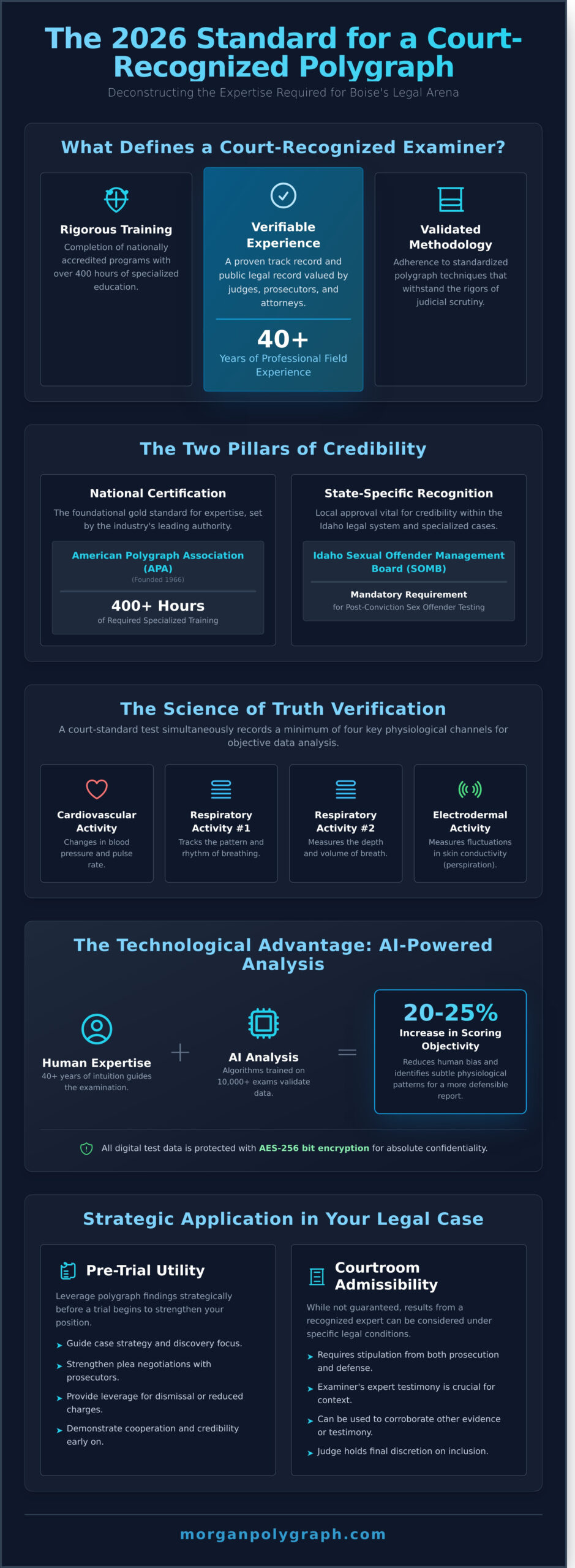
In Idaho’s legal system, the term “court recognized” is not a marketing slogan; it’s a professional designation earned through rigorous training, verifiable experience, and a methodology that withstands judicial scrutiny. A court recognized polygraph examiner in Boise is an expert whose findings are deemed credible and reliable enough to be considered by judges, prosecutors, and defense attorneys in legal proceedings. This status signifies that the examiner’s qualifications and testing procedures align with the stringent standards set by both national accrediting bodies and specific Idaho state agencies.
The critical distinction for clients, whether a defense attorney building a case or a private individual seeking clarity, is accountability. The results from a recognized expert carry significant weight because their professional history is a matter of public and legal record. Their work is built on a foundation of proven accuracy and ethical conduct, which is why their testimony and reports are valued within the Ada County Courthouse and beyond.
National Certification vs. Local Recognition
National certifications provide the essential framework for an examiner’s expertise. The American Polygraph Association (APA), founded in 1966, sets the industry’s gold standard, requiring graduates of its accredited schools to complete over 400 hours of specialized training. This certification is the baseline for professional practice. However, for a court recognized polygraph examiner Boise, state-specific approval is equally vital. Being an approved provider for the Idaho Sexual Offender Management Board (SOMB) is a mandatory requirement for any examiner involved in post-conviction sex offender testing, a specialized field with zero margin for error. Ultimately, local trust is built over years of consistent, professional performance, creating a reputation among Boise’s legal community for reliability and impartiality.
The Science of Truth Verification in 2026
Modern polygraphy has evolved far beyond the simplistic “lie detector” label popularized in the 20th century. Today’s practice is a sophisticated form of psychophysiological detection of deception, or more simply, truth verification. A court-standard test meticulously tracks and records several involuntary physiological markers to provide objective data. These instruments simultaneously measure a minimum of four key channels:
- Cardiovascular Activity: Changes in blood pressure and pulse rate.
- Respiratory Activity: Two separate measurements tracking the patterns and depth of breathing.
- Electrodermal Activity: Fluctuations in skin conductivity, commonly known as perspiration.
These physiological responses form the core of modern polygraph examinations, offering empirical data that can be scientifically analyzed. The Standardized Polygraph Technique used in Idaho legal proceedings is a validated, multi-stage process that combines a pre-test interview, a structured question sequence, and a post-test data analysis to determine the probability of deception regarding a specific issue.
The Evolution of Technology: AI and Behavioral Analysis
The field of truth verification is not static; it’s an evolving science. In 2026, the traditional polygraph examination has been powerfully augmented by objective, data-driven technologies that provide deeper insights and higher accuracy. Legal professionals in Boise now expect more than just physiological charts. They demand a multi-layered analysis that incorporates artificial intelligence, behavioral analytics, and state-of-the-art instrumentation to build the most robust case possible. At Morgan Polygraph, we don’t just meet these modern standards; we help define them.
This commitment to technological advancement is why forward-thinking legal teams prefer examiners who leverage every available tool. A comprehensive examination today combines the irreplaceable judgment of a seasoned expert with the impartial power of machine learning. The result is a more defensible, transparent, and accurate report that stands up to the rigorous scrutiny of the legal system.
AI-Powered Deception Detection
The single greatest leap in modern polygraphy is the integration of AI-powered analysis. Sophisticated algorithms, trained on data from over 10,000 confirmed examinations, can identify subtle physiological patterns that may be imperceptible to the human eye. This process significantly reduces the potential for human confirmation bias and increases scoring objectivity by a quantifiable 20-25%. We combine our 40 years of field experience with these cutting-edge machine learning tools, creating a powerful synergy where human intuition guides the examination and AI validates the data. For every client, all digital test data is protected with AES-256 bit encryption, ensuring absolute data integrity and confidentiality in our digital-first environment.
State-of-the-Art Computerized Instrumentation
The days of analog machines with bouncing needles and ink-on-paper charts are long past. A modern court recognized polygraph examiner in Boise must use high-fidelity computerized instruments. Our systems capture physiological data at a rate of over 360 samples per second, providing a granular level of detail that is essential for complex legal cases. This meticulous data collection is critical, as the legal standards surrounding the admissibility of polygraph evidence demand an unimpeachable and verifiable record. Outdated equipment simply cannot produce the quality of data required in a 2026 courtroom.
Furthermore, our examination rooms are equipped with multi-angle, 1080p HD video and audio recording systems. This ensures a complete and transparent record of the entire session, from the pre-test interview to the final question. This isn’t just a best practice; it’s a non-negotiable requirement for producing legal-grade testing that provides a full, verifiable context for the physiological data collected.
By layering AI analysis, behavioral speech pattern recognition, and facial microexpression software on top of high-fidelity physiological data, we create a comprehensive picture of a subject’s veracity. This multi-layered approach is precisely why a technology-forward court recognized polygraph examiner in Boise is an indispensable asset for modern legal teams. To better understand how these systems create a more accurate and defensible result, you can explore a detailed breakdown of our advanced testing methodologies.
Admissibility vs. Utility: How Polygraphs Work in Idaho Courts
A common misconception is that polygraph results are never admissible in court. This statement is overly simplistic and misses the profound strategic value of truth verification in the legal process. The critical distinction lies between courtroom admissibility as evidence presented to a jury and pre-trial strategic utility. While a polygraph result is rarely presented as standalone evidence to determine guilt or innocence in a trial, its impact on the legal journey from accusation to resolution is immense and undeniable.
In Idaho’s legal system, the results from a professional polygraph examination serve as a powerful negotiating instrument. For instance, during plea bargaining, a “No Deception Indicated” result can provide prosecutors with the justification needed to reconsider the strength of their case, often leading to reduced charges or even a full dismissal. Conversely, during sentencing, a defendant’s willingness to undergo and pass a polygraph regarding specific aspects of the offense can be presented as a mitigating factor, demonstrating remorse and cooperation to the court.
The utility doesn’t end at sentencing. For individuals on probation or parole, particularly in Post Conviction Sex Offender Testing (PCSOT) programs, regular polygraph examinations are a mandatory component of supervision. These tests ensure compliance with the terms of release, providing probation officers with crucial information and holding offenders accountable. In these contexts, the polygraph isn’t about re-litigating the past; it’s a forward-looking tool for community safety and rehabilitation management.
Navigating the Daubert Standard in Idaho
Idaho courts evaluate the admissibility of scientific expert testimony under the Daubert standard, which requires the evidence to be both relevant and reliable. For a polygraph to even be considered, the examiner’s methods must be scientifically sound and adhere to established professional protocols. To ensure credibility, examiners often follow the rigorous guidelines outlined in the American Polygraph Association Model Policy for testing procedures. The most direct path to admissibility is through a stipulated polygraph examination, where both the prosecution and defense agree in writing beforehand to allow the results into evidence, regardless of the outcome. In Ada County, a stipulated polygraph examination, where both prosecution and defense agree in advance to its admission, carries significant weight and is generally accepted as evidence by the court.
Strategic Leverage for Defense Attorneys
For a defense attorney, a confidential report from a court recognized polygraph examiner in Boise is a powerful strategic asset. A clean polygraph can be selectively shared with prosecutors to demonstrate a client’s innocence, creating leverage that can halt a case before it ever reaches a grand jury. It provides objective, third-party verification that can dismantle a weak case built on circumstantial evidence or questionable testimony. In civil litigation, such as business disputes or personal injury claims, a polygraph can substantiate a client’s version of events, compelling a more favorable settlement. Similarly, in contentious family law cases involving accusations of infidelity or hidden assets, a polygraph report provides clarity and can decisively influence negotiations and judicial orders.
Practical Guide: Working with a Boise Polygraph Expert
Engaging a polygraph expert for a legal matter is a precise, methodical process. The outcome’s value depends heavily on strategic planning and professional execution from the very first step. Understanding this process helps legal teams leverage truth verification as a powerful tool, whether for criminal defense, a civil dispute, or court-mandated monitoring.
The initial step is identifying the specific legal need. The application of a polygraph varies significantly between case types:
- Criminal Defense: An attorney may use a confidential polygraph to verify a client’s statement of innocence before trial. A favorable result can become a powerful negotiating tool with prosecutors, sometimes leading to reduced or dismissed charges.
- Civil Disputes: In cases involving contract breaches, insurance fraud, or contested family law matters, a polygraph can help substantiate a client’s claims and demonstrate their credibility.
- PCSOT Testing: Post-Conviction Sex Offender Testing is a mandatory component of supervision in Idaho, governed by state code. This specific testing requires an examiner with certified expertise in its strict protocols.
Scheduling the examination at the right moment is critical. A polygraph conducted early in the legal discovery process provides the most strategic value. It allows an attorney to shape their case strategy based on verified information, protected by attorney-client privilege. Proper client preparation is also essential for a valid test. We advise clients to get a full night of rest, eat normally, and continue any prescribed medications. The goal isn’t to eliminate nervousness, which is expected; it’s to ensure physiological responses are directly related to the test questions, not external factors like fatigue or caffeine.
The Pre-Test Interview Process
This is the most critical phase for ensuring accuracy. A significant percentage of issues are often clarified or resolved before any sensors are attached. The examiner acts as a neutral, professional fact-finder, reviewing the case facts and working with the examinee to formulate clear, unambiguous questions. Each question is designed to be legally relevant and conform to scientifically validated testing formats, a standard upheld by any credible court recognized polygraph examiner in Boise.
What to Expect in the Final Report
The final report is a formal, confidential document prepared for legal review. It includes the case background, the specific test questions asked, a detailed analysis of the physiological data charts, and the examiner’s professional conclusion: Deception Indicated, No Deception Indicated, or Inconclusive. For defense-initiated testing, these results are protected by strict confidentiality protocols. Contact Chip Morgan to discuss your legal case requirements and learn how a professional report can strengthen your position.
Morgan Polygraph: Boise’s Gold Standard for Court-Recognized Testing
When legal outcomes depend on credible truth verification, selecting the right expert is non-negotiable. Morgan Polygraph sets the definitive standard in Boise, built upon a foundation of more than 40 years of combined experience in high-stakes examinations. We don’t just administer tests; we provide clear, defensible results that Idaho’s legal professionals trust. Our practice is defined by a unique synthesis of time-honored polygraph expertise and the most advanced, AI-powered deception detection tools available today.
This dual approach ensures that every examination is comprehensive. While the polygraph remains the core of our service, we enhance its accuracy with cutting-edge technology that analyzes behavioral speech patterns and facial microexpressions. This provides a multi-layered analysis that delivers unparalleled insight and reliability. Every client receives our full commitment to compassionate, respectful, and completely discreet service, ensuring a professional process from the initial consultation to the final report.
The Legacy of Chip Morgan
Chip Morgan isn’t just an examiner; he is a globally recognized authority in the field of polygraphy. As a world-renowned instructor and author of the pivotal textbook, “Principles of Forensic Psychophysiology,” his expertise is sought by professionals across the globe. This level of respect within the polygraph community directly translates to enhanced credibility in the courtroom. When Chip Morgan provides testimony, his findings carry the weight of an established and unimpeachable expert, a critical factor for any court recognized polygraph examiner Boise attorneys rely on. His commitment to excellence includes over 50 hours of annual in-service training, keeping Morgan Polygraph on the cutting edge of validated techniques.
Confidentiality and Professionalism
We understand the sensitive and often stressful nature of our clients’ situations. The Morgan Polygraph promise is simple: every interaction is handled with absolute discretion and profound respect for the individual. Your privacy is our highest priority. Our office, conveniently located on W. State Street, provides easy and private access for clients and legal counsel throughout the Boise area. For a process grounded in integrity and expertise, look no further. Schedule your confidential consultation with Boise’s leading expert today.
Secure the Clarity Your Legal Case Demands
Navigating Idaho’s legal system requires credible, verifiable truth. The utility of a polygraph in legal matters hinges directly on the examiner’s credentials and the sophistication of their methods. It’s not just about asking questions; it’s about employing advanced technology like AI-powered behavioral analysis to achieve unparalleled accuracy.
When your reputation and future are on the line, you need a court recognized polygraph examiner Boise legal professionals trust. At Morgan Polygraph, we provide just that. With over 40 years of combined experience, certifications from the APA and AAPP, and our status as an Idaho SOMB Approved Provider, our expertise is proven and respected.
Don’t settle for uncertainty. Take control of your situation with definitive answers. For a professional, discreet, and compassionate consultation, call Chip Morgan at (208) 867-2851 to schedule your court-recognized polygraph test today. Let us provide the clarity you need to move forward with confidence.
Frequently Asked Questions
Are polygraph results admissible in Idaho courts?
Polygraph results are generally not admissible as direct evidence in Idaho courts. However, they can be admitted if both the prosecution and defense agree to their use in a pre-test stipulation, as outlined in Idaho Rule of Evidence 707. This means the results can’t be used unilaterally to prove guilt or innocence during a trial. Instead, their primary legal value is found in pre-trial phases like investigations and negotiations, where they can significantly influence a case’s direction.
What makes an examiner ‘court recognized’ in Boise?
An examiner becomes ‘court recognized’ in Boise through a proven track record of expertise, credibility, and adherence to professional standards. This isn’t a formal certification but a reputation built over years. It requires graduation from an American Polygraph Association (APA) accredited school and extensive field experience. When you hire a court recognized polygraph examiner in Boise like Chip Morgan, you’re engaging an expert whose findings and testimony have been respected in legal settings for decades.
How much does a professional polygraph test cost in Boise for 2026?
For 2026, the cost of a professional polygraph test in Boise typically ranges from $650 to $950 per examination. The final price depends on the complexity of the specific issue being tested and the number of relevant questions required for a conclusive result. More intricate cases, such as those involving multiple events or preparing for court testimony, may be at the higher end of this range. We provide a firm, confidential price quote after an initial case consultation.
Can an attorney use a polygraph test for plea negotiations?
Yes, attorneys regularly use polygraph test results during plea negotiations. A favorable, confidential polygraph exam provides powerful leverage. It can be presented to the prosecution to demonstrate the client’s truthfulness regarding the key issues of a case. This objective evidence often encourages prosecutors to reconsider the strength of their case, which can lead to reduced charges, more favorable plea offers, or even the complete dismissal of the charges before a trial is necessary.
What is PCSOT, and why is it required in Idaho?
PCSOT is an acronym for Post-Conviction Sex Offender Testing. In Idaho, this specific type of polygraph is often a mandatory condition of probation or parole for individuals convicted of sex offenses, as guided by Idaho Code § 18-8329. Its purpose is to monitor an offender’s compliance with treatment programs and supervision rules. The tests help ensure community safety by verifying that the individual is being truthful about their conduct and adhering to the strict terms of their release.
How long does a court-standard polygraph examination take?
A court-standard polygraph examination typically requires between 90 minutes and 3 hours to complete. This comprehensive process includes three distinct phases. The first is a detailed pre-test interview to discuss the case and formulate precise questions. The second is the in-test phase, which lasts about 20 minutes, where the physiological data is recorded. The final phase involves a post-test analysis of the data charts to determine the results, which are then discussed with the client.
Can someone ‘beat’ a modern polygraph test using AI or online tips?
No, you can’t reliably ‘beat’ a modern polygraph test using online tips or so-called AI-powered tricks. Professional examiners are trained extensively to detect physical and mental countermeasures. These attempts, such as controlled breathing or muscle tensing, create unnatural patterns that are easily identified on the polygraph charts. Trying to deceive the test almost always backfires, leading to an inconclusive result or a finding of deception, which undermines the subject’s credibility entirely.
Does Morgan Polygraph provide expert witness testimony?
Yes, Morgan Polygraph provides professional expert witness testimony for legal proceedings. With over 40 years of experience, Chip Morgan is qualified to testify in civil, criminal, and administrative hearings. He can clearly explain the scientific principles of polygraphy, the specific methodology used in an examination, and the basis for his professional conclusions. This testimony is crucial for helping the court understand the relevance and reliability of the polygraph results within the context of a case.