
What if the truth about your relationship isn’t hidden in a deleted text message, but in the subtle physiological responses only a certified examiner can detect? You’ve likely spent months feeling exhausted by gaslighting and questioning your own reality. It’s a heavy burden to carry when you’re facing a life-altering decision based on nothing but suspicion. You deserve to know exactly how accurate are infidelity polygraph tests before you rely on one to rebuild or resolve your trust.
We understand that uncertainty about the science can be just as stressful as the suspicion itself. Drawing on over 40 years of combined experience at Morgan Polygraph, this 2026 guide reveals the scientific reality behind modern truth verification. We’ll show you how professional testing provides the objective proof you need for closure or reconciliation. You’ll learn about the latest advancements, including how the American Polygraph Association reports accuracy rates exceeding 90 percent for specific-issue diagnostic exams. We’ll also examine how the integration of AI-powered tools ensures a path toward clarity that is both compassionate and technically precise.
Key Takeaways
- Learn why professional examiners achieve 85% to 95% accuracy by distinguishing between active deception and verified truth.
- Understand how accurate are infidelity polygraph tests by exploring the American Polygraph Association’s standards and the science of the autonomic nervous system.
- Discover how modern digital algorithms and physiological monitoring remove guesswork to provide objective relationship clarity.
- Identify the critical factors, such as question formulation and examiner certification, that prevent inconclusive results and ensure test validity.
- Explore how “Full Disclosure” testing serves as a compassionate clinical tool for rebuilding trust and achieving long-term relationship recovery.
The Scientific Reality: How Accurate Are Infidelity Polygraph Tests?
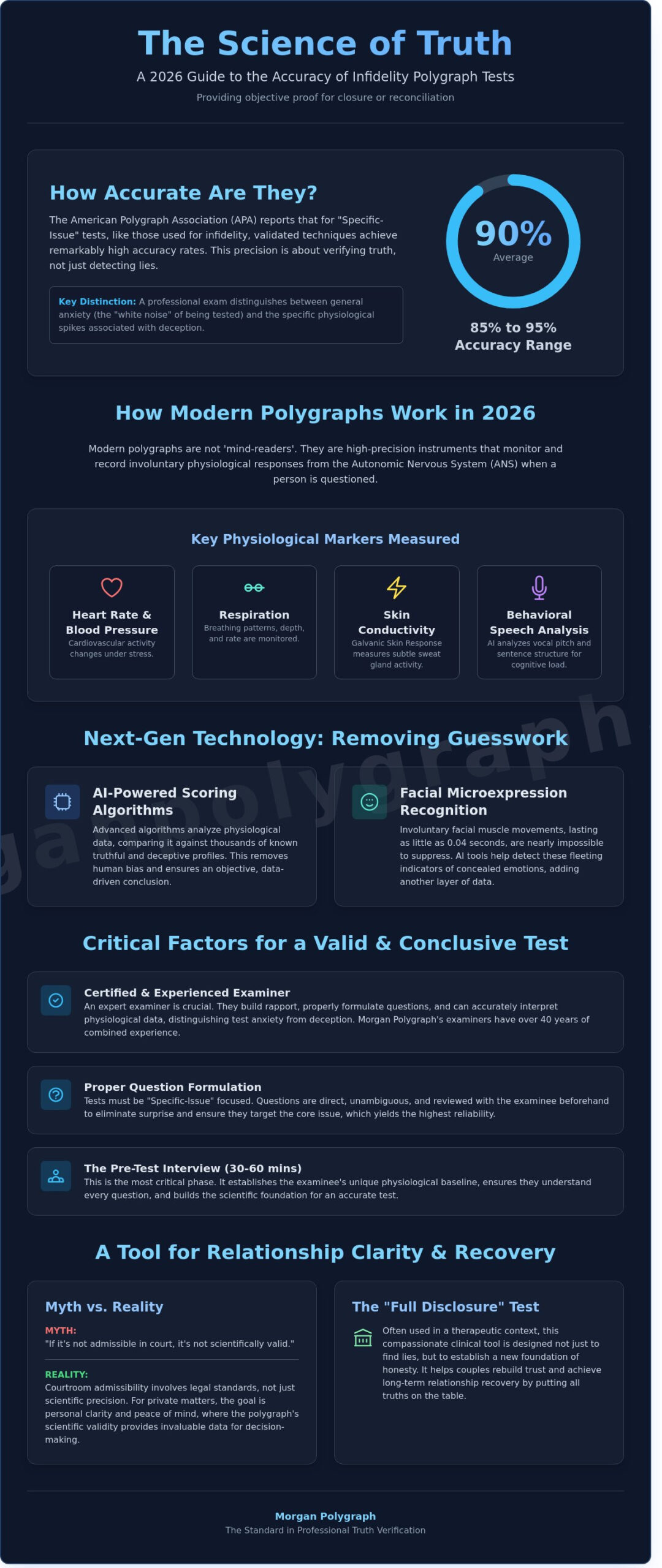
The American Polygraph Association (APA) establishes a clear baseline for professional examinations, rating validated techniques between 85% and 95% accurate. When partners ask how accurate are infidelity polygraph tests, they’re typically seeking a definitive resolution to a period of uncertainty. In the context of relationship testing, accuracy isn’t just about catching a lie; it’s about the precision of truth verification. These exams are classified as “Specific Issue” tests. Unlike general screenings, they focus on a single, defined set of circumstances, which traditionally yields the highest reliability in the field of psychophysiology.
A common hurdle for many is the “inadmissibility” myth. People often assume that because results aren’t always used in criminal trials, they lack scientific validity. This is a misunderstanding of legal standards versus scientific ones. Courtrooms exclude evidence for a variety of procedural and constitutional reasons that don’t reflect the equipment’s precision. For private truth verification, the goal is clarity and peace of mind. With over 40 years of combined experience, our examiners use these tools to provide the data necessary for individuals to make informed decisions about their futures.
Validated Accuracy Rates for Specific Issue Testing
Single-issue testing protocols updated for 2026 consistently achieve accuracy rates exceeding 90% when administered by certified professionals. Compared to other investigative methods, the polygraph offers a unique advantage. A private investigator might capture a photo of a meeting, but they can’t confirm the nature of the interaction. Forensic phone audits are useful but limited to data that hasn’t been scrubbed or encrypted. Modern polygraphy relies on decades of peer-reviewed research to ensure that the results are based on physiological data rather than an examiner’s “gut feeling.”
The Difference Between Deception Detection and ‘Mind Reading’
It’s vital to understand that an examiner isn’t reading your thoughts. The process involves monitoring how modern polygraphs work by recording involuntary physiological stress responses through heart rate, respiration, and skin conductivity. One of the biggest fears clients have is that their natural nervousness will be mistaken for guilt. However, a professionally scored exam distinguishes between the “white noise” of general anxiety and the specific autonomic spikes associated with deception. The pre-test interview is a critical component of this process. It allows the examiner to establish your unique physiological baseline, ensuring that the final score is a reflection of truthfulness rather than just the stress of the situation.
The Science of Truth: How Modern Polygraphs Work in 2026
Modern polygraphs in 2026 function as high-precision instruments that monitor the Autonomic Nervous System (ANS). These systems track heart rate, blood pressure, respiration, and galvanic skin response with microscopic accuracy. The technology has evolved significantly since the early 20th century. We’ve moved from analog charts and ink pens to sophisticated digital algorithms. Morgan Polygraph leads this change by integrating AI-powered deception detection tools. These tools allow for objective data analysis that goes beyond simple observation. The pre-test interview is the most critical phase of this process. It sets the scientific foundation for the entire exam. During this 30 to 60-minute session, the examiner builds rapport and ensures the examinee understands every question. This prevents “surprise” reactions that could skew the results and provides a clear baseline for how accurate are infidelity polygraph tests in domestic settings.
Next-Gen Technology: AI and Behavioral Analysis
AI-driven scoring systems are now standard in high-level truth verification. These algorithms remove human bias by comparing physiological data against thousands of known deceptive and truthful profiles. We supplement traditional data with facial microexpression recognition. These involuntary muscle movements occur in as little as 0.04 seconds and are nearly impossible to suppress. Behavioral speech analysis also adds a layer of certainty. It examines vocal pitch and sentence structure to find markers of cognitive load. This comprehensive tech stack provides a level of detail that was unavailable just a decade ago. The combination of AI and human expertise creates a robust environment for finding the truth in sensitive relationship matters.
Physiological Markers of Deception
Skin conductance is a primary marker because it’s controlled by the sympathetic nervous system. You can’t consciously tell your sweat glands to stay dormant under stress. Cardiographic changes also provide clear signals. Truthful answers usually show a steady heart rate, while deceptive responses often trigger a sudden blood pressure shift. Respiratory patterns are another key indicator. Some individuals attempt countermeasures like “holding their breath” to beat the test. Our experts identify these patterns immediately. When considering the scientific reality of polygraph accuracy, it’s clear that physiological responses are reliable indicators of psychological stress. Understanding these biological responses helps explain how accurate are infidelity polygraph tests when administered by a court-recognized expert. If you’re facing a difficult situation and need clarity, you can contact Chip Morgan to discuss your specific needs in a discreet environment.
Factors That Can Influence (or Compromise) Test Accuracy
Identifying the truth requires more than just a machine. It demands a controlled environment and a highly skilled professional. When people ask how accurate are infidelity polygraph tests, they must realize the data is only as good as the person interpreting it. A 2023 review of forensic protocols highlights that standardized testing procedures are what separate a reliable result from a guess. Several variables can shift the outcome, making it vital to control the testing atmosphere from start to finish.
The Critical Role of the Polygraph Examiner
You should always verify that your examiner holds an APA certification and has court-recognized status. A seasoned expert understands the nuances of human physiology and psychological stress. They know how to create a neutral setting so the examinee’s baseline isn’t skewed by the natural anxiety of the situation. This level of expertise prevents false positives. If you want a professional result, start by finding a certified polygraph near me to ensure you are working with a vetted specialist.
Poorly phrased questions are a primary cause of inconclusive results. We strictly avoid “double-barreled” questions. These are queries that ask two things at once, such as “Did you go to the bar and meet with your ex?” If the person did one but not the other, the brain produces a conflicted physiological signal. Precision in language is non-negotiable for successful truth verification.
The examinee’s physical state also plays a major role in the process. Sleep deprivation of less than five hours or extreme emotional trauma can dull autonomic responses. While medications like beta-blockers might slow a heart rate, they don’t hide the complex patterns of deception that a seasoned expert identifies. We look for a consistent “signature” across multiple channels, which is why the examinee’s condition is assessed before the sensors are even attached.
Common Myths About ‘Beating’ the Test
Many believe the “tack in the shoe” myth. They think causing themselves physical pain will mask a lie by creating a reaction to every question. In reality, physical pain creates a sharp, localized spike on the chart that looks nothing like a deception response. Modern 2026 technology uses AI-powered tools to spot these “atypical” signatures immediately. Modern equipment is designed to differentiate between genuine cognitive load and manual attempts to spike the sensors.
- The ‘Remain Calm’ Fallacy: Meditation or drugs can’t hide involuntary autonomic responses.
- Physical Countermeasures: Biting the tongue or tensing muscles creates recognizable “noise” that examiners are trained to detect.
- Technological Oversight: Current systems use behavioral speech analysis and facial microexpression recognition to back up traditional sensor data.
Trying to manipulate the results is the fastest way to trigger an “intentional manipulation” finding. Our advanced tools and decades of experience allow us to see through these tricks. When considering how accurate are infidelity polygraph tests, remember that the technology is now sophisticated enough to identify the specific physiological markers of someone trying to “beat” the system.
Using Polygraphs for Relationship Clarity and Recovery
Couples often reach a standstill where trust is completely shattered and words no longer carry weight. In these moments, the primary concern is how accurate are infidelity polygraph tests for rebuilding a broken foundation. We view the polygraph as a therapeutic bridge rather than a simple interrogation. It facilitates “Full Disclosure,” a process where the unfaithful partner provides a complete, honest account of past behaviors. This “Clean Slate” protocol is vital. It prevents the devastating cycle of “trickle-truth,” where new information surfaces over months or years, repeatedly re-traumatizing the betrayed spouse.
The Therapeutic Polygraph Process
We work closely with marriage counselors and sex addiction therapists to ensure the exam serves the recovery plan. Before the test, the couple establishes a formal disclosure document. The polygraph then verifies the honesty of that document. For those understanding infidelity tests, this step is about more than catching a lie; it’s about providing the betrayed partner the psychological safety needed to even consider reconciliation. This verification offers a definitive starting point for professional counseling to begin in earnest.
Interpreting the Results: Beyond ‘Pass’ or ‘Fail’
Professional polygraph results are categorized by physiological data. A “No Significant Response” (NSR) indicates no deception was detected, while a “Significant Physiological Response” (SR) suggests the examinee was untruthful. Statistics from the American Polygraph Association show that modern techniques reach accuracy levels between 85% and 95%. However, approximately 10% to 15% of exams result in “Inconclusive” findings. This doesn’t mean someone is guilty. It simply means the physiological data wasn’t clear enough for a definitive call. In these cases, we look at external factors like fatigue or medications and schedule a retest.
The post-test interview is perhaps the most critical stage of the entire process. If a “Deception Indicated” result occurs, the examiner provides the individual an opportunity to clarify their responses. In clinical settings, up to 80% of relevant admissions happen during this structured conversation. This provides the clarity the betrayed spouse needs to make informed decisions about their future. Truth verification offers a sense of relief that years of circular arguments cannot provide.
Boise’s Expert in Infidelity Testing: The Morgan Polygraph Standard
Chip Morgan brings over 40 years of specialized experience to the field of high-stakes truth verification. When clients in Idaho ask how accurate are infidelity polygraph tests, the answer often rests on the examiner’s shoulders. At our Boise office, we don’t just rely on legacy methods. We’ve pioneered a 2026 standard that integrates cutting-edge AI tools with traditional polygraphy. This hybrid approach uses behavioral speech analysis and facial microexpression recognition to support the physiological data collected during the exam.
We use court-recognized protocols for every private client, ensuring that the same rigor applied to criminal cases is used for your relationship matters. This commitment to precision is why Morgan Polygraph remains the trusted choice for those seeking definitive answers in difficult times. By combining veteran experience with modern technology, we provide a level of certainty that helps couples move forward.
Confidentiality and Professionalism in Boise
Our Boise, Idaho office provides a neutral, secure environment for couples facing uncertainty. We understand that these sessions involve deeply personal issues, so we prioritize a compassionate and respectful atmosphere. From the moment you arrive, your privacy is our primary concern. We ensure that no two clients overlap in our waiting area, maintaining total discretion throughout the process. It’s a professional setting designed to put you at ease while maintaining the integrity of the test.
The physical environment is clinical yet welcoming, designed to minimize stress which can sometimes skew results. If you have concerns about the science behind the process, you can read more about are polygraphs accurate to understand the factual reliability of modern lie detection.
Why Experience Matters for Accuracy
Chip Morgan’s status as a nationally certified and court-recognized expert isn’t just a title. It’s a guarantee of quality. Over four decades of testing at the highest levels of law enforcement and private security means he has seen every possible variable. This deep background translates directly to more reliable relationship exams. He knows how to structure questions that eliminate ambiguity and get to the core of the truth.
- Over 40 years of specialized truth verification experience.
- Advanced training in detecting and neutralizing countermeasures.
- Implementation of AI-powered deception detection tools for 2026.
- Strict adherence to American Polygraph Association standards.
When investigating how accurate are infidelity polygraph tests, remember that the technology is only as good as the person operating it. Chip’s extensive history ensures that your results are based on sound science and veteran intuition. Call Chip Morgan today to discuss your situation with total confidentiality.
Restoring Trust Through Scientific Clarity
Understanding how accurate are infidelity polygraph tests is the first step toward emotional recovery. In 2026, truth verification relies on a blend of seasoned expertise and cutting-edge innovation. Successful outcomes depend on the examiner’s ability to mitigate external stressors while utilizing state-of-the-art AI-powered deception detection technology. With 40+ years of combined expert experience, the team at Morgan Polygraph ensures that every session meets the highest professional standards. Our nationally certified and court-recognized examiners provide the objective data needed to move past uncertainty.
You don’t have to carry the weight of doubt alone. Whether you’re seeking to rebuild a marriage or find personal peace, scientific validation offers a clear path forward. Our Boise-based office provides a discreet, compassionate environment where your privacy is the priority. It’s time to replace suspicion with facts and begin the healing process today.
Schedule a Confidential Infidelity Polygraph with Chip Morgan to gain the answers you need. You deserve the peace of mind that comes with the truth.
Frequently Asked Questions
Is it possible for an innocent person to fail an infidelity polygraph due to nerves?
It’s highly unlikely for an innocent person to fail solely due to nerves because the examiner establishes a physiological baseline before asking any relevant questions. When exploring how accurate are infidelity polygraph tests, it’s important to know that professional examiners distinguish between general anxiety and the specific physiological spikes caused by deception. Research from the American Polygraph Association indicates that validated protocols reach accuracy levels between 86% and 90% when conducted by a certified expert.
How long does a typical infidelity lie detector test take?
A standard infidelity examination requires between 90 and 150 minutes to complete in our office. This timeframe includes a 60 minute pre-test interview where Chip Morgan explains the process and reviews every question with the subject. The actual data collection phase, where sensors record physiological responses, usually lasts about 30 to 45 minutes across multiple charts.
Can medications like anti-anxiety pills affect the accuracy of the test?
Medications like anti-anxiety pills or beta-blockers can dampen physiological responses, but they rarely result in a false “pass” for a guilty subject. Our examiners document all substances taken within 24 hours of the test to adjust the analysis accordingly. In roughly 10% of cases involving heavy medication, the results may return as inconclusive rather than definitive; this ensures we don’t provide a misleading or inaccurate report.
What kind of questions are asked during a cheating polygraph?
We only ask direct, closed-ended questions that require a “yes” or “no” answer to ensure maximum precision. You won’t face vague inquiries about feelings or intentions. Instead, we focus on specific actions, such as “Since January 1, 2023, have you had sexual contact with anyone other than your spouse?” All questions are shared with the examinee before the test begins to ensure there are no surprises.
Are the results of a private infidelity test admissible in an Idaho court?
Private infidelity test results are generally not admissible in Idaho courts unless both legal parties sign a written stipulation before the exam. Under Idaho Rule of Evidence 702, judges maintain strict control over scientific evidence. Most clients utilize our services for personal truth verification and relationship resolution rather than for use in a formal 2026 divorce proceeding.
What happens if my partner refuses to take the test or tries to manipulate it?
If a partner refuses the test, the process cannot proceed; however, if they try to manipulate the sensors, our cutting-edge technology will likely catch them. We use motion-sensitive seating and AI-powered behavioral analysis to detect 95% of common countermeasures. If manipulation is detected, the examiner will stop the test and record the attempt as a purposeful non-cooperation in the final report.
How soon can I get the results after the examination is finished?
You can expect to receive your formal, written report within 24 to 48 hours after the session concludes. While Chip Morgan may provide a preliminary verbal consultation immediately following the test, we require time for a methodical review of the charts. This ensures that every data point is verified against our 40 years of combined experience before we issue a final truth verification document.
Is there a difference in accuracy between a ‘cheating’ test and a criminal polygraph?
The fundamental technology remains the same, but the accuracy levels of specific-issue tests, like cheating, are often higher than broad screening exams. When assessing how accurate are infidelity polygraph tests, data from the 2011 Meta-Analytic Survey shows that single-issue exams achieve higher reliability than multi-issue screenings. This is because the subject’s focus is concentrated on one specific event, leading to clearer physiological data for the examiner to analyze.