

When facing a situation that requires absolute clarity, the process of finding answers can feel overwhelming. You need a professional, confidential solution, but simply searching for a “polygraph near me” can leave you with more questions than answers. Who can you trust with such a sensitive matter? How can you be sure the results will be accurate and the process handled with the discretion you deserve? The uncertainty surrounding the examination itself can be intimidating, leaving you unsure of what to expect.
This expert guide is designed to remove that uncertainty and empower you with confidence. We will walk you through the essential steps for finding and choosing a certified, court-recognized polygraph examiner in your area. You will learn what qualifications to look for, what to expect from start to finish, and how to ensure your personal or legal issue is handled with the highest degree of professionalism. Our goal is to equip you with the knowledge to find a reputable expert and get the clear, reliable answers you need.
Step 1: How to Verify the Credentials of a Polygraph Examiner
When you begin your search for a “polygraph near me,” it’s natural to focus on location and cost. However, the most critical factor for an accurate and reliable outcome is the examiner’s credentials. The polygraph is a sophisticated instrument, but its results are only as valid as the professional administering the test. Understanding what a polygraph test entails reveals that it is a complex process combining psychology, physiology, and meticulous interview techniques. Using an uncertified or inexperienced examiner not only risks wasting your money but can also lead to inconclusive or incorrect results, causing further distress and complication.
To ensure you are hiring a true professional, you must perform due diligence. A qualified examiner will be transparent about their background and affiliations. Here is what to look for and the red flags to avoid.
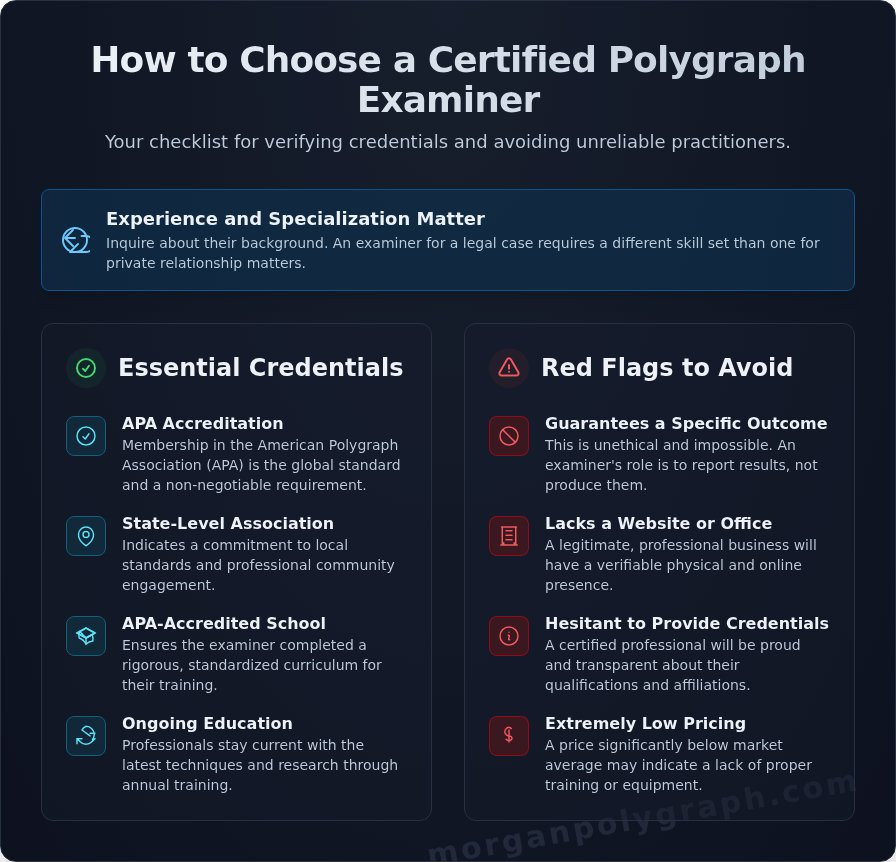
Essential Certifications and Memberships
Professional affiliations are the bedrock of an examiner’s credibility. They signify adherence to strict ethical codes and standardized practices. Before scheduling an appointment, verify the following:
- American Polygraph Association (APA) Accreditation: The APA is the leading professional polygraph organization, setting the global standard for training and practice. Membership is a non-negotiable requirement for any serious examiner.
- State-Level Association Membership: Many states have their own professional polygraph associations. Membership indicates a commitment to local standards and networking within the professional community.
- Graduation from an APA-Accredited School: Ask where the examiner received their training. A diploma from an APA-accredited institution ensures they have completed a rigorous, standardized curriculum.
- Ongoing Education: The field of truth verification evolves. A professional examiner should complete annual continuing education to stay current with the latest techniques and research.
Experience and Specialization Matter
Beyond certifications, an examiner’s practical experience is invaluable. Inquire about their background, specifically asking if they specialize in your area of need. An examiner with a 20-year law enforcement background brings a different, highly valuable skill set to a criminal defense case compared to one who primarily handles private relationship matters. For highly sensitive issues like Post-Conviction Sex Offender Testing (PCSOT), examiners must hold specific, advanced certifications beyond their basic training. Don’t hesitate to ask how many years they have been a full-time examiner and what percentage of their work relates to your specific situation.
Red Flags to Watch Out For
Your search for a qualified polygraph near me should also involve looking for warning signs. Be cautious of any practitioner who:
- Guarantees a specific outcome. This is unethical and impossible. An examiner’s role is to conduct a fair test and report the results, not to produce a desired conclusion.
- Lacks a professional website or physical office. A legitimate business will have a professional presence to build trust. For instance, whether you’re vetting a legal expert or a home service provider, you can discover Division One Plumbing as an example of a company that establishes this credibility online.
- Is hesitant to provide credentials. A certified professional will be proud to share their qualifications and references.
- Offers extremely low pricing. While costs vary, a price significantly below the market average may indicate a lack of proper training, equipment, or adherence to professional standards.
Step 2: Understanding the Types of Polygraph Tests Offered
Polygraph examinations are not a one-size-fits-all service. The nature of your situation dictates the structure, scope, and specific question format of the test. A certified, expert examiner will conduct a thorough pre-test interview to understand your unique circumstances and tailor the examination accordingly. Recognizing your specific need is the first step in narrowing your search for a “polygraph near me” and connecting with a specialist equipped to handle your case with the required expertise. This ensures the right questions are asked to deliver maximum clarity and accuracy.
Different scenarios require distinct approaches. Here are the primary categories of polygraph testing you will encounter:
Legal, Criminal, and Civil Examinations
In the legal arena, polygraph results can provide significant leverage. Defense attorneys frequently use these examinations to verify a client’s testimony, while civil litigation cases may use them to resolve factual disputes. These situations demand an examiner with extensive experience in the legal field, who can produce detailed, professional reports structured for court review and expert testimony. The examiner’s credibility and familiarity with legal procedures are paramount.
Private and Relationship Testing
When trust has been damaged in a personal relationship, a polygraph test can be a powerful tool for achieving resolution. These examinations, often focused on issues of infidelity or other personal matters, are handled with the utmost discretion and complete confidentiality. A professional and compassionate examiner understands the sensitive nature of these situations, working with clients to formulate specific, non-ambiguous questions and facilitating the process with respect.
Pre-Employment and Agency Screening
Government agencies, law enforcement departments, and certain private security firms rely on pre-employment polygraph screening to vet candidates. These tests are strictly regulated by federal laws like the Employee Polygraph Protection Act (EPPA) and are designed to verify a candidate’s background and suitability for a position of trust. This level of screening requires examiners who meet exceptionally high professional standards. It is wise to verify the credentials of any examiner you consider, as licensing bodies maintain stringent requirements. When you need this type of test, your search for a “polygraph near me” should prioritize examiners approved for government and agency work.
Step 3: The Examination Process from Start to Finish
Understanding the polygraph examination process is the most effective way to reduce anxiety and ensure you are properly prepared. A common misconception is that the test is just a few questions asked while connected to a machine. In reality, a professional examination is a structured, multi-stage procedure where the in-test phase is only one component. A hallmark of any trustworthy examiner you find when searching for a polygraph near me is complete transparency about these steps.
The Initial Consultation and Case Review
The process begins not with a test, but with a conversation. This initial, confidential discussion allows you to explain the specific issue you are facing. The expert examiner will listen, ask clarifying questions, and determine if the matter is suitable for truth verification. During this review, all logistics, including scheduling, professional fees, and what to expect on the day of the test, are clearly outlined. Call us for a confidential consultation about your case.
The Pre-Test Interview
Immediately before the examination begins, you will sit down with the examiner for a thorough pre-test interview. The examiner will explain the science behind the polygraph instrument, how the components work, and what they measure. Most importantly, every single question to be asked during the test will be reviewed with you word-for-word. This critical step ensures you fully understand each question, eliminating surprise or confusion. The questions are structured using validated techniques, and you can learn more about the scientific basis for different Types of Polygraph Tests from government-level analysis.
The In-Test (Data Collection) Phase
Once you have agreed on the finalized questions, the in-test phase begins. Several painless sensors will be attached to your body to measure and record physiological responses like cardiovascular activity, respiration, and sweat gland activity. The examiner will then ask the reviewed questions multiple times. This phase is relatively short, typically lasting only 15-20 minutes. Your only responsibility is to sit still and answer each question truthfully.
Post-Test Analysis and Results
After the data collection is complete, the examiner conducts a detailed analysis of the physiological data recorded on the polygraph charts. Using proven scoring methodologies, a professional conclusion is reached regarding the truthfulness of your answers. Results are typically provided verbally in a private setting soon after the analysis, followed by a formal written report. Throughout this entire process, from the first call to the final report, strict confidentiality is maintained.
Step 4: Evaluating the Cost of a Local Polygraph Test
When seeking a truth verification service, cost is a practical and important consideration. However, the price of a polygraph test is directly linked to the quality, accuracy, and professionalism of the examination. The cheapest option is rarely the most reliable. Investing in a certified, experienced examiner is an investment in obtaining a valid and defensible result, protecting you from the damaging consequences of a poorly administered test.
Understanding what you are paying for is the first step toward making an informed decision. A professional test is a comprehensive process, not just a simple procedure.
Factors Influencing Polygraph Prices
The final cost for a polygraph test is not arbitrary. When you search for a polygraph near me, the prices you find are determined by several key factors:
- Nature of the Case: A straightforward, single-issue private matter will typically cost less than a complex corporate, criminal, or legal case that requires extensive pre-test interviews and precise question formulation.
- Examiner’s Expertise: A highly experienced, court-recognized expert with advanced certifications from institutions like the American Polygraph Association (APA) will command a higher fee. You are paying for a proven track record of accuracy and professionalism.
- Geographic Location: Operating costs vary by region. A test in a major metropolitan area may have a different price point than one in a smaller town.
- Reporting Requirements: A verbal confirmation of the results is different from a comprehensive, detailed written report intended for legal proceedings, which requires significant additional time to prepare.
Understanding the Average Cost Range
For private issues, such as relationship or family matters, professional tests generally range from $400 to over $1,500. More complex legal or criminal cases will often exceed this range due to the increased preparation and reporting involved. Be extremely cautious of services advertised for under $300. Such a low price can be a red flag, potentially indicating an unqualified examiner, outdated equipment, or a rushed process that fails to meet industry standards for accuracy.
This principle of value over price applies across many professional services. For example, when homeowners invest in property upgrades like specialized concrete coatings, the durability and quality of the finish are directly tied to the provider’s expertise and materials. To see how professionals detail their process and value, you can learn more on their site.
Ultimately, the price of a professional polygraph reflects the examiner’s deep expertise, the time dedicated to your specific case, and the assurance of a confidential and methodically conducted examination. For a transparent discussion of costs related to your situation, it is best to consult directly with a certified firm. You can learn more about professional testing standards by visiting morganpolygraph.com.
Why Choose Morgan Polygraph for Your Needs in Boise, Idaho
When your search for a reliable polygraph near me leads you to seek answers in the Treasure Valley, it’s crucial to choose a service with local roots and unparalleled expertise. For private citizens, legal professionals, and businesses across Idaho, Morgan Polygraph stands as the trusted local choice. We combine decades of field experience with state-of-the-art technology to provide truth verification services that are both accurate and discreet.
Our commitment is to handle every case with the highest degree of professionalism, compassion, and respect. We understand the sensitive nature of your situation and are dedicated to providing clarity in a confidential and supportive environment. Our examiners are not just technicians; they are court-recognized experts dedicated to upholding the strictest ethical and professional standards.
Local Expertise You Can Trust
As a cornerstone of the Boise community, we possess a deep and practical understanding of Idaho’s legal landscape. Our nationally certified examiners have decades of experience serving attorneys, therapists, and private individuals from our convenient and professional Boise office. This local presence means we are not just a service provider but a respected part of the community we serve, accountable to our clients and neighbors.
A Commitment to Confidentiality and Accuracy
Your privacy is our highest priority from the first call to the final report. We ensure complete discretion throughout the entire process. Our commitment to accuracy is unwavering, which is why we utilize modern, computerized polygraph systems and adhere to methods validated by the latest scientific research. After the examination, you will receive a clear, unbiased, and professional report detailing the findings, giving you the concrete information you need.
Ready to Find the Truth?
Don’t let uncertainty or suspicion control your life any longer. Taking the step to verify the truth can provide the peace of mind and resolution you need to move forward. At Morgan Polygraph, we are here to provide definitive answers from a trusted expert. We offer a path to clarity with professionalism and integrity at every step.
To learn more or to schedule an appointment, Contact Chip Morgan for a confidential consultation today.
Your Final Step to Finding Clarity and Truth
Finding a certified polygraph near me is a significant decision that demands careful research. This guide has equipped you with the essential knowledge to make an informed choice, from verifying an examiner’s credentials and understanding different test types to navigating the examination process itself. By focusing on professionalism, certification, and transparent communication, you can confidently select a service that meets the highest standards of accuracy and integrity.
For residents of Boise, Idaho seeking unparalleled expertise, Morgan Polygraph is the definitive choice. Our commitment to truth verification is backed by over 40 years of combined experience. Each of our examiners is nationally certified and court-recognized, ensuring the results we provide are credible and defensible. We understand the sensitive nature of your situation, which is why we guarantee strict confidentiality for every client, handling your case with the discretion and respect it deserves.
Don’t let uncertainty linger. Take the next step toward resolution with a team you can trust. Schedule a Confidential Consultation with Our Boise Experts today and find the peace of mind that comes with knowing the truth.
Frequently Asked Questions
How long does a complete polygraph examination take?
A professional polygraph examination is a comprehensive process, typically lasting between two to three hours. This duration is not just for the test itself but includes three critical phases: a detailed pre-test interview to discuss the issue and review questions, the in-test phase where data is collected, and a post-test review to discuss the results. This methodical approach ensures accuracy and allows for a complete and fair assessment of the examinee’s responses.
Are polygraph test results admissible in court?
The admissibility of polygraph results varies significantly by jurisdiction and the specific circumstances of a case. In many state and federal courts, polygraph evidence is not directly admissible due to legal precedent. However, results are frequently used in pre-trial negotiations, plea agreements, and internal investigations. They can also be admitted if both the prosecution and defense agree to it beforehand through a legal stipulation, making them a valuable tool in the legal process.
Is the polygraph process completely confidential?
Yes, confidentiality is a cornerstone of professional truth verification services. The entire process, from the initial consultation to the final report, is held in the strictest confidence. When you search for a professional “polygraph near me,” you must be assured that your privacy is protected. Results are disclosed only to the client who arranged the examination or to other parties, such as an attorney, with the client’s explicit written consent. Your sensitive information is always handled with discretion.
Can anxiety or nervousness affect my polygraph results?
It is completely normal to feel nervous about taking a polygraph test, and certified examiners are trained to account for this. A professional examiner understands the difference between general anxiety and the specific physiological reactions that are indicative of deception. The pre-test interview helps establish your unique baseline responses, allowing the examiner to accurately interpret the data collected during the examination. Your natural nervousness will not cause you to fail the test.
What kind of questions will be asked during the test?
The questions are developed collaboratively during the pre-test interview. There will be no surprise questions. Generally, three types are used: irrelevant questions (e.g., “Is your name John?”), diagnostic control questions (e.g., “Have you ever told a lie?”), and the relevant questions that pertain directly to the specific issue being investigated. Every relevant question is reviewed with you for clarity and understanding before the examination begins to ensure a fair and accurate process.
Can I be forced to take a lie detector test?
In most situations, no, you cannot be forced to take a polygraph test. For civil or private matters, participation must be completely voluntary. In the context of employment, the Employee Polygraph Protection Act (EPPA) of 1988 severely restricts most private employers from using lie detector tests for pre-employment screening or during the course of employment. There are limited exceptions for specific industries like security services and pharmaceutical manufacturing, but consent is still required.