

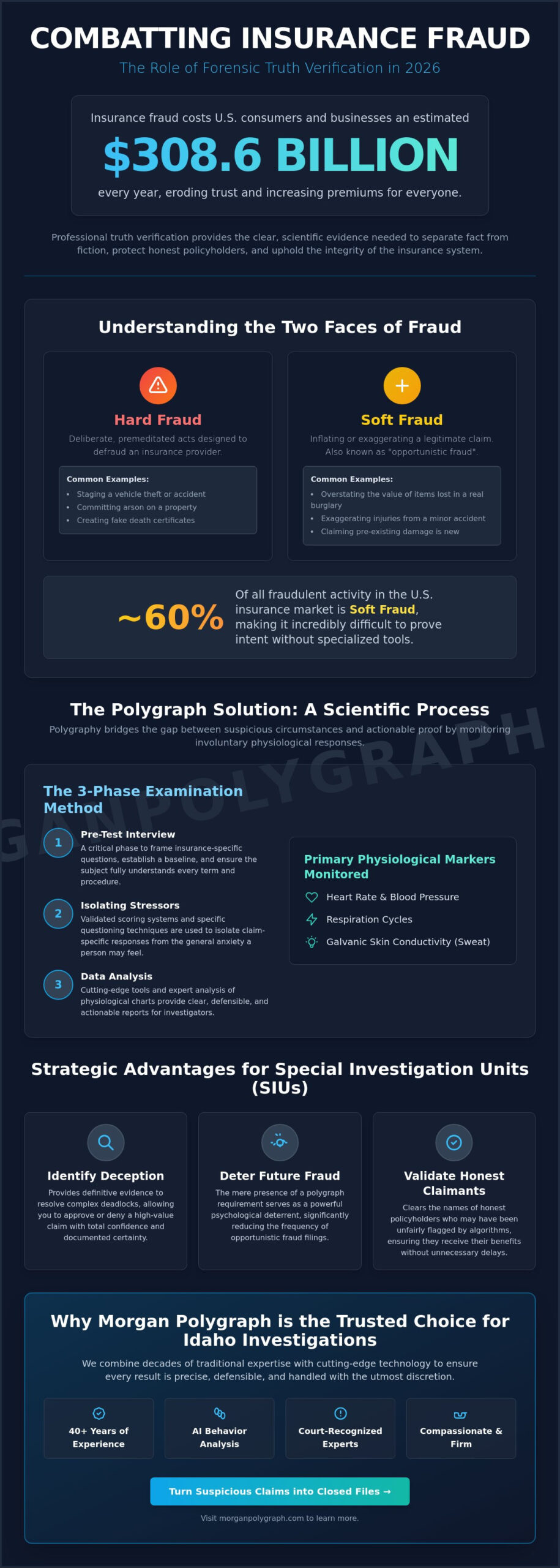
Insurance fraud costs U.S. consumers and businesses an estimated $308.6 billion every year, according to data from the Coalition Against Insurance Fraud. You likely feel the daily pressure of managing high-value claims in Idaho where “soft fraud” makes proving intent feel nearly impossible. Utilizing a professional polygraph for insurance claim investigation helps you strike the right balance between the corporate need for a quick settlement and your professional duty to conduct a rigorous investigation into suspicious activity.
This 2026 expert guide shows you how professional truth verification provides the clear, scientific evidence needed to approve or deny a claim with total confidence. At Morgan Polygraph, we combine over 40 years of traditional expertise with cutting-edge AI behavior analysis to ensure every result is precise and defensible. You’ll learn how our court-recognized reports help identify deception early, provide a powerful deterrent against future fraudulent filings, and offer a compassionate yet firm approach to truth verification. We’ll walk through the specific protocols that turn a suspicious claim into a closed file with documented certainty.
Key Takeaways
- Understand how forensic truth verification addresses the $308 billion annual insurance fraud crisis by separating fact from fiction in high-stakes claims.
- Discover the strategic advantages of utilizing a polygraph for insurance claim investigation to resolve complex deadlocks within Special Investigation Units (SIUs).
- Learn to distinguish between opportunistic “soft fraud” and premeditated “hard fraud” to identify deliberate fabrication in arson and theft cases.
- Navigate Idaho’s specific legal landscape for civil claim verification and the necessity of hiring court-recognized experts for insurance reports.
- Explore how the integration of local expertise and over 40 years of experience ensures accuracy and discretion in every Idaho-based investigation.
The Role of Polygraph Testing in Modern Insurance Fraud Investigations
Insurance fraud is not a victimless crime; it is a $308 billion annual crisis according to data from the Coalition Against Insurance Fraud. To combat this, the polygraph for insurance claim investigation has emerged as a vital forensic tool for verifying high-stakes claims. While modern digital systems are excellent at flagging statistical anomalies, they cannot confirm a claimant’s intent or the physical reality of an event. Professional truth verification fills this gap by providing a scientific method to validate the human element of a claim.
At Morgan Polygraph, we treat every case with the discretion and expertise required in such sensitive matters. A polygraph isn’t just a test; it’s a specialized forensic process designed to protect the integrity of the insurance pool. By using court-recognized techniques, we help adjusters distinguish between legitimate losses and fraudulent attempts to exploit the system.
The Evolving Landscape of Insurance Fraud in 2026
By 2026, sophisticated fraud rings have learned to exploit automated claims processing through synthetic identities and deepfake documentation. These groups often bypass traditional algorithms that look for simple patterns. We’ve also seen a rise in “soft fraud,” where otherwise honest individuals exaggerate their losses by 20% to 30% to cover deductibles. The 2026 fraud landscape is a battle of technologies where human expertise must validate digital flags. When an AI flags a claim as “suspicious,” a polygraph for insurance claim investigation provides the definitive evidence needed to close the file or proceed with payment.
The Science of Truth Verification for Claimants
To understand the value of this tool, it is helpful to first review What is a Polygraph? and its history in forensic science. The instrument monitors three primary physiological markers: heart rate, respiration cycles, and galvanic skin conductivity. These markers are controlled by the autonomic nervous system, which reacts when a person attempts to deceive an examiner about a specific event.
Our expert examiners use a methodical approach to ensure accuracy:
- The Pre-Test Interview: This phase is critical for framing insurance-specific questions and ensuring the subject understands every term.
- Isolating Stressors: We use validated scoring systems to isolate claim-specific responses from the general anxiety a person feels during a test.
- Data Analysis: We utilize cutting-edge tools to analyze physiological charts, providing clear and actionable reports for investigators.
The mere presence of a polygraph requirement also serves as a powerful psychological deterrent. When claimants know their statements will face expert scrutiny, the frequency of opportunistic exaggerations drops. This process doesn’t just catch fraud; it clears the names of honest policyholders who may have been unfairly flagged by an algorithm, ensuring they receive their benefits without unnecessary delays.
Hard Fraud vs. Soft Fraud: How Polygraphy Separates Fact from Fiction
Insurance fraud isn’t a monolith. It splits into two distinct categories: hard and soft. Hard fraud involves deliberate, premeditated acts like staging a vehicle theft or burning a warehouse to collect a payout. Soft fraud, which accounts for roughly 60% of fraudulent activity in the U.S. insurance market, involves inflating a legitimate claim. This might look like a claimant overstating the value of items lost in a real burglary or exaggerating a neck injury from a minor fender bender. Using a polygraph for insurance claim investigation helps examiners peel back these layers of deception by focusing on the element of intent.
The DOJ Polygraph Technique provides a structured framework for these examinations. It ensures the pre-test interview and questioning phases focus on the claimant’s specific knowledge and intent. It’s not just about the act; it’s about whether the claimant knowingly provided false information to secure a payout. Truth matters. Evidence is key. A polygraph bridges the gap between suspicious circumstances and actionable proof.
Investigating High-Value Property and Arson Claims
In arson cases, the “point of origin” is a critical point of contention. A 2023 report by the National Fire Protection Association noted that intentional fires caused $1.2 billion in direct property damage. A polygraph verifies if a claimant’s account of the fire’s start matches the physical evidence found by fire marshals. For high-end theft, examiners verify the existence and historical value of “stolen” assets. In one 2024 Idaho case, a claimant reported $50,000 in stolen jewelry after a residential burglary. The polygraph examination revealed the “break-in” was an inside job, and the items had been sold months prior to the reported theft.
Personal Injury and Workers Compensation Verification
Malingering, or the deliberate faking of physical symptoms, is the most common form of soft fraud. While medical experts assess physical limits, a polygraph tests the honesty of self-reported pain levels. If a claimant says they can’t walk without assistance, but investigators have footage of them performing yard work, the polygraph identifies the deliberate fabrication. Examiners work alongside medical professionals to provide a holistic view of claimant credibility. This process ensures that legitimate claimants receive their benefits while fraudulent actors are identified. If you’re managing a complex claim, you can consult with a certified examiner to discuss your specific needs.
SIU Integration: When to Request a Polygraph Exam
Special Investigation Units (SIUs) utilize truth verification technology to move cases past investigative deadlocks. When a 60-day investigation yields conflicting statements and zero physical evidence, the polygraph for insurance claim investigation serves as a decisive pivot point. It isn’t just about identifying fraud; it’s a strategic tool for “claimant defense.” This process clears innocent policyholders who find themselves caught in suspicious circumstances through no fault of their own. Professional, compassionate, and respectful interactions during the exam help maintain the insurer’s relationship with honest clients while protecting the bottom line.
Strategic timing is essential for cost-effectiveness. Requesting an exam within the first 30 days of a suspicious claim often prevents the accumulation of massive legal expenses. If an SIU waits until the final verification stage, they risk potential bad faith litigation. A professional examiner provides the clarity needed to settle legitimate claims quickly or deny fraudulent ones with confidence. Results from these exams significantly shift the leverage during settlement negotiations, often leading to a voluntary withdrawal of the claim when deception is indicated.
Red Flags That Trigger a Polygraph Referral
Adjusters must identify specific indicators before moving to a formal referral. Inconsistencies between a recorded statement and a written proof of loss are common starting points. Claims filed within 14 days of a policy inception or a significant coverage increase also warrant closer scrutiny. When physical evidence is absent, the human element becomes the primary source of data. Understanding the admissibility of polygraph examination results helps SIU directors determine the weight these findings carry in broader legal contexts, even if used primarily as an investigative guide.
- Selective Amnesia: The claimant remembers complex details that support the loss but forgets basic, neutral facts about the day of the incident.
- Pressure Tactics: Making aggressive demands for immediate payment or threatening legal action before the standard 30-day review period ends.
- Technical Expertise: Using advanced insurance industry jargon or specific legal terminology that a typical policyholder wouldn’t know.
- Documentary Resistance: Refusing to sign medical or financial releases while simultaneously demanding a high-value settlement.
- Hyper-Vigilance: Providing an overly rehearsed narrative that doesn’t vary even slightly across multiple interviews, suggesting a scripted story.
Collaboration Between Examiners and Private Investigators
The examiner doesn’t work in a vacuum. Effective polygraph for insurance claim investigation relies on data provided by private investigators and field agents. Surveillance footage from a specific date, such as October 12, provides the “ground truth” used to calibrate the exam questions. If open-source intelligence (OSINT) findings show the claimant active on social media while claiming total physical disability, the examiner integrates these discrepancies into the physiological monitoring phase. This synergy between field intelligence and behavioral analysis ensures the highest level of accuracy. At Morgan Polygraph, we combine decades of experience with innovative tools to ensure every result is backed by comprehensive, multi-layered data.
Legal Admissibility and the Insurance Polygraph in Idaho
Idaho’s legal framework for truth verification depends heavily on the context of the case. While criminal courts often restrict results without a prior agreement, civil litigation offers more flexibility. In the context of a polygraph for insurance claim investigation, the primary goal isn’t always trial admissibility. Instead, insurers use these tests to establish the “reasonableness” of their investigation. This is a critical defense against claims of a biased or incomplete review process.
Adhering to Idaho Rules of Evidence 702 is vital. This rule dictates that expert testimony must be based on sufficient facts and reliable methods. Using a court-recognized expert ensures the report carries the necessary weight during depositions or settlement negotiations. In many instances, parties enter into a “stipulated polygraph.” This is a written agreement where both the insurer and the claimant agree to the exam and its subsequent admissibility in court. These agreements are common in high-stakes casualty or arson cases where physical evidence is inconclusive.
- Idaho Rule 702: Requires examiners to demonstrate scientific reliability.
- Civil Standards: Focuses on the insurer’s duty to investigate claims thoroughly.
- Stipulations: Pre-test agreements that define how results will be used in litigation.
Working with Defense Attorneys and Corporate Counsel
Defense teams need reports that don’t crumble during cross-examination. Our examiners provide detailed, defensible documentation that tracks every physiological response. This level of detail is essential for avoiding “bad faith” litigation. By utilizing a polygraph for insurance claim investigation, counsel can demonstrate that the insurer took every possible step to verify the facts. Legal professionals can find more technical details in this attorney guide to polygraphs. We focus on providing objective data that supports a clear “pass” or “fail” based on validated scoring algorithms.
The Ethics of Insurance Testing
Ethical testing is the foundation of our practice. Every claimant must provide voluntary, written consent before an exam begins. They’re informed of their rights, including the right to terminate the session at any time. We maintain strict confidentiality in accordance with Idaho state regulations and professional standards. The examiner’s role is that of a neutral third party; we don’t work for the “win,” we work for the truth. This objectivity ensures that the claimant’s rights are respected while the insurer gets the clarity they need to process the claim fairly. Data security is handled with the same level of precision, ensuring sensitive behavioral speech analysis and physiological data remain protected.
Protect your investigation from legal challenges by hiring a veteran examiner. Consult with a court-recognized expert today to ensure your reports are defensible.
Why Morgan Polygraph is the Trusted Choice for Idaho Investigations
Morgan Polygraph brings over 40 years of combined expertise to every polygraph for insurance claim investigation. This deep experience isn’t just a statistic. It represents thousands of hours spent in high-stakes environments where accuracy is the only acceptable outcome. Based in Boise, the firm offers a distinct local advantage for Idaho-based insurers while maintaining national certification standards. Chip Morgan is a court-recognized expert who understands the regional legal landscape and the specific needs of local adjusters. The team prioritizes professional, compassionate, and respectful interactions with every subject. This human-centric approach reduces unnecessary anxiety, which leads to clearer physiological data and more reliable results.
The Future of Deception Detection: AI and Beyond
By 2026, truth verification has moved far beyond traditional needle movements on a chart. Morgan Polygraph integrates facial micro-expression recognition to detect subtle muscle movements that the human eye can easily miss. We also incorporate behavioral speech analysis into the interview phase of the polygraph for insurance claim investigation. This technology analyzes vocal frequencies to identify shifts in cognitive load that often signal deception. While these digital tools can boost detection precision by over 12 percent, technology alone isn’t a silver bullet. You still need a seasoned human examiner to interpret these signals. Chip Morgan ensures that AI serves as a powerful support system, not a replacement for professional judgment and decades of investigative intuition.
Scheduling an Investigation in Boise
Special Investigation Units (SIUs) and defense attorneys can book an exam through a straightforward, methodical process. First, a preliminary consultation determines the specific scope of the investigation. Second, the exam is conducted in a controlled, professional environment at the Boise office. Finally, a comprehensive report is delivered, typically within 24 to 48 hours of the exam. This professional report includes:
- A detailed summary of the pre-test interview and any statements made.
- The exact questions utilized during the physiological recording phase.
- A clear, expert opinion regarding the subject’s truthfulness.
- A breakdown of the numerical scoring used to reach the conclusion.
If you’re currently finding a certified polygraph near me, you need a partner who balances futuristic tech with traditional investigative rigor. Don’t leave the integrity of your claim to chance or uncertified examiners. Contact Chip Morgan to discuss your insurance case today and secure the expert testimony your investigation requires to move forward with confidence.
Protect Your Assets with Advanced Truth Verification
Modern fraud detection requires a strategic blend of seasoned expertise and 2026 technology. Utilizing a polygraph for insurance claim investigation allows SIU teams to effectively separate hard fraud from soft fraud with scientific precision. In Idaho, where legal admissibility standards are specific, working with court-recognized experts ensures that your findings remain robust and professional. This systematic approach reduces ambiguity in high-stakes claims and provides the clarity needed for final resolutions.
Morgan Polygraph offers over 40 years of combined truth verification experience to help you navigate these sensitive matters. Our team utilizes state-of-the-art AI-powered deception detection tools alongside traditional methods to provide unmatched accuracy. We maintain a discreet, compassionate environment while delivering the authoritative results your firm requires to close cases confidently. You’ll benefit from the insights of nationally certified specialists who are respected across the Pacific Northwest for their methodical approach.
Discuss your insurance investigation with Chip Morgan today to secure the clarity your organization deserves. It’s time to put these innovative tools to work for your team.
Frequently Asked Questions
Is a polygraph test admissible in an Idaho insurance court case?
Polygraph results aren’t typically admissible in Idaho courts unless both parties sign a written stipulation beforehand. While the Idaho Supreme Court has maintained this stance since the 1954 State v. Pusch ruling, these tests remain vital investigative tools. Insurance companies use them to verify truth during the initial claim phase rather than as trial evidence. This helps resolve disputes before they reach a courtroom.
Can an insurance company force a claimant to take a lie detector test?
An insurance company can’t legally force you to take a lie detector test, but your policy’s cooperation clause might require it. If you refuse, the insurer could deny the claim for failing to cooperate with the investigation. Statistics from the Coalition Against Insurance Fraud show that 95 percent of policies include language requiring claimants to assist in verifying losses. You should review your specific policy language or consult legal counsel.
How accurate are polygraph tests for detecting insurance fraud?
A polygraph for insurance claim investigation yields accuracy rates between 80 and 95 percent when conducted by a certified examiner. At Morgan Polygraph, we enhance these results using AI-powered tools that analyze behavioral speech and facial microexpressions. The American Polygraph Association reports that modern validated techniques significantly reduce the margin of error. This combination of traditional sensors and new technology ensures a highly reliable truth verification process.
What happens if a claimant fails a polygraph test during an investigation?
Failing a polygraph often leads to an immediate denial of the insurance claim and a referral to the Special Investigative Unit. In 2023, insurance fraud cost the industry roughly 308 billion dollars, prompting companies to take failed tests seriously. An examiner will usually offer the claimant a chance to explain the physiological reactions before finalizing the report. This document then serves as a foundation for further legal or administrative action.
How long does an insurance-related polygraph examination take?
A standard insurance-related examination takes between 2 and 4 hours to complete. This timeframe includes the pre-test interview, the actual data collection phase, and the post-test analysis. We don’t rush the process because precision requires a calm and methodical environment. Our examiners spend at least 60 minutes just on the initial interview to ensure the claimant understands every question before the sensors are even attached.
What kind of questions are asked during an insurance fraud polygraph?
Examiners ask direct, closed-ended questions that require a simple “yes” or “no” response. These questions focus on specific facts like, “Did you intentionally set fire to the property on July 14?” or “Do you know who took the vehicle?” We avoid open-ended or ambiguous phrasing to ensure the physiological data is clear. Every question is reviewed with the claimant beforehand so there are no surprises during the test.
Do polygraphs work for “soft fraud” like exaggerated medical symptoms?
Polygraphs are effective for investigating “soft fraud” like exaggerated medical symptoms or inflated property values. By asking specific questions about the claimant’s daily activities or the original condition of the items, we can detect deceptive patterns. The 2024 Insurance Fraud Report indicates that soft fraud accounts for 60 percent of all fraudulent claims. Using truth verification helps distinguish between legitimate suffering and calculated exaggeration.
How much does an insurance claim polygraph investigation cost?
The cost of a polygraph for insurance claim investigation varies based on the complexity of the case and the examiner’s experience level. While we don’t list specific fees here, industry data from the American Association of Police Polygraphists suggests professional private exams typically range from 500 to 1,500 dollars. For a precise quote tailored to your specific investigation needs, it’s best to call Chip Morgan directly to discuss the details of the case.