
What if the most effective tool for your criminal defense isn’t a piece of evidence that a jury ever sees? While many defendants feel trapped by the prosecution’s narrative, a professional Nampa polygraph for plea bargain negotiations can fundamentally shift the power balance before you ever step foot in a courtroom. You’re likely facing the crushing weight of trial risks and the uncertainty of Idaho’s strict evidence rules. It’s a stressful position where the stakes couldn’t be higher.
At Morgan Polygraph, we understand this pressure and provide the expert, discreet truth verification you need to regain control. This guide reveals how to use a polygraph to secure reduced charges or even a dismissal, despite the fact that Idaho Administrative Code requires all parties to stipulate to admissibility. We’ll explore the strategic use of our 90% accuracy rate in criminal investigations and how cutting-edge AI tools, like facial micro-expression recognition, are redefining truth verification in 2026. You’ll learn exactly how to turn a private examination into a powerful bargaining chip for a more favorable plea agreement.
Key Takeaways
- Discover how truth verification serves as a powerful discovery tool to shift the narrative in your favor before a case reaches the courtroom.
- Learn why a Nampa polygraph for plea bargain negotiations can provide the specific leverage needed to secure reduced charges or a full dismissal.
- Understand the strategic difference between Idaho court admissibility and the tactical use of stipulated results to influence a prosecutor’s decision.
- Get a clear breakdown of the 2-3 hour examination process so you can approach the testing day with confidence and clarity.
- Find out why working with a court-recognized expert like Chip Morgan adds indispensable credibility to your criminal defense strategy.
The Strategic Role of Polygraphs in Nampa Criminal Defense
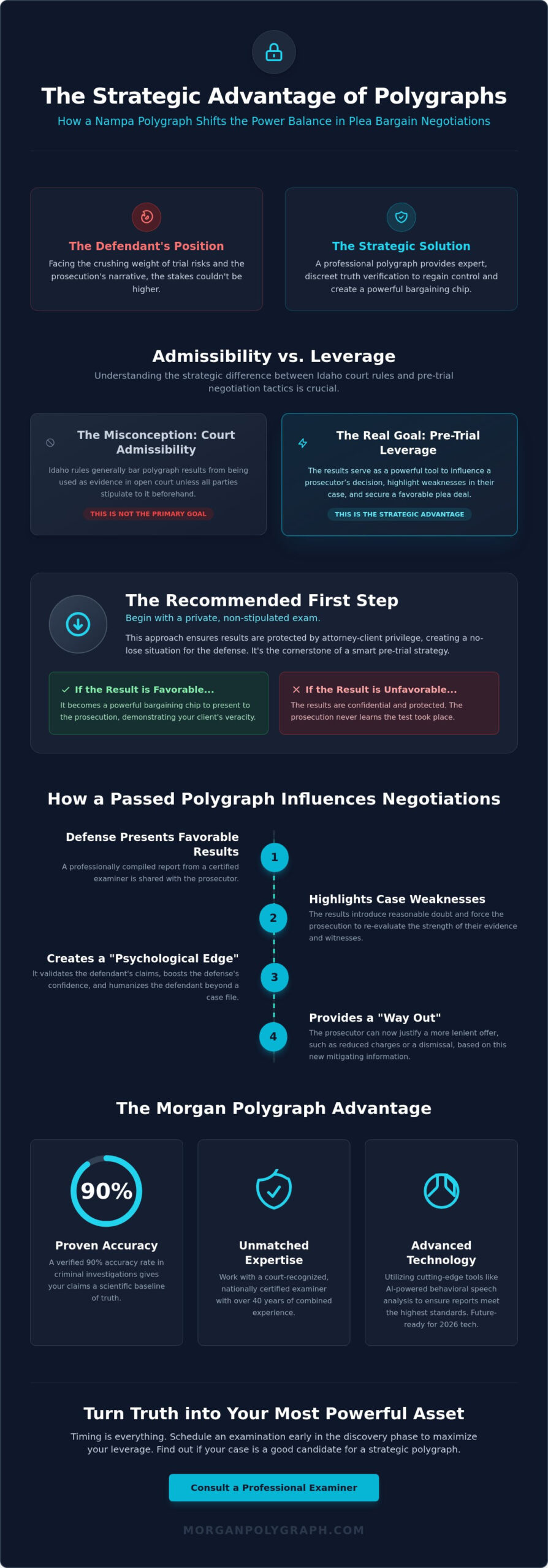
In the Idaho legal system, the path to a favorable resolution often begins long before a jury is seated. For defendants in Canyon County, a Nampa polygraph for plea bargain negotiations serves as a sophisticated discovery tool. While Idaho Administrative Code generally bars polygraph results from open court, they remain a staple of pre-trial strategy. The distinction between a stipulated and non-stipulated exam is the first hurdle for any defense team. A stipulated exam means both the defense and the prosecution agree ahead of time that the results will be admissible, regardless of the outcome. Most strategic defense attorneys, however, begin with a private, non-stipulated exam. This approach ensures that the results are protected by attorney-client privilege. If the results are favorable, they become a powerful bargaining chip; if they aren’t, the prosecution never learns the test took place.
At Morgan Polygraph, we provide the technical expertise required for high-stakes felony and misdemeanor cases. Polygraph examinations offer a scientific baseline of truth that can stabilize a defense narrative. When a defendant is facing years of incarceration, the ability to present a passed examination to a prosecutor can change the entire trajectory of the case. It isn’t just about proving total innocence; it’s about verifying specific elements of a story that might lead to reduced charges or the dismissal of the most serious counts.
Leveraging Truth in Canyon County Courts
The legal community in Nampa and Caldwell is tight-knit, and reputation matters. Prosecutors in Canyon County are often managing heavy caseloads and look for “mitigating factors” that justify a departure from standard sentencing or charging guidelines. When a defense attorney presents a report from a nationally certified examiner with over 40 years of combined experience, it carries weight. We use advanced technology, including AI-powered behavioral speech analysis, to ensure our reports meet the highest standards of credibility. This professional rigor gives prosecutors a “way out” on cases where the evidence is thin or the defendant’s intent is in question.
The “Psychological Edge” in Plea Negotiations
A successful Nampa polygraph for plea bargain negotiations provides a psychological shift for both sides of the table. For the defense attorney, a passed test validates their client’s claims and increases their confidence during aggressive bargaining. It forces the prosecution to re-examine the reliability of their own witnesses and the strength of their physical evidence. Beyond the data, these results help humanize the defendant. Instead of being just another file on a desk, the defendant becomes a person who has proactively sought to verify their truth, often making the prosecution more amenable to a more compassionate plea agreement.
How a Polygraph Examination Influences Plea Bargain Negotiations
Negotiations in the Canyon County legal system are often about risk management. A Nampa polygraph for plea bargain negotiations provides the objective data a prosecutor needs to justify a lenient offer. While the Idaho Rules of Evidence generally prohibit polygraph results in a trial setting, the rules of the bargaining table are different. Here, the goal is to establish a baseline of innocence regarding specific criminal elements that the state might struggle to prove beyond a reasonable doubt. It’s about providing concrete reasons to doubt the prosecution’s narrative before it reaches a jury.
Prosecutors don’t like to lose. If a defense attorney presents a certified report showing a 90% accuracy rate in truth verification, it highlights the inherent weaknesses in the state’s case. It provides the deputy prosecutor with a “way out.” They can tell their supervisors that new, mitigating information has come to light. This makes a dismissal or significant reduction the most logical path forward. This strategy is particularly effective when the case relies heavily on a single witness with their own credibility issues.
Timing is everything. You should schedule the examination as early as possible, ideally during the discovery phase or before the preliminary hearing. This allows your attorney to use the results as a preemptive strike. If you’re currently facing charges, it’s helpful to consult with a professional examiner to determine if your specific case is a good candidate for testing. Early results can lead to reduced sentencing or even placement in alternative programs like drug court or mental health court.
Step-by-Step: The Negotiation Workflow
Success requires a methodical approach to ensure the results are both confidential and impactful.
- Step 1: Attorney-directed referral. Your lawyer must request the test. This ensures all communications remain protected under attorney-client privilege.
- Step 2: Pre-test consultation. We work with your counsel to narrow down issue-specific questions. This prevents a “fishing expedition” and focuses solely on the core charges.
- Step 3: Conducting the examination. We use state-of-the-art technology to conduct a Nampa polygraph for plea bargain negotiations that stands up to professional scrutiny.
- Step 4: Presentation. Your attorney presents the certified report to the Canyon County Prosecutor’s Office as a catalyst for a better deal.
Targeting Specific Charges in Nampa
Certain cases are better suited for truth verification than others. In “he-said, she-said” sex crime allegations, a passed polygraph can be the only piece of evidence that counters a complainant’s statement. In drug cases, we often test for lack of knowledge or lack of intent regarding the presence of controlled substances. For felony DUI or vehicular manslaughter charges, the exam can verify mitigating circumstances. These might include the defendant’s actions immediately preceding the incident. Verifying these details can lead to alternative sentencing rather than mandatory prison time.
Admissibility vs. Leverage: Navigating Idaho Rules of Evidence
A common misconception among defendants is that a polygraph is only useful if it can be presented to a jury. In reality, admissibility is often a secondary concern when pursuing a Nampa polygraph for plea bargain negotiations. The true power of truth verification lies in its ability to influence the pre-trial phase where over 90% of criminal cases are actually resolved. While Idaho courts act as strict gatekeepers for expert testimony, the informal discussions between your defense counsel and the Canyon County Prosecutor’s Office operate under a different set of priorities.
The Daubert standard in Idaho requires that scientific evidence be both relevant and reliable. Because the state doesn’t have a universal licensing requirement for examiners, the credibility of the person conducting the test is the most important factor. There’s a significant difference between a court-ordered exam and a defense-hired exam. A court-ordered test usually lacks the privacy protections of a private exam. When you hire Morgan Polygraph through your attorney, the results are shielded by attorney-client privilege. This allows you to test the waters without the risk of the prosecution ever knowing the results if they aren’t in your favor.
If your goal is to have the results entered into the official court record, you must pursue a “Stipulation Agreement.” This is a formal contract where both the defense and the prosecution agree that the results will be admissible regardless of whether the defendant passes or fails. This is a high-stakes move that requires absolute confidence in the truth. Without this agreement, the results remain a tactical tool for the bargaining table rather than a piece of evidence for the witness stand.
Idaho Rule of Evidence 702 and Polygraphs
In 2026, Idaho courts maintain that polygraph results are generally inadmissible unless all parties stipulate to their entry, viewing the technology as a tool for investigation rather than an absolute judicial truth.
Expert testimony from a certified examiner like Chip Morgan is vital because his 40 years of experience and status as a court-recognized expert provide the scientific gravitas required to satisfy a judge’s scrutiny. Without this level of professional standing, the prosecution is likely to dismiss the results as “junk science.” However, attorneys must be careful not to “open the door” to polygraph evidence during a trial unless they’re prepared for the prosecution to cross-examine the examiner on every detail of the testing process.
The Informal Negotiation Loophole
Prosecutors often use favorable polygraph results to justify “interests of justice” dismissals to their superiors or victims. It gives them a professional reason to deviate from a standard prosecution path. Because a failed test in a private setting is never shared with the state, there’s no downside to seeking truth verification early in the process. We use cutting-edge AI-powered tools to ensure the highest level of accuracy, protecting your record while providing your lawyer with the ammunition needed to pursue a favorable plea agreement.
Preparing for Your Nampa Polygraph: A Guide for Attorneys and Defendants
A successful outcome in truth verification begins long before the sensors are attached. When utilizing a Nampa polygraph for plea bargain negotiations, the preparation phase is just as critical as the examination itself. Most sessions last between two and three hours. This time allows for a comprehensive pre-test interview, the actual data collection, and a post-test review. Defendants should arrive well-rested and having eaten a light meal. It’s essential to maintain your normal routine; don’t skip prescribed medications or consume excessive caffeine, as these can create physiological “noise” that complicates the analysis.
Honesty during the pre-test interview is the most important factor in a reliable result. This isn’t an interrogation; it’s a professional and compassionate dialogue designed to ensure you fully understand every question. At Morgan Polygraph, we create a controlled, low-stress environment. Our examiners are trained to distinguish between the natural anxiety of a legal proceeding and the physiological markers of deception. We use cutting-edge tools to neutralize environmental factors, ensuring the focus remains entirely on the truth of the specific issues at hand.
Attorney Best Practices for Nampa Referrals
Defense counsel plays a pivotal role in shaping the effectiveness of a Nampa polygraph for plea bargain negotiations. We recommend drafting “Relevant Questions” that align directly with your defense theory. These questions should be narrow, objective, and capable of a “yes” or “no” answer. It’s vital to prepare your client for the polygraph examination by explaining that the process is methodical and clinical. By ensuring the client knows what to expect, you reduce the risk of erratic physiological responses caused by surprise or confusion. A well-prepared client is more likely to produce a clear, scorable chart that can be used as leverage with the prosecution.
Debunking Preparation Myths
One of the most dangerous mistakes a defendant can make is attempting to “beat” the test using techniques found online. These “countermeasures” are easily detected by seasoned examiners and advanced AI-powered deception detection tools. Such attempts often result in a finding of “purposive non-cooperation,” which is essentially useless for negotiations and can damage your credibility with your own legal team. Instead of looking for shortcuts, focus on the facts. If you’re concerned about how stress might impact your results, review the data on are polygraphs accurate to understand how modern science accounts for nervous system activity. If you’re ready to proceed with a strategic defense, contact us today to schedule your consultation.
Why Nampa Attorneys Trust Morgan Polygraph for High-Stakes Negotiations
Credibility is the currency of the legal system. When a defense team presents a Nampa polygraph for plea bargain negotiations, the weight of that report depends entirely on the credentials of the examiner. At Morgan Polygraph, we bring over 40 years of combined experience to every case. Our principal examiner, Chip Morgan, isn’t just a practitioner; he’s a nationally recognized instructor and court-recognized expert. This level of authority ensures that when your attorney walks into the Canyon County Prosecutor’s Office, the results they carry are backed by decades of professional standing and scientific rigor.
We understand the human element of criminal defense. Facing charges is a vulnerable experience, and we pride ourselves on professional, compassionate, and respectful interactions. Our process is designed to be discreet, protecting your privacy while providing the objective data your case requires. We’ve built our reputation in the Boise and Nampa legal circles by being methodical, organized, and consistently accurate. In fact, our 90% accuracy rate in criminal investigations has made us a trusted partner for attorneys throughout the Treasure Valley who need results that stand up to scrutiny.
The Morgan Advantage: Beyond Traditional Testing
At Morgan Polygraph, we don’t just follow the future, we help shape it. While many examiners rely solely on traditional methods, we integrate cutting-edge AI-powered deception detection tools into our workflow. Our reports can include behavioral speech analysis and facial microexpression recognition. These innovative layers of data provide an unparalleled depth that traditional polygraphs can’t match. This scientific gravitas makes our findings significantly more persuasive to prosecutors who are looking for objective reasons to justify a more favorable plea agreement.
Convenience is also a priority for our clients in Canyon County. Our Boise office is easily accessible for Nampa and Caldwell residents, providing a professional and neutral setting for your examination. By combining traditional expertise with futuristic technology, we provide a product that represents the forefront of truth verification in 2026. This dual approach ensures that your defense strategy is supported by the most reliable data available.
Schedule Your Confidential Legal Polygraph
Timing is a critical factor in any criminal case. Plea deadlines and court dates wait for no one, so it’s vital to act quickly to secure your testing slot. If you’re considering a Nampa polygraph for plea bargain negotiations, you should initiate the process as soon as discovery is shared. Attorneys can easily start a referral through our dedicated “Lieguy” portal or by contacting us directly to discuss the specifics of a case. Don’t leave your leverage to chance when the stakes are this high. Contact Chip Morgan for a Legal Consultation today to ensure your truth is verified by the most respected experts in Idaho.
Secure Your Legal Future with Truth Verification
Navigating a criminal defense in Canyon County requires more than just hope; it demands strategic leverage. A professional Nampa polygraph for plea bargain negotiations can transform a stagnant case by providing prosecutors with objective, mitigating evidence. By shifting the focus from courtroom admissibility to the practical realities of the bargaining table, you give your attorney the tools needed to secure a more favorable outcome. Whether you’re addressing felony charges or complex misdemeanor allegations, the path to a resolution often begins with a verified truth.
At Morgan Polygraph, we combine 40 years of combined expertise with state-of-the-art AI-powered technology to deliver reports that carry weight. Our nationally certified and court-recognized examiners provide the discreet, professional environment you need during this stressful time. Don’t leave your defense to chance or rely on outdated methods when your future is on the line. Secure your defense leverage, schedule a Nampa-area polygraph with Chip Morgan today. You deserve a defense strategy that is proactive, scientific, and focused on protecting your rights. It’s time to take control of your narrative and move forward with confidence.
Frequently Asked Questions
Can a Nampa prosecutor force me to take a polygraph for a plea deal?
A prosecutor cannot legally compel you to undergo truth verification against your will. While they don’t have the power to force an exam, they may offer a specific plea agreement that is contingent on you passing a polygraph. This is a voluntary choice you and your attorney must evaluate together. Most defense teams prefer to schedule a private examination first to ensure the results are favorable before discussing any testing with the state.
What happens if I fail a private polygraph during plea negotiations?
If you fail a private Nampa polygraph for plea bargain negotiations, the results remain confidential under attorney-client privilege. The prosecutor’s office never learns the test occurred because the report is only released to your defense counsel. This privacy allows you to assess the strength of your claims without any legal risk. Your attorney will simply use the information to adjust their strategy or focus on other mitigating factors to resolve your case.
How much does a legal polygraph for a plea bargain cost in Idaho?
Professional, single-issue examinations for legal matters in 2026 typically range from $500 to $2,500. This cost varies based on the complexity of the criminal charges and the examiner’s specific credentials. At Morgan Polygraph, we provide customized quotes after a consultation because legal cases require precise preparation and detailed reporting. We also require a non-refundable deposit to secure your appointment. Avoid providers charging under $400, as they often lack the expertise required for legal leverage.
Are Morgan Polygraph results recognized by Canyon County courts?
Yes, our reports are recognized as expert truth verification by legal professionals throughout Canyon County. While Idaho Administrative Code requires all parties to stipulate before results enter the official court record, prosecutors and judges frequently review our findings during pre-trial negotiations. Chip Morgan’s status as a court-recognized expert with 40 years of experience ensures that your report is treated with the highest level of professional respect by the state and defense counsel.
How long does a plea-negotiation polygraph exam take?
A standard examination usually lasts between two and three hours. This timeframe is necessary to conduct a thorough pre-test interview and ensure all physiological sensors are calibrated correctly for the highest accuracy. We don’t rush the process because precision is our primary goal. The session includes a detailed review of the questions and a post-test analysis. Most of this time is spent ensuring you are comfortable and fully understand the procedure.
Can my attorney be present during the polygraph examination?
Your attorney cannot be physically present in the examination room during the active testing phase. This rule prevents outside distractions or unintended cues from influencing your physiological responses during data collection. However, your lawyer is encouraged to participate in the pre-test consultation to help draft the relevant questions. We maintain a professional environment where your counsel can be briefed immediately after the session concludes to discuss the preliminary findings and next strategic steps.
Will passing a polygraph automatically get my charges dropped in Nampa?
Passing an exam doesn’t guarantee an automatic dismissal, but it provides significant leverage that can lead to that outcome. It serves as a powerful mitigating factor that forces the prosecution to reconsider the strength of their evidence. In many Nampa cases, a passed test has led to significantly reduced charges or alternative sentencing. It gives the prosecutor a documented reason to offer a better deal. Success depends on how your attorney integrates the report.
What is the difference between a police polygraph and a private one?
The primary difference is who controls the information and the results. A police-administered test is an investigative tool for the state; any result recorded becomes part of the prosecution’s file and can be used against you. A private Nampa polygraph for plea bargain negotiations is conducted specifically for your defense team. The results are protected by privilege. If you pass, your lawyer uses it as leverage. If you don’t, the state never knows the exam occurred.