

What if the most effective way to stop playing detective in your own home isn’t more monitoring, but a single, clinical baseline of truth? When you’re trapped in a cycle of gaslighting and “trickle-truth,” the uncertainty feels paralyzing, making it almost impossible to even consider a future together. Utilizing a professional polygraph test to rebuild trust serves as a decisive turning point, replacing exhausting suspicion with verifiable facts. It’s not about simply catching a lie. It’s about providing the radical honesty required to finally begin the recovery process.
We understand that the decision to undergo an examination is often a last resort for couples who feel they’ve reached an impasse in therapy. You need to know the full story before you can commit to the hard work of reconciliation. This guide explores how a professional polygraph examination provides the evidentiary foundation needed to verify a full disclosure statement and move past deception. By establishing this factual baseline, you can stop looking backward and start focusing on whether your relationship can be restored on a new, honest foundation.
Key Takeaways
- Learn how verifying a Full Disclosure Statement can finally end the cycle of trickle-truth and provide a stable foundation for your future.
- Discover why modern computerized monitoring makes a polygraph test to rebuild trust a precise, evidence-based method for resolving uncertainty.
- Understand the Three Relevant Questions framework and how specific, narrowly focused inquiries ensure the highest levels of accuracy.
- Explore the professional examination process in Boise and the importance of the pre-test interview in establishing a fair and thorough baseline.
- Gain insights on how to use examination results as a clinical tool to move away from constant suspicion and toward genuine relationship recovery.
Restoring Transparency: Can a Polygraph Test to Rebuild Trust Actually Work?
Recovery cannot begin in a vacuum of uncertainty. A relationship polygraph serves as a structured verification of a “Full Disclosure Statement,” which is a comprehensive document where the involved partner details the extent of their actions. This process isn’t about an interrogation; it’s about establishing a definitive baseline of reality. Utilizing a professional polygraph test to rebuild trust helps couples exit the exhausting “detective phase.” This is the period where the betrayed partner feels compelled to monitor GPS logs, social media, and financial records. Verification provides the evidence needed to stop the surveillance and start the healing.
The Problem with “Trickle-Truth” in Relationship Recovery
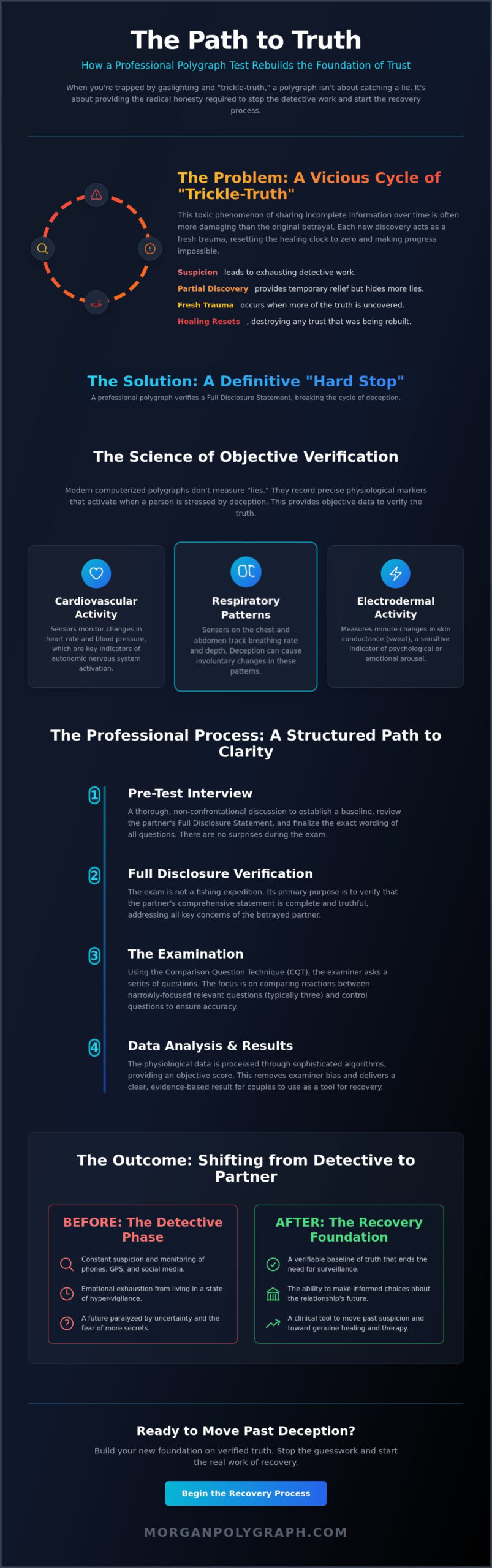
“Trickle-truth” is a toxic phenomenon where information is shared in small, incomplete increments over months or years. This slow leak is often more psychologically damaging than the original act of infidelity. Each new discovery acts as a fresh trauma, effectively resetting the healing clock to zero and making progress in reconciliation impossible. A professional polygraph provides a definitive “hard stop” to this cycle of deception. By verifying that the “full story” has finally been told, it removes the fear of the unknown that keeps couples trapped in a loop of suspicion and despair.
Polygraph as a Diagnostic Tool, Not a Weapon
We position the polygraph as a diagnostic tool rather than a weapon of punishment. While some may view the test as a way to “catch” a spouse, its most effective use is verifying the honesty required for genuine reconciliation. This shift in perspective is vital for long-term success. When testing is approached as a way to confirm truth, it empowers the betrayed partner to make informed choices about their future based on verified data rather than speculation. The examiner functions as a neutral, third-party fact-finder, utilizing The Science of Verification to provide objective results. This professional distance helps lower emotional volatility, creating a bridge between the initial discovery of betrayal and the possibility of authentic recovery.
Authentic reconciliation is only possible when both parties are working from the same set of facts. Without verification, the betrayed spouse is left wondering if they are forgiving the whole truth or just the portion they managed to uncover. A professional exam removes that ambiguity. It provides the clarity needed to decide if the relationship has the transparency required to survive. Establishing this baseline of truth is the first practical step in a long-term recovery plan. While it isn’t a substitute for therapy, it provides the clinical data that helps couples navigate the emotional aftermath of betrayal and build new, healthy patterns of communication.
The Science of Verification: How Modern Polygraphy Bridges the Information Gap
Modern computerized polygraph systems at Morgan Polygraph represent a significant leap from the analog equipment of the past. These advanced tools don’t measure “lies” directly. Instead, they record specific physiological markers that occur when a person’s autonomic nervous system is activated by the stress of deception. During a polygraph test to rebuild trust, we utilize high-precision sensors to monitor three primary systems: heart rate and blood pressure, respiratory patterns through chest and abdominal sensors, and electrodermal activity, which measures minute changes in skin conductance. These data points are processed through sophisticated algorithms to provide an objective analysis of the examinee’s responses.
A professional examination relies heavily on the Comparison Question Technique (CQT). This methodical approach involves asking a series of questions where the reactions to “relevant” questions, such as those regarding infidelity, are compared against reactions to “comparison” questions. The pre-test interview is a vital component of this process. It’s here that the examiner and the examinee review every question in detail to ensure complete understanding. This step eliminates confusion and ensures that the physiological data collected is a direct response to the specific issues being verified.
Understanding Physiological Data vs. Emotional Stress
A frequent concern for many individuals is whether their natural nervousness will cause them to fail the exam. It’s a common misconception that general anxiety registers as deception. Professional examiners are trained to distinguish between the “global” anxiety of being in a high-stakes environment and the “situational” physiological spikes triggered by specific questions. Modern polygraphy measures the autonomic nervous system’s reaction to specific stimuli, not generalized fear. While everyone feels some level of apprehension during the process, the computerized systems focus on the significant deviations from your established baseline that occur only when a deceptive answer is provided.
Accuracy and Reliability in 2026
The credibility of the results is supported by extensive research. A 2011 meta-analysis by the American Polygraph Association (APA) found that single-issue polygraph examinations, which are standard for relationship verification, have an accuracy rate of approximately 89%. While some critics point to what psychological science says about polygraphs regarding their use in non-specific screenings, their application in focused relationship cases remains a highly reliable clinical tool. For a deeper look at the data, you can read more about are polygraphs accurate in our detailed breakdown of current industry standards. If you’re ready to move past uncertainty, our specialized relationship testing provides the clarity needed to proceed.
Designing the Examination: Effective Questions for Infidelity and Relationship Clarity
Precision is the cornerstone of a successful examination. Choosing a professional polygraph test to rebuild trust requires a shift from emotional accusations to factual inquiries. We utilize the “Three Relevant Questions” rule, which is a standard in high-accuracy testing. By limiting the scope to three primary issues, we prevent the physiological data from becoming diluted or “noisy.” This focus ensures that the examinee’s autonomic system provides a clear, readable response to the most critical concerns. A polygraph test to rebuild trust is most effective when it focuses on verifiable actions rather than vague concepts.
The phrasing of these questions is vital. For instance, a question like “Did you have sex?” is often too ambiguous for clinical verification. A professional examiner will refine this to “Have you had any sexual contact outside of the marriage?” to cover a broader, more accurate range of behavior. Additionally, questions must be time-bound to prevent confusion. Phrases such as “Since the date of your wedding” or “Since the start of your relationship” provide a clear temporal boundary. It’s also important to understand that a polygraph cannot test intent or feelings. Questions like “Do you love her?” or “Do you regret your actions?” are not testable because they lack a factual, physiological baseline.
Formulating the “Full Disclosure” Questions
Before the sensors are attached, the involved partner must provide a written “Full Disclosure Statement.” This document serves as the foundation for the entire exam. We use this statement to verify the scope of infidelity, including who was involved and where the encounters occurred. We also address “Secret Contact,” which involves verifying the use of hidden apps, burner phones, or deleted messages. While the U.S. Department of Justice maintains strict guidelines for the use of these tools in legal settings, the same level of professional rigor is applied to relationship recovery cases to ensure the highest degree of reliability.
The “No-Surprise” Rule in Professional Testing
A professional polygraph is never a “gotcha” moment. The examinee must review and agree to the exact wording of every question during the pre-test interview. This “no-surprise” rule is essential for reducing false positives caused by shock, confusion, or the sudden realization of a forgotten detail. If a question is vague, the examiner’s role is to refine it into a testable fact that both partners understand. This methodical approach ensures that any physiological reaction recorded is a direct response to deception rather than a reaction to a poorly worded or unexpected question.
The Professional Process in Boise: What to Expect During a Relationship Polygraph
Entering a clinical environment for relationship verification can feel intimidating, but the experience at Morgan Polygraph is designed to be professional, discreet, and respectful. Our Boise office, located at 6126 W. State Street, provides a neutral setting where couples can address sensitive issues without the heightened emotions often found at home. A polygraph test to rebuild trust is a methodical three step process. We don’t utilize the aggressive or accusatory tactics sometimes depicted in media; instead, we maintain a calm, authoritative atmosphere that prioritizes data accuracy and client dignity.
The process begins with the Pre-Test Interview. During this phase, the examiner gathers necessary background history and reviews the specific questions that were formulated based on the “Full Disclosure Statement” discussed in previous sections. This ensures there is no ambiguity. The second phase is the In-Test Phase, where the physiological sensors are attached to monitor respiratory, cardiovascular, and electrodermal activity. This recording typically takes fifteen to twenty minutes. Finally, the Post-Test Phase involves a detailed analysis of the charts. Once the data is scored, the examiner provides the results, ensuring both parties have a clear understanding of the findings.
Discretion and Confidentiality Standards
Relationship testing requires extreme sensitivity. We handle every case with the highest standards of privacy, ensuring that your personal matters remain confidential. Results are typically delivered through a formal written report, though a verbal summary is often provided immediately following the exam. Choosing a finding a certified polygraph near me is essential for establishing face-to-face credibility. This local, personal interaction allows the examiner to observe behavioral nuances that remote or automated systems simply cannot capture, providing a more reliable outcome for your recovery journey.
Preparing for the Exam in Idaho
Proper preparation is key to obtaining a clear physiological baseline. We recommend that the examinee gets adequate sleep and continues taking any regularly prescribed medications as directed by their physician. It’s vital to avoid “interrogating” or arguing with your partner the night before the test. High emotional volatility immediately preceding the exam can lead to physical exhaustion, which may complicate the data collection process. You should also verify that your examiner holds a membership with the American Polygraph Association (APA). This membership ensures the practitioner adheres to the strict ethical and technical standards required for professional relationship testing. If you are ready to begin the verification process, you can schedule an examination at our Boise facility to secure your baseline of truth.
Beyond the Result: Integrating Polygraph Findings into Your Healing Journey
Receiving the final report marks the end of speculation and the beginning of a deliberate path forward. Whether the result is “No Deception Indicated” or “Deception Indicated,” the data provides the clarity needed to move forward without the weight of the unknown. If the examiner determines that no deception was indicated, the couple must commit to transitioning away from the surveillance and suspicion of the “detective phase.” A successful polygraph test to rebuild trust provides the evidentiary foundation for this transition, allowing you to focus on emotional intimacy rather than monitoring logs. Conversely, a deceptive result is undeniably difficult, but it doesn’t necessarily mean the end of the relationship. It often reveals that the “full story” hasn’t yet been told, providing a final opportunity for radical honesty before reconciliation efforts proceed.
For many couples in Idaho, long-term accountability is maintained through periodic follow-up examinations. These maintenance tests help ensure that the new boundaries established during recovery remain intact over the coming months or years. We often coordinate these efforts with marriage counselors in Boise to ensure the findings are integrated into a broader therapeutic plan. While the polygraph provides the “what” regarding past actions, your therapist helps you navigate the “why” and “how” of your future together. This collaborative approach ensures that the clinical data we provide is used as a constructive tool for healing.
Using the Results in Therapy
Utilizing a professional infidelity test provides a clinical “clean slate” that many therapists require before starting intensive reconciliation work. This data supports a formal “Accountability Contract,” where both partners agree on specific transparency standards and behavioral boundaries moving forward. It’s vital to rely on the professional interpretation of the physiological charts provided by the examiner. You should avoid “kitchen table” analysis or trying to re-score the results yourself, as only a trained expert can accurately correlate the autonomic nervous system’s data with the specific stimuli presented during the test.
Next Steps: Booking Your Consultation
Before calling our office to schedule your session, we recommend completing a short checklist to ensure you’re prepared for the process. First, ensure the involved partner has completed their written disclosure statement. Second, identify the three most critical areas of concern you need verified. Third, ensure both parties are emotionally ready to accept the findings, whatever they may be. We encourage a soft approach when discussing the exam: “We are doing this to save our marriage, not to end it.” This mindset fosters cooperation rather than defensiveness. If you’re ready to stop the cycle of uncertainty, Contact Morgan Polygraph in Boise to regain clarity today.
Establishing Your Path to Clarity
Choosing a polygraph test to rebuild trust is a courageous step toward ending the cycle of uncertainty and gaslighting. By moving beyond the “detective phase” and establishing a clinical baseline of truth, you provide your relationship with the oxygen it needs to survive. We’ve explored how modern computerized verification and precise question design remove the ambiguity that often stalls recovery. This process isn’t just about analyzing the past; it’s about creating a factual foundation where authentic reconciliation can finally begin.
Our practitioners bring over 30 years of industry experience to every examination, ensuring your case is handled with seasoned expertise. As nationally certified and court-recognized examiners, we specialize in the unique requirements of therapeutic and relationship testing. We understand the vulnerability involved in this process and provide a discreet, professional environment to help you move forward. You don’t have to remain trapped in a loop of suspicion and doubt. Schedule a Confidential Consultation with Morgan Polygraph today to secure the clarity your future deserves. Healing is possible when it begins with the truth.
Frequently Asked Questions
Can a polygraph test really help rebuild trust in a marriage?
A polygraph test provides the objective evidence required to end the cycle of suspicion and gaslighting. It serves as a clinical baseline that allows both partners to stop acting as investigators and begin the work of reconciliation. Utilizing a polygraph test to rebuild trust is most effective when it verifies a full disclosure statement, ensuring that no hidden information remains to sabotage future progress in therapy.
How accurate are infidelity polygraph tests in 2026?
Single-issue examinations, which are standard for relationship testing, maintain an accuracy rate of approximately 89% according to the American Polygraph Association. Other research from the National Research Council has documented accuracy ranges between 81% and 91%. These results are highly dependent on the use of modern computerized equipment and the skill of a qualified examiner who can accurately interpret the physiological data collected during the session.
What happens if my partner is just very nervous during the test?
Nervousness is a standard reaction and doesn’t cause an individual to fail a professional examination. Examiners are trained to establish a physiological baseline for each person before the actual testing begins. We distinguish between “global” anxiety, which is general stress about the process, and the “situational” physiological spikes that occur only when a deceptive answer is provided in response to a specific relevant question.
Can someone pass a polygraph if they have practiced “beating” it?
Passing a test through practiced “tricks” is extremely difficult because the equipment monitors the autonomic nervous system, which isn’t under conscious control. Modern sensors and advanced scoring algorithms are specifically designed to detect “counter-measures” or intentional attempts to manipulate the data. A seasoned examiner recognizes these patterns immediately, and such attempts are typically noted as a failure to cooperate or an inconclusive result.
How much does an infidelity polygraph test cost in Boise, Idaho?
Fees for relationship testing in Idaho are determined by the complexity of the case and the specialized experience of the practitioner. You should contact local providers directly to discuss your specific needs and receive a detailed quote for their professional time. Prices generally reflect the clinical environment, the use of high-precision technology, and the comprehensive nature of the pre-test and post-test analysis.
What kind of questions are asked during a relationship lie detector test?
Questions focus on verifiable, action-oriented behaviors rather than feelings or intentions. For example, we ask about specific physical contacts or secret communications rather than asking if a partner is “in love” with someone else. Every question is reviewed and agreed upon during the pre-test interview to ensure there’s no confusion or surprise when the sensors are active during the polygraph test to rebuild trust.
How long does the entire polygraph process take?
A professional relationship examination typically requires between two and three hours to complete. The majority of this time is spent in the pre-test interview, where the examiner gathers history and refines the test questions. The actual physiological recording phase usually lasts only fifteen to twenty minutes. This unhurried approach is necessary to ensure the examinee is comfortable and that the data collected is of the highest quality.
Should I tell my therapist we are getting a polygraph test?
Informing your therapist is highly recommended as it allows the results to be integrated into your overall recovery plan. Many marriage counselors in Boise find that a verified disclosure provides a “clean slate” that accelerates the healing process. While we don’t offer counseling ourselves, providing your therapist with the official report ensures that your clinical work is based on a foundation of facts rather than ongoing suspicion.