

Can a simple chemical swab really provide the peace of mind you need, or is it just another source of uncertainty? You’ve likely spent restless nights staring at the ceiling, replaying conversations and searching for inconsistencies. The fear of being gaslit is exhausting; it’s natural to want a definitive answer that stops the cycle of doubt. When you’re facing a potential betrayal, choosing the right infidelity test is the first step toward reclaiming your life and your sleep.
In this article, you’ll discover the most effective methods to verify relationship honesty and learn why a professional polygraph offers the absolute clarity that chemical kits cannot provide. We will examine the differences between biological traces and behavioral data, including the 89% accuracy rate of single-issue diagnostic exams. This guide ensures you have the knowledge to move forward with discreet, professional proof, allowing you to either restore trust or obtain the evidence required for a clean separation. You deserve a methodical approach to your private life that replaces crushing uncertainty with authoritative results.
Key Takeaways
- Learn why DNA kits only detect biological presence while a professional polygraph identifies the actual intent and truth behind a partner’s actions.
- Understand the specific physiological markers, such as skin conductivity and respiration, that make an infidelity test a scientifically grounded tool for restoring relationship honesty.
- Discover the essential pre-test steps for establishing ground truth, ensuring that the examination addresses your most critical concerns with precision.
- Gain insights into the best practices for discussing testing with your partner to ensure the process remains a constructive step toward resolution.
- Find out how professional certification and state-of-the-art technology in a discreet setting provide the security needed for high-stakes personal decisions.
Understanding the Infidelity Test: Why Clarity Matters
An infidelity test is a structured instrument designed to reveal the objective truth within a relationship. In 2026, these tools have evolved to provide far more than mere suspicion; they offer a scientific baseline for honesty. It’s often the last resort for those who find themselves trapped in a cycle of doubt and denial. When communication breaks down and trust is compromised, a professional examination serves as an impartial arbiter. It moves the conversation away from emotional accusations and toward a factual resolution.
The Emotional Toll of Suspicion
Chronic doubt is more than a relationship hurdle; it’s a significant health concern. The stress of not knowing the truth can lead to anxiety, loss of focus, and physical exhaustion. Most people don’t seek a test because they want to end their relationship; they seek it because they can’t live with the uncertainty anymore. This “gut feeling” is often a biological response to inconsistent behavior. However, without empirical data, that feeling remains a source of conflict. A formal exam provides the closure necessary to either begin the healing process or establish the grounds for a separation.
Tracing the Evolution of Lie Detection
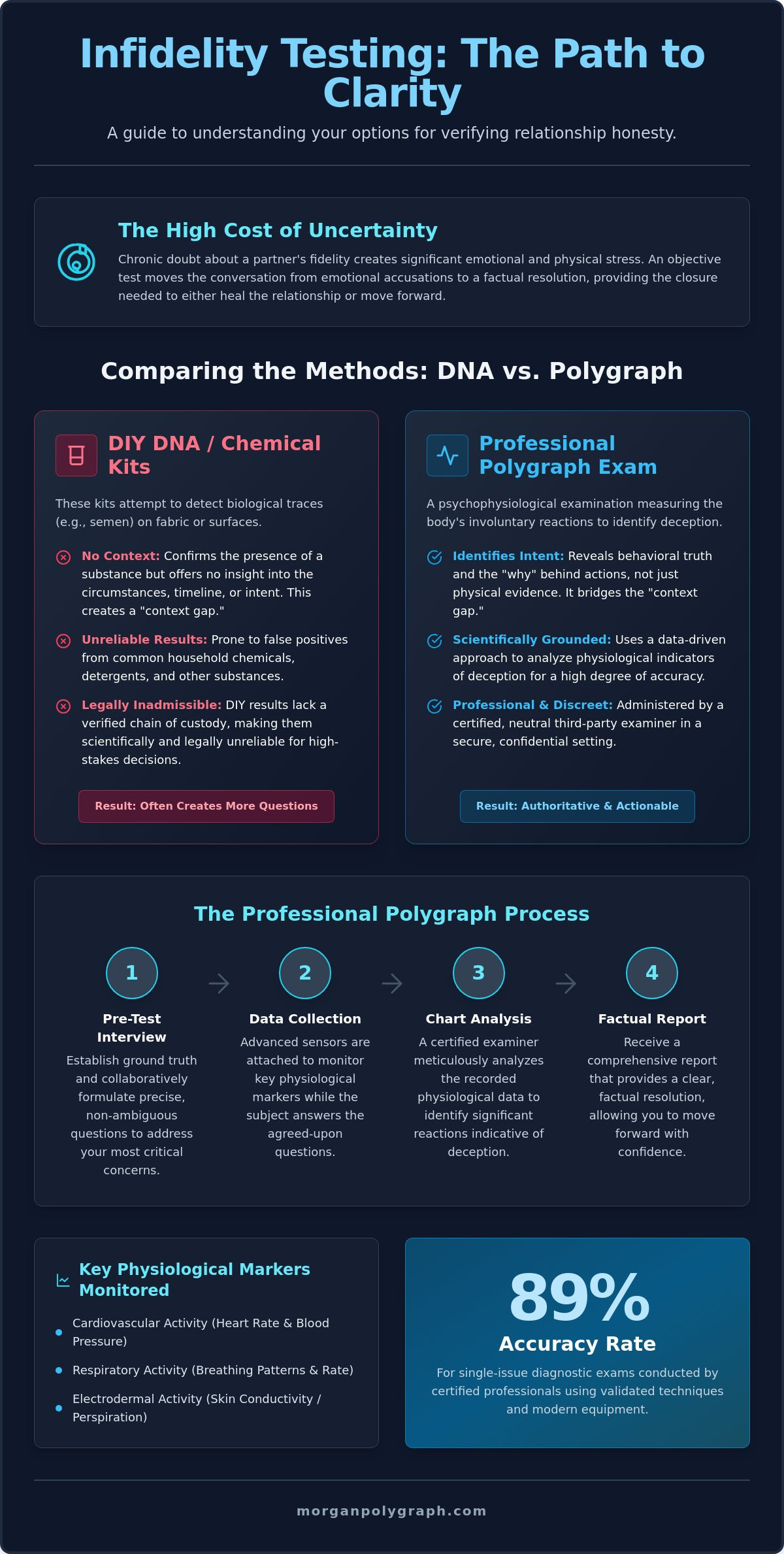
The methods used to verify fidelity have transitioned from primitive chemical sprays to sophisticated psychophysiological examinations. Many people still consider DIY “semen kits” found on large retail platforms, but these kits have significant limitations. They detect biological markers without providing any context regarding how or when those traces appeared. This is where behavioral verification becomes superior. Learning how a polygraph test works helps clarify why it’s the preferred choice for those seeking absolute truth.
Unlike a DNA kit that only looks at physical evidence, a polygraph analyzes the body’s internal reactions to specific inquiries. Modern exams in 2026 utilize advanced sensors to monitor heart rate, respiration, and skin conductivity. This data-driven approach identifies the physiological indicators of deception that a physical sample simply cannot capture. By moving away from unreliable DIY methods and toward professional, certified testing, you ensure that your private life is handled with the expertise and discretion it requires.
Comparing Infidelity Tests: DNA Kits vs. Polygraph Exams
Choosing between a forensic DNA kit and a professional polygraph exam requires understanding the fundamental difference between biological traces and behavioral truth. A DNA-based infidelity test typically involves swabbing clothing or bedding to detect the presence of foreign genetic material. While these kits can confirm the presence of another person’s biological markers, they are retrospective. They show what was left behind but offer no insight into the circumstances, the timeline, or the intentions of the individuals involved. This creates a “context gap” that often leaves the user with more questions than answers.
A polygraph examination takes a different approach by measuring internal physiological responses. Instead of looking at physical residue, the examiner monitors heart rate, blood pressure, respiration, and skin conductivity while the subject answers specific questions. Research on Polygraph examination validity indicates that these exams provide a high degree of accuracy when conducted by certified professionals. This method bridges the context gap by allowing the subject to account for their actions directly, providing the “why” and “how” that a chemical swab simply cannot reach.
The Limitations of Chemical Detection Kits
Home detection kits are prone to significant technical hurdles. Many household substances, including certain laundry detergents and cleaning chemicals, can trigger false positives on semen detection swabs. Additionally, DIY DNA results are rarely admissible in Idaho courts because they lack a verified chain of custody. Without a professional third party to oversee the collection, there is always a risk that samples were contaminated or even staged, making the results scientifically and legally unreliable for high-stakes decisions.
Why Polygraphs Offer Superior Resolution
The primary advantage of a polygraph is its ability to establish a comprehensive timeline. An examiner can structure questions to address the full scope of a partner’s actions, from emotional affairs to physical encounters. This process is conducted by a neutral, third-party professional who remains objective throughout the session. By removing the emotional volatility of a home environment, the examination provides a controlled setting where the truth can surface without the interference of household contamination or “he-said, she-said” arguments. For those seeking absolute certainty, specialized infidelity testing services offer a level of clinical precision that home kits lack.
Ultimately, the value of an infidelity test
How an Infidelity Polygraph Test Works
A professional infidelity test using polygraph technology follows a rigorous, multi-stage protocol designed to ensure scientific accuracy and emotional safety. The process is not an interrogation; rather, it is a clinical data collection exercise conducted in a controlled environment. By removing the volatility of a home setting, the examiner can focus on the physiological signals that occur when a subject attempts to conceal information. This methodical approach provides a level of clarity that simply cannot be replicated through casual conversation or unverified home kits.
The Science of Psychophysiological Detection
Modern Psychophysiological Detection of Deception (PDD) relies on the Autonomic Nervous System (ANS). When a person provides a deceptive answer to a significant question, their body undergoes involuntary changes. In 2026, we utilize high-resolution digital sensors to monitor heart rate, blood pressure, respiration patterns, and electrodermal activity (skin conductivity). These sensors ensure data integrity by capturing even minute physiological shifts that the human eye cannot detect. This data is then compared against a baseline established earlier in the session.
Crafting the Right Questions
The success of an examination depends on the precision of the questions. All inquiries must be phrased in a “Yes” or “No” format to eliminate ambiguity and cognitive noise. Certified examiners work with the client to define the scope, ensuring the questions address the most critical concerns. Common examples include:
- Since your marriage, have you had sexual contact with anyone other than your spouse?
- Have you maintained a secret dating profile during the last six months?
- Are you currently hiding any physical romantic encounters from your partner?
The examination begins with a pre-test interview. During this phase, the examiner reviews every question with the subject to ensure they fully understand the terminology and the context. This step is vital for establishing “ground truth” and removing the element of surprise. Surprise can cause physiological spikes that are unrelated to deception, so a transparent review process is essential for maintaining the validity of the results.
Once the data collection is complete, the examiner enters the analysis phase. They don’t rely on gut feelings or behavioral “tells.” Instead, they interpret complex physiological charts, looking for consistent, significant deviations from the subject’s baseline. The final report categorizes the results into clear findings: No Deception Indicated (NDI), Deception Indicated (DI), or Inconclusive. This report serves as a definitive document, providing the absolute clarity needed to make life-changing decisions about the future of the relationship.
By using an infidelity test grounded in psychophysiological science, you move beyond the “he-said, she-said” dynamic. You gain access to objective data interpreted by a nationally certified professional, ensuring that your private matters are handled with the highest standard of care and technical precision.
Preparing for Relationship Testing: Best Practices
Success in an infidelity test isn’t solely dependent on the technology used; it requires significant emotional and logistical preparation. Before scheduling an appointment, you must consider the psychological state of both parties. Approaching a partner about testing should be handled with a focus on mutual clarity rather than hostile accusation. Framing the exam as a tool to remove the “fog of doubt” often facilitates a more cooperative atmosphere, which is essential for obtaining valid physiological data.
When selecting a provider, you must be vigilant about “cheap” or uncertified services. A professional examination requires specialized training and state-of-the-art equipment. If a service seems unusually inexpensive or lacks national certification, it likely lacks the scientific rigor necessary for a life-changing decision. Ensure the environment is professional and neutral. A clinical setting helps the subject focus on the questions, reducing the risk of external stressors influencing the physiological charts.
Ethical Considerations and Consent
Consent is the cornerstone of a valid examination. In the State of Idaho, all polygraph testing must be voluntary. Forced participation is ethically problematic and scientifically counterproductive. If a subject feels coerced, their body may produce “countermeasure” responses or heightened baseline anxiety, which can lead to inconclusive results. Voluntary participation ensures that the physiological data collected reflects the subject’s actual reactions to the questions rather than their resentment toward the process.
Handling the Results
Deciding what happens after the results are delivered is as important as the test itself. You should establish clear boundaries and agreements before the session begins. Will a “Deception Indicated” result lead to a separation, or will it be used as a starting point for a psychosexual evaluation to address underlying behavioral issues? Having a plan in place prevents impulsive decisions during a highly emotional moment.
Moving forward requires a methodical approach to either trust restoration or a healthy separation. If the results indicate honesty, the test serves as a foundation for rebuilding. If deception is found, the report provides the empirical evidence needed to move forward with absolute clarity. To ensure your case is handled with the highest level of professional discretion, you can schedule a confidential consultation with our Boise-based experts.
Choosing Morgan Polygraph for Infidelity Testing in Boise
When you require an infidelity test in Boise, Idaho, the quality of the examiner is just as important as the technology itself. Morgan Polygraph offers a higher standard of care by combining decades of traditional experience with the latest 2026 psychophysiological advancements. Our practice is built on the pillars of absolute discretion and professional integrity. We understand that the individuals walking through our doors are often in a vulnerable state, and we are committed to providing a non-judgmental environment where the truth can be established with clinical precision.
Court-Recognized Standards in Idaho
There is a significant difference between a “hobbyist” examiner and a court-recognized expert. Our reports carry weight in both legal and civil proceedings because we adhere to the strict standards set by the American Polygraph Association (APA). This national certification ensures that every polygraph examination we conduct meets the highest professional benchmarks for accuracy and ethics. In a field where results can change the course of a life, you cannot afford to rely on unverified services that lack these credentials.
The Morgan Polygraph Experience
Clients who visit our State Street office in Boise can expect a methodical and organized experience. Located in Suite 208, our facility is designed to be a calm, neutral space that prioritizes your privacy. We specialize in sensitive matters, including sex addiction and relationship fidelity, which requires a deep understanding of the human element involved in these cases. We don’t just provide charts and data; we offer a path toward resolution through specialized expertise and compassionate interaction.
Our lead practitioners are recognized within their professional communities for their contributions to the field. This level of experience ensures that your case is handled by a seasoned expert who understands the technical nuances of data-driven detection. By choosing a local leader in the industry, you ensure that your private life is handled with the respect and specialized skill it deserves. If you are ready to obtain the absolute clarity needed to move forward, we invite you to schedule a confidential consultation at our Boise office today. Our commitment to innovation and tradition provides the definitive evidence you need to reclaim your peace of mind.
Moving Forward with Absolute Certainty
The journey from suspicion to resolution requires more than just biological traces found in a home kit. You’ve seen how a professional infidelity test bridges the context gap by analyzing intent and behavior through advanced physiological data. By choosing a methodical, clinical approach, you replace sleepless nights with the empirical evidence needed to make life-altering decisions. Whether the goal is to restore a damaged bond or provide proof for a separation, the quality of the examiner remains the most critical factor.
Our team provides the security of Nationally Certified Examiners and state-of-the-art PDD technology to ensure every session meets the highest professional standards. As Boise’s trusted court-recognized experts, we prioritize your privacy and the human element of your case. You deserve a path forward that’s built on facts rather than fear or gaslighting. Professional verification is the first step toward a future defined by honesty.
Get the Clarity You Deserve – Schedule Your Confidential Infidelity Test Today
You don’t have to carry the weight of uncertainty alone. Expert help is available to help you reclaim your future and find the peace you’ve been searching for.
Frequently Asked Questions
How accurate is a polygraph test for infidelity?
Single-issue diagnostic polygraph tests have an accuracy rate of approximately 89% according to a 2011 meta-analysis by the American Polygraph Association. This level of precision makes it the most reliable infidelity test available for relationship verification. The results depend heavily on the examiner’s expertise and the use of modern sensors to monitor physiological markers like heart rate and skin conductivity.
Can someone “cheat” or pass a polygraph if they are actually lying?
It is extremely difficult to “cheat” a modern polygraph because it monitors involuntary Autonomic Nervous System (ANS) responses. Examiners are specifically trained to identify “countermeasures,” which are deliberate attempts to manipulate physiological data. Using 2026 technology, sensors are sensitive enough to detect these physical or mental tactics, often resulting in a finding of “Deception Indicated” or an invalid session.
Is an infidelity test admissible in an Idaho court?
The admissibility of an infidelity test in Idaho courts often depends on a prior stipulation between both parties. While New Mexico is the only state with routine admission, Idaho courts may consider results in non-trial settings or pre-trial negotiations. You should consult with legal counsel to understand how a professional report might influence your specific civil or family law case.
How long does a relationship polygraph exam usually take?
A standard relationship polygraph examination typically takes between two and three hours to complete. This timeframe includes the pre-test interview, the data collection phase where the subject is attached to sensors, and the post-test analysis. We don’t rush the process; each stage is vital to ensure the physiological charts are clear and the results are scientifically sound.
What is the difference between a DNA kit and a lie detector test?
A DNA kit detects the physical presence of foreign biological material, while a polygraph verifies the intent and truth behind an action. DNA cannot tell you “when” or “why” a trace was left, nor can it detect emotional affairs. A polygraph provides a comprehensive timeline by measuring internal bodily responses to specific questions about a partner’s conduct.
Should I tell my partner I am scheduling a test?
You should inform your partner before scheduling because voluntary consent is a legal and ethical requirement for the exam. Forced testing is counterproductive and often leads to inconclusive results due to extreme emotional distress. A transparent approach helps establish the ground truth and ensures the subject is in the proper psychological state for accurate data collection.
What happens if the test results are inconclusive?
An inconclusive result means the physiological data collected was not distinct enough to render a definitive finding of “Deception” or “No Deception.” This can occur due to certain medications, health conditions, or excessive fatigue. In these cases, our examiners review the charts and may suggest a re-test at a later date once the interfering factors have been addressed.
Where can I find a certified “polygraph near me” in the Boise area?
For a certified “polygraph near me” in the Treasure Valley, Morgan Polygraph is located at 6700 W State Street, Suite 208, Boise, Idaho. We provide a discreet, professional environment specialized in relationship fidelity. Our examiners are nationally certified and recognized as court experts, ensuring your private matters are handled with the highest level of technical skill.