

Did you know that even highly trained professionals detect deception at a rate of only 54%? This statistic is barely better than a coin flip, which explains why specialized technology is essential for a fair, data-driven result. If you are preparing for an upcoming appointment, you probably have several questions about what to expect during a polygraph test. It’s natural to feel a sense of trepidation about the unknown, worry about the physical discomfort of the sensors, or fear that your anxiety might be mistaken for dishonesty.
We recognize the weight of these moments and strive to provide a clinical, quiet environment that prioritizes your privacy. This 2026 guide reveals the exact three-phase process of a professional polygraph exam to eliminate your anxiety and ensure an accurate outcome. You will gain a clear understanding of how modern instrumentation, such as the LX7 system, works to protect the integrity of the session. We’ll walk you through the logistics of the day, explain how to manage your nerves, and provide a timeline for when you will receive your final results.
Key Takeaways
- Understand why the pre-test interview is the most critical phase for accuracy, ensuring you fully comprehend every question before sensors are activated.
- Learn how modern digital sensors and 2026 software algorithms monitor autonomic nervous system activity to provide a neutral, data-driven analysis.
- Gain a clear walkthrough of what to expect during a polygraph test, including the repetitive “collection of charts” phase designed to eliminate physiological outliers.
- Discover how standardized numerical scoring replaces subjective hunches to ensure your results are fair, objective, and professionally recognized.
- Identify simple preparation steps, such as maintaining your daily routine and wearing comfortable attire, to minimize external stress and support a precise examination.
The Pre-Test Interview: Setting the Foundation for Accuracy
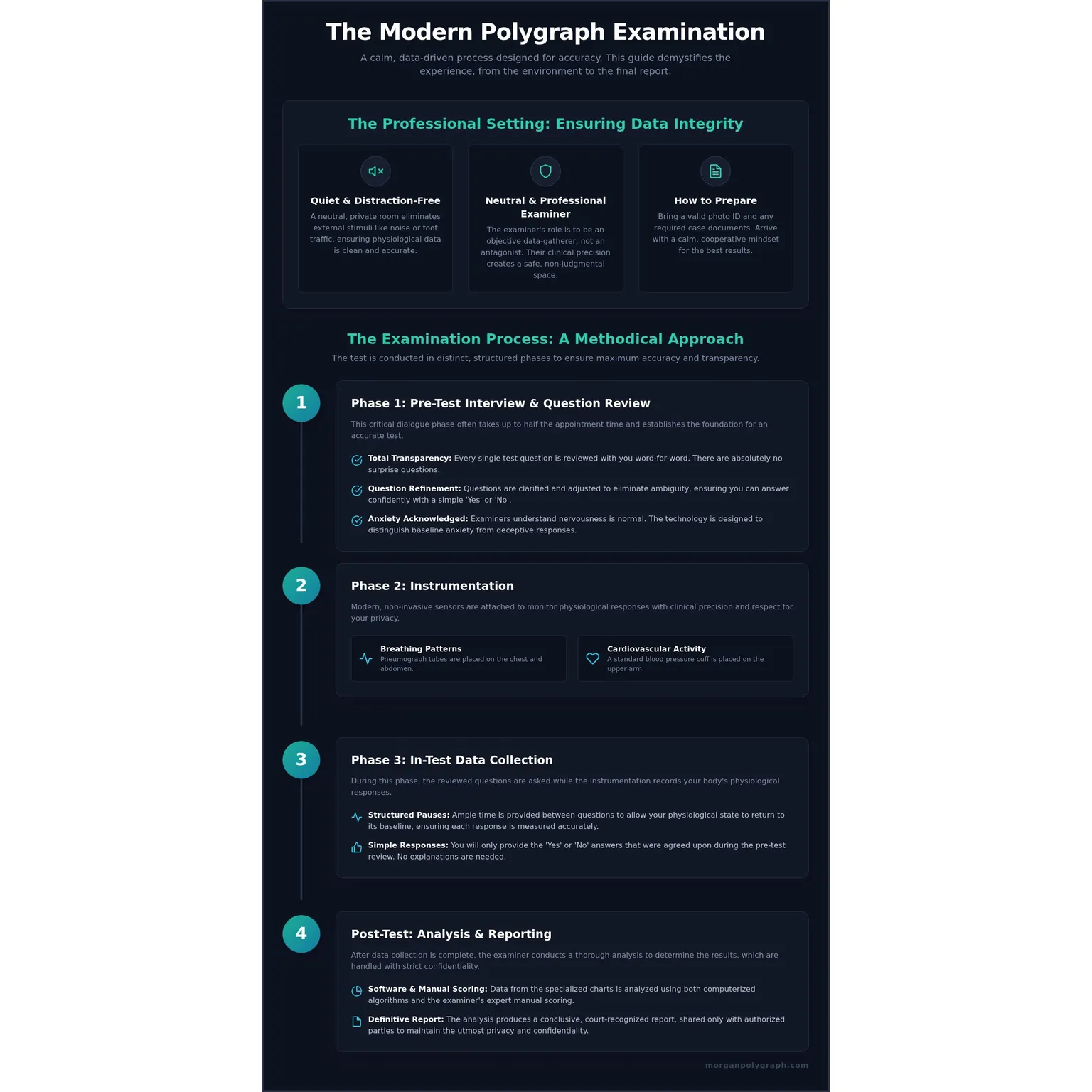
The pre-test interview is the clinical heart of the entire process. While many people believe the examination begins the moment sensors are attached, the foundation for a fair result is actually laid during this initial conversation. Knowing what to expect during a polygraph test starts with understanding that the pre-test is often the longest phase of your appointment, frequently lasting an hour or more. This time is dedicated to ensuring you fully understand the process and feel comfortable with the environment.
Our examiners act as neutral fact-finders, not interrogators. During this phase, we establish a professional rapport to help minimize “innocent” nervous responses that can occur when someone feels overwhelmed or misunderstood. A primary goal is the “No Surprise” Rule. This means every single question that will be asked during the exam is read, discussed, and finalized before any equipment is used. We follow a methodical approach to ensure clarity:
- Explanation of Technology: We describe how the sensors monitor your autonomic nervous system.
- Review of the Issue: We discuss the specific facts of the case to ensure we are testing the right information.
- Question Finalization: We adjust the phrasing of questions until you are confident you can answer them with a clear “Yes” or “No.”
- Psychological Preparation: We address your fears to ensure your physiological baseline is stable.
By the time the sensors are placed, you’ll have a complete understanding of what a polygraph is and how the data collection will proceed. This transparency is vital for accuracy.
Reviewing the Case Facts and Questions
Whether the appointment concerns infidelity, a criminal defense matter, or Post-Conviction Sex Offender Testing (PCSOT), we spend significant time refining the inquiry. We don’t use “trick” questions. Instead, we focus on specific, observable behaviors. If a question feels ambiguous to you, we rewrite it. This collaborative refining process ensures that when the test begins, your physiological reactions are tied to the truth of your statement rather than confusion over a word’s meaning.
Legal and Ethical Disclosures
Your rights and well-being are our priority. Before proceeding, we review the polygraph examination consent forms in detail. It’s essential to remember that the test is entirely voluntary, and you have the right to stop at any time. We also conduct a brief health screening to ensure you are physically and mentally fit for testing. Factors like significant sleep deprivation or certain medications can impact the data, so we verify your readiness to ensure the most reliable outcome possible. This clinical approach maintains the integrity of the results while respecting your personal dignity.
Understanding the Technology: How Polygraph Sensors Monitor Physiology
Modern polygraphy has evolved far beyond the analog needles and scrolling paper seen in old films. Today, practitioners utilize sophisticated digital interfaces, such as the Lafayette LX7 system, to capture high-resolution physiological data. When considering what to expect during a polygraph test, it’s vital to understand that the equipment doesn’t “read minds” or detect lies directly. Instead, it records specific changes in your autonomic nervous system. These biological signals are analyzed using validated algorithms to identify patterns often associated with the cognitive load of deception.
This polygraph examination technique relies on the body’s involuntary reactions to external stimuli. Because these responses occur automatically, they provide a more reliable data set than behavioral observation alone. If you are visiting our office for Boise polygraph services, you will see that the environment is designed to be clinical and quiet; this ensures the sensors can capture these subtle shifts without interference from outside noise.
The Four Key Physiological Channels
In a standard 2026 examination, four primary sensors are used to monitor your body’s activity. Each channel provides a different piece of the physiological puzzle:
- Pneumographs: Two rubber tubes are placed around your chest and abdomen. These monitor your respiratory rate, depth, and any suppressed breathing patterns.
- Galvanometers: Small electronic attachments are placed on your fingertips. These measure Galvanic Skin Response (GSR), which tracks minute changes in sweat gland activity.
- Cardio Cuff: A standard blood pressure cuff is wrapped around your arm or leg. It records changes in heart rate, rhythm, and blood volume during the questioning.
- Activity Sensor: A specialized pad is placed on your seat. This detects intentional physical movements or “countermeasures” intended to manipulate the data.
Why Nerves Won’t Make You Fail
One of the most common fears is that general anxiety will lead to a false result. However, examiners don’t look for simple nervousness. Instead, they look for “significant, consistent, and timely” reactions that occur only when specific, relevant questions are asked. An autonomic response is a reaction the body cannot consciously control. Because your general state of nervousness is captured during the “baseline” phase, the software can distinguish between your background anxiety and a targeted physiological shift. For individuals who find their stress levels difficult to manage, clinical support from Assure Psychiatry can provide valuable tools for emotional regulation. This methodical approach ensures that being “a nervous person” does not equate to a deceptive result.
The In-Test Phase: Navigating the Questioning Process
Once the pre-test interview is complete and the sensors are comfortably in place, you move into the in-test phase. This is the core of what to expect during a polygraph test. The environment is strictly controlled to ensure the highest level of accuracy. At our Boise office, this phase occurs in a quiet, private room specifically designed to minimize outside distractions. You’ll be asked to sit in a specialized chair, face a neutral wall, and remain as still as possible. Even small physical movements can create “noise” in the physiological data, so following the examiner’s instructions on posture and breathing is essential for a clear result.
The actual questioning involves what we call the “Collection of Charts.” Unlike the rapid-fire interrogations depicted in television dramas, this process is slow, deliberate, and repetitive. The examiner will read the finalized question set multiple times, usually between three and five times. We repeat the questions to ensure that any physiological reactions are consistent and not just a “one-off” response to a stray thought or a sudden noise. The examiner monitors the data in real-time on a computer screen, watching the waveforms for your heart rate, respiration, and skin conductivity to ensure the sensors are functioning perfectly throughout each chart.
The Structure of the Questions
The examination follows a specific, standardized sequence. We use “Relevant Questions” to address the core issue, such as specific details in a criminal case or relationship matter. These are balanced with “Comparison Questions,” which help us establish your truthful reaction profile. Finally, “Neutral Questions,” such as “Is today Tuesday?”, are interspersed to allow your physiology to return to its baseline state. This methodical approach is supported by the scientific review of polygraph testing, which emphasizes how structured questioning techniques are vital for distinguishing between targeted stress and general anxiety.
The Experience of Being “On the Box”
During the test, you’ll feel the cardio cuff tighten on your arm or leg, much like a standard blood pressure check at a doctor’s office. It will stay inflated for a few minutes at a time while the questions are asked. The examiner will remain mostly silent and neutral during these periods to avoid influencing your reactions. It’s a clinical experience, not a confrontational one. If a sensor slips or needs adjustment mid-test, the examiner will simply stop the chart, fix the sensor, and restart the sequence. This ensures the integrity of the data remains uncompromised from start to finish.
After the Exam: Analyzing Data and Delivering Results
The examiner’s work continues long after the sensors are detached. When considering what to expect during a polygraph test, many people assume the result is immediate. In reality, a professional examiner must conduct a meticulous analysis of the recorded charts. We do not rely on a “hunch” or gut feeling; we utilize a standardized numerical scoring system. Every physiological deviation is compared against your baseline to ensure the final opinion is rooted in data, not subjectivity.
In 2026, this process is enhanced by sophisticated software algorithms. For example, validated systems like PolyScore Version 5.1 assist our experts by providing an objective secondary analysis. Research indicates these algorithms can exceed 98% accuracy when evaluating real-life criminal cases. Following the chart analysis, the examiner may conduct a brief post-test interview. This is a respectful opportunity for you to clarify any significant reactions recorded during the questioning. For complex or high-stakes matters, we often employ a Quality Control (QC) process where a second, independent expert reviews the charts to verify the findings. This ensures your results are held to the highest professional standards.
Numerical Scoring and Final Opinions
The scoring process results in one of three professional opinions. “No Deception Indicated” (NDI) means the data suggests truthfulness. “Deception Indicated” (DI) means the physiological patterns align with deceptive responses. An “Inconclusive” result occurs when the data is not clear enough to make a definitive call. This is not a failure; it simply means your body did not provide a strong enough signal for a clinical determination. You can typically expect a formal, written report within 24 to 48 hours of your appointment.
Confidentiality and Reporting
Discretion is a cornerstone of our practice. We only release results to the authorized parties identified during the intake process, such as your attorney or the specific agency involved. For private clients utilizing our infidelity test services, we provide a detailed reporting process that respects the sensitive nature of relationship issues. All data is stored in secure, encrypted environments to protect your privacy and ensure maximum confidentiality. If you are ready to proceed with a professional examination, you can contact our Boise office to discuss the specifics of your case.
Preparing for Your Examination at Morgan Polygraph
Preparation for a professional examination begins long before you arrive at our Boise office. While the previous sections of this guide have detailed the clinical and technical aspects of what to expect during a polygraph test, your personal state on the day of the appointment is equally important. We recommend prioritizing a full night of restorative sleep and maintaining your regular daily routine. Drastic changes to your caffeine intake or meal schedule can create unnecessary physiological fluctuations that complicate the baseline data collection. Our goal is to capture your body in its natural state, which allows the technology to function with maximum precision.
When selecting your attire, choose comfortable, professional clothing. The sensors described earlier, including the pneumograph tubes and the cardio cuff, require proper placement to ensure accuracy. A light shirt or short sleeves usually work best. You should also avoid following “Internet advice” or searching for ways to pass a polygraph test through physical or mental maneuvers. Modern 2026 equipment, specifically the activity sensors in our Boise facility, is designed to detect these “countermeasures” immediately. Attempting to manipulate the results often leads to an inconclusive or deceptive finding, whereas simply being honest ensures the most reliable outcome.
Practical Tips for the Day of the Exam
To ensure a stress-free experience, please arrive 15 minutes early to our discreet location at 6126 W. State Street. This allows you time to settle into the quiet environment and complete any necessary paperwork without feeling rushed. If you take prescribed medications for blood pressure, anxiety, or other conditions, continue taking them as directed by your physician. We also emphasize the importance of total transparency during the pre-test interview. Being forthright about your concerns or even minor past mistakes helps the examiner refine the questions, which is the most effective way to ensure an accurate and fair chart collection.
Why Choose a Certified Boise Examiner?
Selecting a nationally certified examiner is vital, especially for sensitive matters like criminal defense polygraphs or PCSOT requirements. At Morgan Polygraph, we combine decades of industry experience with a commitment to the American Polygraph Association (APA) ethical standards. We understand the human stress involved in these situations and approach every case with a blend of technical precision and professional compassion. You are not just a data point; you are a client deserving of respect and a neutral, fact-based investigation. Contact Morgan Polygraph today to schedule your confidential consultation.
Securing the Truth with Professional Precision
A professional polygraph examination is a structured, clinical diagnostic tool designed to provide clarity in sensitive situations. By following a three-phase process that includes a thorough pre-test interview, high-resolution physiological monitoring, and standardized numerical scoring, you can trust that the results are objective and fair. This methodical approach ensures that your natural anxiety doesn’t interfere with the integrity of the data.
Understanding exactly what to expect during a polygraph test allows you to approach your appointment with a calm, collected confidence. Whether you’re navigating a legal defense, a relationship issue, or a screening requirement, having an expert fact-finder on your side is essential. We prioritize your privacy and handle every case with the utmost discretion and respect.
Morgan Polygraph provides the specialized skill and clinical environment necessary for accurate results. We feature nationally certified examiners and offer court-recognized expert testimony supported by state-of-the-art 2026 technology. You don’t have to face the unknown alone. Schedule Your Professional Polygraph in Boise to begin the process of finding the answers you need today.
Frequently Asked Questions
Can my anxiety cause a ‘false positive’ on the polygraph?
General anxiety doesn’t cause a false positive because the examiner establishes a physiological baseline before the formal questioning begins. We look for specific, consistent reactions to relevant questions that deviate significantly from your background state of nervousness. Standardized numerical scoring and 2026 software algorithms ensure that constant, general anxiety is distinguished from targeted physiological responses.
Are polygraph results admissible in Idaho courts?
In Idaho, polygraph results are generally admissible in court only when both parties agree to their entry through a legal stipulation. While New Mexico remains the only state that routinely admits this evidence without a prior agreement, our Boise-based examiners are court-recognized experts. They provide professional testimony that adheres to the rigorous standards required for legal, civil, and PCSOT proceedings.
How long does a typical polygraph examination take?
A typical polygraph examination takes approximately two to three hours to complete from start to finish. This timeframe includes the extensive pre-test interview, the collection of multiple physiological charts, and the initial data analysis. We maintain a deliberate and unhurried pace to ensure you feel respected and that the data collected is of the highest clinical quality.
What should I do if I am taking medication for blood pressure or nerves?
You should continue taking all medications exactly as prescribed by your physician on the day of your appointment. It’s essential to disclose these medications to the examiner during the pre-test phase. We account for these substances when establishing your physiological baseline to ensure they don’t interfere with the accuracy or integrity of the final results.
Will the examiner ask me surprise questions I haven’t seen?
No, you’ll never be asked a surprise question during the actual testing phase. Every question is reviewed, discussed, and finalized with you during the pre-test interview to ensure complete clarity. This transparency is a fundamental part of what to expect during a polygraph test, as it prevents physiological reactions caused by shock or confusion.
Can I ‘fail’ the test if I’m just a naturally nervous person?
Being a naturally nervous person doesn’t result in a failure. The technology monitors specific deviations from your own unique physiological baseline rather than comparing you to a “normal” person. If you follow the instructions and remain still, the examiner can easily identify the difference between your background nerves and a significant, timely reaction to a specific question.
What happens if the test results are inconclusive?
An inconclusive result means the physiological data wasn’t clear enough to support a definitive opinion of truthfulness or deception. This isn’t a failure but a clinical determination that the data is ambiguous. In these instances, we’ll discuss the potential factors involved and may suggest a retest at a later date to ensure a fair and accurate outcome.
Is there anything I should avoid doing the night before the test?
You should avoid consuming excessive caffeine, alcohol, or any illicit substances the night before your examination. It’s also vital to get a full night of sleep and avoid researching “countermeasures” on the internet. These actions can lead to physical exhaustion or erratic physiological patterns that make it difficult to establish a stable and accurate baseline during your session.