
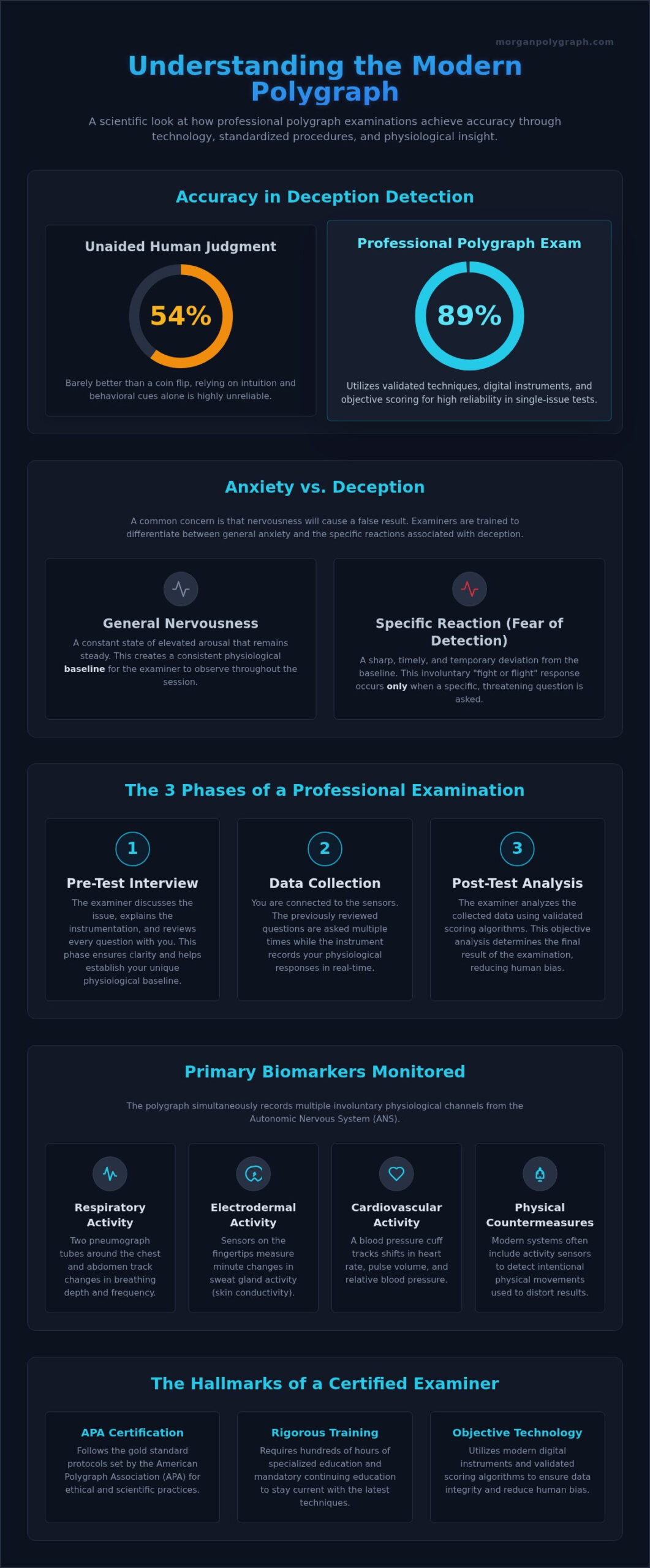
Did you know that unaided human judgment is only accurate about 54% of the time, which is barely better than a coin flip? In contrast, a professionally administered, single-issue polygraph reaches an accuracy rate of approximately 89%. It’s completely natural to feel a surge of anxiety when facing an upcoming examination. You might worry that your racing heart or sweaty palms will be misinterpreted as deception, even when you’re being fully honest. Understanding the science behind these reactions is the first step toward a successful outcome.
This guide will show you exactly how to prepare for a polygraph test by focusing on physiological stability and cognitive clarity rather than outdated myths. We’ll demystify the process by breaking down the three distinct phases of the examination and the rigorous professional standards followed by certified examiners in 2026. You’ll gain a clear perspective on how modern digital instrumentation and validated scoring algorithms work to protect the integrity of your session. By the end of this article, you’ll have the confidence to approach your appointment with a calm, informed mindset.
Key Takeaways
- Distinguish between pop-culture “lie detectors” and the sophisticated forensic instruments used in modern diagnostic environments.
- Learn how to prepare for a polygraph test by understanding the autonomic nervous system’s role and the transparent three-phase process used by professionals.
- Explore why general anxiety won’t lead to a false result and how state-of-the-art sensors identify intentional physical countermeasures.
- Understand the specific professional standards and certifications required for court-recognized expert testimony in Idaho legal cases.
- Discover how a compassionate, discreet environment combined with innovative technology reduces pre-test stress and improves examination accuracy.
What is a Polygraph? Defining the Modern Diagnostic Tool
The term “polygraph” originates from the Greek words for “many writings.” In a forensic context, this describes the simultaneous recording of several physiological channels, including heart rate, blood pressure, respiration, and skin conductivity. While cinema and television often portray these devices as “magic boxes” that flash red for a lie, the reality is far more clinical. A polygraph is a forensic psychophysiological instrument designed to measure the body’s involuntary responses to specific stimuli. When you research how to prepare for a polygraph test, it is vital to view the process as a diagnostic examination rather than an interrogation.
Examiners don’t technically “detect lies.” Instead, they monitor for a “fear of detection.” This is a specific physiological shift that occurs when an examinee perceives a question as a direct threat to their security or reputation. For a comprehensive overview of the polygraph and its historical development, one can see how the technology has moved toward objective, data-driven results. The examiner serves as a neutral, highly trained professional whose primary responsibility is to ensure the integrity of the data collected during the session.
The Evolution of Detection Technology in 2026
The industry has undergone a significant transformation leading into 2026. We’ve transitioned from the traditional analog ink-and-paper charts to high-precision digital sensor arrays. These modern systems utilize sophisticated software that assists in objective data interpretation. By using validated scoring algorithms, examiners can provide a standardized analysis that significantly reduces the risk of human bias. This technological leap is essential for producing results that meet the rigorous standards required for court-recognized expert testimony in Idaho.
The Necessity of Professional Certification
Professionalism in this field is defined by strict adherence to national standards. Training from the American Polygraph Association (APA) is considered the gold standard for practitioners. A certified examiner must complete hundreds of hours of specialized schooling and maintain their status through mandatory continuing education. This ensures they’re up to date on the latest 2026 APA protocol updates, especially for sensitive cases like Post-Conviction Sex Offender Testing (PCSOT). Choosing a certified professional ensures that the examination is conducted with the compassion, discretion, and scientific accuracy necessary for legal and private resolutions.
The Science of Stress: How Your Body Reacts During an Exam
A polygraph does not function as a mind-reading device. Instead, it acts as a highly sensitive biological monitor for your Autonomic Nervous System (ANS). This system regulates involuntary body functions such as your heart rate, digestion, and respiratory patterns. When a person perceives a question as a threat, their brain triggers the “fight or flight” response. This evolutionary survival mechanism is nearly impossible to suppress through sheer willpower. When considering how to prepare for a polygraph test, you should realize that your body’s survival instincts are exactly what the sensors are designed to observe.
One of the most common fears for examinees is that their general anxiety will be mistaken for a lie. Professional examiners are trained to distinguish between “general nervousness” and a “specific physiological reaction.” General nervousness is a constant state of elevated arousal that remains steady throughout the session. In contrast, a specific reaction is a sharp, temporary deviation from your established baseline that occurs only when a certain question is asked. To ensure accuracy, the examiner spends significant time establishing this unique baseline for your physiology before the actual testing begins. These rigorous protocols are reflected in the Department of Defense Polygraph Procedures, which set a high bar for forensic reliability.
The Four Primary Biomarkers Measured
Modern digital instruments track four distinct physiological channels to create a comprehensive data set:
- Respiratory Activity: Two pneumograph tubes placed around the chest and abdomen monitor changes in breathing depth and frequency.
- Electrodermal Activity (GSR): Small sensors on the fingertips measure minute changes in sweat gland activity, which is highly sensitive to psychological stress.
- Cardiovascular Activity: A standard blood pressure cuff tracks shifts in heart rate and mean blood pressure throughout the exam.
- Vasomotor Activity: A photoelectric plethysmograph measures blood volume changes in the extremities, capturing subtle pulses that the human eye cannot see.
Psychological Triggers and Cognitive Load
Maintaining a lie requires significantly more “cognitive load” than telling the truth. Your brain must simultaneously suppress the truth, invent a plausible alternative, and monitor the examiner’s reaction. This mental effort creates a measurable physiological tax. When the limbic system perceives the threat of detection, it bypasses the conscious mind and activates the ANS. In forensic polygraphy, stimulus-response refers to the specific, measurable physiological shift that occurs immediately following a meaningful external prompt.
Understanding these biological realities helps strip away the mystery of the process. If you have concerns about your physiological baseline, discussing the process with a nationally certified examiner in Boise can provide significant clarity and help lower your initial stress levels.
The Three Phases of a Professional Polygraph Examination
A successful forensic evaluation isn’t a sudden event. It is a systematic, multi-stage process designed to ensure the highest levels of accuracy and fairness. At our Boise office, we prioritize transparency and discretion from the moment you arrive. Understanding these stages is a critical part of how to prepare for a polygraph test, as it removes the fear of the unknown. You can expect a professional, clinical environment where every step is explained in detail. For a deeper dive into the specific workflow of a polygraph examination, our guide offers additional technical insights into our methodology.
Phase 1: The Pre-Test Interview
The session begins with an extensive interview. This is often the longest portion of the exam. The examiner reviews the case facts and explains the technology to lower your baseline stress. Most importantly, every single question that will be asked while the sensors are active is reviewed with you beforehand. There are never any “surprise” or “trick” questions. This phase establishes the “psychological set.” This ensures that an honest person is focused on the truth, while a deceptive person is focused on the specific threat of detection.
Phase 2: The In-Test (Chart Collection)
Once the sensors are attached, the formal data collection begins. You’ll be asked to sit still and maintain a quiet environment to ensure “clean” physiological charts. Movement or heavy breathing can create noise in the data, making interpretation difficult. The examiner will repeat the reviewed question set multiple times. This isn’t a sign of suspicion. It is a scientific requirement to verify that any physiological reactions are consistent and not just random fluctuations. The environment remains calm and unhurried throughout this process.
Phase 3: Data Analysis and Results
After the charts are collected, the examiner uses validated numerical scoring systems to analyze the data. This removes subjective “gut feelings” from the process. There are three possible outcomes for a test: No Deception Indicated (NDI), Deception Indicated (DI), or Inconclusive. An inconclusive result means the data wasn’t clear enough to make a definitive call, often due to physiological fatigue or environmental noise. If you’re concerned about how these results are weighted, you can explore the question are polygraphs accurate to better understand the reliability of modern forensic scoring.
Accuracy, Limitations, and the Myth of ‘Beating’ the Test
A common concern for examinees is whether general anxiety can trigger a false failure. As established in the science of stress, professional examiners distinguish between a constant state of nervousness and a specific physiological deviation. When you research how to prepare for a polygraph test, you will likely encounter various “tricks” promised to help you “beat” the system. In 2026, these methods are not only ineffective but often lead directly to a “Deception Indicated” result. Modern instrumentation uses sophisticated algorithmic scoring that filters out random noise while pinpointing intentional manipulation.
Old-fashioned countermeasures, such as placing a tack in a shoe or biting one’s tongue, rely on the idea that you can mask a reaction with a self-induced spike in pain. This approach fails because modern sensors are far too sensitive. Today’s forensic environments include medical-grade sensors that monitor more than just heart rate; they track the subtle timing of reactions across multiple channels simultaneously. If the data shows a physical reaction that does not align with the question’s timing or the baseline, the examiner will identify it as a countermeasure. This transparency protects the integrity of the results for all parties involved.
Why Countermeasures Often Fail
The primary reason these methods fail is the involuntary nature of the human body. While you can consciously control your breathing for a short period, you cannot control your sweat gland activity or the diameter of your blood vessels. Our Boise office utilizes state-of-the-art activity sensors. These are specialized pads placed on the chair and under the feet that detect even the slightest muscle contractions or pressure shifts. Attempting to manipulate your physiology creates a “dirty” chart that an expert examiner will immediately recognize as an attempt to deceive the process.
Factors That Actually Influence Reliability
Reliability is most affected by the examinee’s physical and mental readiness rather than their ability to “trick” the device. Fatigue, acute illness, or the use of certain medications can dampen physiological responses, leading to an inconclusive result. This is why getting a full night’s rest and being honest about your medical history is vital. These factors are especially important in sensitive matters, such as an infidelity test, where emotional stakes are high. Providing a stable, healthy baseline ensures the most accurate data collection for your case.
If you have questions about specific medications or physical conditions, it is best to consult with a nationally certified examiner before your scheduled appointment.
Choosing a Certified Examiner in Boise: Why Professionalism Matters
Selecting the right practitioner is just as important as knowing how to prepare for a polygraph test. In Idaho, there is no state-level licensing requirement for examiners. This means the burden of verifying credentials falls on the client. Choosing a nationally certified professional ensures that your examination follows the strict ethical and scientific protocols established by the American Polygraph Association. At Morgan Polygraph, we bridge the gap between clinical science and legal resolution. We provide over 20 years of forensic experience to the Boise community, utilizing state-of-the-art digital instrumentation in a discreet, compassionate environment.
Professionalism is particularly vital when the results are intended for legal or official use. Our office provides court-recognized expert testimony, which requires a level of precision that unverified practitioners cannot offer. We stay current with the 2026 APA protocol updates, especially regarding Post-Conviction Sex Offender Testing (PCSOT). These specialized exams demand advanced certifications and strict adherence to specific, rigorous protocols to ensure their legal and ethical integrity. Whether you are involved in a civil case or a private matter, the integrity of the data depends entirely on the expertise of the individual conducting the session.
Legal vs. Private Testing Standards
Defense attorneys frequently trust nationally certified examiners for case preparation and discovery. In criminal litigation, the methodology must be beyond reproach to be considered by legal counsel. Relationship or infidelity cases require the same technical rigor but often involve a more empathetic, client-focused approach to handle the emotional sensitivity of the situation. If you need local contact information or specific directions to our office, you can find a polygraph near me through our expert guide.
Preparing for Your Appointment
On the day of your exam, your physical state is a primary factor in data quality. We recommend wearing comfortable, non-restrictive clothing that allows for the easy placement of sensors. Arrive well-rested and hydrated. Please bring a valid form of identification and a list of any medications you are currently taking. Our commitment to privacy and ethical standards ensures that your session is handled with the utmost confidentiality. We do not provide legal advice or counseling; our role is to provide a neutral, scientific assessment of the facts. To discuss your specific needs with a Boise expert, Contact Morgan Polygraph to schedule a confidential consultation.
Approaching Your Examination with Clarity and Confidence
Successful preparation for a forensic evaluation requires a shift from fear to understanding. By deconstructing the science of the autonomic nervous system and the transparency of the three-phase process, you can replace anxiety with objective knowledge. Modern diagnostic tools aren’t fooled by internet myths. They rely on medical-grade sensors to provide a clear, data-driven picture of the truth. When you understand how to prepare for a polygraph test, you’re better equipped to maintain the physiological stability necessary for an accurate result.
Choosing an expert with 20+ years of forensic experience ensures your session is conducted with the highest professional standards. Our Boise office utilizes state-of-the-art digital instrumentation to provide nationally certified and court-recognized results for every client. Whether you’re seeking resolution for a legal matter or a private concern, you deserve a process defined by integrity and compassion.
Schedule Your Confidential Polygraph Exam in Boise Today to speak with a seasoned practitioner about your specific needs. You can move forward with the confidence that your case is in capable, trustworthy hands.
Frequently Asked Questions
Can you fail a polygraph test just by being nervous?
You cannot fail a polygraph examination simply because you are nervous. Examiners expect a certain level of baseline anxiety from every examinee and use the pre-test phase to establish your unique physiological baseline. A result of “Deception Indicated” only occurs when there is a sharp, significant deviation from that baseline in direct response to a specific relevant question.
Is a polygraph test admissible in Idaho courts?
Polygraph results are generally not admissible as evidence in Idaho courts. There is an exception if both the prosecution and the defense agree to their admission before the test is conducted. Despite this general rule, many legal professionals in Boise utilize nationally certified examiners to assist with case strategy, discovery, and criminal defense preparation.
How long does a typical polygraph exam take to complete?
A standard examination typically requires two to three hours to complete in its entirety. This duration accounts for the detailed pre-test interview, the attachment of digital sensors, and multiple rounds of chart collection. The examiner remains with you throughout the process to ensure every question is understood and that the environment remains clinical and quiet.
Can I take a polygraph if I am on blood pressure medication?
You can undergo testing while taking blood pressure medication, but it’s vital to disclose all prescriptions during your pre-test interview. Certain medications can dampen your body’s natural physiological responses, which might affect the clarity of the data. Understanding your medical history is a necessary step in how to prepare for a polygraph test to ensure the most reliable results.
What happens if the polygraph result is ‘inconclusive’?
An inconclusive result means the physiological data collected didn’t provide a clear enough pattern to determine truthfulness or deception. This isn’t a “fail” or a “pass” but rather a lack of definitive data, often caused by physical exhaustion, illness, or inconsistent breathing. If this occurs, the examiner will discuss the potential reasons and may suggest a re-test at a later date.
Are there questions that cannot be asked during a polygraph?
Professional ethical standards and the American Polygraph Association prohibit questions regarding your religious beliefs, political opinions, sexual orientation, or union affiliations. The examination focuses exclusively on the specific issues of the case or screening. Every question is reviewed with you word-for-word before the sensors are activated so that you aren’t surprised by the inquiries.
How should I prepare for my polygraph examination at the Boise office?
The best way to learn how to prepare for a polygraph test is to focus on your physical stability by getting a full night’s rest and eating a balanced meal. Wear comfortable, loose-fitting clothing that allows for the easy placement of sensors on your chest and fingertips. Please bring a valid photo ID and arrive at our Boise office a few minutes early to settle into the environment before the interview begins.