
Every business owner in the Treasure Valley has wondered the same thing at some point: can you actually use a lie detector test to find out which employee has been stealing from you? The answer is yes, but only if you do it right. Internal theft quietly drains businesses of far more than money; it erodes the trust that holds a team together, and the suspicion alone can poison morale long before a culprit is ever identified.
You already know the financial damage is real. What you may not know is that a professionally administered polygraph examination, conducted in full compliance with the Employee Polygraph Protection Act and Idaho labor regulations, can serve as a precise investigative tool rather than a legal liability. For businesses seeking a polygraph for civil litigation in Boise, Idaho, the stakes are especially high; every step of the process must be legally defensible from start to finish.
This guide walks you through exactly how to use polygraph examinations to investigate workplace theft in 2026, stay on the right side of federal and state law, and build an investigation record that protects both your business and your employees.
Key Takeaways
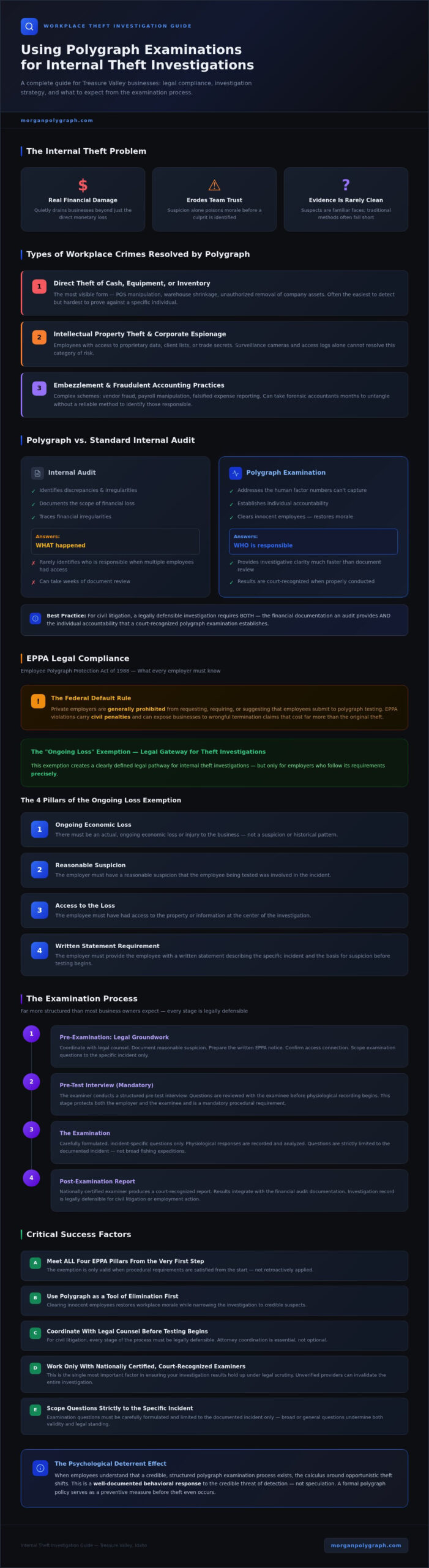
- Internal theft investigations using polygraphs are legally permissible under the Employee Polygraph Protection Act’s “Ongoing Loss” exemption, but only when specific procedural requirements are met from the very first step.
- A polygraph examination is most powerful as a tool of elimination – clearing innocent employees restores workplace morale while narrowing the investigation to credible suspects.
- For businesses pursuing a polygraph for civil litigation Boise Idaho, every stage of the process must be legally defensible, making coordination with both a qualified examiner and legal counsel essential before testing begins.
- The examination process is far more structured than most business owners expect, with carefully formulated, incident-specific questions and a mandatory pre-test interview that protects both the employer and the examinee.
- Working with nationally certified, court-recognized examiners – rather than unverified providers – is the single most important factor in ensuring your investigation results hold up under legal scrutiny.
The Role of Polygraph for Internal Theft Investigations in 2026
Internal theft remains one of the most financially damaging and emotionally disruptive challenges a business can face. The losses are real, the suspects are familiar faces, and the evidence is rarely clean. Traditional investigative methods, including standard interviews and internal reviews, frequently fall short when the person responsible is sophisticated enough to cover their tracks. That’s where a professionally administered polygraph examination changes the dynamic entirely.
What makes polygraph testing particularly valuable in 2026 is the breadth of workplace crimes it can address. Internal theft is no longer limited to cash disappearing from a register. Businesses across the Treasure Valley are contending with schemes that range from straightforward inventory skimming to complex digital embezzlement that can take forensic accountants months to untangle.
Types of Workplace Crimes Resolved by Polygraph
A polygraph examination can be structured to address a wide range of internal incidents, including:
- Direct theft of cash, equipment, or inventory: The most immediately visible form of internal loss, often involving point-of-sale manipulation, warehouse shrinkage, or unauthorized removal of company assets.
- Intellectual property theft and corporate espionage: Employees with access to proprietary data, client lists, or trade secrets represent a category of risk that surveillance cameras and access logs alone cannot resolve.
- Embezzlement and fraudulent accounting practices: Complex schemes involving vendor fraud, payroll manipulation, or falsified expense reporting require both financial forensics and a reliable method of identifying the individuals responsible.
The psychological deterrent effect of a formal polygraph policy also deserves recognition. When employees understand that a credible, structured examination process exists, the calculus around opportunistic theft shifts. This isn’t speculation; it’s a well-documented behavioral response to the credible threat of detection.
Polygraph vs. Standard Internal Audits
Internal audits are an essential tool. They identify discrepancies, trace financial irregularities, and document the scope of a loss. But audits answer the question of what happened. They rarely answer who is responsible, particularly when multiple employees had access or when the scheme was designed to distribute suspicion.
A polygraph examination addresses the human factor that numbers simply cannot capture: the knowledge, intent, and direct involvement of a specific individual. Where a forensic audit might require weeks of document review, a properly scoped examination can provide meaningful investigative clarity far more quickly.
For Treasure Valley businesses considering a polygraph for civil litigation Boise Idaho, this distinction matters enormously. Building a legally defensible investigation record requires both the financial documentation an audit provides and the individual accountability that a court-recognized polygraph examination can establish. Working with nationally certified, court-recognized examiners ensures that neither element undermines the other.
Navigating the Employee Polygraph Protection Act (EPPA) Compliance
The Employee Polygraph Protection Act of 1988 establishes a federal baseline that every Treasure Valley employer must understand before scheduling a single examination: private employers are generally prohibited from requesting, requiring, or suggesting that employees submit to polygraph testing. Full stop. But that prohibition is not absolute, and the law’s “Ongoing Loss” exemption creates a clearly defined legal gateway for exactly the kind of internal theft investigation most businesses actually face.
Getting this wrong isn’t just a procedural misstep. EPPA violations carry civil penalties and can expose your business to wrongful termination claims that cost far more than the original theft. The exemption is available, but only to employers who follow its requirements precisely.
The 4 Pillars of the Ongoing Loss Exemption
Think of EPPA compliance as a four-legged structure. Remove any single leg, and the entire legal justification collapses. To lawfully administer a polygraph examination under the Ongoing Loss exemption, all four conditions must be satisfied simultaneously:
- A specific, identifiable economic loss must have occurred. The exemption doesn’t apply to vague concerns about general shrinkage or a feeling that something is off. There must be a concrete, documented loss: missing inventory, a reconciled cash shortfall, confirmed fraudulent transactions, or a verified breach of proprietary data.
- The employee must have had access to the property or assets in question. This is not about who might have had access in theory. You must be able to demonstrate, with documentation, that the specific employee being examined had actual, verifiable access to the affected assets during the relevant timeframe.
- The employer must have reasonable suspicion of that employee’s involvement. Suspicion must be individualized and articulable. It cannot be based solely on the fact that an employee had access, nor can it rest on anonymous tips without corroborating evidence. Documented behavioral changes, witness accounts, access logs, and financial discrepancies all contribute to a defensible reasonable suspicion standard.
- A signed, written statement must be provided to the employee at least 48 hours before the examination. This statement must identify the specific incident being investigated, describe the basis for reasonable suspicion, and explain the employee’s rights under EPPA. Verbal notice does not satisfy this requirement.
Employee Rights and Employer Prohibitions
Compliance isn’t only about what employers must do; it’s equally about what they cannot do. Employees retain the right to terminate the examination at any time, for any reason, without penalty. Examiners are prohibited from asking questions touching on religious beliefs, political views, sexual behavior, or union affiliation. These restrictions aren’t negotiable, and a qualified examiner will structure the question set accordingly.
Perhaps the most consequential prohibition: an employer cannot discharge, discipline, or discriminate against an employee solely on the basis of polygraph results. The examination result is one piece of an investigative record, not a standalone verdict. For businesses pursuing a polygraph for civil litigation Boise Idaho, this distinction is critical; any employment action taken must be supported by additional evidence independent of the test itself.
Coordinating with a nationally certified examiner from the outset ensures that every procedural requirement is met before the examination begins, not discovered to be missing afterward. If you’re building an investigation that needs to hold up in court, working with court-recognized examiners is the most reliable way to protect that record from the start.
Integrating Polygraphs into Your Investigation Strategy
A polygraph examination is not a starting point. It’s a destination you reach only after the investigative groundwork is already solid. Businesses that treat the examination as a first response, rather than a structured component of a broader investigative arc, consistently produce results that are legally vulnerable and operationally counterproductive. The goal is to arrive at the examination with a clean, documented record that supports every decision made along the way.
Step-by-Step Investigative Integration
Before a certified examiner is ever contacted, three foundational steps must be completed:
- Initial fact-finding and evidence preservation: Secure all physical and digital evidence immediately. Access logs, transaction records, surveillance footage, and inventory documentation should be preserved in their original form before any internal interviews take place. Altered or incomplete records weaken the investigation regardless of what the examination reveals.
- Identifying the narrow group: Polygraph testing is most legally defensible when applied to a clearly defined group of employees who had documented access and opportunity. Broad, unfocused testing invites EPPA challenges. Narrow the field using the evidence you’ve already gathered.
- Consulting a certified examiner on feasibility: A nationally certified, court-recognized examiner can assess whether the documented evidence supports the legal threshold required for testing. This consultation also shapes the question formulation process, ensuring the examination is scoped precisely to the incident at hand.
Legal counsel should be involved before this process begins, not after a problem surfaces. For businesses pursuing a polygraph for civil litigation Boise Idaho, the coordination between your attorney and your examiner is what keeps the investigation record legally defensible at every stage.
Communicating with the Workforce
How you communicate an internal investigation determines whether your team emerges from it intact. Framing matters. An investigation announced as a search for a guilty party creates fear and resentment. The same investigation framed as a process designed to clear the innocent restores trust far more quickly.
Be direct with your team: the examination exists to eliminate suspicion, not manufacture it. Most employees facing a polygraph are innocent, and a well-administered examination confirms that. If your workforce has questions about the reliability of the process, point them to credible resources. Understanding how polygraph accuracy actually works helps employees approach the process with confidence rather than anxiety.
Confidentiality is equally non-negotiable. Information about who is being examined, what questions were asked, and what results were produced must be restricted to those with a direct need to know. Disclosure beyond that circle creates real defamation exposure, regardless of whether the results were accurate.
The Examination Process: What Happens During an Internal Theft Polygraph
Most business owners are surprised by how structured the examination process actually is. This isn’t a confrontational interrogation or a fishing expedition. A professionally administered polygraph for civil litigation Boise Idaho follows a precise, three-phase sequence designed to produce legally defensible data while treating every examinee with dignity and procedural fairness.
The process begins well before any physiological sensors are attached. The pre-test interview is where the examiner establishes rapport, explains exactly how the instrument works, reviews every question that will be asked during the examination, and confirms that the examinee understands both the process and their rights. Nothing asked during the data collection phase should come as a surprise. This transparency isn’t just ethical protocol; it’s what makes the physiological responses meaningful. An examinee who genuinely doesn’t know what’s coming produces unreliable data. An examinee who has reviewed every question in advance and still shows a significant physiological response to specific relevant questions is providing the examiner with something far more useful.
The data collection phase itself uses state-of-the-art polygraph instrumentation to monitor multiple physiological channels simultaneously, including cardiovascular activity, respiratory patterns, and electrodermal response. The examiner administers the question series in a controlled, methodical sequence, typically running multiple chart presentations to ensure the data is consistent and interpretable.
Question Formulation for Internal Affairs
The quality of an examination lives or dies on the precision of its questions. Broad, speculative inquiries produce ambiguous data. Incident-specific questions produce actionable results. A properly scoped examination focuses exclusively on the documented loss, not on an employee’s general character or unrelated history.
The distinction between question types matters significantly here. A question like “did you steal from the company?” is far less diagnostically useful than “did you take any of the cash from the register on the evening of [specific date]?” The second question is anchored to a specific, verifiable incident. It eliminates interpretive ambiguity for both the examinee and the examiner. Clear, binary yes-or-no questions are essential for accuracy because the instrument measures physiological responses to specific cognitive and emotional states; vague questions produce vague responses that can’t be reliably scored. Questions probing whether an examinee knows who committed the theft are equally valid and often produce critical investigative leads when the primary subject is truthful.
Interpreting the Results
When chart analysis is complete, the examiner produces a professional written report. Results are typically categorized as either “No Significant Physiological Response” (indicating truthfulness to the relevant questions) or “Significant Physiological Response” (indicating deception). A third outcome, “Inconclusive,” is also possible and reflects data that doesn’t meet the threshold for either determination.
Interpreting these charts requires genuine expertise. Scoring isn’t automated; it’s a disciplined analytical process that nationally certified, court-recognized examiners are specifically trained to perform. For businesses building an internal investigation record, the final report serves as a structured document that informs decision-making alongside the financial and physical evidence already gathered, never as a standalone verdict.
If you’re ready to understand how a properly scoped examination fits your specific situation, contact Morgan Polygraph to speak with a certified examiner before your investigation goes any further.
Why Boise Businesses Trust Morgan Polygraph for Internal Investigations
Choosing the right examiner isn’t a minor administrative decision. It’s the variable that determines whether your investigation holds up under legal scrutiny or unravels at the worst possible moment. For Treasure Valley businesses navigating the specific pressures of internal theft, the examiner you select shapes every downstream outcome, from the admissibility of results in civil proceedings to the defensibility of any employment action that follows.
Morgan Polygraph brings decades of combined experience across criminal and civil case polygraphs to every engagement. That depth of experience isn’t simply a credential to cite; it’s what allows the team to anticipate the procedural challenges that arise in complex internal investigations and address them before they become problems. Court-recognized examiners understand what legal counsel needs, what judges scrutinize, and what documentation gaps create vulnerabilities. That institutional knowledge is built over years, not months.
Certified Expertise in Idaho
The gap between a certified examiner and an unverified provider is not a matter of preference. It’s a matter of legal defensibility. When results from a certified polygraph near me are introduced into civil proceedings or used to support an employment decision, opposing counsel will scrutinize the examiner’s credentials, methodology, and instrumentation. Morgan Polygraph’s nationally certified, court-recognized examiners have a documented history of serving legal, private, and governmental clients throughout the Treasure Valley, producing reports that withstand that scrutiny.
State-of-the-art instrumentation also matters in 2026. Polygraph technology has advanced considerably, and examinations conducted with current-generation equipment produce more reliable physiological data across multiple channels simultaneously. That technical precision strengthens every result, whether it’s clearing an innocent employee or identifying a credible suspect in a case being built for civil litigation in Boise, Idaho.
Discretion is equally non-negotiable. Morgan Polygraph operates from a professional environment specifically designed to minimize examinee stress, because a composed examinee produces more diagnostically reliable data than an anxious one. Every examination is conducted with the confidentiality that sensitive internal matters require.
Next Steps for Your Business
If you’ve identified a documented loss, established a reasonable suspicion basis, and are ready to move forward, the next step is a confidential consultation. Prepare the following before you reach out:
- Documentation of the specific loss: Transaction records, access logs, inventory discrepancies, or financial irregularities that establish the Ongoing Loss exemption threshold.
- A defined list of employees with documented access to the affected assets during the relevant timeframe.
- Any witness accounts or behavioral observations that contribute to individualized reasonable suspicion.
Arriving at the consultation with organized documentation allows the examiner to assess feasibility immediately and begin shaping the question formulation process without delay. To understand the full scope of what a professional examination involves before scheduling, review the polygraph examination portal for a complete guide to the process. When you’re ready to speak with a certified examiner about your specific situation, contact Morgan Polygraph directly. Your investigation deserves a foundation built on expertise, not uncertainty.
Protect Your Business with a Legally Defensible Investigation
Internal theft doesn’t resolve itself. The longer a loss goes uninvestigated, the more it costs: financially, operationally, and in the trust that holds your team together. A professionally administered polygraph examination, built on EPPA compliance and conducted by nationally certified examiners, gives Treasure Valley businesses a structured path forward that protects both the investigation and the people involved in it.
Three things determine whether your investigation succeeds: documentation gathered before testing begins, an examiner whose credentials hold up under legal scrutiny, and a process that treats every examinee with procedural fairness. Get those three things right, and your results will stand.
For businesses that need a polygraph for civil litigation Boise Idaho, the standard is even higher. Court-recognized expertise isn’t optional when the stakes include legal proceedings. Morgan Polygraph’s nationally certified, EPPA-compliant examiners are built for exactly that standard.
Your investigation deserves a foundation that holds. Schedule a confidential consultation with Morgan Polygraph and take the first step toward clarity with confidence.
Frequently Asked Questions
Is it legal to use a polygraph for internal theft investigations in Idaho?
Yes, it’s legal under specific conditions. The Employee Polygraph Protection Act’s “Ongoing Loss” exemption permits Idaho employers to request polygraph testing when a documented economic loss has occurred, the employee had verifiable access to the affected assets, and individualized reasonable suspicion exists. Idaho doesn’t impose additional state-level restrictions beyond EPPA, but federal procedural requirements must be satisfied precisely before any examination is scheduled.
What is the Employee Polygraph Protection Act (EPPA)?
EPPA is a federal law enacted in 1988 that generally prohibits private employers from requiring or requesting polygraph tests from employees or job applicants. The law isn’t an absolute ban; it includes defined exemptions, the most relevant being the Ongoing Loss exemption for internal theft investigations. Violations carry civil penalties and can expose employers to wrongful termination claims, making compliance non-negotiable regardless of how clear-cut the suspected theft appears.
Can an employee refuse to take a lie detector test?
Yes, absolutely. Employees retain the legal right to decline or terminate a polygraph examination at any point, without penalty. An employer cannot discharge, discipline, or otherwise retaliate against an employee solely for refusing to submit to testing. That said, a refusal doesn’t end the investigation; it simply means the employer must rely on the physical, financial, and testimonial evidence already gathered to support any subsequent employment decisions.
What qualifies as ‘reasonable suspicion’ for a workplace polygraph?
Reasonable suspicion must be individualized and documented; it can’t rest on gut instinct or the simple fact that an employee had access. Qualifying evidence typically includes access logs placing the employee at the point of loss, witness accounts, documented behavioral changes following the incident, or financial discrepancies tied to specific transactions the employee controlled. Anonymous tips alone don’t satisfy the standard without corroborating evidence. A certified examiner can assess whether your documentation clears this threshold before testing begins.
Can I fire an employee if they fail a polygraph test?
Not on the basis of the test result alone. EPPA explicitly prohibits taking adverse employment action solely because an employee produced a significant physiological response during examination. Any termination or disciplinary decision must be supported by independent evidence gathered separately from the polygraph result itself. The examination informs the investigation; it doesn’t replace the evidentiary record. For businesses pursuing a polygraph for civil litigation Boise Idaho, this distinction is especially critical because employment actions built on test results alone are legally vulnerable.
How much does a polygraph test for employee theft cost in 2026?
Pricing for professional polygraph examinations varies depending on the complexity of the investigation, the number of examinees, and the scope of question formulation required. Contact Morgan Polygraph directly for accurate pricing specific to your situation. What’s worth understanding is that the cost of a professionally administered examination is typically a fraction of the ongoing financial loss an unresolved internal theft produces, particularly when legal proceedings become part of the outcome.
Are the results of an internal theft polygraph admissible in court?
Admissibility depends on jurisdiction, the specific proceedings involved, and the credentials of the examiner who conducted the test. In civil litigation contexts, polygraph results are sometimes admitted by agreement of both parties or as supporting evidence within a broader investigative record. Working with nationally certified, court-recognized examiners is what makes results defensible under legal scrutiny. Reports produced by unverified providers are far more vulnerable to challenge and are routinely excluded.
How long does a workplace polygraph examination take?
A complete examination typically runs between two and three hours from start to finish. The pre-test interview, which covers question review, instrument explanation, and rights confirmation, accounts for a substantial portion of that time. The actual data collection phase is shorter, but the examiner will run multiple chart presentations to ensure consistency. Employers should plan accordingly and avoid scheduling examinations in a way that creates time pressure on either the examiner or the examinee, as a composed testing environment directly affects the reliability of the results.