
If your reputation, your career, or your marriage depended on a single answer, would you trust a $20 smartphone app to decide your future? The debate between an online polygraph vs professional polygraph often centers on convenience; however, the underlying technology and methodology are worlds apart. It’s completely understandable why many people look for digital solutions when they’re facing the crushing weight of uncertainty. You want answers quickly. You likely want to avoid the perceived high costs of a formal office visit while resolving a painful situation as discreetly as possible.
This article will help you discover the critical differences between automated online tools and certified professional examinations to ensure you get the truth when it matters most. We’ll explore why forensic precision requires a human expert and how to choose a method that produces results valid for legal or therapeutic use. By the end of this guide, you’ll understand how to avoid the embarrassment of a false result and find a reliable way to prove the truth in 2026.
Key Takeaways
- Understand the fundamental differences in an online polygraph vs professional polygraph, specifically how professional exams utilize multi-channel physiological sensors instead of basic software algorithms.
- Recognize that professional examinations are court-recognized and suitable for legal or therapeutic use, while online tools are typically designed for entertainment only.
- Learn why the presence of a certified examiner is vital for detecting countermeasures and ensuring the integrity of the testing environment.
- Discover how professional forensic procedures achieve accuracy rates of 90% or higher by monitoring respiratory, sweat, and blood pressure markers simultaneously.
- Identify the specific credentials, such as APA certification, required to ensure your results are valid and respected in Boise and beyond.
What is the Difference Between Online and Professional Polygraphs?
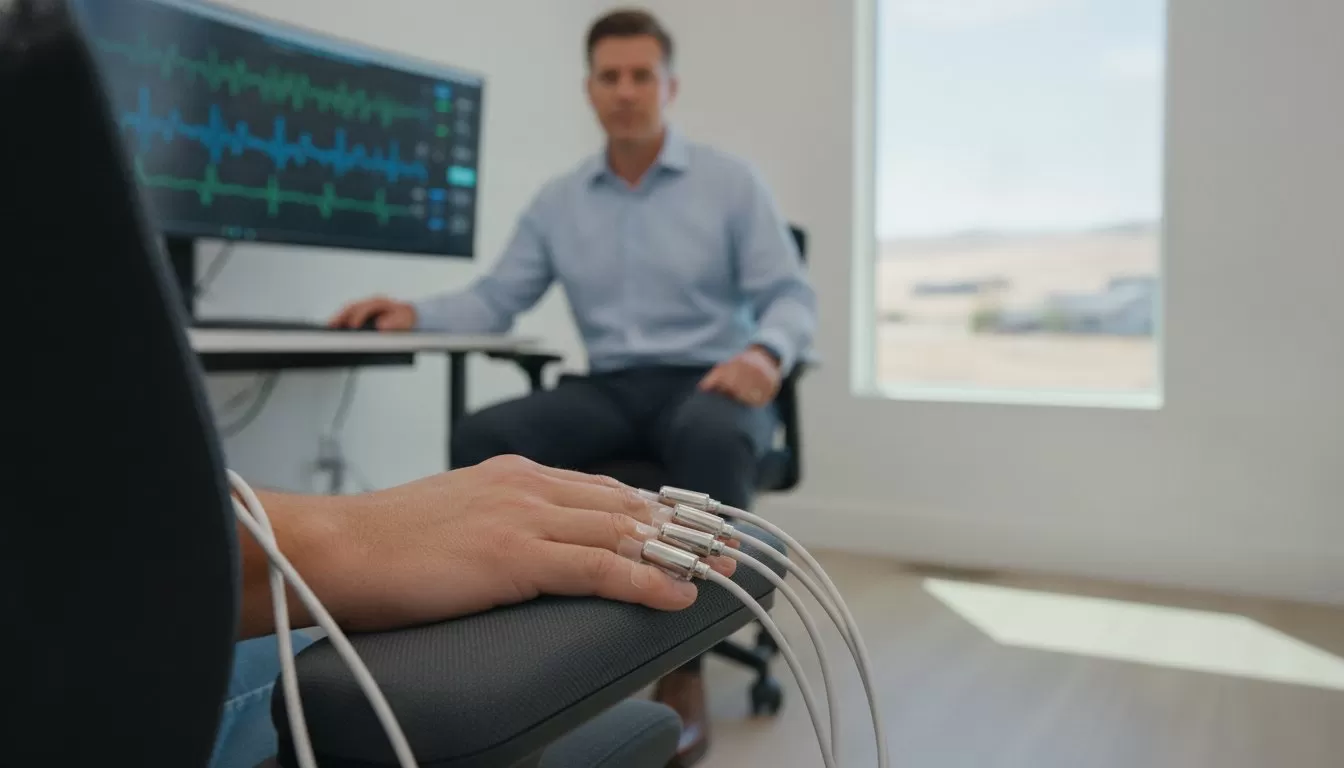
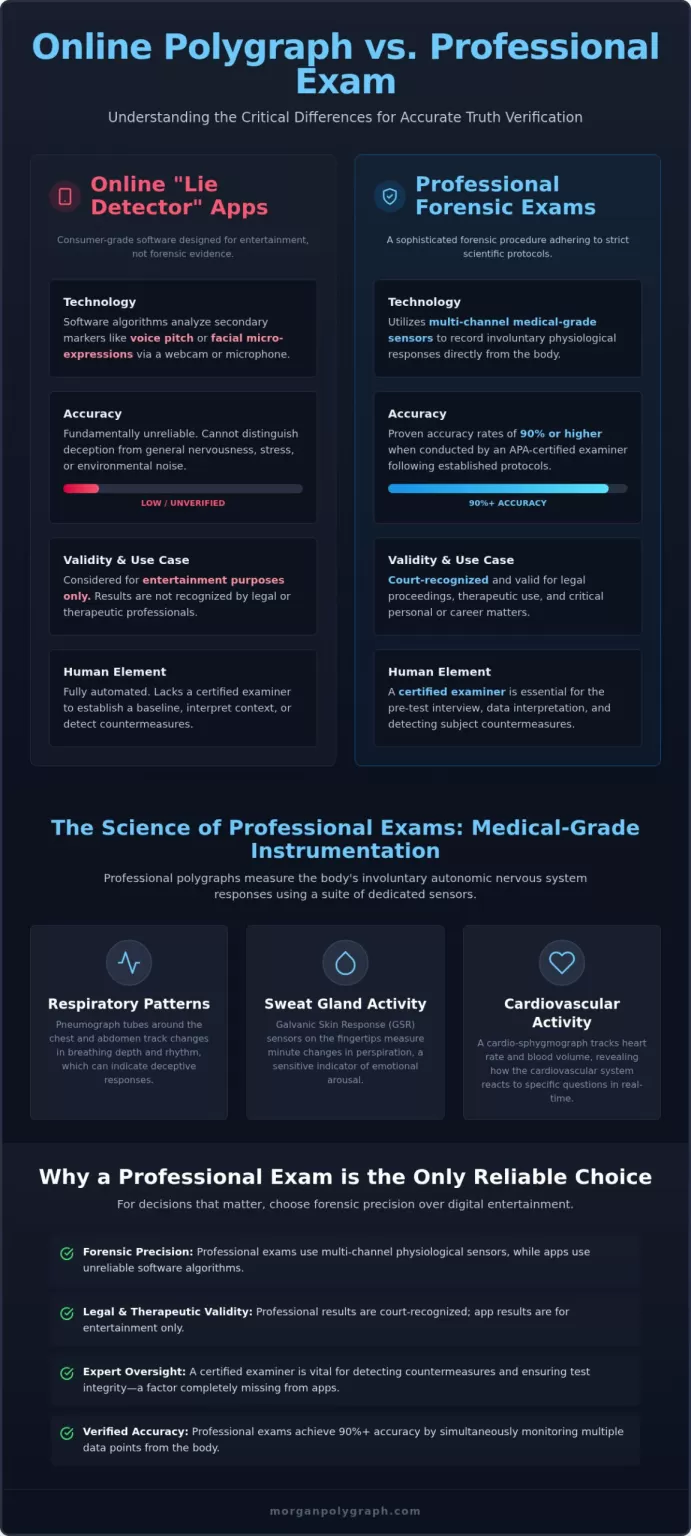
Professional polygraphy is a sophisticated, multi-channel physiological recording process designed to capture internal bodily responses that are beyond conscious control. When comparing an online polygraph vs professional polygraph, the most significant distinction lies in the data source. A professional examination utilizes medical-grade sensors to monitor four primary systems: respiratory patterns, electrodermal activity (sweat), blood pressure, and heart rate. These sensors provide a high-resolution map of a person’s autonomic nervous system, creating a data-driven foundation for truth verification.
In contrast, online “polygraphs” are typically consumer software packages that rely on secondary markers like voice pitch or facial micro-expressions. These tools don’t measure the body’s internal state; they interpret external signals that can be easily influenced by environmental noise, poor lighting, or simple nervousness. For life-altering decisions involving legal cases or relationship integrity, relying on software alone is a significant risk. The gap between medical hardware and consumer algorithms is the difference between forensic evidence and digital entertainment.
The Rise of Virtual ‘Lie Detector’ Apps
Most virtual apps marketed as lie detectors use algorithms to analyze fluctuations in voice frequency or micro-expressions captured via a smartphone camera. While these technologies sound futuristic, they’re fundamentally unreliable because they lack a physiological baseline. Without knowing a subject’s unique “normal” state under controlled conditions, a software program cannot accurately distinguish between the stress of a lie and the stress of being recorded. Many users experience a psychological placebo effect, where the mere presence of the app makes them feel more honest, but this isn’t a substitute for forensic science.
Professional Examinations: A Forensic Standard
A professional examination is a forensic procedure that adheres to strict protocols established by the American Polygraph Association (APA). These standards ensure that every test is conducted in a neutral, distraction-free environment. A physical examiner is essential because they don’t just read a chart; they interpret complex, overlapping data points while observing the subject’s behavior. This human oversight is what makes the results valid for legal or therapeutic use.
The pre-test interview is perhaps the most critical stage of this process. During this phase, the examiner ensures the subject understands the questions and establishes a psychological baseline. This human-led approach allows for the detection of countermeasures and ensures that the final result is based on physiological data rather than a computer guess. For those in Boise, seeking a nationally certified examiner ensures that your results meet the rigorous requirements for court recognition and professional standing.
The Science of Sensors vs. Software Algorithms
Understanding the technical gap in an online polygraph vs professional polygraph requires a look at what is actually being measured. Professional polygraphy relies on the concept of physiological arousal, the body’s involuntary reaction to a perceived threat or stressor. To capture this accurately, an examiner must monitor multiple physiological systems simultaneously. If a system only tracks one metric, like voice pitch or facial movement, it cannot distinguish between the fear of being caught in a lie and the general anxiety of the testing process itself.
Online tools often rely solely on a computer’s microphone or webcam. This creates a “noise” problem where environmental factors or personal temperament are misinterpreted as deception. A professional exam filters out this noise by using a suite of dedicated sensors that provide a comprehensive view of the subject’s autonomic nervous system.
Medical-Grade Instrumentation
A certified examiner uses specialized hardware to ensure data integrity. These instruments include:
- Pneumograph tubes: These are placed around the chest and abdomen to monitor respiratory patterns. They detect subtle suppression of breath or changes in breathing depth that often accompany deceptive responses.
- Galvanic Skin Response (GSR): This sensor measures minute changes in sweat gland activity on the fingertips. It is one of the most sensitive indicators of autonomic arousal.
- Cardio-sphygmograph: This component tracks heart rate and fluctuations in blood volume. By monitoring cardiovascular activity, the examiner can see how the heart reacts to specific stimuli in real time.
The Algorithm Fallacy
Software algorithms are designed to find patterns, but they often fail to account for individual baseline differences. Every person has a unique physiological signature. A computer program running on a standard laptop doesn’t have the context to know if a high heart rate is due to a lie or a pre-existing medical condition. This lack of context leads to frequent false positives, where honest individuals are incorrectly flagged as deceptive.
Professional examiners at Morgan Polygraph calibrate their equipment for each individual subject. This personalized approach involves a pre-test phase where a baseline is established under controlled conditions. By comparing active responses against this unique baseline, an expert can provide a level of accuracy that automated software simply cannot match. This methodical calibration is why professional results are recognized in forensic and legal environments while online apps remain in the category of novelty entertainment.
Professional vs. Online: A Direct Comparison
When weighing an online polygraph vs professional polygraph, the choice is ultimately between a forensic procedure and digital entertainment. Professional polygraphy is a scientific discipline rooted in decades of physiological research. Online “tests” are often marketed as convenient, low-cost alternatives, but they operate on unverified algorithms that provide little more than random chance. Because these apps lack the medical-grade hardware required to track autonomic responses, they cannot offer the reliability needed for serious life decisions.
Accuracy rates for professional examinations, when performed by nationally certified practitioners, can reach 90% or higher. Online software lacks the peer-reviewed data to support any specific accuracy claim. Ethical oversight also sets the two apart. Certified examiners follow strict American Polygraph Association (APA) codes of conduct, ensuring your privacy is protected and the testing process remains unbiased. This level of professional accountability doesn’t exist in the world of automated apps.
Credibility and Admissibility in Idaho
Legal proceedings in Boise require standards that online tools simply cannot meet. Attorneys understand that only court-recognized experts hold weight in a courtroom or during settlement negotiations. If you’re involved in a criminal defense polygraph, the stakes are too high for guesswork. A professional examiner provides a detailed, data-backed report that establishes a verified chain of custody for the truth. This documentation is essential for proving your side of the story in a way that legal professionals respect.
Personal Integrity and Relationship Testing
The emotional weight of infidelity tests shouldn’t be left to an unverified smartphone app. A false positive result from a poorly designed piece of software can cause irreparable damage to a marriage or family. A neutral, third-party professional provides a controlled, compassionate environment. This human element allows both parties to feel heard and respected. Beyond just providing a result, a professional exam offers real therapeutic value by creating a foundation of verified facts from which a couple can begin rebuilding trust.
Professional exams are also highly customized. Whether you’re dealing with a civil case, a pre-employment screening, or a Post-Conviction Sex Offender Testing (PCSOT) requirement, the questions and methodology are tailored to the specific situation. Online tools use a “one-size-fits-all” approach that fails to capture the nuances of complex human interactions and motivations.
Why Online Polygraphs Fail the ‘Real World’ Test
The label “online lie detector” is frequently a marketing myth designed to capture interest rather than provide forensic results. Most of these platforms are legally classified as entertainment, yet they’re often used by individuals facing serious life crises. When evaluating an online polygraph vs professional polygraph, one must consider the adversarial nature of truth verification. A software program assumes the subject is cooperating with the technology; a professional examiner knows that a deceptive person may actively try to subvert the process.
There is also a significant risk involving service-based companies that act as middlemen. These entities often assign unknown examiners who may not hold national certifications or follow established ethical codes. This lack of transparency can lead to inconsistent results and a complete lack of accountability if the test is performed incorrectly. A professional environment ensures that you know exactly who is conducting your exam and what their credentials are.
Countermeasures and Manipulation
Automated apps are fundamentally blind to countermeasures. These are physical or mental maneuvers, such as controlled breathing or self-induced pain, used by subjects to distort physiological readings. Without a human expert present to observe the subject’s physical posture and behavioral cues, these tricks often go undetected. Professional examiners are trained to identify over 20 types of countermeasures. This expertise ensures that the data being analyzed is genuine and not the result of a subject trying to manipulate the outcome.
The Fraudulent Nature of ‘Free’ Online Tests
Data privacy is a major concern with unverified digital tools. When you record your voice or face for an app, you’re often handing over biometric data to companies with no clear privacy policy. Many of these “free” services are also built on a pay-to-see-results scam. They lure users in with the promise of a quick answer, only to lock the final report behind a high fee once the session is complete. In 2026, the distinction between fact and fiction is more important than ever. Truth is not a commodity that can be found in a free download.
To protect your privacy and ensure the integrity of your results, you should always consult a nationally certified polygraph professional for any serious matter. This ensures your sensitive issues are handled with the discretion and scientific rigor they deserve.
Choosing the Right Professional in Boise, Idaho
Finding a resolution to a sensitive legal or personal matter requires more than just a software algorithm. When you evaluate an online polygraph vs professional polygraph, the most important factor is the human expert behind the equipment. In Boise, residents need examiners who understand the local legal landscape and adhere to the highest national standards. A professional examination isn’t just about the technology; it’s about the methodology, the environment, and the ethical framework that ensures the results are both accurate and actionable.
Selecting a local expert provides a level of accountability that digital apps cannot match. You aren’t just a user of a platform; you’re a client receiving a forensic service. This relationship is built on trust and the assurance that your most private issues are being handled with the gravity they deserve. By choosing a local Boise office, you ensure that the testing environment is controlled, distraction-free, and designed for scientific precision.
Checking Credentials and Experience
Before booking an appointment, you must verify the background of your examiner. Ensure they are a certified polygraph professional with standing in recognized organizations like the American Polygraph Association (APA). This certification is your guarantee that the examiner follows validated testing protocols and uses modern, peer-reviewed techniques. Experience in specific case types is also vital. You should ask whether they have extensive history in:
- Criminal and Civil cases: Requiring strict adherence to evidentiary standards.
- Post-Conviction Sex Offender Testing (PCSOT): Demanding specialized training and state-mandated protocols.
- Relationship and Infidelity testing: Requiring a blend of technical accuracy and interpersonal compassion.
A professional office environment is also a non-negotiable requirement. The room must be neutral and quiet to prevent external stimuli from influencing the subject’s physiological responses. If an examiner suggests conducting a test in a public space or over a standard web camera, they aren’t following forensic standards.
The Morgan Polygraph Commitment
Morgan Polygraph bridges the gap between decades of traditional expertise and the latest technical innovations. We provide nationally certified and court-recognized examinations right here in Boise, Idaho. Our approach is methodical and organized, ensuring that every client feels respected and informed throughout the process. We understand the high stress involved in these situations, which is why we maintain a discreet office environment where privacy is the central theme. We don’t rely on the unverified claims of an online polygraph vs professional polygraph; we rely on data-driven detection and behavioral observation.
Our commitment to technical precision is matched only by our dedication to the human element. We take the time to conduct thorough pre-test interviews, ensuring that the questions are clear and the subject is properly prepared. This careful preparation is what leads to the high accuracy rates that legal and governmental clients depend on. If you’re ready to find a reliable way to prove the truth, Schedule a professional polygraph examination with Morgan Polygraph today.
Securing Your Future with Verified Truth
Choosing between an online polygraph vs professional polygraph isn’t just about cost; it’s about the weight of the results. Digital apps lack the medical-grade sensors and human expertise required to provide forensic-level certainty. Only a certified examiner can identify countermeasures and establish a reliable physiological baseline when your reputation or relationship is at stake. The software-only approach simply cannot account for the complex variables of human stress and deception.
Our Boise office utilizes state-of-the-art technology and nationally certified examiners to provide court-recognized expert testimony. We understand that behind every test is a human story that deserves compassion and technical precision. Don’t leave your future to an unverified algorithm or a “free” app that lacks scientific validation. We provide the methodical, organized environment necessary for results you can actually use.
Book Your Professional Polygraph Exam in Boise to ensure your voice is heard and the truth is documented with absolute integrity. You deserve the peace of mind that comes from a definitive, professional answer.
Frequently Asked Questions
Is an online polygraph test as accurate as a professional one?
No, an online polygraph test isn’t as accurate as a professional examination. In the debate of online polygraph vs professional polygraph, the primary difference is the data source. Apps use software to guess at deception based on voice or face patterns. Professional exams use medical-grade sensors to record actual physiological changes in the heart, lungs, and skin. This scientific approach is the only way to achieve forensic-level accuracy.
Can online lie detector results be used in court?
Online lie detector results aren’t admissible in Idaho courts. Legal proceedings require expert testimony from a nationally certified examiner who follows strict forensic protocols. A software algorithm can’t be cross-examined or verify the subject’s identity and environment. Attorneys in Boise only trust results that come from a professional, controlled setting with a documented chain of custody for the truth.
Why do online polygraph apps ask for payment after the test?
Most online polygraph apps are marketed as entertainment products that use a pay-to-see business model. They often offer a free session to capture your attention and biometric data, then require a fee to unlock the results. This is a common marketing tactic in the novelty app industry. It doesn’t indicate that the results are scientifically valid or useful for any serious legal or personal matter.
What are the risks of using a ‘USB Polygraph’ kit at home?
Home USB kits are novelty items that lack the precision of professional forensic tools. These devices aren’t calibrated to medical standards and often fail to measure the multiple physiological channels required for a valid test. Without a trained expert to interpret the data and account for the subject’s unique baseline, these kits frequently produce false results. They shouldn’t be used for resolving significant life issues.
How do I know if a polygraph examiner is actually certified?
You should verify an examiner’s credentials by checking the American Polygraph Association (APA) member directory. A legitimate expert will hold national certifications and be recognized by local courts. In Boise, it’s important to ask about their specific training and professional affiliations. A reputable examiner will always be transparent about their experience and the forensic standards they follow during every test.
Are there any ‘online’ tests that are scientifically recognized?
There are no online lie detection tools that are currently recognized as scientifically valid by major forensic organizations. The scientific community requires the simultaneous recording of respiratory, cardiovascular, and sweat gland activity. A standard computer microphone or webcam simply can’t capture this data. While some apps claim to use AI or voice stress, these methods don’t meet the rigorous standards of a multi-channel polygraph exam.
What happens if an online test gives a false result?
If an online test gives a false result, there is usually no professional recourse or ethical board to contact. These apps are sold as-is for entertainment purposes, meaning the company isn’t responsible for the emotional or legal consequences of an error. This is why it’s vital to use a certified professional. An expert provides accountability, follows strict ethical codes, and ensures the integrity of the final report.
How much more does a professional polygraph cost than an online app?
A professional polygraph requires a higher investment than an app because it involves medical-grade hardware and specialized forensic expertise. You’re paying for a controlled environment, a thorough pre-test interview, and a result that is recognized by legal and governmental agencies. While an online tool is cheaper, it provides no evidentiary value. The cost of a professional examination reflects the scientific rigor and reliability of the process.