

What if the most stressful part of your upcoming appointment wasn’t the technology itself, but the fear of a “gotcha” question you never saw coming? When your relationship is at a crossroads, the uncertainty of the process can feel as heavy as the emotional distress you’re already carrying. You’re likely searching for clarity on exactly what questions are asked in an infidelity polygraph test and whether an examiner might delve into private thoughts that have nothing to do with the issue at hand.
We understand that this is a vulnerable moment, and we’re here to replace that anxiety with professional transparency. In this 2026 guide, you’ll learn how infidelity polygraph questions are strictly formulated for clinical accuracy, ensuring the process remains fair and respectful. We’ll break down the specific categories covered during an exam, explain the vital role of the pre-test interview, and show you why a professional protocol means you’ll never be surprised by a question during your appointment. By the end of this article, you’ll have the confidence to approach your test with a clear mind and a full understanding of how modern technology serves the truth.
Key Takeaways
- Understand how the “No Surprise” rule ensures you review and approve every specific inquiry before any sensors are attached.
- Discover exactly what questions are asked in an infidelity polygraph test, including specific categories for physical acts and digital boundaries.
- Learn about the critical role of the pre-test interview in formulating a fair, clinical examination that focuses on your specific concerns.
- Recognize the scientific distinction between relevant and control questions and how they work together to produce accurate results.
- See why choosing a court-recognized examiner in Boise ensures your sensitive case is handled with the highest level of professional discretion.
The Foundation of Truth: How Infidelity Polygraph Questions Work
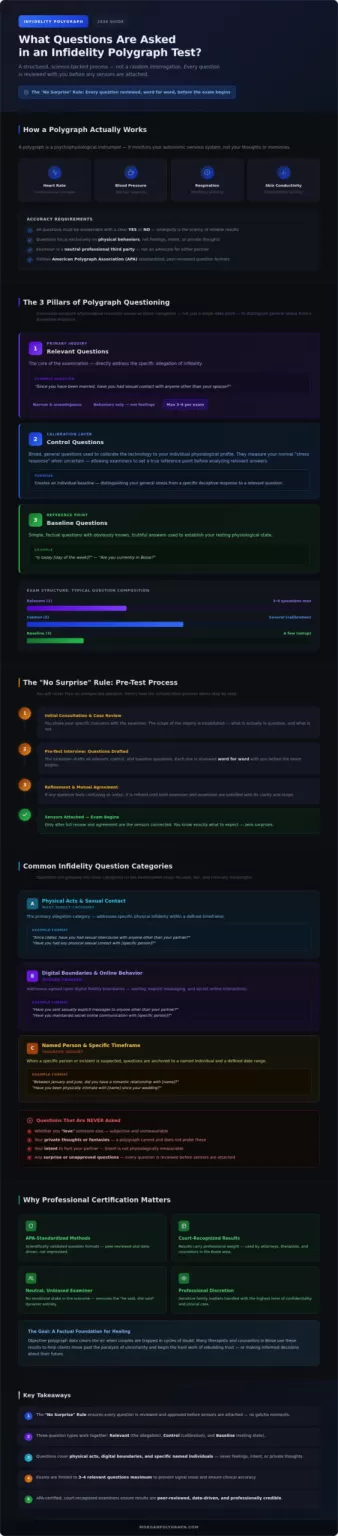
A polygraph doesn’t scan your brain for hidden memories or private fantasies. Instead, it functions as a sophisticated psychophysiological instrument that monitors autonomic nervous system responses. These include changes in heart rate, blood pressure, respiration, and skin conductivity. One of the most frequent concerns for couples in Idaho is understanding exactly what questions are asked in an infidelity polygraph test during a formal examination. The process is far more structured than what is often depicted in popular media.
The examiner acts as a neutral, professional third party in our Boise office, removing the emotional charge often found in domestic disputes to focus on verifiable data. Accuracy requires simplicity. Questions must be designed so they can be answered with a clear “yes” or “no.” Ambiguity is the enemy of a reliable test. If a question is too complex or open to interpretation, the physiological data becomes difficult to analyze. By keeping inquiries direct and factual, we ensure the results meet the highest clinical standards.
We strictly adhere to the “No Surprise” Rule. This protocol is central to our professional ethics. Every single question is reviewed, word for word, with the examinee before the sensors are ever attached. This eliminates the fear of “gotcha” moments and ensures that the person taking the test fully understands the scope of the inquiry. If a question feels confusing or unfair, it’s refined during this pre-test phase until both the examiner and the examinee are satisfied with its clarity.
The Goal of Relationship Testing
Relationship testing isn’t about “winning” an argument; it’s about establishing a factual baseline. Many couples come to us when they’re trapped in a cycle of “he said, she said” that prevents any real progress in their relationship. By providing objective data, a polygraph can clear the air. This factual foundation often serves as a turning point, allowing partners to stop litigating the past and start focusing on the future. Many therapists and counselors in the Boise area rely on these results to help their clients move past the paralysis of doubt and begin the hard work of rebuilding trust.
The Role of the American Polygraph Association (APA) Standards
Morgan Polygraph follows the strict national ethical guidelines set by the American Polygraph Association (APA). These standards are not just suggestions; they’re the bedrock of professional credibility. Standardized question formats are used because they’ve been scientifically validated to produce the highest accuracy rates. When you work with a court-recognized expert, you’re ensuring that the methodology used is peer-reviewed and data-driven. This level of professional rigor is essential when dealing with sensitive family matters where the stakes are incredibly high.
The Three Pillars of Polygraph Questioning: Relevant, Control, and Baseline
A professional examination isn’t a random interrogation. It’s a structured scientific process. To understand what questions are asked in an infidelity polygraph test, you must first understand the three distinct categories used to ensure accuracy. The examiner doesn’t just look at a single spike on a graph; they compare your physiological reactions across these pillars to reach a definitive conclusion. This comparison allows us to distinguish between the general stress of the situation and a specific deceptive response.
Relevant Questions: Focusing on Concrete Actions
Relevant questions are the core of the examination. They address the specific allegations of infidelity directly. For instance, an examiner might ask, “Since you have been married, have you had sexual contact with anyone other than your spouse?” These inquiries are designed to be narrow and unambiguous to prevent any “gray areas” in the data.
A Relevant Question is the primary inquiry into the specific allegation of infidelity.
These questions focus exclusively on behaviors rather than feelings or intent. We don’t ask if you “love” someone else or “intended” to hurt your partner, as those are subjective and impossible to measure physiologically. Instead, we focus on physical acts. To maintain the highest accuracy rates, we typically limit relevant questions to three or four per exam. This prevents “signal noise” and ensures the data remains clear and manageable for clinical analysis.
Control and Baseline Questions: The Science of Calibration
Before we can analyze your answers to the important questions, we must calibrate the technology to your unique physiology. This is where baseline and control questions come in. Everyone’s body reacts differently to stress, so we need a “map” of your personal responses.
- Irrelevant (Baseline) Questions: These are simple, non-threatening facts like “Is your name John?” or “Are we in Boise?” They establish how your body reacts when you’re telling the truth about something mundane.
- Comparison (Control) Questions: These questions are designed to evoke a reaction from a truthful person. They often cover minor past transgressions, such as, “Before 2024, did you ever tell a lie to get out of trouble?”
Baseline questions help reduce the impact of general “test anxiety.” It’s normal to be nervous during this process. However, there’s a distinct physiological difference between being “nervous” and being “deceptive.” Anxious reactions tend to be constant throughout the test, while deceptive reactions are specific and localized to the relevant questions. By comparing these reactions, we can filter out the noise of your nerves to find the signal of the truth. If you’re ready to seek clarity, you can schedule a professional consultation at our Boise office to discuss your specific situation.
Collaborative Design: Why You Will Never Be Surprised by a Question
The pre-test interview is the most essential phase of your appointment at our Boise office. It’s during this time that the examiner and the examinee work together to bridge the gap between emotional suspicion and clinical data. This isn’t a brief check-in; it’s a detailed consultation where we discuss the history of the relationship and the specific issues that led to the test. This dialogue ensures that when we finally determine what questions are asked in an infidelity polygraph test, they’re perfectly aligned with the facts of your situation.
We move away from subjective labels that can cause confusion. Words like “cheating” or “betrayal” are too vague for scientific measurement because they mean different things to different people. Instead, we refine these concepts into measurable, objective actions. You have the right to review and even reword questions until you’re completely comfortable with how they’re phrased. This collaborative approach removes the fear of “gotcha” moments and builds the professional rapport necessary for an accurate, valid result.
Defining Terms: What Does “Sexual Contact” Mean?
Standardized definitions are the bedrock of a fair exam. To ensure the examinee understands exactly what’s being asked, we define terms like “sexual contact” or “intimate act” with clinical precision. This might include specific physical behaviors or boundaries that have been discussed within the relationship. By establishing these definitions before the sensors are ever attached, we prevent “accidental” deceptive readings. A person shouldn’t fail a test because they interpreted a question differently than the examiner intended.
The Requesting Partner’s Input
The partner requesting the test plays a vital role in shaping the scope of the inquiry. They help us identify the “issues of concern” and the specific timeline of suspected infidelity. However, a professional examiner must balance these emotional needs with the scientific limits of the polygraph. We can’t test for every minor suspicion over a decade-long marriage. Instead, we focus on the most critical allegations to maintain high accuracy. This ensures the questions address the core issues while remaining within the proven capabilities of the technology. Our goal is to provide the requesting partner with the answers they need while maintaining a fair, professional environment for the examinee.
Common Infidelity Question Categories and Examples
Understanding what questions are asked in an infidelity polygraph test requires looking at how modern relationships define boundaries. Infidelity in 2026 isn’t limited to physical encounters; it often involves digital interactions or financial secrets that erode trust. We categorize these inquiries into four primary areas to ensure every concern is addressed with clinical precision. By organizing the test this way, we provide a comprehensive look at the relationship’s health while maintaining the scientific integrity of the data.
- Physical Infidelity: These questions focus on sexual contact or intimate physical acts as defined during your pre-test interview.
- Digital Infidelity: This category covers the use of dating apps, secret messaging platforms, or maintaining “emotional affairs” through hidden communication.
- Financial Deception: We may include questions about hidden bank accounts or significant sums of money spent on a third party without a partner’s knowledge.
- Historical Infidelity: Sometimes a partner needs to know if there are other secrets from the entire duration of the relationship that haven’t been disclosed.
Sample “Yes/No” Questions Used in Exams
The phrasing of each question is critical. They must be direct and leave no room for interpretation. During your appointment in our Boise office, we’ll finalize the exact wording of questions like these:
- “Since you’ve been in a relationship with [Name], have you had sexual contact with anyone else?”
- “Have you maintained any secret communication with an ex-partner that [Name] doesn’t know about?”
- “Besides what you told me during the interview, have you ever paid for a dating site subscription?”
Prohibited Topics: What an Examiner Will NOT Ask
A professional, APA-compliant examination has strict ethical boundaries. We don’t ask about religious beliefs, political affiliations, or sexual preferences. Our focus remains solely on the behaviors and actions that constitute a breach of your relationship’s specific agreements. Thoughts, fantasies, and “crushes” are not testable issues because they aren’t physical actions. A polygraph measures physiological responses to specific memories of behaviors, not fleeting internal feelings. Additionally, we don’t delve into irrelevant past history that has no bearing on your current partner unless it’s specifically part of the agreed-upon “issues of concern.” This professional distance ensures the exam is respectful and focused on the truth. If you’re ready to resolve these concerns with a court-recognized expert, you can book your infidelity polygraph exam today.
Why Professional Certification Matters in Boise, Idaho
Morgan Polygraph has served the Boise community for nearly two decades, establishing a reputation for clinical precision and ethical conduct. When you’re determining what questions are asked in an infidelity polygraph test, the credentials of the examiner are just as important as the technology they use. Choosing a court-recognized expert ensures that your results are based on validated scientific protocols rather than subjective guesswork. Our commitment to American Polygraph Association (APA) standards means every exam is conducted with state-of-the-art technology in a controlled, professional environment that meets national benchmarks for accuracy.
The stakes of a relationship exam are incredibly high. Relying on an uncertified provider can lead to inconclusive results or, worse, false readings that cause irreparable damage. A certified expert understands the delicate balance between gathering facts and maintaining the dignity of both partners. By adhering to strict procedural safeguards, we ensure that the data collected is reliable enough to be used as a foundation for your future decisions. Whether you’re seeking clarity for your own peace of mind or for a clinical referral, professional certification is the only way to guarantee a fair and accurate process.
Discretion and Confidentiality in Relationship Testing
Privacy is our highest priority at our Boise office. We understand the sensitive nature of relationship testing and have designed our facility to be a secure, discreet environment. Our suite at 6126 W. State Street in Boise provides a professional setting where you can find answers without fear of judgment. Searching for a certified polygraph near me is a critical step in protecting your emotional well-being. Uncertified alternatives often lack the rigorous training required to manage the complex psychological dynamics of infidelity cases. By choosing a nationally certified examiner, you’re opting for a methodology that is respected by legal and clinical professionals across Idaho.
Integrating Polygraph Results into Relationship Recovery
The results of an infidelity test are often the catalyst for radical honesty within a relationship. While we don’t provide therapy ourselves, we frequently work alongside local Boise counselors who use our findings to guide couples through the recovery process. Objective data removes the doubt and circular arguments that often stall progress in counseling sessions. Whether the results confirm suspicions or provide the exoneration a partner needs, they offer a factual foundation that helps you move forward. Taking the first step toward clarity is often the hardest part of the journey. If you’re ready to resolve the uncertainty, we invite you to schedule a confidential consultation. Our team is here to guide you through every step of the process, ensuring you feel prepared and respected throughout your appointment.
Moving Forward with Clarity and Professional Support
Resolving the weight of relationship uncertainty requires a process built on transparency and scientific rigor. You now understand that the “No Surprise” rule and collaborative question design ensure a fair environment for everyone involved. By focusing on measurable behaviors rather than subjective feelings, we provide the objective data needed to break the cycle of doubt. Knowing exactly what questions are asked in an infidelity polygraph test allows you to prepare for your appointment with confidence rather than fear.
At Morgan Polygraph, we combine decades of experience with state-of-the-art detection technology to deliver results you can trust. Our nationally certified and court-recognized examiners operate from a discreet Boise office, prioritizing your privacy at every stage. If you’re ready to find the answers you need and begin the process of healing, schedule a confidential infidelity polygraph in Boise today. You don’t have to carry the burden of the unknown any longer; let us help you establish a foundation of truth. We’re here to provide the professional support you deserve as you take this step toward peace of mind.
Frequently Asked Questions
How many questions are asked during an infidelity polygraph?
A typical examination includes between 10 and 12 total questions, though only three or four of these are “relevant” questions regarding the infidelity. The remaining inquiries are baseline and control questions used to calibrate the equipment to your unique physiology. This limited number of relevant questions ensures the highest level of accuracy by preventing data fatigue and keeping the focus on the most critical issues of concern.
Can I write the questions for my partner’s polygraph test?
You can certainly provide the “issues of concern” and the specific topics you want addressed, but the examiner must finalize the actual phrasing. Professional standards require that questions are formulated as simple “yes” or “no” inquiries that are free from emotional bias. We work with both partners during the pre-test interview to ensure the final questions address your core concerns while remaining within scientific testing limits.
What happens if a question is too vague?
If a question is too vague, it’s refined during the pre-test interview until it’s perfectly clear. When clients ask about what questions are asked in an infidelity polygraph test, they’re often worried about subjective terms like “cheating.” We replace these with measurable actions, such as “sexual contact” or “online dating subscriptions.” This eliminates ambiguity and ensures that the examinee’s physiological response is based on a shared understanding of the facts.
Will the examiner ask about my sexual history before this relationship?
No, we don’t ask about sexual history that occurred prior to your current relationship. Professional ethics and APA standards dictate that the exam must stay focused on the specific allegations and the agreed-upon timeline. Delving into irrelevant past history is considered intrusive and counterproductive to the clinical goal of the test. Our priority is to provide clarity on the current issues affecting your relationship today.
Can “nervousness” cause a false positive on an infidelity question?
General nervousness doesn’t typically cause a false positive because it’s a constant factor throughout the entire exam. Our technology establishes a baseline of your “nervous” state using irrelevant questions. A deceptive response is a specific, localized physiological spike that occurs only when a person is untruthful about a relevant issue. We’re trained to distinguish between the steady hum of anxiety and the distinct physiological shift caused by specific deception.
Are the questions asked the same way for every person?
While we follow standardized formats to maintain scientific validity, the specific details of the relevant questions are tailored to your unique situation. Every relationship has different boundaries and specific “red flags.” We adapt the inquiries to reflect the specific acts or digital behaviors that are in question for your case. This ensures the test is relevant to your life while still adhering to strict, court-recognized testing protocols.
Can I change my mind about a question once the test starts?
No, all questions must be finalized and reviewed during the pre-test phase before the sensors are ever attached. This “no surprise” rule is essential for maintaining the integrity of the physiological data. If a question is changed or introduced mid-test, it could cause an emotional reaction that isn’t related to deception. We spend significant time during the interview ensuring you’re completely comfortable with every word before the exam begins.
Do you offer infidelity polygraphs for couples in Boise?
Yes, we specialize in relationship fidelity testing at our professional Boise office. We provide a discreet and respectful environment for local couples who are seeking the truth through state-of-the-art technology. Our facility is designed to handle sensitive domestic matters with the highest level of confidentiality. You can visit our Boise suite to work with a court-recognized expert who understands the unique needs of couples in the Treasure Valley.