

What if the difference between a “failed” polygraph and a vital piece of defense evidence isn’t your client’s honesty, but their physiological anxiety? Most Ada County legal professionals recognize that a high-stakes examination requires more than just a truthful client; it requires a controlled environment and precise briefing. This attorney guide to preparing a client for polygraph in Ada County provides the framework you need to ensure results are reliable and professionally defensible. You likely share the concern that a client’s nerves might be misinterpreted as deception, especially under the scrutiny of Idaho’s specific evidence rules.
We’ve developed this strategic guide to help you manage the nuances of local examiner standards while neutralizing the stress that often leads to inconclusive data. You’ll find a clear preparation checklist, an overview of current Idaho standards for 2026, and insights into how expert reporting can strengthen your position in negotiations. By following a methodical briefing process, you ensure your client is physically and mentally ready to provide the clear, objective data your case requires.
Key Takeaways
- This attorney guide to preparing a client for polygraph in Ada County explains how to navigate Idaho’s specific admissibility rules for stipulated and non-stipulated examinations.
- Learn the structured three-phase protocol to help your client understand physiological sensors and reduce the risk of anxiety-driven data distortions.
- Identify why national APA or AAPP certification is the essential standard for selecting an examiner whose findings will withstand rigorous legal scrutiny in Southern Idaho.
- Gain a tactical checklist for client briefing, including essential physical requirements like sleep and medication management to ensure the most reliable results.
- Understand the specialized confidentiality and logistical protocols used at the Boise State Street office to protect sensitive defense data in high-profile cases.
Strategic Use of Polygraphy in Ada County Legal Strategy
In the Fourth Judicial District, the tactical application of polygraphy extends beyond simple truth-seeking. For defense counsel, it serves as a critical diagnostic tool. This attorney guide to preparing a client for polygraph in Ada County emphasizes that results aren’t just data points; they’re instruments of negotiation. Whether you’re handling a felony case in Boise or a complex civil dispute, understanding how to deploy these findings can alter the trajectory of a case. Successful results often provide the necessary leverage to secure a charge reduction or even a full dismissal before a case reaches trial.
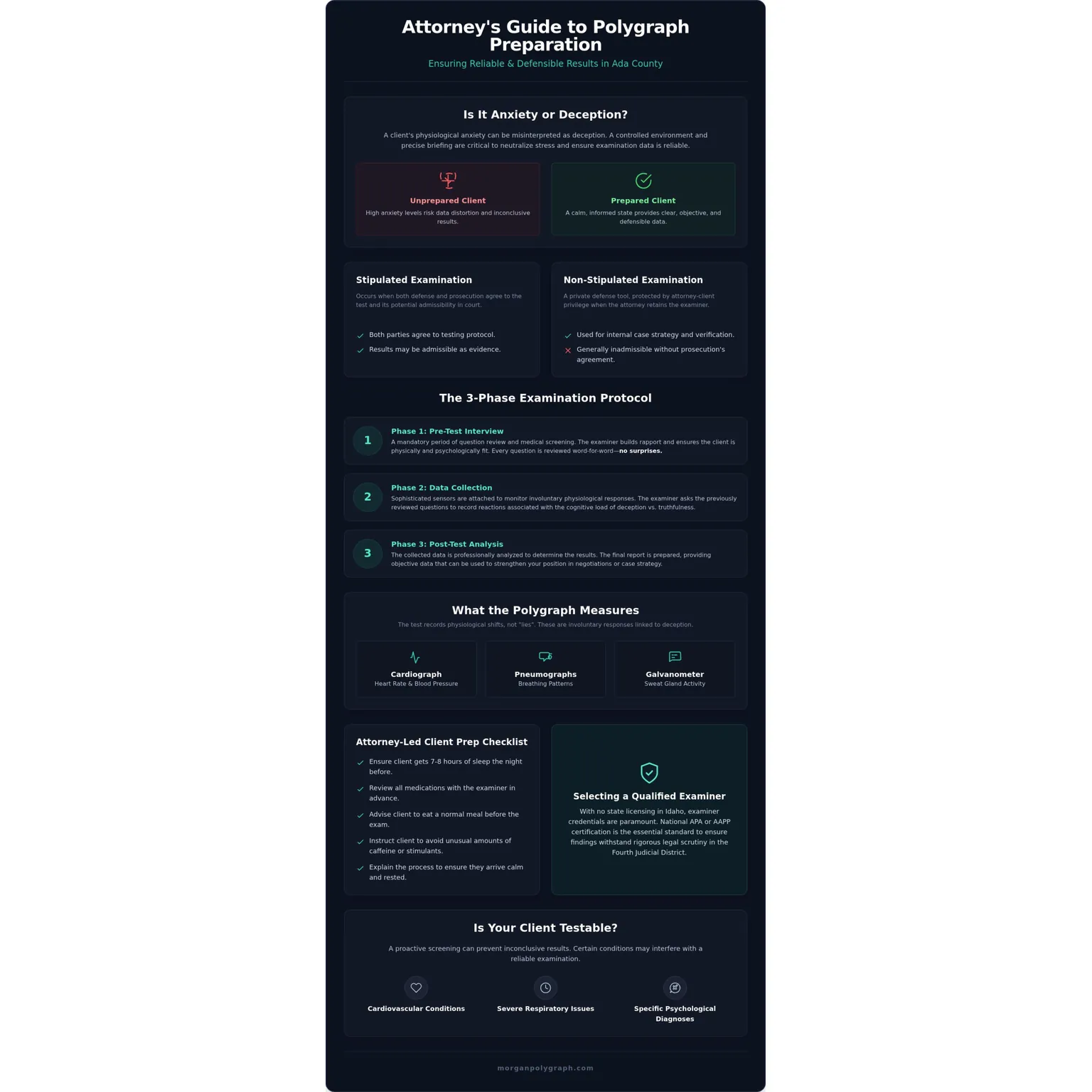
Legal professionals distinguish between stipulated and non-stipulated examinations. A stipulated exam occurs when both the defense and the prosecution agree to the test and its potential admissibility. Conversely, a non-stipulated exam remains a private defense tool. While the public understands what a polygraph is in a general sense, local attorneys use it to pressure the state’s narrative by presenting objective, data-driven evidence of a client’s account. This internal attorney guide to preparing a client for polygraph in Ada County helps counsel decide which path best serves the defense objective.
Admissibility and the Idaho Rules of Evidence
As of September 2026, Idaho courts maintain a strict stance on admissibility. Polygraph evidence remains generally inadmissible under the Idaho Rules of Evidence unless all parties stipulate to its entry. This rule also applies to administrative hearings as of the July 1, 2024, regulation updates. Because the state doesn’t require specific licensing, the weight of the evidence depends heavily on the examiner’s credentials. Utilizing a nationally certified expert from Morgan Polygraph ensures that the methodology meets the rigorous standards expected by the Fourth Judicial District.
Client Screening and Case Evaluation
The Examination Protocol: What Your Client Needs to Know
Clarity is the most effective antidote to client anxiety. When an individual understands the mechanical and psychological structure of the test, their physiological baseline stabilizes. This attorney guide to preparing a client for polygraph in Ada County outlines a three-phase process: the pre-test interview, the data collection phase, and the post-test analysis. Each stage is designed to filter out “noise” from the data, ensuring that the final report reflects truthfulness rather than simple nervous system arousal. By explaining this structure to your client, you help them approach the session with the calm, collected confidence necessary for a reliable result.
Modern examinations rely on sophisticated sensors that monitor involuntary physical responses. While legal discussions often focus on the admissibility of polygraph evidence, the technical reliability of that evidence begins with the sensors. The examiner uses pneumographs to track breathing patterns, galvanometers to measure sweat gland activity on the fingertips, and cardiographs to monitor heart rate and blood pressure. These instruments don’t detect “lies” directly. Instead, they record the physiological shifts that occur when a person experiences the cognitive load associated with deception.
The Pre-Test Interview Phase
The pre-test interview is a mandatory period of question review and medical screening. During this time, the examiner builds professional rapport and ensures the client is physically and psychologically capable of being tested. Every question that will be asked during the exam is reviewed word-for-word. There are no surprise questions. This transparency is vital because it prevents the “startle response” that could otherwise lead to a false positive. Establishing this baseline allows the examiner to distinguish between general situational stress and specific reactions to relevant case facts.
Data Collection and Physiological Monitoring
During the data collection phase, state-of-the-art technology at Morgan Polygraph eliminates manual scoring errors by utilizing validated algorithms. The examiner typically begins with an “acquaintance test.” This simple exercise demonstrates the equipment’s sensitivity to the client, building their confidence in the process. Clients must understand that intentional breathing changes or physical movements can invalidate the charts. Consistency is key. If you’re ready to move forward with a professional evaluation, you can schedule a session at our Boise office to ensure your client receives the highest standard of technical care.
The core of the data collection involves comparing “control” questions to “relevant” questions. Control questions deal with general honesty and are designed to provoke a baseline reaction in truthful subjects. Relevant questions pertain directly to the case. A truthful subject will typically show a stronger reaction to the control questions, while a deceptive subject will react more significantly to the relevant questions. This comparative analysis is what allows a nationally certified examiner to provide a definitive finding for your legal team.
Selecting a Court-Recognized Examiner in Southern Idaho
Idaho’s lack of a state-specific licensing requirement for polygraph examiners creates a unique challenge for counsel. In this environment, certification from the American Polygraph Association (APA) or the American Association of Police Polygraphists (AAPP) isn’t just a badge; it’s the only objective metric of competence. This attorney guide to preparing a client for polygraph in Ada County emphasizes that the examiner’s credentials directly influence the credibility of the defense’s position during negotiations. A “private” examiner might offer testing, but only a court-recognized expert provides the academic gravitas needed for Fourth Judicial District proceedings.
Judges and prosecutors in Boise value examiners who maintain rigorous continuing education and adhere to validated scoring algorithms. When results are presented as part of a plea package or a motion to dismiss, the examiner’s professional standing is often the first point of scrutiny. Professional reporting must be detailed, transparent, and capable of withstanding cross-examination. Clear, data-driven reports are the standard at the State Street office, ensuring that every finding is supported by recorded physiological data.
The Importance of Certified Credentials
Verifying an examiner’s standing requires looking beyond a local business listing. You should confirm their active membership in national bodies and their history of providing testimony in Idaho courts. Specialized training in criminal defense work is essential, as the protocols differ significantly from pre-employment screenings. Utilizing certified, court-recognized experts is a foundational step in any defense strategy. It ensures that the methodology aligns with Idaho’s official rule on polygraph admissibility, which generally requires a mutual stipulation for results to enter the record.
PCSOT and Specialized Testing Standards
Post-Conviction Sex Offender Testing (PCSOT) involves a distinct set of Idaho Sexual Offender Management Board (SOMB) requirements. Examiners must hold specific certifications to conduct these tests, which are used to monitor probation compliance and therapeutic progress. Morgan Polygraph strictly adheres to Idaho Department of Correction (IDOC) standards, providing the structured oversight necessary for these sensitive cases. These examinations help manage risk and provide objective feedback for treatment providers, making them a staple of the Southern Idaho judicial landscape. Counsel should ensure their chosen expert is specifically certified for PCSOT, as general polygraph training is insufficient for these high-stakes compliance evaluations.
Attorney-Led Preparation: Setting the Stage for Success
The success of a polygraph examination begins in your office, long before the client arrives at the testing suite. As counsel, your role is to act as the primary gatekeeper of information. This attorney guide to preparing a client for polygraph in Ada County emphasizes the “Full Disclosure” rule: your client must disclose every relevant detail to you before they sit for the exam. If an examiner uncovers new information during the pre-test interview, it can trigger a defensive physiological spike that complicates the data. Your briefing should focus on the necessity of honest answers rather than “perfect” ones. Clients who attempt to curate their responses often appear evasive to the sensors, even if they’re fundamentally truthful.
Managing the client’s emotional state is equally vital. Many individuals fear that their natural anxiety will lead to a false positive. You should reassure them that the equipment is designed to distinguish between situational stress and the specific physiological shift associated with deception. When you consult with our Boise team, we provide the professional oversight needed to ensure these nuances are handled with care. A well-prepared client is a cooperative one, and a cooperative client provides the most reliable data for your defense strategy.
The Night-Before Checklist for Clients
Physical readiness is a prerequisite for a valid examination. Instruct your client to secure a full night’s sleep and to avoid excessive stimulants like caffeine or nicotine on the morning of the test. These substances can artificially elevate heart rate and skin conductivity, creating “noise” in the baseline data. Crucially, clients must continue taking all prescribed medications as usual. Abruptly stopping a maintenance medication can cause physiological withdrawal symptoms that are far more disruptive to the test than the medication itself. Arriving with a clear, rested mind allows the client to focus on the examiner’s instructions without unnecessary physical distractions.
Addressing Common Myths and Fears
Clients often encounter “online tricks” or countermeasures designed to fool the sensors. You must explicitly warn them that attempting these maneuvers is a guaranteed path to failure. Modern examiners are trained to detect physical movements, controlled breathing, and other manipulation tactics immediately. Instead, explain to your client how polygraph examinations are designed to account for baseline stress through a series of comparison questions. “Passing” a polygraph is about physiological consistency, not a lack of nerves. By debunking these myths, you help the client trust the process and the professional expertise of the examiner, which leads to a more stable and defensible result.
Strategic Implementation with Morgan Polygraph in Boise
Integrating a certified polygraph expert into your litigation team is a strategic move that requires precise coordination and professional trust. This attorney guide to preparing a client for polygraph in Ada County highlights that the relationship between counsel and examiner is built on mutual clarity and technical expertise. When you incorporate a court-recognized expert early in the case, you gain a diagnostic advantage that informs your overall defense strategy. Our Boise State Street office provides a secure, professional environment specifically designed to protect the privacy of your clients during these sensitive proceedings, ensuring that every interaction remains discreet and focused on the objective data.
Confidentiality protocols are strictly enforced, especially for high-profile Ada County cases where public or media scrutiny is a constant concern. We manage scheduling and logistics with a focus on discretion, ensuring that your client’s presence and the resulting examination data remain confidential within the defense team. Turnaround times for professional reports are optimized to meet the demands of fast-moving legal calendars, typically providing you with actionable data shortly after the examination concludes. This efficiency allows you to use the findings as leverage during critical windows of negotiation with the prosecution or opposing counsel.
Professional Reporting for Legal Use
A comprehensive final report serves as a vital document for any legal record. Attorneys should look for reports that provide a transparent overview of the physiological data, the validated scoring algorithms used, and a clear interpretation of the findings. This level of detail is essential if the results are to be used in negotiations or presented under stipulation in court. It is precisely how Morgan Polygraph maintains state-of-the-art standards for Boise attorneys who require defensible, high-quality evidence. Beyond the written report, our examiners remain available for depositions or trial testimony to provide expert clarification on the methodology and results, bridging the gap between technical data and legal argument.
Booking and Initial Consultation
Initiating a professional legal examination is a straightforward, methodical process designed to respect your firm’s time and resources. The first step involves an initial consultation where we discuss the specific objectives of the test and the unique legal context of the case. You will need to provide a case brief that outlines the relevant facts, which allows our team to draft questions that are legally pertinent and physiologically sound. This collaborative approach ensures that the resulting data directly supports your defense or litigation objectives without unnecessary procedural delays. Contact Morgan Polygraph to schedule a professional legal examination today.
Advancing Your Case Strategy with Precision Polygraphy
Successful legal outcomes in the Fourth Judicial District often hinge on the quality of your preparatory work and the reliability of your experts. This attorney guide to preparing a client for polygraph in Ada County provides the groundwork for neutralizing client anxiety while ensuring data integrity. By focusing on transparent briefing and selecting examiners who understand Idaho’s unique evidentiary landscape, you transform a sensitive examination into a powerful tool for negotiation. It’s about moving beyond simple truth-seeking to provide your team with defensible, data-driven insights.
Our Boise office on State Street offers a discreet environment equipped with state-of-the-art technology to support your litigation team. We provide nationally certified examiners and court-recognized expert testimony specifically tailored to the rigorous standards of Southern Idaho law. You can trust that every report is prepared with the academic gravitas required for high-stakes defense and professional scrutiny. We prioritize the human element of every case while maintaining the technical precision your strategy demands.
Schedule a Confidential Legal Polygraph for Your Client and secure the objective insights your case requires. We’re ready to help you navigate these complex proceedings with professional precision and calm, collected confidence.
Frequently Asked Questions
Are polygraph results admissible in Ada County courts?
Polygraph results are generally inadmissible in Ada County courts unless all parties stipulate to their admission in writing before the test. This standard applies across the Fourth Judicial District and was reinforced by a July 1, 2024, rule regarding administrative hearings. While often barred from trial, results are frequently used in probation revocation hearings or during pre-trial negotiations to influence the prosecution’s perspective on a case.
How much does a legal polygraph test cost for a defense client?
The cost of a professional examination varies based on the complexity of the case and the specific requirements of the legal team. Morgan Polygraph provides competitive pricing with clear, upfront terms and no hidden fees for defense firms in Southern Idaho. We offer a free initial consultation to discuss the scope of the work, ensuring that the defense budget is respected while maintaining the high standards of a nationally certified expert.
Can a client’s anxiety or high blood pressure cause a false positive?
General anxiety or chronic high blood pressure does not cause a false positive result. The examiner establishes a physiological baseline for each individual before the data collection phase begins. Deception is identified by specific, significant deviations from this established baseline in response to relevant questions. This attorney guide to preparing a client for polygraph in Ada County notes that identifying these patterns requires a court-recognized expert who utilizes validated, state-of-the-art scoring algorithms.
What happens if my client fails a polygraph during the screening process?
If a client fails a private screening examination, the results are typically protected by attorney-client privilege. This assumes the attorney directly retained the examiner as part of the defense work product. Counsel can then use this information to adjust their case strategy, re-evaluate the client’s account, or focus on plea negotiations. These results remain confidential and are not shared with the prosecution unless the defense team chooses to disclose them for strategic leverage.
How long does a typical legal polygraph examination take in Boise?
A standard legal polygraph examination in Boise typically lasts between two and three hours. This duration includes the mandatory pre-test interview, the data collection phase, and the subsequent data analysis. The examiner takes the necessary time to review every question with the client to ensure there are no surprises. Rushing the process can lead to inconclusive results, so we maintain a methodical pace to ensure the highest levels of accuracy.
Should I be present in the room during my client’s polygraph exam?
Attorneys should not be present in the examination room during the test. The presence of a third party, even legal counsel, can create a distraction that interferes with the client’s physiological responses. Most professional protocols require a one-on-one environment between the examiner and the subject to maintain the integrity of the data. However, counsel is encouraged to participate in the initial briefing and review the final report once the analysis is complete.
What medications can interfere with a polygraph reading?
Clients should never discontinue prescribed medications before a test. While certain central nervous system stimulants or depressants can affect physiological reactivity, a sudden change in medication status is more likely to invalidate the results. The examiner conducts a medical screening during the pre-test phase to account for any substances in the client’s system. This attorney guide to preparing a client for polygraph in Ada County emphasizes that transparency about medication is essential for accurate baseline calibration.
How do I choose between a private examiner and a law enforcement polygraph?
Choosing a private examiner allows the defense to maintain control over the results and the scope of the questioning. Private examinations at our State Street office are conducted with a focus on defense objectives and are protected by privilege. Law enforcement examinations are typically conducted by the state and don’t offer the same confidentiality protections. Utilizing a nationally certified private expert ensures your client’s rights are protected while providing the same technical rigor as police testing.