
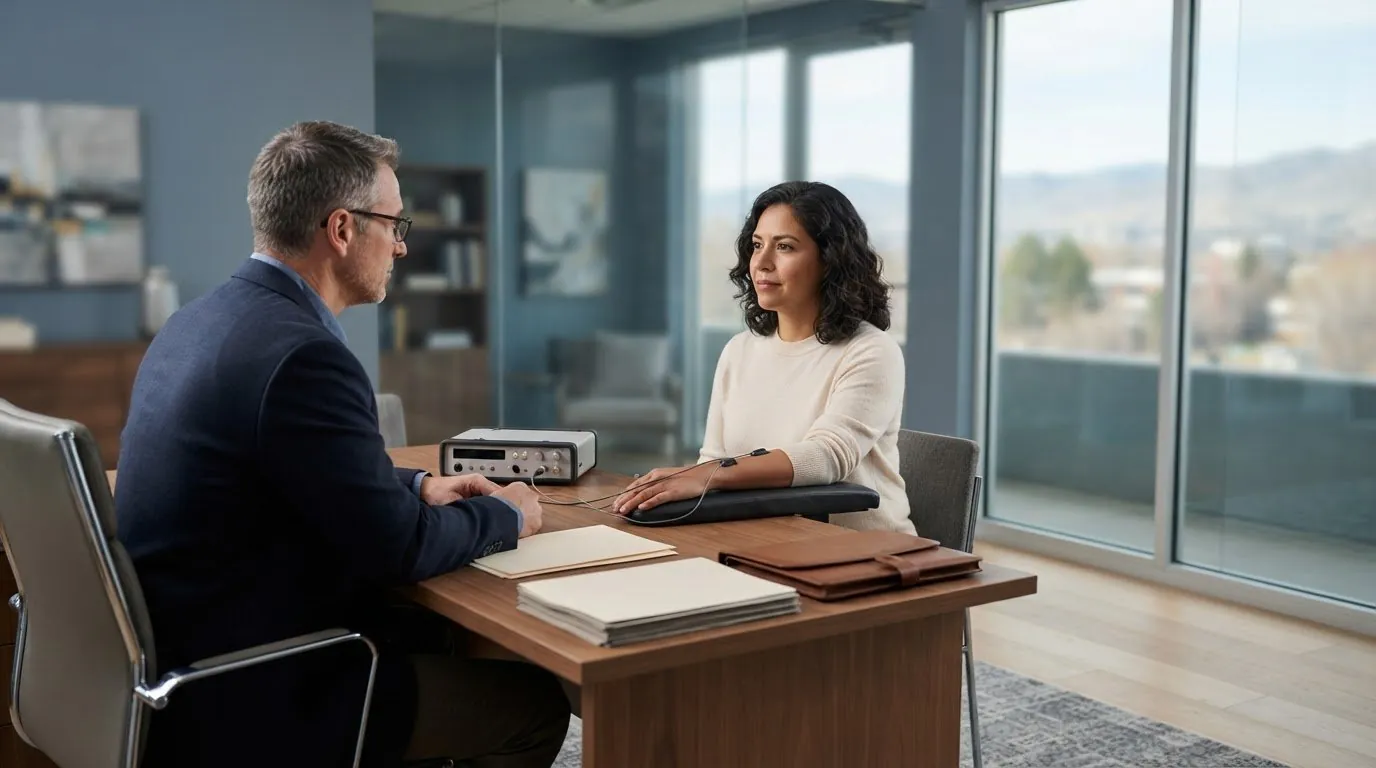
Could a polygraph help clarify disputed claims without deciding whether a protective order is warranted? If you’re considering verifying claims for a protective order with a polygraph Nampa, it’s important to understand that an examination can offer structured information, but it isn’t a legal ruling or a substitute for advice from an attorney.
That distinction matters in a sensitive civil dispute. In Idaho, polygraph results are generally inadmissible in court unless all parties agree in writing before the examination. Even with an agreement, the court determines the evidence’s relevance and weight. Discuss the legal and strategic implications with your counsel before deciding whether to proceed.
This article explains what a polygraph may contribute, what it can’t establish, and how to prepare questions for the required intake conversation. Morgan Polygraph conducts civil examinations by appointment at its Boise office, serving Southern and Southwest Idaho, including the Nampa area. You’ll also learn what to expect from a professional, respectful examination and how to arrange an appointment by email or telephone.
Key Takeaways
- Verifying claims for a protective order with a polygraph Nampa may provide structured information, but it doesn’t decide whether a legal claim is true or an order is warranted.
- Polygraph findings, documents, witness accounts, and court decisions have distinct roles. None should be treated as interchangeable.
- Discuss proposed examination questions and legal strategy with your attorney. A polygraph isn’t a substitute for legal counsel.
- Morgan Polygraph’s civil examinations begin with a required, free intake conversation before an appointment is scheduled.
- Nampa-area appointments take place at the Boise office. Schedule by email or telephone and allow at least two hours for an examination.
Can a Polygraph Help Address Protective-Order Claims in Nampa?
When accounts of a troubling event conflict, it’s understandable to look for a clearer way to address the disagreement. A polygraph examination may offer structured information about a specific issue, but it doesn’t independently establish what happened or prove that a legal claim is true. The Polygraph overview provides general background on how examinations work and how their use has been viewed in different settings.
Morgan Polygraph conducts civil testing, including private and court-ordered examinations. People in Nampa and nearby communities are served from the Boise office. The service area is Southern and Southwest Idaho. In a protective-order matter, an examination is one source of information to consider alongside the circumstances of the dispute, not a replacement for legal advice or a court’s assessment.
An examination reports findings; the court makes decisions. That distinction matters whether you’re the person seeking an order or responding to claims connected with one. Verifying claims for a protective order with a polygraph Nampa should begin with a clear understanding of what an examination can address and what remains a legal question.
What question can an examination address?
A proposed issue needs to be specific, factual, and suitable for an examination. Broad questions about whether someone is “credible,” who is right overall, or whether an entire dispute is true combine multiple issues and ask for a sweeping conclusion. A more focused concern relates to a defined event or factual assertion. Whether a proposed question is suitable depends on the circumstances and is discussed during the required, free intake conversation.
The intake gives the examiner an opportunity to understand the issue and discuss the proposed question before an examination is arranged. It also gives you a chance to describe the concern plainly, without treating the examination as a forum for resolving every disagreement in a relationship or case. Keep the focus on the specific point you want to discuss.
What a polygraph cannot decide
A polygraph examination doesn’t issue, modify, or dismiss a protective order. It can’t determine whether an order is legally warranted, guarantee a particular result, or promise that findings will be admitted or affect a judge’s decision. The court process and the examination are separate, even when someone hopes an examination may inform a broader civil dispute.
If you’re considering an examination, discuss legal strategy and any court requirements with your attorney before proceeding. Counsel can help you understand how the examination may fit, if at all, within your matter. The examiner’s role is to conduct the evaluation and report its findings, not to provide legal advice or predict how a court will rule.
How a Protective-Order-Related Polygraph Is Evaluated and Conducted
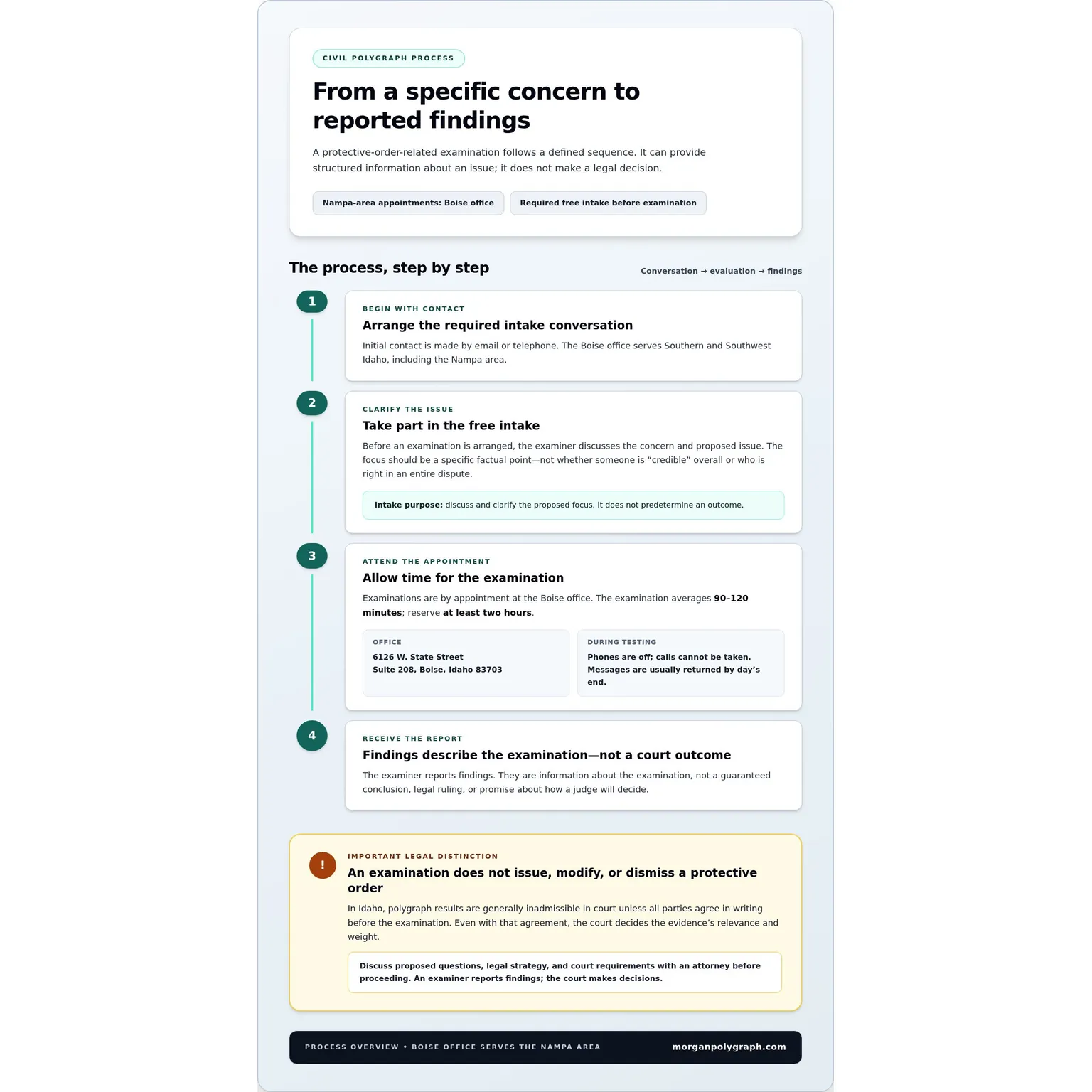
A clear process can make an examination feel more manageable, especially when the subject is a sensitive personal dispute. For people considering verifying claims for a protective order with a polygraph Nampa, the process begins with a conversation, not with testing. Each stage has a distinct purpose, from clarifying the issue to conducting the examination and reporting the findings.
- Initial contact: Contact Morgan Polygraph by email or telephone to arrange the required intake conversation. The Boise office serves Southern and Southwest Idaho.
- Required intake: Take part in a free intake conversation before an examination. The examiner discusses the concern and the proposed issue.
- Examination: Attend the scheduled appointment at the Boise office. Examinations average 90-120 minutes, so reserve at least two hours.
- Professional reporting: The examiner reports the examination findings. Those findings provide information about the examination, not a legal decision or guaranteed conclusion.
Why the intake conversation comes first
The required, free intake conversation gives you and the examiner time to discuss the concern and clarify the specific issue being considered. It’s a necessary step before an examination, not an optional substitute for one. You can explain the matter in straightforward terms and raise questions about the proposed focus. The conversation helps frame what is being evaluated, but it doesn’t predetermine whether an examination will produce a particular outcome.
Preparing a short account of the central concern may help keep the conversation focused. A complex dispute can involve several events or conflicting details. Use the intake to identify the particular issue you want to discuss rather than treating the examination as a review of every disagreement.
What to expect at the appointment
Examinations take place by appointment at Morgan Polygraph’s Boise office, at 6126 W. State Street, Suite 208, Boise, Idaho 83703. Plan for at least two hours, even though the examination itself averages 90-120 minutes. Allowing that time can help you attend without needing to rush to another commitment immediately afterward.
Phones are off during an examination, so you won’t be able to take calls while testing is underway. Messages are usually returned by day’s end. The appointment is handled professionally and respectfully, with the focus on the examination process and the issue discussed beforehand. Findings aren’t an instant legal answer, and an examination can’t guarantee how a court or another party will respond.
If you’re considering a civil examination, you can schedule a polygraph appointment by email or telephone after completing the required intake conversation. The intake gives you an opportunity to discuss the issue and understand appointment logistics before proceeding.
Polygraph Findings Compared with Documents, Testimony, and Legal Decisions
In a protective-order dispute, different kinds of information address different questions. A polygraph report describes findings from an examination focused on a defined issue. Documents may record communications or events, witnesses may describe what they observed, and a court makes legal decisions. Treating these sources as interchangeable can create false certainty.
| Information source | What it may address | What it doesn’t do by itself |
|---|---|---|
| Polygraph findings | Reports findings from an examination focused on a specific issue. | Automatically prove or disprove a claim, or resolve the full dispute. |
| Documents and records | May help establish details such as when a message was sent or what a record contains. | Explain every surrounding circumstance or settle disagreements about meaning. |
| Witness accounts | May describe what a person saw, heard, or experienced. | Provide a complete account of events outside that person’s knowledge. |
| Court decisions | Determine legal matters before the court based on the applicable process. | Be made by an examiner or replaced by an examination report. |
How an examination differs from documentary or witness information
A polygraph report is one form of examination-related information, not a substitute for records or testimony. For example, a message may document that communication occurred at a particular time, while a witness may speak to an interaction they personally observed. An examination addresses its defined issue through a different process. No single source automatically settles the dispute, and different sources may relate to separate parts of an account.
This distinction is useful when considering verifying claims for a protective order with a polygraph Nampa. An examination doesn’t authenticate a text, establish who was present, or supply details that a witness didn’t observe. Likewise, a document’s existence doesn’t necessarily explain the context around it. Keeping each source’s role distinct helps avoid assuming that one result answers every factual question.
Why legal use and admissibility require caution
Whether information can be considered in a legal proceeding may depend on applicable rules and the circumstances of the case. Don’t assume that arranging an examination means its findings will be admitted, given a particular weight, or affect a court’s decision. In Idaho, polygraph results are generally inadmissible unless all parties agree in writing before the examination. Even then, the court determines the evidence’s relevance and weight.
Legal decisions remain with the appropriate court. If you have questions about whether a report, record, or witness account can be used in your matter, discuss them with your attorney. An examiner can explain the examination and its findings, but legal questions about admissibility, court procedure, or strategy belong with counsel. This keeps the examination’s role clear without ranking information sources or predicting an outcome.
Preparing for a Nampa-Area Civil Polygraph Examination
Preparation can help you explain a sensitive concern clearly without trying to decide in advance what an examination will show. If you’re considering verifying claims for a protective order with a polygraph Nampa, focus on the specific issue, what you personally know, and practical appointment details. The goal is to make the intake conversation organized, not to build a case or predict a result.
Organize the concern before the intake
Before the required intake conversation, write a concise timeline of the disputed events. Note relevant dates and records you may want to discuss, such as a message or other document connected to the concern. These details can help explain the context, but they don’t determine examination findings. Separate what you directly saw, heard, or experienced from assumptions about another person’s intentions.
Keep your notes straightforward. For example, distinguish “I received a message on this date” from an interpretation of why it was sent. If the issue involves several events, identify the particular concern you want to discuss rather than trying to summarize every disagreement at once. You can also note questions for the examiner about the process. Discuss legal strategy and court-related questions with your attorney, who can consider them in the context of your matter.
Plan the appointment and communication
Morgan Polygraph serves Southern and Southwest Idaho, including the Nampa area, from its Boise office. The office is appointment-only and ADA-compliant. Appointments are arranged by telephone or email, not through online booking. A free intake conversation is required before an examination; the examination appointment is arranged after that conversation.
Examinations average 90-120 minutes, so reserve at least two hours for the appointment. The office is located at 6126 W. State Street, Suite 208, Boise, Idaho 83703. Planning for the Boise location and setting aside enough time can reduce avoidable pressure on the day of the examination.
A practical preparation sequence can keep the next steps clear:
- Identify the concern. Write one or two sentences describing the specific disputed issue you want to discuss.
- Make a brief timeline. List key events in order and note dates you recall, distinguishing direct knowledge from interpretation.
- Gather discussion points. Note relevant records or questions to raise during intake. Don’t assume they establish an examination outcome.
- Coordinate with counsel. Discuss legal strategy and any court-related questions with your attorney.
- Arrange the appointment. Complete the required intake conversation, then schedule by telephone or email and plan for the Boise visit.
This preparation is intended to support a clear, professional discussion, not to guarantee a particular finding or legal effect. To begin arranging the required intake conversation for a civil examination, contact Morgan Polygraph by telephone or email.
Discussing a Protective-Order Examination with Morgan Polygraph
Considering a polygraph in a protective-order matter can feel like a significant step. Morgan Polygraph provides civil testing, including private and court-ordered examinations, for people seeking structured information about a specific issue. An examination is not a legal decision, and its findings don’t determine whether a protective order is warranted or how a court will rule.
Professional experience and respectful service
Sensitive civil matters deserve a measured, respectful approach. Morgan Polygraph’s examiners bring more than 50 years of combined polygraph testing experience and are court-recognized experts. Chip Morgan is a nationally certified examiner and senior polygraph instructor. These credentials reflect professional experience, but they don’t guarantee that a particular court will accept or rely on examination findings.
The office is in Boise and serves Southern and Southwest Idaho, including the Nampa area. It’s ADA-compliant, and appointments take place at 6126 W. State Street, Suite 208, Boise, Idaho 83703. The location is in Boise rather than Nampa, so plan for the trip when considering appointment logistics.
A civil examination may be one source of information to consider alongside the records, accounts, and legal process involved in a dispute. The examiner’s role is to conduct the examination and report its findings, not to provide legal advice or predict how a judge will assess the matter. For questions about court strategy or requirements, consult your attorney.
How to take the next step from Nampa
Appointments are scheduled by telephone or email, and a free intake conversation is required before an examination. During that conversation, you can describe the concern and discuss the proposed issue. You don’t need to have every detail resolved before making initial contact; a concise explanation can help begin a focused discussion.
To arrange the intake conversation, call Morgan Polygraph at (208) 573-9405 or email lieguy@gmail.com. Scheduling is handled by phone or email, not through online booking. If you’d like to understand the process before reaching out, review a complete guide to the polygraph examination process and learn about polygraph accuracy and its limitations.
If you’re weighing verifying claims for a protective order with a polygraph Nampa, take time to discuss the examination’s role and limits with your attorney, then decide whether to arrange the intake conversation. You can use the conversation to ask questions and understand the process before making a decision.
Take a Clear, Considered Next Step
A sensitive dispute can make it tempting to seek a definite answer quickly. Instead, give yourself room to consider what information an examination could offer and what questions remain for your attorney. If you’re researching “verifying claims for a protective order with a polygraph Nampa,” keep the central distinction in view: an examination may provide information, but legal decisions belong to the court.
A focused intake conversation can help you discuss the issue being considered and understand the examination process before deciding how to proceed. You don’t need to treat that first conversation as a commitment to testing. Use it to raise practical questions and consider whether an examination fits your circumstances, while keeping legal strategy between you and your counsel.
When you’re ready to explore the process, schedule a free intake conversation by phone or email. A thoughtful next step can bring greater clarity, whatever you decide.
Frequently Asked Questions
Can a polygraph prove that someone violated a protective order?
No. A polygraph doesn’t establish by itself that someone violated a protective order. An examination addresses a defined issue, but its findings aren’t a legal determination of whether conduct violated an order. For example, a result doesn’t independently establish when an interaction occurred or whether the conduct met the order’s terms. Ask your attorney how to document and address the alleged conduct within the relevant legal process.
Can a polygraph result be used in an Idaho protective-order case?
Don’t assume a polygraph result will be accepted or considered in court. Whether examination findings can be used may depend on current Idaho rules and the circumstances of the case. Before arranging an examination for possible legal use, ask your attorney to review the applicable requirements and explain any effect on your case strategy. The examiner can discuss the examination, but legal questions about admissibility should go to counsel.
Is a polygraph appropriate for a civil dispute involving a protective order?
It may be considered when the concern can be framed as a specific, factual issue suitable for examination. A broad request to decide who is trustworthy or resolve every disagreement in a relationship is different from examining a focused question about a particular event. Consider the purpose carefully and discuss legal strategy with your attorney. A polygraph is one possible source of information, not a substitute for the court process.
How do I schedule a polygraph examination near Nampa?
Contact Morgan Polygraph by telephone at (208) 573-9405 or by email at lieguy@gmail.com to arrange the required, free intake conversation. Appointments are scheduled by phone or email, not online. After the intake, appointment arrangements can be discussed. Nampa-area clients are served from the Boise office at 6126 W.
How long does a protective-order-related polygraph appointment take?
The examination averages 90-120 minutes, and you should reserve at least two hours for the appointment. That time allows for the examination without needing to schedule another commitment immediately afterward. The required intake conversation takes place before the examination appointment, so plan for it separately when organizing your schedule. Phones are off during an examination, so arrange any time-sensitive communication in advance.
What should I prepare before the polygraph intake conversation?
Prepare a brief description of the specific concern and a simple timeline of the events involved. Note dates you remember and identify any details that are uncertain, rather than presenting estimates as exact facts. You can also write down questions about the examination process. Keep the focus on what you personally recall, and discuss legal arguments or strategy with your attorney rather than trying to resolve them during intake.
Does Morgan Polygraph have an office in Nampa?
No. Morgan Polygraph’s office is in Boise and serves Southern and Southwest Idaho, including the Nampa area. The address is 6126 W. Examinations are by appointment, so arrange one by telephone or email before traveling. The office is ADA-compliant. Contact the practice to arrange the required intake conversation.