
What if a screening step meant to reduce hiring risk creates legal exposure when it’s used for the wrong role? Screening private security contractors in Boise with polygraph calls for a careful look at the position, the employer’s circumstances, and current legal requirements. It is not a substitute for a thorough hiring process or a routine fit for every role.
Before adding an examination, consider the candidate’s rights, the purpose of screening, and how any information will be used. This guide offers practical steps for defining a role-related objective, preparing for legal review, and arranging a professional examination in Boise. Morgan Polygraph conducts pre-employment testing for law-enforcement agencies. Its examiners have more than 50 years of combined polygraph testing experience, and examinations are scheduled by telephone or email at the Boise office.
Key Takeaways
- Assess whether screening private security contractors in Boise with polygraph fits the specific role, its duties, and the employer’s circumstances.
- Build a focused process: define the concern, review legal eligibility, and keep proposed questions narrow and job-related.
- Have qualified Idaho employment counsel review current legal requirements before implementation. Consider examination information alongside other relevant hiring information, not as a complete hiring verdict.
- Compare examiner credentials, relevant experience, and professional recognition. Morgan Polygraph’s Chip Morgan is a Nationally Certified Polygraph Examiner and Senior Polygraph Instructor.
- Complete the required free initial intake conversation before the examination, which averages 90-120 minutes. Allow at least two hours for the appointment.
When Does Polygraph Screening Fit Private Security Contractor Hiring in Boise?
Start with the position, not a general suspicion about applicants. Consider the job’s actual duties, responsibilities, and access, then identify a specific screening objective connected to the role. A position involving entry to restricted facilities or responsibility for protecting valuable assets may raise different questions from one with limited access and a narrower scope of responsibility.
This distinction matters. Polygraph screening is not a routine step for every security position, and choosing to screen should not imply that candidates are presumed dishonest. First define what the employer needs to assess. Then determine whether screening is appropriate for that role and permitted under current requirements. The employer’s circumstances and the candidate’s actual position both matter.
Definition: A polygraph examination can provide one bounded source of information in an eligible hiring process. It supports, but does not replace, employer judgment or a broader evaluation of a candidate.
Which contractor roles may prompt screening questions?
Focus on the work itself. Relevant considerations include the candidate’s assigned duties, level of responsibility, and access to sensitive environments, property, or assets. Ask whether there is a clear connection between those responsibilities and the employer’s screening objective.
For example, a role with access to a restricted site may present different screening considerations from a post with limited access. Neither position automatically calls for an examination. A clear job description and a defined concern are more responsible starting points than broad assumptions about a person’s character.
Hiring a private security contractor is not automatically the same as law-enforcement pre-employment screening. The employer, role, and applicable requirements can differ. An agency’s approach to screening law-enforcement applicants should not simply be transferred to a private security position without reviewing the specific circumstances.
What a polygraph examination can and cannot contribute
An examination can contribute information for consideration, but it cannot establish a candidate’s character or make a hiring decision on the employer’s behalf. Interpret examination information in context and alongside other relevant hiring materials. Do not treat a result as a standalone verdict.
Before screening, make the purpose concrete. Identify the role-related issue the employer wants to assess, separate it from assumptions about honesty, and decide how examination information will be weighed with the rest of the hiring process. The polygraph examination process guide explains what to expect from the examination itself. For general background on the method and questions about its scientific validity, consult Polygraph on Wikipedia.
- Role: What duties and responsibilities define the position?
- Access: What facilities, property, or assets would the candidate encounter?
- Purpose: What specific, job-related concern would screening address?
- Context: How will examination information be considered with other hiring information?
These questions help employers decide whether further review is warranted. They do not determine legal eligibility. Before implementing screening, have qualified Idaho employment counsel review the proposed use and verify current requirements for the specific employer and role.
How to Build a Focused, Responsible Polygraph Screening Process
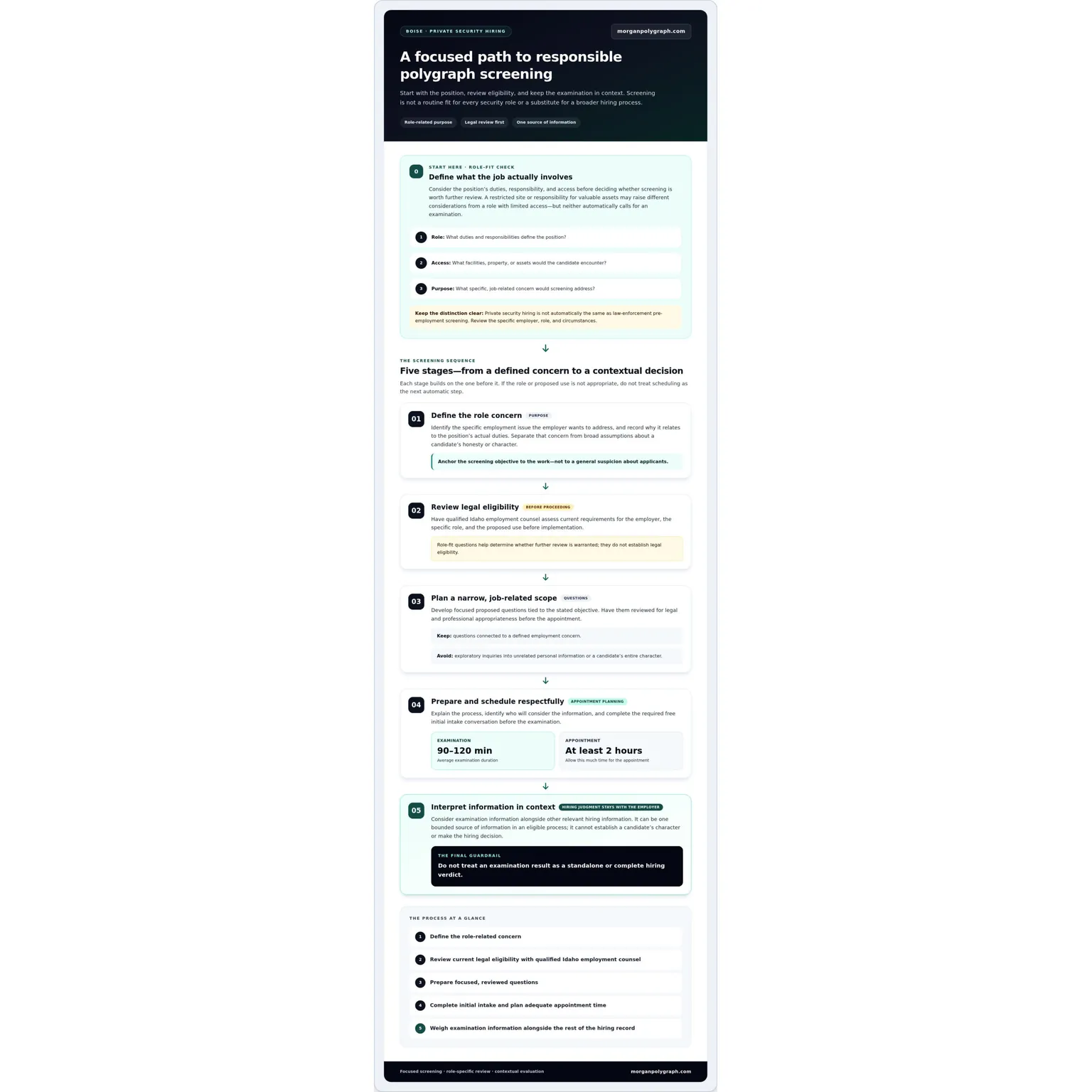
A sound process starts before an examination is scheduled. Define the purpose, review whether the proposed use is appropriate, prepare a narrow scope, explain expectations, and decide how examination information will be weighed with other hiring material. This sequence keeps screening private security contractors in Boise with polygraph deliberate and connected to the position, rather than turning it into a general inquiry about a candidate.
- Define the role concern. Identify the specific, job-related issue the employer wants to address. Record why it relates to the position’s actual duties.
- Review legal eligibility. Have qualified Idaho employment counsel assess current requirements for the employer, role, and proposed use before proceeding.
- Plan the scope. Develop focused proposed questions tied to the stated objective. Have them reviewed for legal and professional appropriateness.
- Prepare and schedule. Explain the process respectfully, identify who will consider the information, and arrange the appointment after the required initial intake conversation.
- Interpret in context. Consider examination information alongside other relevant hiring information. Do not treat it as a complete hiring verdict.
Set the screening objective before scheduling
Broad or exploratory questions can weaken the purpose of screening. Avoid using an examination to search for unrelated personal information or assess a general impression of someone’s honesty. Instead, define the particular employment concern and keep the proposed scope consistent with applicable law and professional standards. Review employer questions before the appointment rather than improvising them during the hiring process.
A focused screening question addresses a specific, job-related concern without attempting to assess a candidate’s entire character. For example, an employer might identify a concern tied to a stated responsibility, then have the proposed wording reviewed for relevance and appropriateness. This is a way to define scope, not a guarantee about what an examination will establish.
Prepare candidates and decision-makers for the process
Clear expectations support an orderly and respectful experience. Explain the purpose of the examination and the general appointment process in advance, using straightforward language. The complete polygraph test guide offers basic context about what a polygraph test involves.
Before scheduling, identify who within the organization will receive and consider examination information, and how it will be evaluated alongside the rest of the hiring process. Morgan Polygraph requires a free initial intake conversation before an examination. Appointments are arranged by telephone or email. Examinations average 90-120 minutes, so allow at least two hours for the appointment. Employers arranging pre-employment testing for law-enforcement agencies can discuss the process with Morgan Polygraph and prepare the relevant role context and expectations.
What Boise Employers Should Review Before Using Polygraph Screening
Legal eligibility depends on current law and the facts of the particular employer, position, and proposed examination. A company should not assume that operating in private security automatically makes every role or applicant eligible for screening. Before using screening private security contractors in Boise with polygraph, have qualified employment counsel review the plan against current federal, Idaho, and applicable local requirements.
Separate general federal guidance from Idaho-specific advice
The federal Employee Polygraph Protection Act (EPPA) generally restricts private employers’ use of lie detector tests, while providing limited exemptions that may apply in certain circumstances. That high-level description does not determine whether a particular security employer or job qualifies. Whether an exemption is relevant depends on the details, and state or local requirements may also matter.
Ask counsel to verify Idaho-specific requirements and how they apply to the employer, position, and proposed use before screening begins. Avoid relying on broad national summaries or repeating online legal conclusions without independent review. This article offers practical considerations, not legal advice.
Employer questions
What role is being considered? What duties and access does it involve? What specific, job-related concern would screening address?
Operational considerations
How will the employer explain the process respectfully? Who will receive and assess the information? How will examination information fit alongside other hiring information?
Items requiring legal review
Does the employer and position meet applicable requirements? What federal, Idaho, and local rules apply? Are the proposed questions and procedures appropriate for this use?
Set safeguards for fair and contextual decisions
A result should not be presented as a standalone hiring decision or proof of a candidate’s character. Establish a consistent process tied to the role, document the screening objective, and decide in advance how examination information will be considered with other relevant hiring information. Communicate expectations clearly and respectfully so applicants understand the process without being treated as presumptively dishonest.
Consistency matters. If screening is considered for a role, use the same defined, role-related framework rather than changing the purpose from candidate to candidate. Have counsel review how the process is designed and how decisions are made. For broader context on the limits and interpretation of test findings, consult this factual review of polygraph accuracy.
Before implementation, prepare a concise review file with the job description, the rationale for screening, proposed questions, candidate communications, and the planned decision-making process. These materials give counsel specific details to assess instead of a general request to approve polygraph use. Resolve legal questions first, then coordinate examination logistics under the reviewed process.
How to Compare Examiner Credentials and Plan a Boise Appointment
For employers considering screening private security contractors in Boise with polygraph, examiner qualifications and clear appointment expectations are practical parts of the planning process. Credentials offer context about an examiner’s training and professional background. They do not guarantee a particular outcome or replace the employer’s responsibility to make a fair, contextual hiring decision.
Credentials and professional experience to consider
Review an examiner’s certification, relevant experience, and professional recognition. Consider whether their background includes employment screening and whether their role or credentials indicate experience in the field. These details can inform a professional conversation about examination planning, but should not be treated as a promise about results.
At Morgan Polygraph, Chip Morgan is a Nationally Certified Polygraph Examiner and Senior Polygraph Instructor. The examiners have more than 50 years of combined polygraph testing experience, and they are court-recognized. These credentials describe professional background and recognition. They do not establish that an examination will determine a hiring decision or guarantee a particular finding.
- Certification: Identify the examiner’s stated certification and professional role.
- Relevant experience: Consider experience related to polygraph testing and pre-employment screening.
- Professional recognition: Note credentials such as instructor roles and court recognition, while keeping their significance in perspective.
Use this checklist to prepare focused questions about the examination process and the examiner’s experience. Keep the employer’s proposed screening objective and any legal review separate from credential review. An examiner’s qualifications do not determine whether a particular employer or position is legally eligible for screening.
Practical scheduling at the Boise office
Morgan Polygraph’s office is at 6126 W. State Street, Suite 208, Boise, Idaho 83703. The office serves Southern and Southwest Idaho. All examinations are scheduled by telephone or email.
A free initial intake conversation is required before an examination. Use it to provide role context and discuss the proposed screening purpose and appointment expectations. The intake conversation helps organize the details before scheduling. It does not replace the employer’s separate legal review of screening eligibility.
Examinations average 90-120 minutes. Allow at least two hours so the appointment is not rushed. Share that time expectation with the candidate in advance, and coordinate a schedule that gives the examination adequate space. Clear arrangements help the process proceed professionally and respectfully.
To discuss Morgan Polygraph’s pre-employment testing and arrange the required intake conversation, contact Morgan Polygraph.
Arrange a Private-Security Screening Consultation With Morgan Polygraph
Once your organization has defined the role-related screening objective and completed its legal review, the next step is a conversation about the examination process. Morgan Polygraph’s initial intake conversation is free of charge and required before an examination is scheduled. Use it to discuss the proposed screening and practical expectations. The conversation does not guarantee a particular result or determine whether the employer is legally eligible to screen.
What to have ready for the initial intake
Prepare a concise description of the position and the specific concern you want to discuss. It is also helpful to have the relevant hiring procedures at hand, along with details of any legal review already completed. This gives the intake conversation useful context without treating it as a substitute for advice from qualified employment counsel.
Before calling or emailing, consider noting:
- The role’s responsibilities and relevant access
- The focused, job-related screening concern
- How examination information may fit into the broader hiring process
- Any questions about examination timing or appointment expectations
Clear preparation helps keep the conversation organized. It also supports respectful communication with the candidate by allowing the employer to explain the purpose and logistics in a considered way.
What to expect on examination day
Plan for adequate time. Examinations average 90-120 minutes, and clients should allow at least two hours for the appointment. Share that time window with the candidate in advance and avoid scheduling other obligations too closely around the examination.
Phones are turned off during examinations. If you call while an examination is underway, messages are usually returned by the end of the business day. Examinations are by appointment, so arrange the intake and examination by telephone or email.
Morgan Polygraph’s Boise office is at 6126 W. State Street, Suite 208, Boise, Idaho 83703, and serves Southern and Southwest Idaho. To begin, call (208) 573-9405 or email lieguy@gmail.com. Include a brief note that your inquiry concerns pre-employment testing, then share the position context during the required intake conversation.
Keep your next steps straightforward: prepare the role information, discuss the proposed screening during intake, and allow sufficient time if an examination is arranged. Contact Morgan Polygraph to discuss its pre-employment testing and plan an appropriate next step.
Make Your Next Hiring Step Deliberate
Before moving ahead, decide how your hiring team will document the purpose of screening, communicate the process to applicants, and weigh examination information alongside other relevant evidence. A clear internal approach can help keep future decisions consistent and focused on each role, while leaving room to assess individual circumstances carefully.
If screening private security contractors in Boise with polygraph appears relevant to your hiring process, take a measured next step: discuss the proposed use before arranging an examination. Morgan Polygraph’s initial intake conversation is free and required before an examination. Call Morgan Polygraph at (208) 573-9405 to schedule your free initial intake conversation.
A thoughtful conversation can help you plan responsibly and move forward with greater clarity.
Frequently Asked Questions
Is polygraph screening legal for private security contractors in Idaho?
It may be permitted in some circumstances, but eligibility depends on the employer, position, and current applicable law. Do not assume that a private security business or every contractor role qualifies for an exemption. Before adopting a screening policy, have qualified employment counsel review federal and Idaho requirements as they apply to your specific situation. This FAQ provides general information only, not legal advice or a determination of eligibility.
Can a private security company use a polygraph as its only hiring test?
No. A polygraph should not be treated as a complete assessment of an applicant or the only input in a hiring decision. Employers should use a broader, consistent evaluation that considers relevant information about the candidate and the position. For example, examination information might be considered alongside the candidate’s work history and role-related qualifications. Applicable rules may limit how results can be used, so consult qualified employment counsel before relying on screening.
Does a polygraph replace a background check or reference checks?
No. These methods address different questions, so an examination should not automatically replace background or reference checks. A background check may help verify information such as employment history, while a reference can offer perspective on prior work. Choose screening steps based on the position and relevant requirements, and apply them consistently. Review the overall policy for legal compliance rather than assuming one method can cover every hiring concern.
What questions can an employer ask during a contractor screening polygraph?
Proposed questions should serve a defined purpose and relate appropriately to the job and screening concern. For example, if the employer’s objective concerns a specific responsibility in the role, the proposed scope should stay focused on that issue rather than expand into unrelated personal matters. Do not assume a topic is automatically permissible. Have the questions reviewed for legal and professional appropriateness before scheduling, and explain the scope respectfully to the candidate.
Should a security contractor candidate be told about polygraph screening in advance?
Yes, employers should communicate the proposed screening process clearly and respectfully before an appointment is arranged. Explain its purpose and relevant expectations so the candidate is not surprised by a sensitive hiring step. Specific notice and consent requirements may depend on applicable law and circumstances. Have qualified employment counsel review what must be communicated and how, rather than relying on a general article to establish those requirements.
How should an employer interpret an inconclusive or disputed polygraph result?
Do not treat an inconclusive or disputed result as automatic proof of dishonesty or unsuitability. Pause and consider the examination information alongside other relevant hiring materials, following the employer’s established procedures. For instance, avoid making an immediate decision based only on the disputed finding. If the result raises questions, seek appropriate professional and legal guidance before deciding how to proceed, and keep the review consistent with the role-related screening process.
Can Morgan Polygraph conduct private-security contractor screening appointments outside Boise?
Morgan Polygraph serves Southern and Southwest Idaho from its Boise office at 6126 W. State Street, Suite 208, Boise, Idaho 83703. Appointments are scheduled by telephone or email, and a free initial intake conversation is required before an examination. Examinations average 90-120 minutes, so allow at least two hours. To discuss Morgan Polygraph’s pre-employment testing, call (208) 573-9405 or email lieguy@gmail.com.