

Facing a polygraph test can be an intimidating experience, largely due to the fear of the unknown. Many people worry about being asked trick questions or having their words twisted. However, a professional polygraph examination is a structured, scientific process designed to be as fair and accurate as possible. The questions are not random; they are carefully formulated to measure physiological responses to specific, clear inquiries.
Understanding how these questions are designed and what to expect can significantly reduce anxiety and help you prepare for the examination. This guide will walk you through the different types of questions, provide real-world examples, and clarify the strict ethical boundaries that professional examiners follow.
The Foundation: How Polygraph Questions Are Designed for Accuracy
At its core, a polygraph test is not about catching you in a lie but about measuring and recording physiological changes in your body when you answer questions. Polygraph questions are not designed to be a surprise; in fact, a certified examiner will review every relevant question with you before the examination begins. This ensures you understand each question perfectly and eliminates ambiguity. The entire process is built on clarity and scientific structure.
Rule #1: The Irrelevant Question
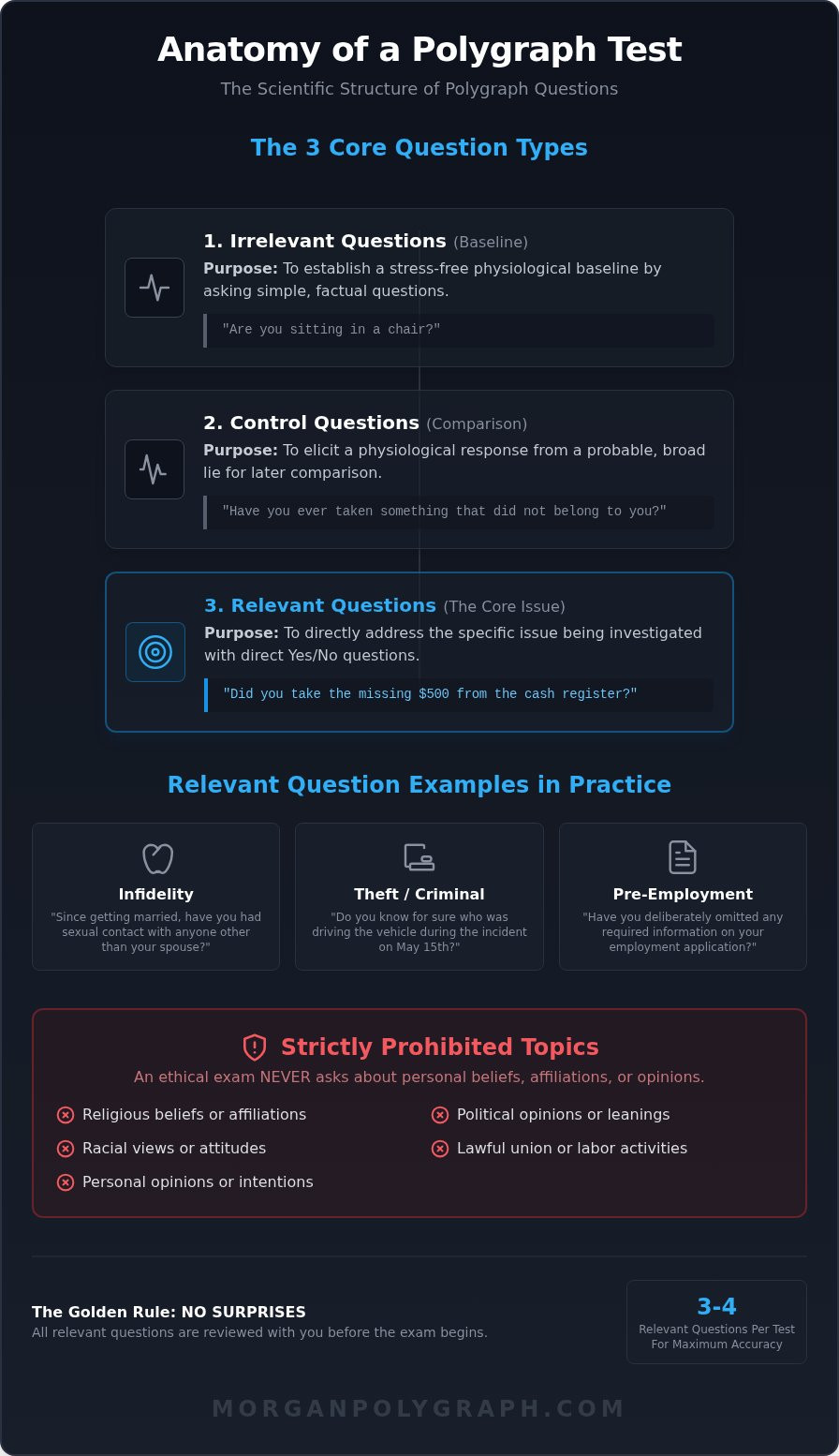
The first type of question you will encounter serves a simple but crucial purpose: to establish a baseline. These are called irrelevant questions because they have no emotional weight and are used to record your body’s normal physiological state when telling the truth without any stress. They are simple, known-fact questions that you can answer easily and honestly.
- Example: “Is your name John?”
- Example: “Are the lights on in this room?”
- Example: “Are you sitting in a chair?”
Rule #2: The Control (or Comparison) Question
Next, the examiner will introduce control questions. The purpose of these questions is to elicit a physiological response from a person telling a probable, but socially acceptable, lie. They are intentionally broad and relate to past actions or behaviors that most people have engaged in at some point in their lives. Your reaction to these questions provides a comparison point for your reactions to the relevant questions later on.
- Example: “Before the age of 21, did you ever tell a lie to get out of trouble?”
- Example: “Have you ever taken something that did not belong to you?”
Rule #3: The Relevant Question
Relevant questions are the core of the polygraph examination. These are the questions that directly address the specific issue being investigated. They are developed in collaboration with the client and are reviewed thoroughly with the examinee before the test starts. To ensure accuracy, every relevant question is direct, unambiguous, and designed to be answered with a simple “Yes” or “No.” There are no open-ended inquiries or trick questions.
Examples of Lie Detector Questions for Common Scenarios
The exact wording of relevant questions is always customized to fit the unique circumstances of each case. An examiner’s skill lies in crafting questions that are precise and directly address the client’s concerns. All relevant questions are discussed and agreed upon with the examinee before the test to ensure they are fully understood. Notice the consistent format in the examples below: they are time-bound, focus on a single issue, and require a clear answer.
Questions for Infidelity & Relationship Tests
In relationship testing, questions are designed to uncover specific actions or behaviors that have occurred within a defined timeframe. The goal is to provide clarity on factual events, not feelings or intentions.
- Example: “Since getting married in 2018, have you had any sexual contact with anyone other than your spouse?”
- Example: “Have you used dating apps to secretly meet someone since January 1st of this year?”
Questions for Theft or Criminal Investigations
For legal or criminal matters, the questions are narrowly focused on the specific incident under investigation. They are designed to be objective and free of emotional language, addressing only the facts of the case.
- Example: “Did you take the missing $500 from the cash register last Friday?”
- Example: “Do you know for sure who was driving the vehicle during the incident on May 15th?”
Questions for Pre-Employment Screening
In pre-employment contexts for law enforcement and government agencies, questions are used to verify information provided on an application and to screen for specific disqualifying behaviors. These questions are strictly regulated to be job-related.
- Example: “Have you deliberately omitted any required information on your employment application?”
- Example: “In the last 12 months, have you used any illegal drugs?”
What Questions Are NOT Allowed on a Polygraph Test?
A professional and ethical polygraph examination is governed by strict standards that protect the person being tested. The questions must remain focused on actions and behaviors, not a person’s internal thoughts, beliefs, or opinions. This ensures the test is fair, objective, and does not delve into areas that are personal, intrusive, or legally protected.
Prohibited Topics in a Professional Examination
During a properly conducted polygraph test, you will never be asked about the following topics. These areas are considered off-limits to protect your privacy and ensure the test’s integrity. If you are ever asked questions on these subjects, it is a sign of an unprofessional examination. Ensure your test is handled professionally. Contact a certified examiner.
- Questions about your religious beliefs or affiliations.
- Questions regarding your political opinions or leanings.
- Questions about your racial views or attitudes.
- Inquiries into lawful union or labor activities.
- Questions about your personal opinions or future intentions.
Frequently Asked Questions
Can you help formulate the questions for your own polygraph test?
Absolutely. In fact, it is a required part of the process. A certified examiner will conduct a thorough pre-test interview where you discuss the issue in detail. All relevant questions that will be asked during the exam are developed and reviewed with you to ensure they are clear, fair, and directly address the matter at hand.
How many relevant questions are asked during an exam?
Typically, a specific-issue polygraph test will include 3 to 4 carefully constructed relevant questions. This focused approach allows for the highest degree of accuracy, as it avoids confusing the results with too many unrelated issues.
What happens if I don’t understand a question?
Because all relevant questions are reviewed with you beforehand, this is rarely an issue. However, if you are ever confused during the test, you should simply stay still and silent. The examiner will move on, and the question can be clarified after the sequence is complete before starting the next one.
Are the questions different for a man versus a woman?
No. The questions are based entirely on the facts and circumstances of the case being investigated, not on the gender of the person being tested. The formulation process is objective and standardized for everyone.
Can I refuse to answer a question?
Since you will have reviewed and agreed to all relevant questions before the examination begins, there should be no reason to refuse an answer. The test requires your full cooperation to be valid. If you are uncomfortable with a question during the pre-test interview, you can discuss reformulating it with the examiner.
A polygraph examination is a tool for revealing the truth, and its effectiveness depends on a structured, professional, and transparent process. By understanding the types of questions asked and the ethical rules that govern them, you can approach the situation with confidence and clarity. If you are facing a situation that requires factual verification, the most important step is to work with a credible, certified professional.
If you need to establish the truth with certainty and discretion, our team of experts is here to help. Schedule a confidential consultation to discuss your specific needs.