
The thought of an upcoming polygraph test can be intimidating. A quick online search for how to fool polygraph unleashes a torrent of so-called ‘tricks’-from biting your tongue to placing a tack in your shoe. These myths, often popularized by movies and anonymous forums, do little more than create anxiety and a false sense of control, leaving you to worry about performing a countermeasure instead of simply telling the truth. This misinformation can lead to nervousness that jeopardizes the very outcome you desire: a clear, accurate result.
As a certified polygraph examiner, I have seen every one of these attempts. This guide is designed to pull back the curtain on the examination process. We will professionally dismantle the most common countermeasure myths, explaining exactly why they fail from an expert’s perspective. More importantly, we will provide you with straightforward, actionable advice on how to properly prepare for your test. Our goal is to replace your anxiety with confidence, ensuring you are equipped for a fair process that accurately reflects your integrity.
Understanding the Modern Polygraph: Why It’s Not Like the Movies
Many people searching for information on how to fool polygraph tests base their understanding on dramatic Hollywood portrayals. In movies, a polygraph is often depicted as a simple lie detector with a single, wildly swinging needle. The reality of a professional polygraph examination is far more clinical, systematic, and technologically advanced. It is not a single machine you can outsmart, but a comprehensive process managed by a highly trained expert dedicated to truth verification.
What a Polygraph Really Measures
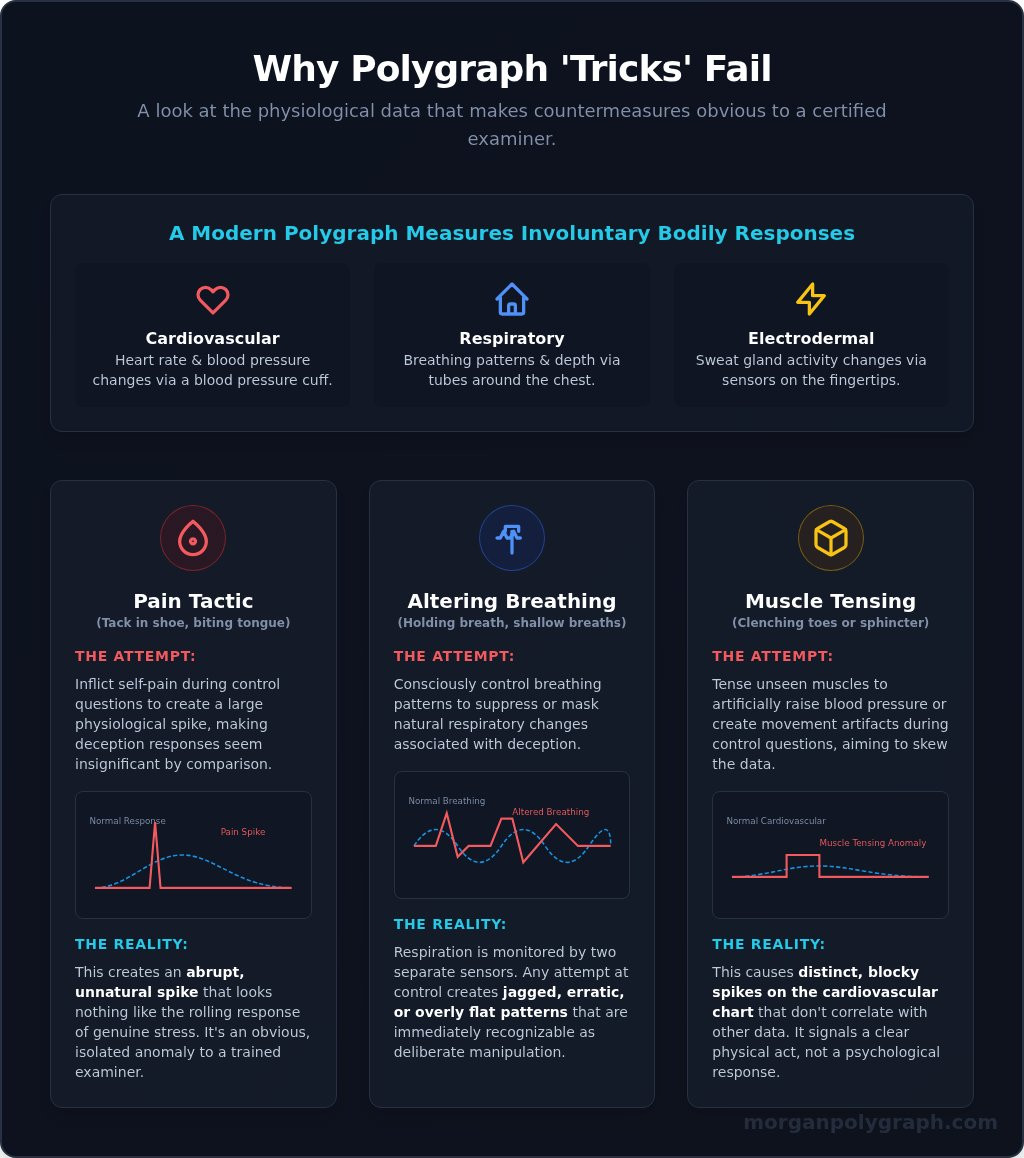
A common misconception is that a polygraph detects lies. In truth, it detects and records involuntary physiological changes in response to questioning. Understanding what a polygraph measures is the first step in demystifying the process. Certified examiners use several sensors to monitor your body’s autonomic nervous system, often called the ‘fight or flight’ response. These include:
- Cardiovascular: A blood pressure cuff measures changes in heart rate and blood pressure.
- Respiratory: Pneumograph tubes placed around the chest and abdomen track breathing patterns and depth.
- Electrodermal: Sensors on the fingertips measure minute changes in sweat gland activity.
These reactions are involuntary, making them extremely difficult to consciously control with any degree of consistency.
The Role of the Certified Examiner
The most critical component of any polygraph examination is not the instrument, but the examiner. A certified polygraph examiner is an expert trained in physiology, psychology, and proper testing procedures. Their work begins long before you are connected to the instrument. During a thorough pre-test interview, the examiner discusses the questions, ensures you understand them perfectly, and establishes your unique physiological baseline-your normal, truthful reactions. This baseline is what your subsequent responses will be compared against.
Modern Equipment and Technology
Forget the old analog machines with ink and paper. Today’s professional examinations utilize state-of-the-art, computerized polygraph systems. These instruments use highly sensitive sensors that can detect physiological fluctuations invisible to the naked eye. The data is then processed through validated scoring algorithms, providing the examiner with an objective analysis to support their professional conclusion. This combination of advanced technology and expert human analysis makes the idea of simply learning how to fool polygraph equipment a significant oversimplification of the challenge.
Physical Countermeasures: Why ‘Tricks’ to Fool the Machine Backfire
A search for how to fool polygraph tests will uncover a host of alleged physical “hacks.” These methods operate on a single, flawed theory: artificially spiking your physiological responses during control questions to make your reactions to relevant questions seem less significant. However, these attempts are well-known to certified examiners and are based on a fundamental misunderstanding of the examination process. While debates exist around the scientific evidence on polygraph accuracy, one area of consensus among professionals is the ease with which these crude countermeasures are detected. They do not mask deception; they create obvious, unnatural patterns that signal non-cooperation.
The Pain Tactic: Tacks in Shoes and Biting Your Tongue
The goal of inflicting self-pain is to generate a sharp physiological response to a baseline question. An individual might press down on a tack in their shoe or bite their tongue, hoping to skew the results. In practice, this creates an abrupt, isolated spike in the data that looks nothing like the more complex, rolling response associated with cognitive and emotional stress. Furthermore, a trained examiner is adept at observing physical behavior and will easily spot the corresponding fidgeting, wincing, or unnatural stillness.
Altering Your Breathing
Deliberately manipulating your breathing pattern-by holding your breath, taking shallow breaths, or hyperventilating-is one of the most common and easily detected countermeasures. The polygraph instrument uses two pneumograph sensors to monitor respiration. Any conscious effort to control breathing creates jagged, erratic, or overly controlled patterns on the chart that are immediately recognizable as deliberate manipulation. This is not a subtle trick; it is a clear announcement to the examiner that you are attempting to interfere with the test.
Muscle Tensing
Another frequently cited technique involves tensing muscles that are not easily visible, such as the sphincter or toe muscles. The intention is to raise blood pressure or create movement artifacts during control questions. However, these actions cause distinct, unnatural spikes on the cardiovascular and motion sensor channels. An experienced examiner will see these anomalies as red flags that do not correlate with the other physiological data, immediately identifying them as a conscious effort to defeat the examination process.
Mental Countermeasures: The Myth of Outsmarting the Examiner
Many online guides detailing how to fool polygraph tests focus on so-called ‘mental countermeasures’-using mind games to manipulate the results. These techniques are well-known to certified examiners and are often counterproductive. The reality is that the intense concentration required to execute these tricks generates its own distinct physiological responses that a trained professional can easily identify. Furthermore, the entire polygraph process, from the pre-test interview designed to build rapport to the structured question format, is engineered to detect and neutralize such attempts at misdirection.
Dissociation and ‘Thinking of Something Else’
One popular but ineffective tactic is attempting to emotionally dissociate from the relevant questions by thinking of something neutral or calming. The theory is to prevent an emotional spike when a critical question is asked. However, maintaining this level of detachment when your reputation or freedom is at stake is nearly impossible. An experienced examiner will recognize an unnaturally flat or unresponsive chart as a clear indicator of non-cooperation or attempted countermeasures, which is just as suspicious as a chart showing significant reactions.
Complex Mental Math
Another frequently suggested trick is to perform complex mathematical calculations in your head to distract from the question’s emotional impact. While this does create a physiological response, it is not the response associated with deception. The cognitive load of performing difficult math creates a unique and recognizable pattern on the polygraph chart. This pattern of intense mental effort is inconsistent with the expected response to a simple ‘yes’ or ‘no’ question and serves as a clear signal to the examiner that the subject is attempting to manipulate the test.
Attempting to Control Your Emotions
The advice to “just stay calm” is perhaps the most common and futile. The very act of trying to consciously suppress a natural emotional response often increases internal physiological activity, such as heart rate and blood pressure. This aligns with what psychological science says about polygraphs; the attempt to suppress a reaction can be more physiologically telling than the reaction itself. Professional examiners are trained to account for baseline nervousness, which is a normal and expected human response. They can distinguish the signs of general anxiety from the specific, focused reactions associated with deception.
The Examiner’s Defense: How Professionals Identify Deception and Countermeasures
A common misconception is that a polygraph examination is a passive process where a person simply answers questions while attached to a machine. In reality, it is an active, diagnostic procedure conducted by a certified expert trained to detect manipulation. Many online guides on how to fool polygraph tests fundamentally misunderstand this dynamic, focusing on the instrument while ignoring the examiner. These attempts, known as countermeasures, often produce erratic physiological data that makes an individual appear more deceptive, not less.
The Pre-Test Interview
Long before any relevant questions are asked, the examiner conducts a thorough pre-test interview. This critical phase is designed to establish your unique behavioral baseline. The examiner observes your normal patterns of speech, body language, and physiological responses to non-threatening conversation. By reviewing every question with you beforehand, we eliminate the element of surprise, ensuring that any significant reaction during the test is tied to the question’s substance, not shock.
Control Question Technique (CQT)
Professionally administered polygraphs utilize validated methods like the Control Question Technique (CQT). This involves comparing your physiological response to a relevant question (e.g., “Did you steal the money?”) with your response to a control question (e.g., “Have you ever told a lie?”). A truthful person will react more strongly to the control question, while a deceptive person reacts more to the relevant one. Countermeasures-such as inflicting pain or performing mental gymnastics-disrupt this scientific comparison, creating unnatural spikes that an expert will identify as an attempt to interfere with the test.
Post-Test Interview and Chart Analysis
An examiner’s analysis goes far beyond a single spike on a chart. We meticulously review the data from multiple charts, looking for consistent, timely, and significant reactions that occur specifically in response to the relevant questions. The anomalies caused by countermeasures lack this consistency and are often poorly timed. During a post-test interview, the examiner may directly address these unusual readings, asking you to explain the specific reaction, which can further reveal attempts at manipulation.
Ultimately, a polygraph examination is a comprehensive process managed by a human expert. For a confidential and professional truth verification service, contact the certified examiners at Morgan Polygraph.
The Best Strategy: How to Genuinely Prepare for a Polygraph Test
While many people search for information on how to fool polygraph tests, the most effective strategy for a truthful individual is not to fight the process, but to ensure it works accurately. Attempting to use “countermeasures” often creates physiological responses that mimic deception, leading to an inconclusive or deceptive result. The most reliable path to a successful outcome is to focus on genuine preparation, which reduces anxiety and allows your truthfulness to be clearly reflected.
This professional approach prioritizes accuracy and cooperation over conflict. By working with the examiner, you create the optimal conditions for a fair and precise truth verification process.
Prioritize Physical and Mental Wellness
Your physiological state is the foundation of a polygraph examination. To ensure the results are not skewed by external factors, it is crucial to arrive well-rested and in a stable condition. We advise all clients to:
- Get a full night’s sleep before the exam to ensure you are alert and calm.
- Avoid alcohol and non-prescribed drugs for at least 24 hours prior, as they can interfere with your natural physiological responses.
- Eat a normal meal and stay hydrated on the day of the test. Do not disrupt your typical routine, as hunger or dehydration can cause unnecessary stress on the body.
Be Honest and Cooperative
A professional polygraph examination is a controlled, structured process. Your cooperation is essential for an accurate reading. Listen carefully to the examiner’s instructions and answer only the question that is asked, without adding extra details or justifications. If you feel nervous-which is completely normal-be truthful with the examiner. A certified expert is trained to differentiate between general anxiety and the specific reactions associated with deception. Honesty builds a foundation of trust and clarity.
Understand the Process
Anxiety often stems from the unknown. A key fact to remember is that in a professionally conducted exam, all questions will be reviewed with you in detail before the test begins. There are no surprises. If you do not fully understand a question, it is your right and responsibility to ask for clarification. Ultimately, focusing on genuine preparation is a far more effective strategy than researching how to fool polygraph technology. For a fair and professional exam conducted with the highest standards of integrity, trust a certified expert.
The Truth About Truth Verification: Your Best Strategy
The search for how to fool polygraph examinations is filled with myths and misinformation. As we’ve explored, common physical and mental countermeasures are not only ineffective against modern polygraph technology, but they are also easily identified by a trained professional. The key takeaway is clear: attempting to manipulate the results often creates more suspicion than it resolves. The most reliable strategy is not deception, but genuine preparation and an honest approach to the examination process.
Instead of trying to beat the system, ensure the system is working for you with a trusted expert. At Morgan Polygraph, our court-recognized and nationally certified examiners bring over 40 years of combined experience to every confidential session. We are committed to a professional and compassionate process, utilizing state-of-the-art polygraph technology to ensure the highest degree of accuracy and fairness for all clients.
For a process grounded in integrity and expertise, schedule a confidential and professional polygraph examination with our certified experts. Facing a polygraph can be a stressful experience, but with the right professional guidance, you can navigate it with confidence and clarity.
Frequently Asked Questions
What happens if the examiner accuses me of using countermeasures?
A certified examiner is trained to detect countermeasures. If attempts to manipulate the test are identified, the examiner will note this in the official report. This can lead to an inconclusive result or a finding of “Deception Indicated,” as the attempt itself demonstrates a lack of cooperation and suggests dishonesty. Using countermeasures severely damages your credibility and often invalidates the entire examination process, working directly against your goal of demonstrating truthfulness.
Can being overly nervous make me fail a polygraph test?
No, general nervousness will not cause a truthful person to fail. Professional examiners expect subjects to be nervous and are trained to account for it. The examination process includes a pre-test interview and calibration questions designed to establish your unique physiological baseline. The test measures significant, timely, and consistent changes from this baseline in response to key questions, not the overall level of anxiety. A constantly elevated state of nervousness looks very different from a deceptive response.
Are polygraph results admissible in court?
The admissibility of polygraph results in court proceedings varies significantly by state and jurisdiction. In many criminal courts, they are not permitted as direct evidence. However, they are frequently used in pre-employment screening, internal investigations, and by law enforcement as a valuable investigative tool. In some cases, results may be admitted upon stipulation, meaning both the prosecution and defense agree to their inclusion before the examination is conducted. Always consult with legal counsel for specific guidance.
Is there any surefire way to pass a polygraph test?
The only certain method to pass a professionally administered polygraph examination is to be completely truthful. While many online sources claim to teach how to fool polygraph tests, these techniques are unreliable and often create physiological patterns that experienced examiners recognize as deliberate non-cooperation. Attempting to manipulate the outcome is the most common reason truthful people fail, as it produces charts inconsistent with a truthful person’s natural responses.
How long does a typical polygraph examination take?
A standard, professional polygraph examination is a comprehensive process that typically takes between two and four hours to complete. This timeframe includes three distinct phases: the pre-test interview where the examiner explains the process and reviews all questions, the in-test phase where data is collected using the instrument, and the post-test interview to discuss the results. This deliberate duration ensures accuracy and adherence to established best practices and standards.
Can a sociopath or pathological liar fool a polygraph?
It is a common myth that individuals with antisocial personality disorder or who are pathological liars can easily pass a polygraph. The examination does not measure remorse or conscience; it measures involuntary physiological responses to the perceived threat of detection. Even individuals who lie without guilt experience an autonomic nervous system reaction when confronted with questions that could expose their deception. A properly structured test administered by an expert examiner can effectively detect these reactions.