

The constant knot of anxiety in your stomach, the feeling that you’re going crazy overanalyzing every text, the late-night searches for an “is my bf cheating on me quiz” that might give you a moment of clarity-these are exhausting signs of a relationship in crisis. While online quizzes offer a quick distraction, they rarely provide the real, definitive answers you need. They can’t understand the nuances of your relationship or the subtle shifts in behavior that have eroded your trust, often leaving you feeling more paranoid and alone than before.
This professional guide is designed to move you beyond speculation and into a place of confidence. Here, you will not find a generic checklist. Instead, you will learn how to identify meaningful behavioral patterns that can indicate infidelity, understand the compassionate and effective ways to approach the situation, and discover the professional methods available for achieving absolute certainty. It is time to stop the endless cycle of suspicion and find a clear, confident path forward, whether that means rebuilding trust or preparing to move on.
Why You’re Searching for a ‘Cheating Boyfriend’ Quiz
If you have found yourself typing “is my bf cheating on me quiz” into a search bar, you are likely in a place of significant emotional distress. This search is not born from simple curiosity; it comes from a place of deep-seated doubt, confusion, and pain. It is a sign that the trust and security that form the bedrock of a healthy relationship have been fractured. At Morgan Polygraph, we handle these sensitive matters with professional and compassionate discretion, understanding that your search for answers is a critical step toward finding peace.
Suspicion is rarely an isolated event. It is often the result of a slow erosion of communication and trust. You are not being paranoid for noticing inconsistencies or feeling that something is fundamentally wrong. Your intuition is a powerful tool designed to detect changes in patterns and behaviors. The goal now is to move beyond the turmoil of gut feelings and begin the methodical process of evaluating observable facts. This article is designed to help you navigate this difficult path with clarity and purpose.
The Emotional Toll of Uncertainty
Living with the constant question of infidelity takes a severe toll on your mental health. The endless cycle of second-guessing, anxiety, and stress can disrupt every aspect of your life, from your ability to concentrate at work to your capacity for restful sleep. Functioning normally becomes a monumental task when your mind is preoccupied with analyzing every text message, late arrival, and vague explanation. This state of emotional limbo is unsustainable and damaging.
Common Triggers: What Sparks the Initial Doubt?
The initial seed of doubt is often planted by a tangible change. It could be a sudden shift in his routine, increased secrecy with his phone, or an emotional distance that you cannot explain. Sometimes, the trigger is as simple as discovering a small lie that opens the door to larger questions about his honesty. This single inconsistency can be enough to make you re-evaluate everything, compelling a deeper look into understanding infidelity and its common indicators. These triggers are valid reasons for concern and warrant a closer, more objective examination.
A Professional Checklist: Key Behavioral Red Flags to Consider
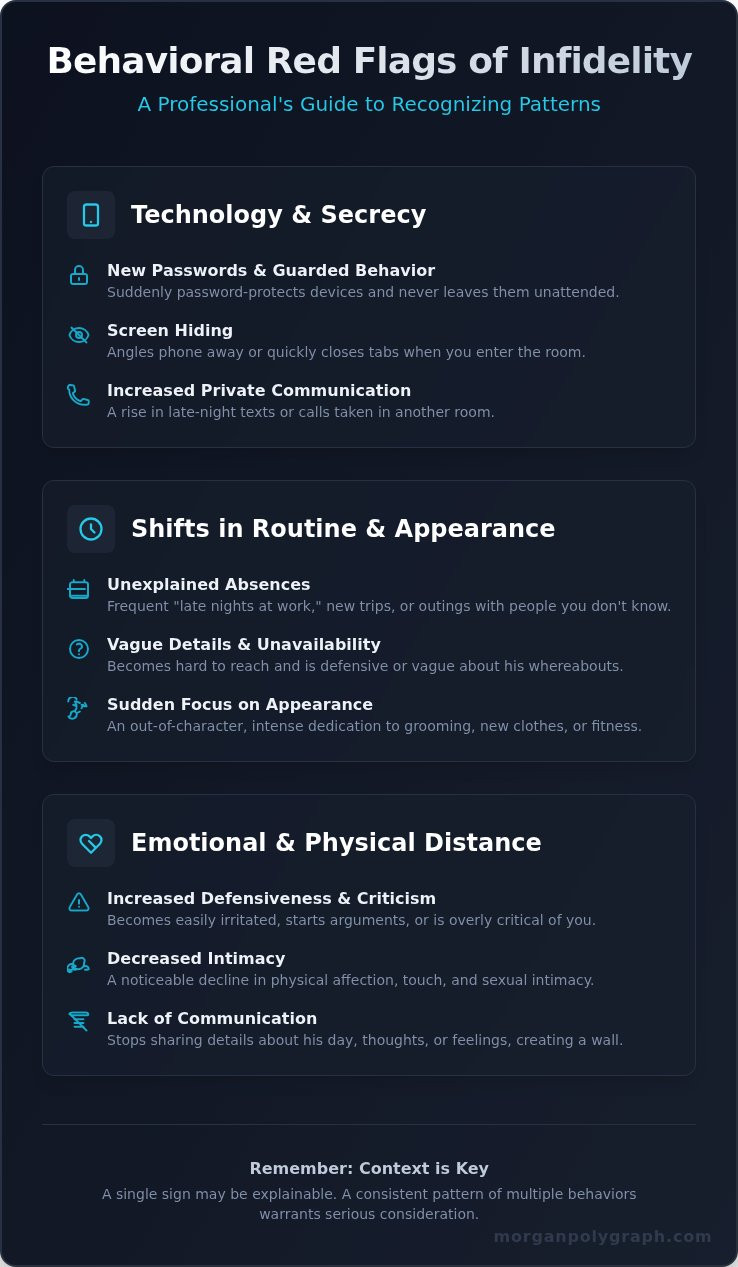
The search for a simple “is my bf cheating on me quiz” often stems from a place of deep-seated fear and uncertainty. While online quizzes can feel like a quick solution, a situation this serious requires a more measured and professional assessment. This checklist is not a game or a scorecard; it is a confidential tool to help you evaluate observable behaviors in your relationship. It is critical to understand that these are indicators, not definitive proof. A single sign may be easily explained, but a consistent pattern of multiple behaviors warrants serious consideration.
Changes in Technology Use & Secrecy
While everyone is entitled to a degree of privacy, a sudden and intense shift toward secrecy is a significant red flag. This often manifests in how your partner handles their digital devices. Look for abrupt changes from their established habits.
- New Passwords and Guarded Behavior: He suddenly password-protects his phone, computer, or specific apps and never leaves his device unattended.
- Screen Hiding: He angles his phone away from you, quickly closes laptop tabs when you enter the room, or puts his phone face down on tables.
- Increased Private Communication: There is a noticeable increase in late-night texts or calls that he takes in another room or whispers through.
- Secondary Devices or Profiles: You discover a second phone, a SIM card, or social media profiles under a different name that you were unaware of.
Shifts in Routine, Availability, and Appearance
Infidelity requires time, energy, and often, money. These resources must be diverted from somewhere else, typically from the primary relationship and normal daily life. These logistical changes can be difficult to hide consistently over time.
- Unexplained Absences: An increase in “late nights at the office,” new business trips, or frequent social outings with people you’ve never met.
- Vague Details and Unavailability: He becomes difficult to reach for long periods and is vague or defensive when asked about his whereabouts.
- Sudden Focus on Appearance: A new and intense dedication to his grooming, wardrobe, or fitness level that seems out of character.
- Financial Discrepancies: Unaccounted-for cash withdrawals, credit card charges for gifts or hotels you never saw, or other unusual expenses.
Emotional and Physical Distance in the Relationship
Perhaps the most painful indicators are the ones that signal an emotional and physical withdrawal from the relationship. When a person is investing their intimacy and emotional energy elsewhere, the primary relationship is often the first to suffer.
- Increased Defensiveness and Criticism: He becomes easily irritated, starts arguments over minor issues, or becomes overly critical of you and the relationship.
- Decreased Intimacy: A noticeable decline in physical affection, sexual intimacy, or non-sexual touch like holding hands or cuddling.
- Lack of Communication: He stops sharing details about his day, his thoughts, or his feelings, creating an emotional wall between you.
- Accusations of Cheating: In a common deflection tactic known as projection, he may accuse you of being unfaithful. Understanding the complex psychology of cheating can help clarify why a partner might engage in this confusing behavior.
The Limits of Online Quizzes: Why They Can’t Give You The Truth
When doubt and anxiety cloud a relationship, the search for answers can feel urgent. It’s understandable why many people type “is my bf cheating on me quiz” into a search bar, hoping for a quick, definitive answer to a painful question. While these quizzes offer a moment of action, they are fundamentally incapable of providing the truth you deserve. They are built on generic assumptions and can do more harm than good, feeding into a cycle of suspicion without offering any real resolution.
The core problem is that these tools encourage confirmation bias. If you already suspect infidelity, the quiz questions are often framed in a way that confirms your fears, validating your anxiety instead of alleviating it. You are left with a “result” that isn’t based on fact, but on an algorithm designed to interpret your own worries back to you, increasing paranoia and pushing you further from a constructive solution.
Generic Questions vs. Your Reality
An online quiz operates on impersonal, one-size-fits-all questions that completely ignore the unique context of your partnership. It might ask if your partner is more distant or protective of their phone, but it cannot comprehend the legitimate reasons behind such behaviors. A demanding project at work, family stress, or even planning a surprise can all be misinterpreted as red flags by a simple algorithm. These tools lack the professional nuance to differentiate between stress and deceit, ignoring the complex psychological predictors of infidelity that require careful, human evaluation. Your relationship’s history, communication patterns, and established dynamics are variables no online tool can process.
The Risk of False Accusations
The most significant danger of relying on a quiz is the potential for causing irreparable damage based on a false positive. Confronting your partner with accusations fueled by an online quiz can shatter the trust you’re trying to repair. It can escalate a manageable issue into a major crisis, creating a defensive environment where honest communication becomes impossible. A quiz score is not evidence; it is a digital guess that offers no certainty. In matters as critical as the foundation of your relationship, you need proof, not algorithm-based suspicion. When you need more than a quiz to find the truth, it is time to speak with a professional.
A Path Forward: How to Move from Suspicion to Clarity
The uncertainty that follows a gut feeling of betrayal can be emotionally paralyzing. While an online “is my bf cheating on me quiz” might confirm your fears, it offers no real solution. Moving from suspicion to clarity requires a measured and mature approach. This structured path is designed to help you gather facts, communicate effectively, and determine the definitive truth in a way that respects both you and your relationship.
Step 1: Observe and Document, Don’t Assume
Before initiating a difficult conversation, it is crucial to ground your feelings in factual observations. Keep a private, confidential journal to log specific incidents. Note the date, time, and context of concerning behaviors. The objective is not to build a case against your partner, but to identify consistent patterns, not isolated events. This documentation provides a clear, rational basis for your feelings and prevents a conversation from devolving into vague, easily dismissed accusations.
Step 2: The Non-Accusatory Conversation
When you are ready to talk, the goal is to open a dialogue, not start a fight. Approach the conversation from a place of vulnerability and concern. Use “I feel” statements to express your emotions without casting blame. For example, instead of saying, “You’re always on your phone,” try, “I feel disconnected and worried when I see you hiding your phone screen.” Focus on the changes you have observed and how they have impacted you. This method invites empathy and discussion rather than defensiveness.
Step 3: When Communication Fails or Isn’t Enough
Sometimes, even a well-handled conversation does not lead to resolution. Your partner may deny everything, yet the suspicious behaviors continue. You may even feel like your reality is being questioned-a common sign of gaslighting. When direct communication reaches an impasse and your intuition insists that something is wrong, you need an impartial method to find the truth.
This is the point where a professional polygraph examination becomes a viable, final step. It is not a tool for interrogation but for truth verification. After trying every other method, you deserve more than another inconclusive is my bf cheating on me quiz. When trust is fundamentally broken, a polygraph provides a clear, unbiased answer. It can eliminate lingering doubt, providing the certainty needed to either begin rebuilding trust or make an informed decision to move on. For a confidential consultation, contact the experts at Morgan Polygraph.
The Ultimate Solution: How an Infidelity Polygraph Provides Certainty
When suspicion takes root in a relationship, the cycle of doubt can be exhausting. You’ve likely gone over conversations in your head, checked for signs, and maybe even taken an online is my bf cheating on me quiz. While these steps can highlight concerns, they ultimately lead to more questions, not answers. A professional polygraph examination is not an act of aggression; it is a definitive tool for truth verification, designed to provide the certainty needed to either heal your relationship or move forward with clarity.
What is a Relationship Polygraph Test?
A relationship polygraph is a confidential, professional examination focused on resolving specific, agreed-upon questions about infidelity or other trust-related issues. Conducted by a certified and experienced examiner in a controlled, neutral environment, the test scientifically measures and records physiological responses-such as heart rate, blood pressure, and respiration-to a structured series of questions. This process provides a highly accurate assessment of truthfulness, moving beyond emotion and speculation.
A Tool to Rebuild Trust or Gain Closure
The outcome of an infidelity polygraph provides a clear path forward, ending the painful “he said, she said” dynamic. The results serve one of two crucial purposes:
- Confirmation of Innocence: If your partner passes the exam, the results can eliminate crippling doubt and serve as a solid foundation upon which to rebuild trust and repair your connection.
- Verification of Deception: If the results indicate deception, you are empowered with the certainty you need to make difficult but informed decisions about your future, free from lingering uncertainty.
The Morgan Polygraph Process: Professional and Discreet
At Morgan Polygraph, we understand the immense stress and sensitivity surrounding relationship issues. Our court-recognized examiners handle every case with the utmost compassion and professionalism. The entire process, from the initial conversation to the final report, is held in the strictest confidence to protect your privacy. We work directly with you and your partner to formulate precise, unbiased questions that address the core of your concerns. If you are ready to find peace of mind, schedule a confidential consultation to find the truth.
From Doubt to Certainty: Your Path to the Truth
The search for answers is an exhausting and emotional process. While you may have started this journey by taking an is my bf cheating on me quiz, you now understand that such tools only deepen suspicion without offering real proof. Recognizing behavioral red flags is an important step, but true clarity requires a definitive, professional approach to truth verification.
When you need absolute certainty, a professional infidelity polygraph provides the answers that speculation cannot. At Morgan Polygraph, our process is completely confidential and respectful from start to finish. Our nationally certified, court-recognized examiners bring over 40 years of combined professional polygraph experience to every consultation, ensuring you receive the highest standard of expert service.
Stop the cycle of doubt and anxiety. Take the decisive step towards knowing the truth. Find Clarity and Peace of Mind. Contact Us for a Confidential Consultation. You deserve to move forward with confidence.
Frequently Asked Questions
What are the most undeniable signs of a cheating boyfriend?
While no single sign is definitive proof, undeniable patterns often emerge. Look for significant shifts in behavior, such as sudden secrecy with a phone, unexplained changes in his schedule, or a new and intense focus on his appearance. Other indicators can include emotional distance, a decreased interest in intimacy, or defensive reactions to simple questions about his whereabouts. It is the combination and consistency of these changes that often signal a problem.
How do I confront my boyfriend about my suspicions without starting a huge fight?
A successful confrontation requires a calm and strategic approach. Choose a private, neutral time when you are both calm. Use “I feel” statements to express your emotions without placing blame, such as, “I’ve been feeling disconnected from you lately.” The goal is to invite an open, honest conversation about the state of your relationship, not to corner him with accusations. This method encourages dialogue rather than immediate defensiveness and conflict.
My boyfriend says I’m just paranoid. How do I know if my gut feeling is right?
Trusting your intuition is important, but it must be balanced with observable facts. When your partner dismisses your concerns, it’s crucial to evaluate the evidence objectively. Instead of relying on an online ‘is my bf cheating on me quiz,’ document specific, consistent behavioral changes that fuel your suspicion. If your gut feeling persists despite a lack of concrete evidence, it may indicate a fundamental breakdown of trust that needs to be addressed professionally.
How much does a private infidelity lie detector test cost?
The cost for a private, confidential infidelity polygraph test typically ranges from $500 to over $2,000. The final price depends on several factors, including the reputation and experience of the certified examiner, the complexity of the specific issue being tested, and the geographic location. We recommend obtaining a precise quote from a professional examiner who can assess the unique circumstances of your situation to ensure accuracy and fairness in pricing.
Can someone really ‘beat’ a professional polygraph test about cheating?
It is a common misconception that one can easily ‘beat’ a polygraph. While individuals may attempt countermeasures, a certified and experienced examiner is expertly trained to identify such efforts. A professional polygraph measures involuntary physiological responses to specific questions-reactions that are nearly impossible to consciously control. The combination of advanced instrumentation and expert analysis makes it exceptionally difficult for deception to go undetected by a qualified professional conducting the examination.
What happens during a relationship polygraph test?
A relationship polygraph test is a structured and professional process. It begins with a confidential pre-test interview where the specific questions are reviewed and finalized with you and the examiner. During the examination, sensors are comfortably attached to monitor physiological data like heart rate and respiration as questions are asked. Afterward, the certified examiner conducts a thorough analysis of the recorded data to provide a conclusive and accurate report on the findings.