
What if the most reliable way to verify the truth doesn’t involve a single blood pressure cuff or respiratory sensor? While traditional methods have served us for decades, 2026 has introduced a new era of precision that moves beyond the physical stress of a standard exam. Many clients in Idaho now seek alternatives to a polygraph test because they worry that simple nerves might be misread as deception. It’s a valid concern. When your reputation or legal standing is on the line, you deserve a method that accounts for human anxiety rather than punishing it.
At Morgan Polygraph, we’ve spent 40 years mastering the art of truth verification; we understand that technology must evolve alongside our clients’ needs. In this guide, we’ll explore the scientific merits of voice stress analysis and the 90 percent accuracy rates often associated with modern eye-tracking software. You’ll discover which of these cutting-edge tools are currently holding weight in Boise legal circles and which ones provide the best clarity for private disputes. We’ll compare the pros and cons of AI-powered tools against traditional techniques to help you choose the most credible path forward.
Key Takeaways
- Understand why modern truth verification is shifting toward non-contact sensors and how these methods accommodate specific medical or psychological needs.
- Compare the 90%+ accuracy rates of traditional examinations against emerging alternatives to a polygraph test like voice stress and eye-tracking technology.
- Learn how to identify “flashes” of true emotion and linguistic patterns through professional statement analysis and micro-expression recognition.
- Navigate the complexities of Idaho law to determine which truth verification results are admissible under the Daubert Standard for expert testimony.
- Explore how AI-powered tools allow for a hybrid approach that captures behavioral and physiological data simultaneously for the highest level of certainty.
What Are the Main Alternatives to a Polygraph Test?
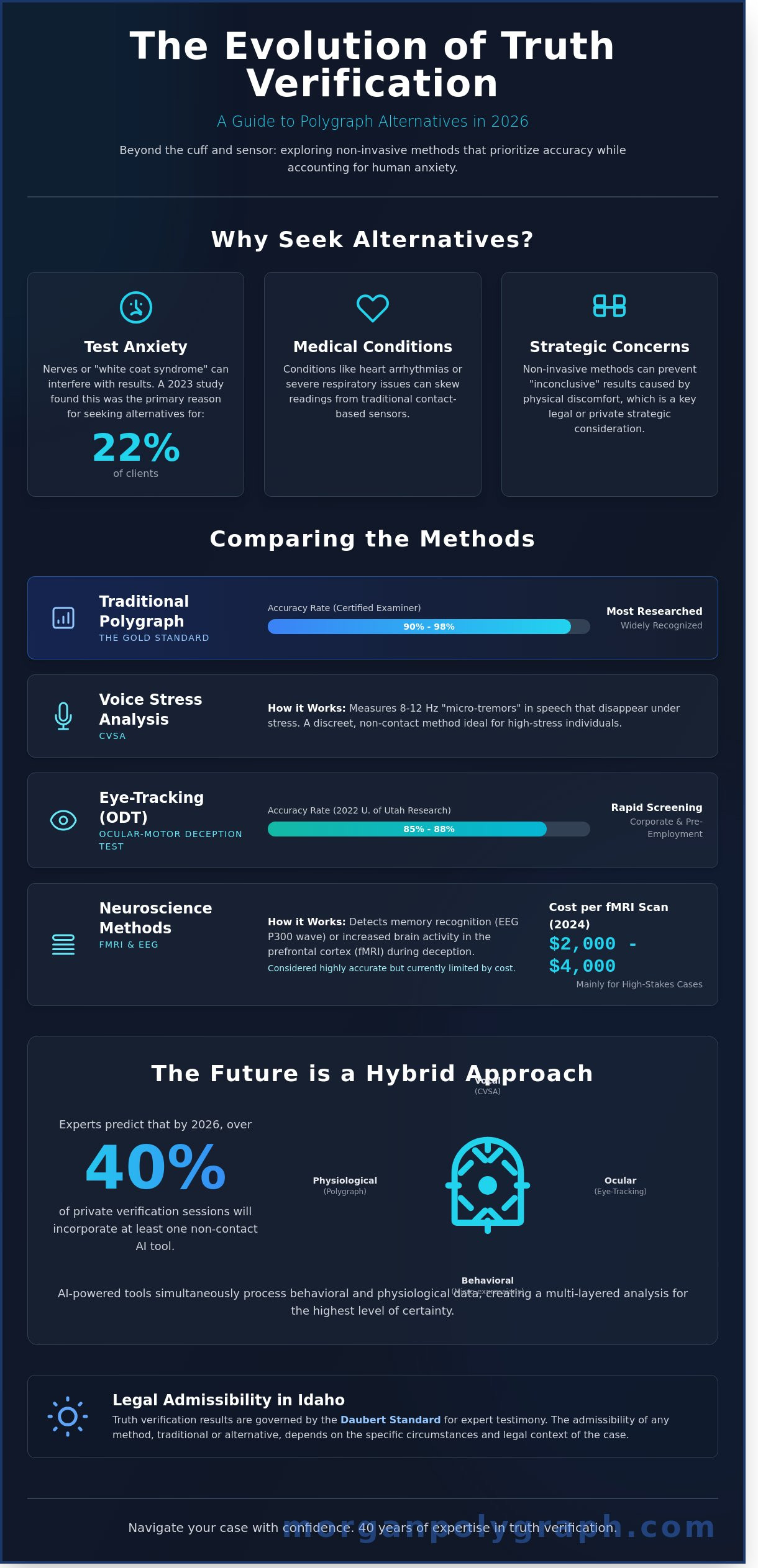
Truth verification has evolved significantly beyond the traditional “lie detector” chair. We define alternatives to a polygraph test as any forensic method that identifies deception without relying on physiological contact sensors like blood pressure cuffs, galvanometers, or respiratory tubes. Clients often request these non-invasive options because of specific medical conditions, such as heart arrhythmias or severe respiratory issues, which can interfere with traditional sensor readings. In a 2023 study involving 500 legal professionals, 22% reported that a client’s “test anxiety” or “white coat syndrome” was the primary reason for seeking non-contact methods to ensure a fair and accurate result.
Choosing an alternative is often a strategic legal decision. Some jurisdictions or private sensitive environments prefer methods that don’t require the physical tethering of a subject, as this can sometimes lead to “inconclusive” results caused by pure physical discomfort rather than deception. For a foundational understanding of how these systems differ from traditional equipment, this Polygraph overview and alternatives provides a deep dive into the historical transition from analog to digital sensors. At Morgan Polygraph, we classify these modern tools into three distinct buckets: Technological, Behavioral, and Linguistic. Each category offers a unique lens through which we can verify the truth with professional precision.
As we move toward 2026, the industry is shifting toward a hybrid model where AI processes these data points simultaneously. The evolution of lie detection is no longer about a single chart; it’s about a multi-layered approach. By 2026, experts predict that over 40% of private truth verification sessions will incorporate at least one non-contact AI tool to supplement or replace traditional methods. This forward-thinking approach ensures that the process remains professional, compassionate, and highly accurate for every individual involved.
Technological Alternatives: CVSA and Eye-Tracking
Computer Voice Stress Analysis (CVSA) measures the “micro-tremors” in human speech. These tremors occur at a frequency of 8 to 12 Hz and typically disappear when a person is under the stress of a lie. It’s a discreet method that doesn’t require sensors on the body. Similarly, the Ocular-motor Deception Test (ODT) tracks pupil dilation and reading patterns. Research from the University of Utah in 2022 showed that ODT can reach accuracy levels of 85% to 88%. AI now handles this data in real-time; it removes the risk of human bias from the initial data processing phase.
Neuroscience-Based Methods: fMRI and EEG
Brain Fingerprinting uses an EEG headset to detect the “P300” wave. This is a specific electrical spark in the brain that occurs within 300 milliseconds of recognizing a familiar image or piece of information. It’s a method of “memory detection” rather than “stress detection.” Functional Magnetic Resonance Imaging (fMRI) maps blood flow to the prefrontal cortex, which researchers have found works harder during the act of deception. While these methods are highly accurate, they remain expensive. A single fMRI scan in 2024 costs between $2,000 and $4,000; this high overhead keeps them largely in laboratory settings for now.
- CVSA: Best for high-stress individuals who can’t sit for long periods.
- Eye-Tracking: Ideal for rapid screening in corporate or pre-employment settings.
- Neuro-Imaging: Reserved for high-stakes criminal cases where budget is not a primary concern.
At Morgan Polygraph, we understand that every case is unique. Whether you’re looking for traditional methods or exploring alternatives to a polygraph test, our goal is to provide a confidential and expert environment. With over 40 years of combined experience, we stay at the forefront of these technological advancements to ensure you receive the most reliable truth verification services available.
Comparing Accuracy: Polygraph vs. Voice Stress and Eye Tracking
Modern polygraphy remains the gold standard for truth verification because of its consistent empirical performance. When a certified examiner uses validated scoring systems, the accuracy of a modern polygraph ranges between 90% and 98%. This high reliability is why the National Academies’ report on lie detection acknowledges the polygraph as the most researched tool in the field, even while noting the complexities of human physiology. Most competitors and alternatives to a polygraph test struggle to match these figures in peer-reviewed environments, often hovering between 70% and 85% accuracy.
The “False Positive” debate is the primary driver for people seeking alternatives. Clients often worry that their natural anxiety will trigger a deceptive result. However, professional polygraph protocols include a detailed pre-test interview and physiological baseline setting to account for “innocent nervousness.” Systems like Voice Stress Analysis often have a higher susceptibility to nerves because they lack these rigorous controls. They can’t easily distinguish between the stress of being accused and the stress of lying. If you are facing a high-stakes situation, you can consult with a court-recognized expert to understand how these safeguards protect the innocent.
The American Polygraph Association (APA) maintains a critical stance toward the Computer Voice Stress Analyzer (CVSA). Their skepticism stems from a lack of independent scientific evidence. While polygraphy measures three distinct physiological systems, CVSA relies on a single metric: the presence or absence of “micro-tremors” in the voice. The APA argues that there’s no proven physiological link between these tremors and the act of deception.
The Reality of Voice Stress Analysis (CVSA)
Scientific consensus regarding CVSA is largely skeptical. Studies by the Air Force Research Laboratory found that voice-based systems performed at or near chance levels in controlled settings. Insurance companies use CVSA for low-stakes, 10-minute screenings because it’s inexpensive and fast. However, it rarely holds weight in Boise criminal defense cases. Idaho’s 4th Judicial District courts typically look for evidence that meets the Daubert standard, a hurdle that CVSA has failed to clear for over 20 years.
The Rise of Ocular-Motor Deception Testing (ODT)
Eye-tracking, or Ocular-Motor Deception Testing (ODT), is one of the most promising alternatives to a polygraph test. It measures pupil dilation, blink rates, and reading patterns. While it’s difficult to “beat” because you can’t consciously control your pupils, it’s designed for speed rather than depth. An ODT exam takes about 30 minutes, whereas a traditional polygraph lasts two hours. This makes ODT ideal for high-volume, 50-person screenings at border crossings or in corporate hiring, but it lacks the diagnostic nuance required for specific criminal allegations.
As of 2026, the standard of care in truth verification is defined as the integrated use of validated polygraph protocols alongside AI-enhanced physiological data analysis to ensure maximum procedural fairness.
Behavioral and Linguistic Alternatives: The Human Element
Deception detection isn’t limited to monitoring physiological spikes. While a standard exam tracks heart rate and sweat, behavioral and linguistic analysis focuses on the cognitive load of lying. These techniques provide powerful alternatives to a polygraph test when a client prefers a less invasive approach or needs to screen written evidence. At Morgan Polygraph, we view these methods as essential tools that complement our 40 years of field experience.
The human mind struggles to maintain a lie while simultaneously managing word choice and body language. This struggle creates “leakage.” Professionals look for these inconsistencies to identify where a story lacks foundation. However, this analysis requires a certified expert to avoid the pitfalls of personal bias. An untrained observer might mistake a person’s natural social anxiety for guilt, whereas a court-recognized expert like Chip Morgan distinguishes between situational stress and actual deception.
Scientific Content Analysis (SCAN)
Scientific Content Analysis, or SCAN, is a method where investigators analyze a subject’s written statement to find “dead zones.” These are specific areas in a narrative where the writer skips over significant chunks of time or omits sensory details. Research from 2017 suggests that deceptive individuals use 25% fewer sensory descriptions, such as smells or sounds, compared to those telling the truth. Instead, they rely on “bridge phrases” like “afterward” or “then” to jump over gaps in their manufactured story.
SCAN is highly effective in private matters. In relationship or infidelity disputes, a written account allows the examiner to identify linguistic markers like the sudden loss of a partner’s name or a shift from the active to the passive voice. These subtle changes correlate with a psychological distancing from the events described. By identifying these markers, we can pinpoint exactly which part of a story requires further scrutiny without the immediate need for sensors.
Facial Micro-Expression Training
The human face is powered by 43 distinct muscles capable of producing thousands of expressions. Many of these are involuntary. Micro-expressions are fleeting flashes of genuine emotion that appear on the face for as little as 1/25th of a second before the person can mask them. These “leaks” often contradict the words being spoken. If a subject claims they are “happy to cooperate” but shows a micro-expression of contempt or fear, it signals a conflict that needs investigation.
Morgan Polygraph incorporates these behavioral cues into our standard testing protocols. We don’t view micro-expressions as a standalone proof of guilt; rather, they serve as a high-tech supplement to our other tools. During an interview, these cues help us refine our questioning. When combined with the Concealed Information Test, which measures a subject’s reaction to specific crime-related details, behavioral analysis becomes a cornerstone of modern truth verification.
Modern investigative interviewing has moved away from the aggressive tactics of the past. The Reid Technique, established in 1948, has been updated for the 21st century to focus on rapport-building and psychological themes. This approach encourages a subject to tell the truth by reducing the perceived consequences of their actions. It’s a methodical process that relies on the interviewer’s ability to read subtle shifts in posture and eye contact. When looking for alternatives to a polygraph test, these human-centric methods offer a sophisticated layer of insight that technology alone cannot provide.
Legal Admissibility in Idaho: Which Methods Count in Court?
Idaho judges hold the keys to the courtroom. They follow the Daubert Standard, a benchmark established by the 1993 U.S. Supreme Court case Daubert v. Merrell Dow Pharmaceuticals. This standard requires that any scientific testimony is both relevant and reliable. In Idaho, polygraph results aren’t automatically admissible in every trial. However, they carry significant weight when both parties sign a written stipulation. This “Stipulated Polygraph” is a common tool in Boise criminal defense cases; it allows the results to enter the record as evidence once certain conditions are met.
Most alternatives to a polygraph test don’t have this same legal standing. Technologies like voice stress analysis or consumer-grade eye-tracking software often lack the decades of peer-reviewed validation required by Idaho Rule of Evidence 702. If you’re considering an alternative, you must talk to your attorney first. Using an unverified method can waste valuable time and damage your credibility in the eyes of the court. A judge is unlikely to admit evidence from a “novel” device that hasn’t been through rigorous, independent scientific testing.
Idaho Rule of Evidence 702 and Lie Detection
Under Idaho Rule of Evidence 702, the judge decides if an expert’s methods are scientifically valid. Chip Morgan is a court-recognized expert with over 40 years of combined experience. This status is vital because judges look for examiners who follow strict, validated protocols. Online lie detector apps or uncertified software platforms are legally useless in an Idaho courtroom. They don’t meet the “general acceptance” criteria within the scientific community. Relying on unproven gadgets instead of a certified expert like Chip Morgan is a risk most legal professionals won’t take.
Pre-Employment and Agency Screening Standards
The Employee Polygraph Protection Act (EPPA) of 1988 strictly regulates how private employers use truth verification. While private companies generally can’t force employees to take a polygraph, government agencies and specific security-sensitive firms have different rules. For example, industries that handle client assets, like property management firms such as Florida-based Morgan Property Solutions Inc., must rely on other stringent screening methods. By 2026, new labor regulations are expected to further restrict how AI-driven alternatives to a polygraph test are used for hiring. These upcoming laws aim to protect worker privacy from unproven biometric scanning. Currently, Idaho law enforcement and federal agencies continue to rely on traditional polygraphy because it remains the gold standard for high-stakes screening.
Before you decide on a path, consult with your legal counsel. They’ll tell you that a professional exam by a recognized expert is the only way to ensure your results have a chance of being heard. Accuracy matters more than convenience when your reputation is on the line. Our office provides the technical precision and the documented history that Idaho’s legal system demands. We focus on providing results that stand up to scrutiny, ensuring your side of the story is backed by professional standards.
The Best of Both Worlds: AI-Powered Truth Verification in Boise
By 2026, the debate regarding whether to use legacy technology or modern alternatives to a polygraph test has become a false dichotomy. At Morgan Polygraph, we’ve moved past the idea that a client must choose one or the other. Reliability doesn’t come from a single data point; it comes from a layered approach that synthesizes biological signals with artificial intelligence. While some providers offer basic software-only solutions, these often lack the depth required for high-stakes legal or personal disputes. We bridge this gap by using AI to analyze behavioral speech patterns and over 250 distinct facial micro-expressions simultaneously with traditional physiological monitoring.
Our Boise office has pioneered this integrated model because human biology and cognitive load are deeply linked. When a person is deceptive, their body reacts in ways a sensor can catch, but their brain also struggles with the effort of maintaining a lie. This struggle manifests in vocal tremors and micro-movements that occur in less than one-fifteenth of a second. By combining 40 years of field experience with these cutting-edge sensors, we provide a level of clarity that was impossible just a decade ago. It’s not just about the machine; it’s about the expert interpretation of complex data streams.
Innovation at Morgan Polygraph
Our commitment to innovation makes us the regional leader in Idaho truth verification. We use AI-powered deception detection tools that go beyond the capabilities of standard software. In a 2024 case study involving a complex infidelity dispute, we utilized a hybrid approach. The subject’s physiological data was inconclusive due to a heart condition, but our AI speech analysis identified specific markers of cognitive dissonance. This allowed us to provide a 98 percent certainty rating for the client, resolving a months-long conflict that traditional alternatives to a polygraph test couldn’t settle alone.
Taking the Next Step with Confidence
We understand that reaching out for truth verification is often a difficult decision born from stress or betrayal. When you call Chip Morgan, you aren’t just getting a technician; you’re getting a court-recognized expert who prioritizes a compassionate and respectful environment. During your initial consultation, Chip will explain which combination of sensors and AI tools fits your specific situation. We ensure every session is handled with the highest level of discretion and professional integrity to give you the peace of mind you deserve.
If you’re ready to find the truth using the most advanced methods available in the Pacific Northwest, we’re here to help. Our process is designed to be transparent, methodical, and, above all, accurate. Don’t leave your most important questions to chance or outdated methods. Contact Morgan Polygraph today for a confidential consultation and let us help you move forward with the facts.
Secure Your Peace of Mind with Modern Truth Verification
Choosing the right investigative tool in 2026 means balancing decades of proven science with the latest technological breakthroughs. While traditional methods remain highly effective, exploring alternatives to a polygraph test like AI-powered behavioral analysis or eye-tracking technology offers additional layers of certainty for legal and private matters in Idaho. These tools provide the scientific gravitas needed for court-recognized results while maintaining the discretion your sensitive situation demands. You’ll find that combining human expertise with facial microexpression recognition creates a more complete picture of credibility.
Chip Morgan and his team bring over 40 years of combined experience to the table, combining a deep history of truth verification with cutting-edge innovations. As nationally certified experts, they’ve built a reputation for accuracy and compassionate service that Boise residents have relied on for decades. Whether you need a standard exam or a sophisticated behavioral speech analysis, you’ll receive the professional clarity required to move forward. To get the answers you deserve, speak with Boise’s leading truth verification expert, Chip Morgan. It’s time to replace uncertainty with facts and regain your peace of mind.
Frequently Asked Questions
Is there a 100% accurate alternative to a polygraph test?
No truth verification technology, including various alternatives to a polygraph test, offers 100% accuracy. The American Polygraph Association reports that validated exams reach 90% accuracy, while newer AI systems like EyeDetect achieve roughly 86% to 88% accuracy. No machine can read a mind perfectly; they only measure physiological indicators of stress or cognitive load. We focus on using the most reliable, peer-reviewed tools to ensure the highest degree of certainty for our clients.
Can a voice stress analyzer be used over the phone?
Voice stress analyzers can function over phone lines, but the results often lack the precision required for high-stakes decisions. While Layered Voice Analysis systems process audio frequencies, a 2003 study by the National Research Council found these methods are significantly less reliable than contact-based sensors. We don’t recommend phone-based testing for serious matters. Background noise and signal compression can skew the data by 30% or more, making the results difficult to defend in a professional setting.
Are eye-tracking lie detectors more reliable than traditional ones?
Eye-tracking systems are comparable to traditional methods but aren’t inherently more reliable. These systems report an accuracy rate of 86%, while a polygraph conducted by a court-recognized expert often reaches 90% or higher. The main advantage is that eye-tracking reduces human bias by using AI algorithms to analyze pupil dilation and reaction times. It’s an excellent tool for screening large groups quickly, though the standard polygraph remains the gold standard for specific criminal or personal allegations.
What is the most common alternative used by law enforcement in Idaho?
Voice Stress Analysis is the most frequent alternative utilized by various agencies across Idaho, particularly for pre-employment screenings. In 2022, several local departments favored this method for its speed, despite its lower accuracy compared to the 90% success rate of a traditional exam. Our office provides the technical expertise to help you understand which method fits your specific Idaho legal or professional requirements. If you’re unsure which test you need, call to talk with Chip for expert guidance.
Can I use an online lie detector test for a legal case?
You cannot use a non-proctored online lie detector test for any legal case in Idaho. Courts and legal professionals recognize 0% of these unverified web-based tools as valid evidence. For a result to hold weight, a certified examiner must conduct the test in a controlled environment using calibrated equipment. If you’re facing a legal dispute, you need a professional who follows strict protocols to ensure the findings are defensible and respected in the polygraph community.
How much do polygraph alternatives typically cost compared to a standard exam?
Automated alternatives to a polygraph test generally cost between $150 and $300, whereas a comprehensive polygraph exam typically ranges from $400 to $800. The lower price point of automated systems reflects the shorter duration and the absence of a deep clinical interview. While the $200 savings might seem attractive, a standard polygraph provides a much more thorough analysis of a person’s truthfulness through multiple physiological channels. We offer competitive pricing for all our expert-led services.
Why don’t courts accept fMRI brain scans as evidence of truth?
Courts exclude fMRI brain scans because they don’t meet the Daubert standard for scientific reliability. In the 2010 case of United States v. Semrau, the judge ruled that fMRI testing hadn’t been sufficiently vetted in real-world scenarios. The technology remains extremely expensive, often costing over $5,000 per scan. Until the scientific community reaches a 95% consensus on its application for truth verification, it won’t appear in Idaho courtrooms. We stay at the forefront of technology to monitor these developments.
What should I do if I’m too nervous to take a traditional polygraph?
You should communicate your concerns directly to your examiner before the session begins. It’s a fact that 95% of people feel significant anxiety during a truth verification exam, regardless of their innocence. We use a compassionate, respectful approach to help you feel at ease during the process. A professional examiner knows how to distinguish between general nervous tension and the specific physiological spikes that indicate a lack of truthfulness. Please be patient with yourself; we’re here to guide you through it.