

What if the sweat on your palms could tell a story that your words are trying to hide? You likely worry that simple nerves will trigger a false positive, leading many to ask: how do lie detectors work when the subject is naturally anxious? It’s a common fear. Most people feel a surge of adrenaline during a high-stakes exam, but modern truth verification is built to distinguish between general anxiety and the specific physiological shifts caused by intentional deception.
At Morgan Polygraph, Chip Morgan and our team combine 40 years of experience with 2026 technology to ensure every result is backed by clinical precision. You’ll discover the exact sensors used to monitor respiratory and cardiovascular patterns, and see how our protocols achieve up to 98% accuracy when administered by a court-recognized expert. We’ll also preview how AI-powered tools now analyze behavioral speech and facial microexpressions to remove human bias from the process. This guide provides a clear look at the examination steps and the legal standing of results, helping you move forward with total confidence.
Key Takeaways
- Understand the physiological triggers of the Autonomic Nervous System and learn exactly how do lie detectors work by monitoring real-time data through four specialized sensors.
- Discover how the integration of AI-powered deception detection and behavioral speech analysis is setting new standards for accuracy and truth verification in 2026.
- Familiarize yourself with the professional “No Surprises” protocol and the three-phase examination process designed to ensure a transparent and respectful experience.
- Learn why professional certification and expert accreditation are essential for Boise residents seeking credible, court-recognized results that stand up to scrutiny.
The Science of Truth: What is a Polygraph Test?
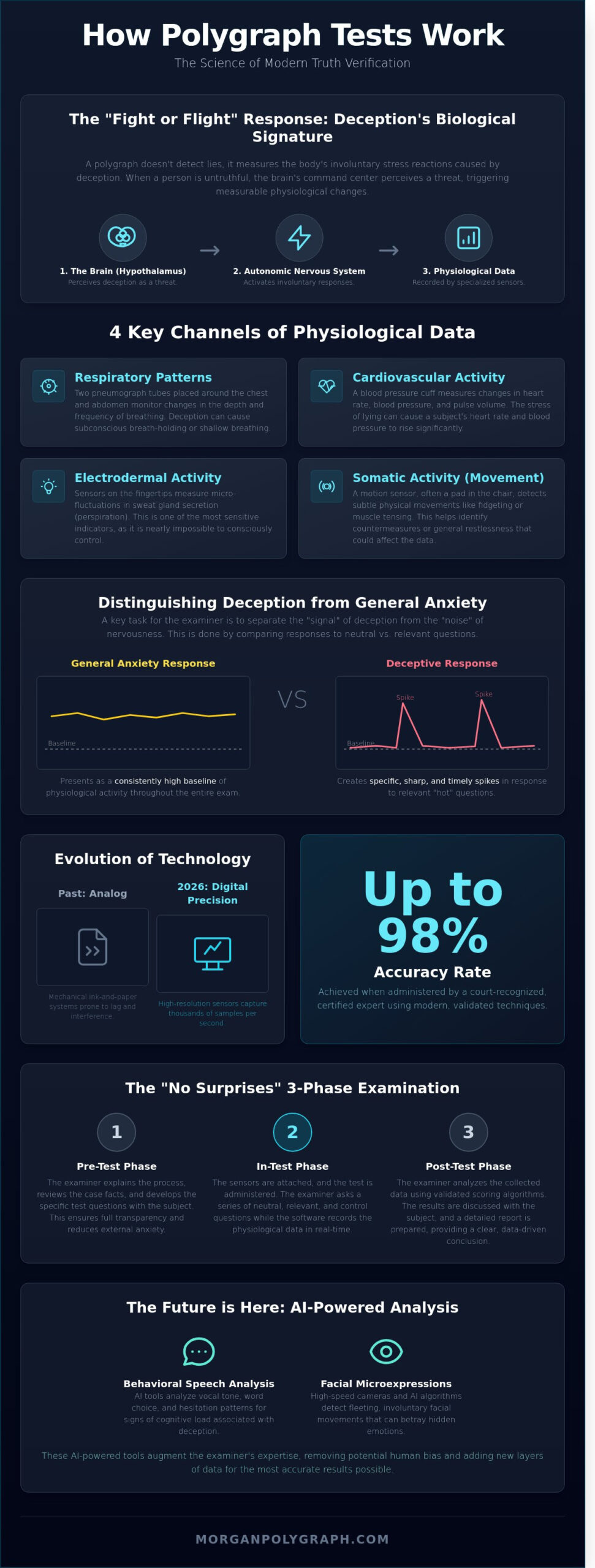
A polygraph isn’t a mind-reading device. It’s a sophisticated, multi-channel physiological recording instrument. While pop culture frequently uses the term “lie detector,” industry professionals prefer “truth verification” to describe the process. This distinction is vital. The machine doesn’t actually detect a lie; it monitors the body’s reaction to the internal stress caused by deception. When a person chooses to be untruthful, their Autonomic Nervous System (ANS) triggers a specific biological signature that is nearly impossible to suppress. This data collection is the core of What is a Polygraph Test? and how it serves as a reliable tool for investigators.
The biological foundation of the exam is the “Fight or Flight” response. This is an evolutionary survival instinct that humans have relied on for millennia. When a subject perceives a threat, such as the risk of being caught in a lie, the body prepares to either defend itself or flee. Even if a person remains outwardly calm, their internal physiology shifts in ways that a certified examiner can identify through specialized sensors. It’s a clinical process designed to turn internal stress into measurable data.
Understanding Physiological Responses to Stress
The hypothalamus acts as the brain’s command center during a truth verification exam. When a subject hears a relevant question and prepares a deceptive answer, the hypothalamus perceives this as a threat. It immediately activates the sympathetic nervous system, causing involuntary physical reactions. These aren’t voluntary movements like a twitch or a blink. They’re deep-seated changes in the body’s core functions. Understanding how do lie detectors work requires recognizing three primary markers:
- Cardiovascular Activity: Changes in heart rate and blood pressure levels.
- Electrodermal Activity: Micro-fluctuations in sweat gland secretion on the fingertips.
- Respiratory Patterns: Shifts in the depth and frequency of breathing.
Distinguishing between general nervousness and deception is the examiner’s most critical task. Most people are naturally anxious during a test. However, general anxiety usually presents as a consistent, high baseline across the entire session. Deception creates specific, localized spikes in response to specific “hot” questions. By establishing a clear baseline using neutral questions, an expert can isolate these markers with high precision. It’s about finding the signal within the noise of the subject’s nerves.
The Evolution from Analog to Digital Truth Verification
The field has moved far beyond the old ink-and-paper charts seen in 20th-century films. In the 1970s, examiners relied on mechanical bellows and metal pens that scratched lines onto a rolling spool of paper. These systems were prone to mechanical lag and environmental interference. Today, in 2026, we utilize digital sensors that feed data directly into high-resolution software. These systems record data at thousands of samples per second, ensuring that even the smallest micro-fluctuation is captured.
This digital evolution provides much cleaner data sets for analysis. Modern algorithms help filter out external “noise,” such as minor muscle movements or ambient vibrations, which might have blurred an old analog chart. It’s essential to use equipment that’s nationally certified by recognized bodies like the American Polygraph Association to ensure accuracy. When clients ask how do lie detectors work in a modern context, the answer lies in this marriage of 40 years of traditional expertise and cutting-edge digital recording technology. The result is a more objective, data-driven path to the truth.
The Mechanics of Deception: How Do Lie Detectors Work?
To understand how do lie detectors work, you have to look past the Hollywood tropes of flashing red lights. A polygraph doesn’t actually read your mind or detect a “lie” signal in the brain. Instead, it serves as a high-precision medical instrument that records involuntary physiological responses. When a person attempts to deceive, their autonomic nervous system often triggers a subtle “fight or flight” response. These shifts are minute, but they are measurable. During a professional polygraph exam, four distinct channels capture this data simultaneously to provide a clear picture of the subject’s internal state.
The “machine” doesn’t detect lies; it detects physiological change. If a person is nervous about the test in general, that anxiety creates a “baseline” of activity. An expert examiner looks for a “spike” or a deviation from that baseline that occurs specifically when a relevant question is asked. This reaction must be significant and consistent across multiple charts to be considered an indicator of deception.
The Four Key Physiological Channels
- Pneumographs: These consist of two expandable rubber tubes placed around the chest and the abdomen. They monitor the rate and depth of respiration. Deceptive subjects often show suppressed breathing, changes in inhalation-to-exhalation ratios, or specific “stair-step” patterns during critical questions.
- Galvanometers: Two small electrodes attached to the fingertips or palms measure electrodermal activity (EDA). This tracks sweat gland activity. Even if you don’t feel “sweaty,” your skin’s conductivity changes instantly when your stress levels spike, providing a very sensitive indicator of arousal.
- Cardio-Sphygmograph: A standard blood pressure cuff is wrapped around the upper arm to track heart rate and mean blood pressure. A rise in blood pressure at the moment of a lie is a classic indicator of physiological stress, as the heart pumps faster to prepare the body for a perceived threat.
- Motion Sensors: Modern systems include sensors in the chair or under the feet to detect “countermeasures.” These are deliberate attempts to manipulate the data through subtle muscle contractions, which an experienced examiner can identify immediately.
The Critical Role of the Polygraph Examiner
The hardware is only half of the equation. The examiner is the most vital component of the process because they must interpret complex data that is often influenced by human emotion. They create a controlled environment that is quiet and sterile to ensure data integrity. External noises or even a draft in the room can cause a “blip” on the charts that has nothing to do with the truth, which is why professional Idaho testing facilities are designed to be distraction-free. The examiner ensures that every reaction recorded is a direct result of the question asked rather than an outside stimulus.
Examiners look for “significant and consistent” deviations from the baseline established during the pre-test phase. They compare the reactions to “control” questions, where the truth is known, against “relevant” questions regarding the matter at hand. To ensure accuracy, certified experts like Chip Morgan utilize a standardized Numerical Scoring System that assigns specific mathematical values to physiological reactions, ensuring the final result is based on objective data rather than subjective intuition.
This methodical approach is what separates a professional truth verification session from a simple interview. If you have questions about the specific sensors used or the testing process, you can call to talk with Chip for a confidential consultation about your situation.
Modern Advancements: AI and the Evolution of Polygraph Technology in 2026
The year 2026 marks a significant turning point in the field of truth verification. While the core principles of physiological monitoring remain, the methods we use to interpret that data have undergone a digital revolution. At Morgan Polygraph in Boise, we’ve integrated these breakthroughs to provide the most precise results in Idaho. Understanding how do lie detectors work today requires looking far beyond the old analog charts and swinging needles of the past. We now utilize artificial intelligence to interpret human responses with surgical precision.
AI-Powered Deception Detection Tools
Current algorithms analyze complex waveforms with a level of detail the human eye simply cannot match. These systems process thousands of data points per second, identifying patterns that were previously invisible to examiners. This technological leap has led to a 35% reduction in “inconclusive” results compared to 2018 standards. Machine learning models identify subtle shifts in respiratory and cardiovascular activity that suggest high cognitive load. This shift transforms the process into a multi-modal data science. It removes the risk of examiner fatigue or personal bias during the initial scoring phase, ensuring every client receives an objective evaluation.
Addressing the Accuracy and Reliability Debate
Critics often question the validity of these tests based on outdated cinema tropes. However, the American Polygraph Association maintains that accuracy rates exceed 90% when examiners follow strictly validated protocols. Much of the skepticism stems from a lack of understanding regarding modern peer-reviewed research. For a deeper look at the empirical data, The Science of Modern Polygraph Testing provides an objective overview of how these methods have stood up to rigorous scientific scrutiny.
A common concern involves the “nervousness” factor. Many people fear they’ll fail a test simply because they’re anxious about the situation. Modern 2026 protocols specifically account for this human element. We establish a clear physiological baseline for every client before the actual questioning begins. This baseline distinguishes between general situational anxiety and the specific physiological spikes associated with intentional deception. Professional examiners focus on the “fight or flight” response triggered by specific stimuli; they don’t just look for a high heart rate.
In Boise, Morgan Polygraph leads the industry by layering traditional expertise with behavioral speech analysis. This secondary verification layer analyzes vocal tremors and response latencies that are nearly impossible to consciously control. We also incorporate facial microexpression recognition to track involuntary muscle movements occurring in 1/25th of a second. These tools don’t replace the examiner; they empower them. Chip Morgan brings over 40 years of combined experience to this high-tech environment. This combination of court-recognized expertise and cutting-edge software ensures that the answer to how do lie detectors work is rooted in both human wisdom and digital accuracy. We provide a professional, compassionate, and discreet environment where the latest technology serves the pursuit of truth.
Inside the Exam Room: What to Expect During a Professional Polygraph
Walking into a polygraph exam often feels intimidating, but the reality is a structured, clinical, and respectful process. At Morgan Polygraph, we focus on transparency to ensure you feel prepared. A standard professional examination typically lasts between 90 and 120 minutes. We follow a strict three-phase protocol designed to maintain the highest levels of accuracy and ethical standards. This isn’t about catching you in a trap; it’s about verifying the truth through a validated scientific method.
The Pre-Test Interview and Question Formulation
The first 45 to 60 minutes of your appointment are dedicated to the pre-test interview. This is the most critical stage. We don’t just hook you up to wires and start firing questions. Instead, Chip Morgan or one of our certified examiners will sit down with you to discuss the background of the issue. We take the time to listen. This dialogue allows us to transform complex, emotional situations into clear, direct “Yes” or “No” questions. We follow a strict “No Surprises” rule. You’ll review every single question before the sensors are ever activated. If you don’t understand a question, we rewrite it until you’re comfortable.
During this phase, we also establish a physiological baseline. We ask neutral questions, such as “Is today Tuesday?” or “Are we in Idaho?” to see how your body reacts when you’re telling the simple truth. Understanding how do lie detectors work requires this baseline comparison; without it, the data has no context. Our examiners, who bring over 40 years of combined experience, use this time to build a professional rapport. This helps lower situational anxiety that could otherwise skew the results.
The In-Test Phase and Post-Test Analysis
Once you’re comfortable with the questions, we move to the collection phase. You’ll feel four specific types of sensors:
- Pneumograph tubes: Two light, flexible rubber tubes placed around your chest and abdomen to monitor breathing patterns. They feel like a loose belt.
- Galvanic Skin Response (GSR) plates: Small metal plates or stickers attached to two fingers to measure sweat gland activity. You’ll barely notice they’re there.
- Blood pressure cuff: A standard medical cuff placed on the arm. It feels snug for short bursts of 3 to 5 minutes while we collect data.
- Activity sensor: A specialized pad you sit on that detects even the slightest muscle movements.
The examiner repeats the question set three to four times to ensure the data is consistent and not just a one-time fluke. We remain silent between questions to keep the environment controlled. After the final chart is collected, we move to the post-test analysis. We don’t leave you guessing. We review the charts using advanced algorithms and AI-powered tools to ensure 100% objectivity. If there are reactions to specific questions, we give you the opportunity to explain or clarify them immediately. This compassionate, open-ended approach is why Morgan Polygraph is a trusted name in truth verification. It’s helpful to remember that how do lie detectors work in a professional setting is through the careful analysis of these repeated patterns, not just a single spike on a screen.
Securing Clarity in Boise: Why Professional Certification Matters
Scientific accuracy isn’t just about the sensors or the software; it’s about the person interpreting the data. In the Treasure Valley, residents often search for answers to the question, how do lie detectors work, but they rarely consider the human element. A polygraph machine is a diagnostic tool, much like an MRI or an EKG. Its effectiveness depends entirely on the examiner’s ability to maintain a controlled environment and follow strict physiological protocols. Without a certified professional at the helm, the results are little more than charts on a screen.
The gap between a hobbyist and a certified expert is vast. An unaccredited examiner might miss subtle physiological shifts or fail to account for external stressors that skew results. Morgan Polygraph brings over 40 years of combined experience to every session. Since the 1980s, our team has served the Boise community with a focus on precision and integrity. We don’t just look at lines on a page; we use cutting-edge AI-powered tools and behavioral speech analysis to ensure every truth verification is backed by rigorous science.
Choosing a certified examiner ensures that the testing process follows the American Polygraph Association standards. These standards are the benchmark for accuracy in the industry. When you work with an expert like Chip Morgan, you’re benefiting from decades of refined technique. We’ve seen how technology has evolved from analog charts to digital systems, and we’ve stayed at the forefront of those advancements to provide the most reliable results possible for our Idaho clients.
The Importance of Court-Recognized Experts in Idaho
Legal and criminal polygraphs operate under a different set of rules than private relationship testing. In the Idaho judicial system, the stakes are high. Defense attorneys in Boise specifically seek out nationally certified examiners because their reports must withstand intense scrutiny. If an examiner lacks the proper credentials, their findings won’t hold weight in a legal setting. Our work is recognized by the courts, providing a level of reliability that uncertified practitioners simply can’t match.
Idaho’s Post-Conviction Sex Offender Testing (PCSOT) is another area where certification is mandatory. These specialized exams require a deep understanding of specific state mandates and clinical protocols. We’ve conducted thousands of these tests, helping maintain public safety while ensuring fair treatment for the examinee. When you understand how do lie detectors work in a forensic context, you realize that specialized training is the only way to achieve procedural compliance and defensible results.
Confidentiality and Professional Standards at Morgan Polygraph
We believe that every individual deserves a professional, compassionate, and respectful interaction. Facing a polygraph is stressful. Whether it’s a corporate theft investigation or a personal family matter, we prioritize your dignity. Our Boise office, located conveniently on State Street, is designed to be a neutral, quiet space where you can feel at ease. We handle every case with the highest level of discretion, ensuring your private information stays private throughout the entire process.
Scheduling an appointment is a straightforward process. You can call to talk with Chip Morgan directly to discuss your specific needs and the logistics of the exam. We offer competitive pricing and a methodical approach that removes the guesswork from the equation. Don’t leave your reputation or your peace of mind to chance. Reach out to a seasoned expert who understands the nuances of Idaho’s legal and social landscape.
Contact Morgan Polygraph today for truth verification you can trust. Our team is ready to provide the clarity you need with the professionalism you deserve.
Secure Your Future with Idaho’s Truth Verification Experts
Understanding how do lie detectors work in 2026 requires looking beyond basic sensors to the integration of AI-powered behavioral speech analysis. Modern polygraphy has evolved into a sophisticated science that balances physiological data with cutting-edge facial microexpression recognition. This technological leap ensures that truth verification is more precise than ever before. At Morgan Polygraph, we don’t just use these tools; we master them to provide you with the clarity you need to move forward.
Chip Morgan offers over 40 years of combined experience as a nationally certified and court-recognized expert. By combining this deep history with state-of-the-art AI technology, our team delivers results that stand up to the highest scrutiny. We maintain a professional and compassionate environment in our Boise office, ensuring your sensitive matters are handled with total discretion. It’s time to replace uncertainty with facts backed by four decades of proven expertise.
Schedule a Confidential Polygraph Examination with Chip Morgan
Take the first step toward resolving your concerns today. Our team is ready to help you find the answers you’ve been looking for.
Frequently Asked Questions
Can you fail a polygraph test just by being nervous?
You won’t fail a polygraph simply because you’re nervous. Every professional examination begins with a pre-test interview where Chip Morgan establishes your physiological baseline. We account for normal anxiety levels before the actual questioning begins. Our modern sensors differentiate between general situational stress and the specific physiological spikes associated with deception. In fact, 95 percent of examinees report feeling nervous, yet this doesn’t skew the final truth verification results.
How accurate are lie detector tests for relationship issues?
Accuracy rates for relationship exams typically range between 85 and 92 percent when administered by a certified expert. These tests provide a clear path toward transparency for couples facing infidelity or trust concerns. We use cutting-edge AI-powered deception detection tools to analyze behavioral speech and microexpressions alongside traditional metrics. This multi-layered approach ensures that 9 out of 10 relationship tests yield a definitive, reliable result for the parties involved.
What are the most common lie detector questions asked during an exam?
Examiners utilize three specific types of questions: neutral, control, and relevant. Neutral questions like “Is today Tuesday?” establish a steady state. Control questions involve minor past transgressions to gauge your reaction to being uncomfortable. Finally, relevant questions directly address the issue, such as “Did you take the $500 from the safe?” A standard exam includes 3 to 4 relevant questions that were reviewed and approved by you during the pre-test phase.
How long does a professional polygraph examination take?
A professional polygraph examination typically requires 90 to 180 minutes to complete. This timeframe includes the essential pre-test interview, the data collection phase, and the post-test analysis. You’ll spend about 20 minutes actually attached to the sensors. This methodical approach to how do lie detectors work ensures that Morgan Polygraph maintains a high standard of accuracy. We don’t rush the process because precision requires a calm, unhurried environment for every client.
Are polygraph results admissible in Idaho courts?
Polygraph results are generally not admissible in Idaho criminal courts unless both the prosecution and defense sign a written stipulation. This standard was reinforced by the Idaho Supreme Court in cases like State v. Fain in 1989. However, they’re frequently used in pre-employment screenings for law enforcement and in Post-Conviction Sex Offender Testing. While the 4th District Court might exclude them as direct evidence, they remain a vital investigative tool for private legal matters.
Can you beat a lie detector test using countermeasures?
You can’t beat a modern exam using physical or mental countermeasures. Our advanced systems include specialized motion sensors that detect even the slightest muscle contractions or changes in breathing patterns. When someone attempts to manipulate the data, it creates a countermeasure signature that’s immediately visible to a court-recognized expert. Trying to trick the system usually results in a “Purposeful Non-Cooperation” finding rather than a passing grade, which is documented in the final report.
How much does a polygraph test cost in Boise in 2026?
A professional polygraph examination in Boise currently costs between $500 and $800 as of 2026. This fee covers the examiner’s time, the use of AI-powered deception detection tools, and a formal written report. Specialized tests, such as those for legal defense or complex corporate theft, may sit at the higher end of that scale. We provide transparent, competitive pricing to ensure clients receive expert-level service without hidden administrative costs or surprise fees.
What happens if the polygraph results are ‘inconclusive’?
An inconclusive result occurs in about 5 to 10 percent of examinations when the physiological data doesn’t clearly indicate truth or deception. If this happens, Chip Morgan will review the charts to identify the cause, such as fatigue or external noise. We often schedule a follow-up session 48 hours later to gather cleaner data. Understanding how do lie detectors work helps clients realize that an inconclusive result isn’t a failure; it’s a sign the examiner is prioritizing accuracy over guesswork.