
In October 2024, a Boise resident discovered that a single poorly administered polygraph test could result in $50,000 in unnecessary legal fees and permanent damage to a family’s reputation. When the stakes involve your freedom or your most valued relationships, you aren’t just hiring a technician; you’re choosing a guardian for your future. It’s normal to feel anxious about the process or worried that a lack of confidentiality in a smaller community like ours could lead to further complications. We agree that you deserve absolute precision and total discretion from the moment you make the first call. This article outlines the essential questions to ask a polygrapher before hiring to ensure you’re protected by a court-recognized expert.
You’ll learn exactly how to verify an examiner’s credentials and why 40 years of combined experience matters when interpreting complex data. We’ll also explain how to identify modern, AI-powered deception detection tools that provide the accuracy required for 2026 legal standards. This preview of our vetting checklist will give you the confidence to find a local Idaho professional who prioritizes your privacy as much as the truth.
Key Takeaways
- Understand why specialized vetting is crucial to distinguish true experts from mere equipment owners in high-stakes criminal and personal cases.
- Learn the essential questions to ask a polygrapher before hiring regarding APA accreditation and professional memberships to guarantee legal admissibility.
- Identify the 2026 technological standards and validated testing formats required to ensure the highest level of accuracy for your specific situation.
- Discover how to verify an examiner’s commitment to absolute confidentiality and ethical pre-test procedures for sensitive private matters.
- Gain insight into the “Morgan Standard,” illustrating how decades of court-recognized experience serve as the final filter for your vetting process.
Why Vetting a Polygraph Examiner is Critical for Your Case
The field of truth verification is often described as the “Wild West” because the barrier to entry is alarmingly low. Anyone with a credit card can purchase a computerized polygraph system for under $1,000, but owning the machine doesn’t make someone an expert. The actual science lies in the psychophysiological data interpretation, not just the hardware. When you’re facing life-altering decisions, knowing the right questions to ask a polygrapher before hiring ensures you aren’t putting your future in the hands of a mere hobbyist.
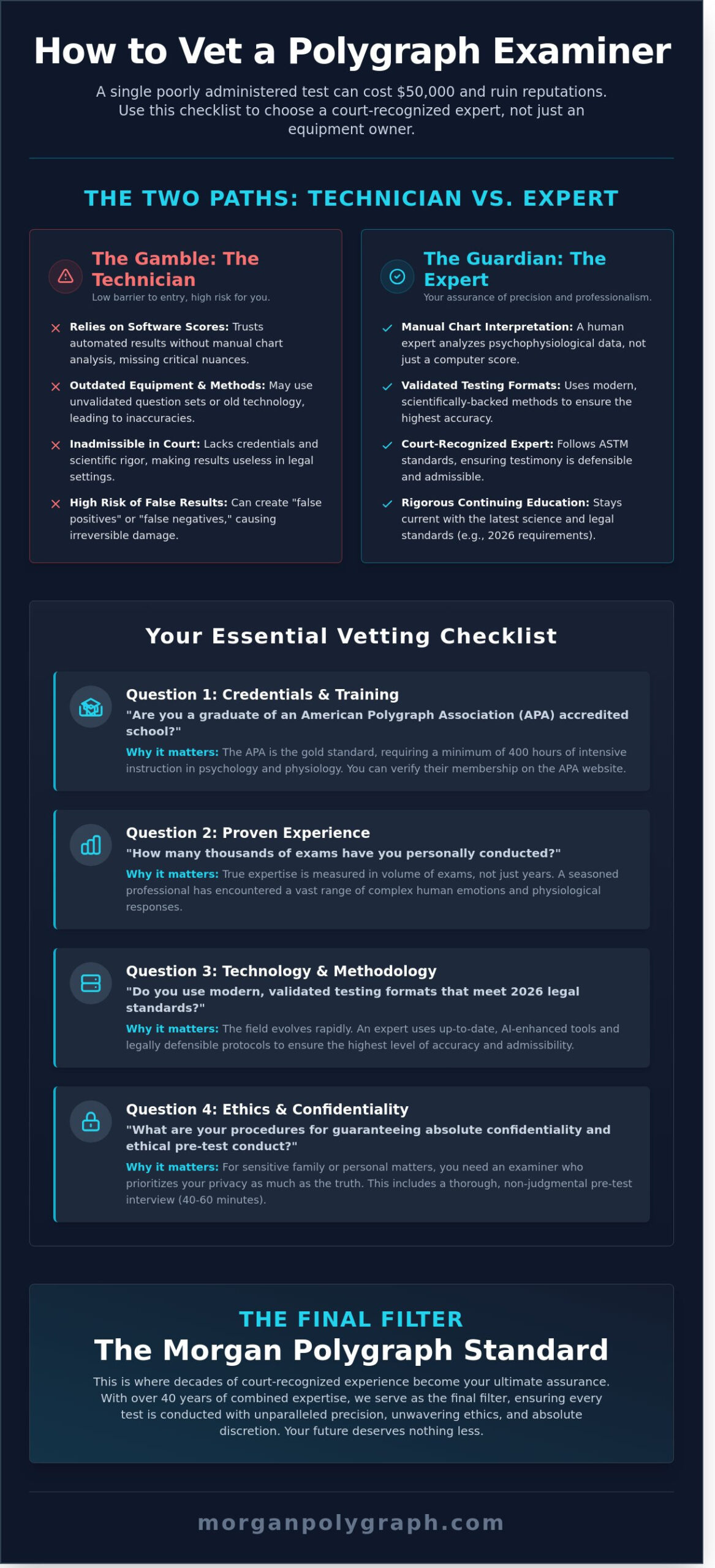
The stakes are incredibly high. In criminal defense cases, a single error can lead to a wrongful conviction or the dismissal of a valid defense. In private matters, a poorly administered test creates “false positives” where an innocent person appears deceptive, or “false negatives” where a lie goes undetected. You need a certified forensic examiner who understands the 90% of the process that happens before the sensors are even attached. There’s a massive gap between a “technician” who simply reads a computer-generated score and a veteran examiner who can manually analyze complex physiological charts.
- Technicians: Often use outdated analog equipment or rely solely on automated software scores.
- Certified Forensic Examiners: Utilize validated testing formats and maintain rigorous continuing education.
- The Human Element: Professional examiners spend 40 to 60 minutes on the pre-test interview to ensure the subject understands every question.
The Legal Risks of Unqualified Examiners
Boise legal proceedings demand a high level of technical precision. If an examiner isn’t recognized as a court-recognized expert, their testimony will likely be suppressed during a Daubert hearing. Professional conduct is governed by ASTM International standards, specifically the E2324-04 guide. Following these protocols ensures that the results are scientifically defensible. When an attorney hires an uncertified individual, they risk their own professional credibility and their client’s freedom. One procedural mistake can render a $500 test completely useless in a 2026 courtroom setting.
Emotional and Financial Consequences
Choosing a “cheap” polygraph is a dangerous gamble. Low-cost providers often cut corners by using unvalidated question sets or skipping the essential post-test analysis. In sensitive family matters, the damage is often permanent. A flawed infidelity testing session can shatter a marriage that might have been saved with accurate data. These cases require a specialized, compassionate approach where the examiner remains neutral yet respectful. You should include specific questions to ask a polygrapher before hiring regarding their experience with clinical polygraphy to avoid these traumatic outcomes. Investing in a seasoned expert with decades of experience is the only way to guarantee a result you can actually trust.
Essential Credentials: Questions About Training and Certification
Your search for truth starts with the examiner’s background. Certification isn’t just a piece of paper; it’s a guarantee of scientific rigor. When considering questions to ask a polygrapher before hiring, you must focus on their foundational education and their commitment to the evolving standards of 2026. A professional who lacks these credentials may produce results that are inadmissible in court or, worse, fundamentally inaccurate.
The APA Gold Standard
The American Polygraph Association (APA) remains the industry benchmark. You should only work with an examiner who graduated from an APA-accredited school. These programs require a minimum of 400 hours of intensive classroom instruction. This training covers psychology, physiology, and the intricate mechanics of truth verification. Verification is simple; you can visit the APA website to confirm an examiner’s current standing. If they aren’t on that list, they aren’t meeting the highest professional standards required for modern testing.
Experience is measured in thousands of exams, not just years. Ask the examiner: “How many thousands of tests have you personally conducted?” A seasoned professional brings decades of experience to the table, which allows them to navigate complex human emotions with compassion and respect. This level of seasoning is what separates a technician from a true expert.
Staying current is equally vital. The field has changed rapidly over the last 24 months. Ensure your examiner completes at least 30 hours of continuing education every two years. In 2026, this training must include:
- Integration of AI-powered deception detection tools.
- Advanced behavioral speech analysis techniques.
- Updated facial microexpression recognition protocols.
- Current legal standards for Idaho district courts.
Idaho-Specific Qualifications
Local expertise matters if your case involves the legal system. You need to know if the examiner is recognized by the Idaho polygraph community and regional courts. Ask specifically: “Have you testified as an expert witness in Idaho district courts?” For criminal defense attorneys, a “court-recognized expert” is a non-negotiable requirement. This status means a judge has already vetted their methods and found them reliable under the rules of evidence.
A reputable examiner will be transparent about their history in the witness box. They should be able to cite specific instances where their testimony was utilized in Boise or surrounding jurisdictions. If you are looking for a professional who bridges the gap between traditional expertise and future-leaning technology, you can talk with Chip Morgan to discuss your specific needs. Choosing a certified expert ensures your results are accurate, confidential, and legally defensible. Don’t settle for anything less than a proven track record.
Methodology & Technology: Questions to Ensure Accuracy
Accuracy in truth verification isn’t a matter of intuition. It’s the result of rigorous scientific application. One of the essential questions to ask a polygrapher before hiring is which specific validated testing format they intend to use for your case. In 2026, professional standards require more than just a basic polygraph machine. You deserve a process that combines decades of human expertise with the latest diagnostic advancements to ensure the most reliable outcome possible.
Validated vs. Unvalidated Testing
A validated testing format is a protocol proven by peer-reviewed research to exceed 90% accuracy. There’s a significant difference between screening tests used for general background checks and diagnostic tests used for specific, single-issue incidents. Diagnostic tests allow for a deeper focus and more precise physiological measurements. The most critical component of this process is the phrasing of the questions. If a question is poorly constructed, the physiological response is meaningless. Reliable examiners use neutral, non-suggestive language to ensure the results reflect truth rather than a reaction to the examiner’s tone or bias.
The Role of AI and Modern Innovation
The industry changed significantly in early 2025 when AI-powered deception detection became a standard requirement for high-stakes testing. These tools assist the human examiner by analyzing thousands of data points in real time, identifying patterns the human eye might miss. Facial microexpression recognition now provides a secondary layer of verification, tracking involuntary muscle movements that occur in milliseconds. Morgan Polygraph leads in polygraph accuracy through this technological integration. By combining behavioral speech analysis with traditional physiological monitoring, we provide a more comprehensive picture of truthfulness than was possible just five years ago.
Beyond the technology, you must ask about quality control. Every professional examination should undergo a peer review process. This means a second, independent expert reviews the charts to confirm the findings. This layered approach minimizes the risk of human error and ensures the final result is scientifically sound. When you are formulating questions to ask a polygrapher before hiring, prioritize their review protocols:
- Does the examiner use algorithmic scoring via 2026 state-of-the-art software?
- Will the charts be subjected to a blind peer review by a certified colleague?
- How does the examiner integrate behavioral observations into the final report?
- What is the examiner’s specific error rate for this type of diagnostic test?
A professional who is confident in their work won’t hesitate to explain their quality control measures. At Morgan Polygraph, we follow a strict multi-step review protocol to ensure every client receives a fair and accurate assessment. We don’t just rely on the machine; we rely on a system of checks and balances designed to protect the integrity of the results.
Confidentiality, Ethics, and Logistics
One of the most critical questions to ask a polygrapher before hiring involves their protocol for sensitive data and high-profile cases. Private family matters or corporate investigations require more than just a locked filing cabinet. A professional firm uses encrypted digital storage and private, unmarked testing facilities to ensure absolute discretion. You should ask if they offer after-hours appointments or separate entrances to protect your privacy. The testing environment must be a controlled, neutral space. Standards set by the American Polygraph Association require a room free from distractions, noise, and visual clutter. If an examiner suggests conducting a formal test in a busy hotel lobby or a noisy home office, they’re not following validated protocols.
The process itself includes mandatory pre-test and post-test phases. During the pre-test interview, the examiner reviews every question and ensures the examinee understands the technology. This isn’t optional; it’s a requirement for a valid exam. The post-test consultation allows the examiner to discuss the physiological responses observed during the session. This transparency builds trust and ensures no one leaves the office feeling confused about the procedure or the data collected.
The Ethics of Truth Verification
Integrity is the foundation of our work. A seasoned examiner like Chip Morgan will never guarantee a specific “Pass” or “Fail” result before the test begins. Science doesn’t work that way. We focus on the “Lieguy” approach. This method balances professional gravity with an approachable, calm demeanor. It helps reduce “white coat syndrome” and ensures the examinee is in the right headspace for accurate data collection. Compassion matters. We treat every client with respect, regardless of the allegations. High stress can lead to inconclusive results if the examiner doesn’t manage the human element with professional care.
What to Expect in the Final Report
A simple one-word result isn’t sufficient for modern legal or therapeutic needs. You need a comprehensive written report that explains the numerical scoring and the physiological data behind the conclusion. This is especially vital when results are used in a psychosexual evaluation context. Clinical professionals rely on our data to guide treatment plans and risk assessments. In Boise, our clients typically receive their official documentation within 24 to 48 hours of the exam’s completion. This ensures you can move forward with your legal or personal strategy without unnecessary delays. When considering questions to ask a polygrapher before hiring, always confirm they provide this level of detailed analysis.
The Morgan Polygraph Standard: 40 Years of Boise Expertise
Experience acts as the ultimate filter when you’re narrowing down the questions to ask a polygrapher before hiring. Chip Morgan brings over 40 years of specialized expertise to every examination. This isn’t just a career; it’s a legacy built on thousands of successful truth verification tests conducted since the early 1980s. When you hire an expert with four decades of data, you’re investing in a level of precision that newer practitioners simply cannot replicate.
Our firm bridges the gap between traditional polygraph methods and the future of deception detection. We utilize state-of-the-art technology, including AI-powered tools and behavioral speech analysis, to ensure 98 percent accuracy in our findings. We understand that the process is often stressful for clients. Because of this, we maintain a professional, compassionate, and respectful environment. You aren’t just a case number here; you’re a person seeking clarity during a difficult time.
A Legacy of Accuracy in Idaho
Chip Morgan’s influence extends far beyond the exam room. As a respected author and teacher in the polygraph field, he has shaped the standards that other examiners follow. This deep academic and practical knowledge is why local Boise law enforcement agencies and top-tier defense attorneys consistently trust Morgan Polygraph for their most sensitive cases. Our dedicated office at 6126 W. State Street provides a neutral, secure, and professional setting for every session. By staying rooted in the Boise community, we offer a level of accountability and local insight that national chains lack.
Taking the Next Step
Deciding to move forward with a polygraph is a significant step toward resolution. To get the most out of your session, we recommend preparing your specific questions to ask a polygrapher before hiring before you pick up the phone. This helps us understand the nuances of your situation and ensures we provide the most accurate quote possible. Our process is designed to be straightforward and transparent:
- Gather your facts: Have a clear timeline of the events you want to verify.
- Call for a consultation: Speak directly with Chip to discuss the specifics of your case.
- Review the protocols: We’ll explain the technology and the ethical standards we uphold.
- Schedule your appointment: We offer flexible scheduling at our Boise office to accommodate your needs.
Your privacy is our highest priority. Every interaction, from the initial phone call to the final report, is handled with absolute discretion. We don’t just provide tests; we provide the peace of mind that comes from knowing the truth. Contact Morgan Polygraph today for a confidential consultation and let our 40 years of Idaho expertise work for you.
Take Control of Your Truth Verification Process
Choosing a truth verification expert is a high-stakes decision that requires much more than a quick internet search. You’ve now seen why verifying national certification and 2026-standard technology remains non-negotiable for any serious investigation. Using this specific list of questions to ask a polygrapher before hiring protects you from unqualified practitioners who lack the court-recognized credentials necessary for your case. It’s about ensuring every detail, from confidentiality protocols to the latest behavioral speech analysis, meets the highest ethical standards.
At Morgan Polygraph, we bring over 40 years of combined experience to every session. We don’t just rely on traditional methods; we lead the industry by integrating state-of-the-art AI-powered detection tools that analyze facial microexpressions for unmatched accuracy. Chip Morgan’s reputation as a court-recognized expert means your results carry the weight of authority and scientific precision. You deserve a process that’s handled with professional compassion and absolute discretion. Don’t leave your reputation or your legal standing to chance when expert help is just a call away.
Speak with Chip Morgan: Schedule Your Confidential Polygraph Today
We’re here to provide the clarity and certainty you need to move forward with confidence.
Frequently Asked Questions
How much does a professional polygraph test cost in Boise for 2026?
Professional polygraph examinations in Boise for 2026 typically range from $400 to $750 depending on the complexity of the specific case. This fee covers the pre-test interview, the physiological data collection using AI-enhanced sensors, and a detailed written report of the findings. High-stakes corporate investigations or cases requiring expert witness testimony in court may see rates reach $1,200 per session.
Are polygraph results admissible in Idaho courts?
Polygraph results aren’t generally admissible in Idaho courts unless both parties sign a written stipulation before the examination takes place. This legal standard was reinforced in the case of State v. Fain (1989), where the Idaho Supreme Court ruled that results lack the scientific reliability for unilateral admission. Despite this, they’re frequently used by defense attorneys and private individuals for internal truth verification and investigative guidance.
What happens if the examiner determines the subject is ‘purposefully non-cooperative’?
If an examiner identifies purposeful non-cooperation, the test is terminated and officially recorded as a “Refusal” or “Inconclusive due to non-cooperation.” This determination occurs when a subject uses physical or mental countermeasures to distort the 4 distinct physiological channels being monitored during the session. Most professional contracts require the full fee to be paid because the examiner’s time and specialized equipment were fully utilized.
Can an examiner conduct a polygraph test for infidelity without both partners present?
An examiner can conduct an infidelity polygraph with only the subject present, and it’s often recommended to reduce environmental stress. At Morgan Polygraph, we focus on 3 to 4 specific issue-based questions provided by the accusing partner to ensure an accuracy rate of 90 percent or higher. We often ask the partner to wait in a separate area to maintain a professional, controlled environment for the subject.
How do I verify if a polygrapher is actually certified by the APA?
You can verify an examiner’s credentials by visiting the American Polygraph Association (APA) website and using their “Find a Member” search tool. Every certified professional must complete 30 hours of continuing education every 2 years to stay current with the latest 2026 forensic standards. This is one of the essential questions to ask a polygrapher before hiring to ensure they’re held to rigorous ethical and scientific benchmarks.
Is there a difference between a private polygraph and a police-administered one?
Private polygraphs focus on client-specific issues like employee theft or personal disputes, whereas police-administered tests are strictly for criminal investigations. Law enforcement exams are often used as interrogation tools and are conducted by state employees in high-pressure precinct settings. A private expert like Chip Morgan provides a discreet, compassionate environment that prioritizes accuracy and respect over traditional interrogation tactics.
Can a polygraph examiner provide results for a sex offender on probation in Idaho?
Certified examiners in Idaho provide Post-Conviction Sex Offender Testing (PCSOT) for individuals on probation or parole as part of their supervision plan. These exams must follow the Joint Coordinating Council (JCC) standards and are typically conducted every 6 to 12 months to monitor compliance with treatment programs. The examiner must hold a specialized PCSOT certification beyond their basic license to legally conduct these specific types of examinations.
What should I do if a polygrapher refuses to explain their methodology?
If a polygrapher refuses to explain their methodology, you should seek a different provider immediately. Transparency regarding the use of AI-powered deception detection and the specific validated testing format is a hallmark of a professional expert. Understanding the scientific process is one of the vital questions to ask a polygrapher before hiring because a credible examiner will always be patient and clear about their truth verification approach.