

A deposition is the worst possible time to discover that your key witness’s story doesn’t hold up under professional scrutiny. Every Nampa attorney understands the frustration of investing months into a case only to have it compromised by a witness who becomes unreliable or inconsistent during formal testimony. You’ve likely dealt with the uncertainty of whether a client’s account is entirely accurate or if a critical witness might ‘flip’ when faced with aggressive questioning. This risk doesn’t just threaten your case; it wastes valuable firm resources and weakens your position at the negotiating table.
Using a polygraph to test witness veracity before deposition Nampa provides a methodical way to verify credibility before it’s too late. By integrating this data-driven technology into your pretrial strategy, you gain a clear understanding of a witness’s truthfulness. This approach offers better leverage during settlement negotiations and provides the confidence required to build a winning case. In the following sections, we’ll examine how these discreet examinations serve as a professional veracity filter, giving you the calm, collected edge needed to navigate complex legal matters in Canyon County.
Key Takeaways
- Understand how Nampa litigators use polygraphs as a “veracity filter” to navigate the Idaho legal system with greater precision and foresight.
- Learn why using a polygraph to test witness veracity before deposition Nampa creates a “veracity shield” that provides critical leverage during settlement negotiations.
- Clarify the distinction between court admissibility and pretrial utility to effectively use polygraph results even in cases without a formal stipulation.
- Discover the specific “Relevant/Irrelevant” testing methodology used to ensure witness statements remain consistent under the pressure of formal discovery.
- Identify the importance of selecting examiners who adhere to American Polygraph Association standards to ensure reports meet the highest professional benchmarks in Canyon County.
Role of Polygraphs in Verifying Witness Veracity in Nampa
In Idaho’s legal framework, witness veracity testing is a specialized investigative procedure designed to evaluate the truthfulness of statements before they’re entered into the official record. Nampa litigators increasingly rely on this tool to manage the risks inherent in formal discovery. While the Role of Polygraphs in Verifying Witness Veracity is often debated in terms of courtroom admissibility, its primary value for defense teams lies in the pretrial phase. A polygraph to test witness veracity before deposition Nampa acts as a rigorous “stress test” for a client’s or witness’s narrative. It identifies inconsistencies that could prove fatal during cross-examination. By distinguishing between investigative polygraphs and trial evidence, attorneys can use these results to shape their strategy without the immediate pressure of a judge’s ruling on admissibility.
Why Credibility Matters Before the Deposition
The financial and strategic cost of a witness changing their story on the record is immense. In Canyon County, a deposition often serves as the “trial before the trial,” where the strength of a witness can either accelerate a favorable settlement or lead to a total case collapse. Identifying “weak links” in a multi-witness case early on is essential for resource management. If a key witness’s story doesn’t hold up under a controlled polygraph examination, it’s better to know that before they’re under oath in a court reporter’s office. This foresight prevents the wasting of firm resources on testimony that won’t withstand scrutiny.
Veracity Testing vs. Traditional Witness Interviews
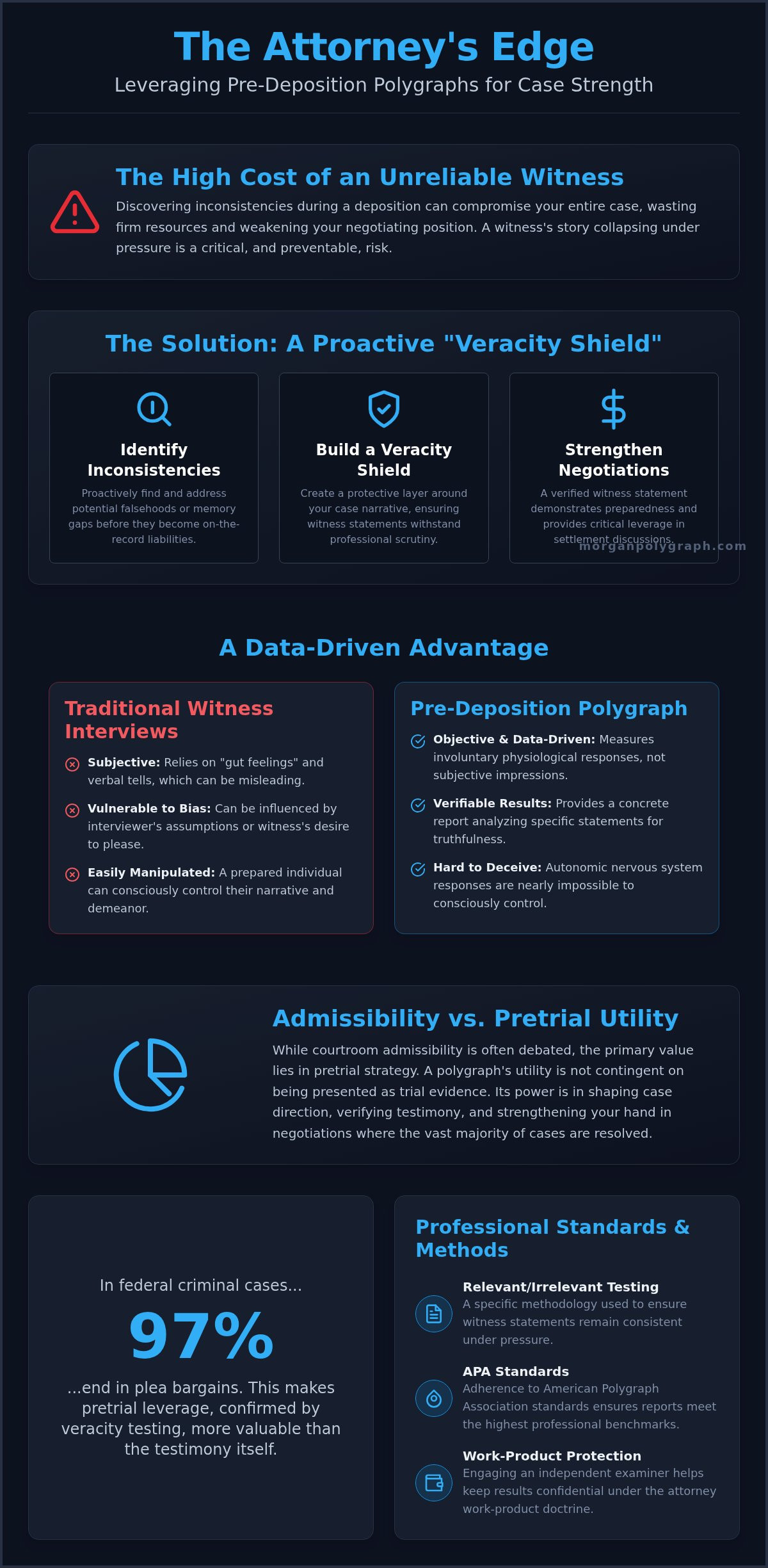
Experienced Nampa litigators know that verbal “tells” or gut feelings aren’t enough to guarantee a witness’s reliability. Traditional interviews are subjective and can be influenced by the interviewer’s bias or the witness’s desire to please. Professional polygraphy offers a distinct physiological data advantage. It records autonomic responses that are nearly impossible to consciously manipulate. Using these data-driven results allows an attorney to refine their deposition questioning strategy with surgical precision. You can focus on verified facts while preparing to mitigate or avoid areas where the witness showed significant physiological reactivity. This methodical approach ensures you aren’t walking into a deposition with blind spots that the opposing counsel will undoubtedly exploit.
Because roughly 97% of federal criminal cases end in plea bargains, the leverage gained from a verified witness statement is often more valuable than the testimony itself. In civil matters, a high-quality polygraph report can be the catalyst for a settlement, as it demonstrates to the opposing side that your evidence has already survived a professional veracity filter.
Strategic Advantages of Pre-Deposition Polygraph Testing
Integrating a polygraph to test witness veracity before deposition Nampa allows a legal team to construct a “veracity shield” around their core narrative. This proactive step identifies deceptive witnesses long before they can be exposed by opposing counsel during formal discovery. When a witness passes a professionally administered exam, it often provides a significant psychological boost. They enter the deposition room with a level of calm, collected confidence that is difficult to shake. Conversely, if an examination reveals inconsistencies, the attorney can pivot their strategy in private, avoiding the public and legal fallout of a witness “flipping” on the record. This risk management is essential in Nampa’s competitive legal environment.
While many focus on the courtroom, the real power of these examinations lies in Navigating Idaho Legal Standards during the pretrial phase. This is especially true for Nampa civil suits where settlement terms are often dictated by the perceived credibility of the parties involved. Utilizing a polygraph to test witness veracity before deposition Nampa ensures that you aren’t blindsided by your own witness’s hidden vulnerabilities.
Protecting the Attorney-Client Privilege
Maintaining the confidentiality of results is a top priority for any defense team. To ensure these findings remain protected under the work-product doctrine in Idaho, it’s essential to hire an independent examiner. By engaging a specialist at Morgan Polygraph, attorneys can manage the distribution of reports with total discretion. This independence helps prevent the results from being easily discoverable by the opposition, keeping the tactical advantage firmly in your hands. A methodical approach to report handling ensures that sensitive data-driven observations stay within the defense’s inner circle until they’re strategically deployed.
Leverage in Plea Bargaining and Settlements
In the high-stakes environment of Canyon County litigation, truth verification serves as a powerful bargaining chip. Presenting exculpatory polygraph results to Nampa prosecutors can lead to dismissed charges or significantly reduced plea offers. Given that 97% of federal criminal cases end in plea bargains, these reports provide the objective data needed to influence a prosecutor’s decision-making process. A passed exam effectively shifts the burden of proof during negotiations, forcing the opposing side to reconsider the strength of their own evidence. This leverage is particularly effective when the case hinges on a “he-said, she-said” scenario where objective physiological data can break the deadlock.
Admissibility vs. Utility: Navigating Idaho Legal Standards
A frequent hurdle for Nampa litigators is the assumption that polygraph results are legally irrelevant because they aren’t automatically admissible in court. Under the Idaho Administrative Code, effective July 1, 2024, polygraph results are inadmissible unless all parties involved stipulate to their entry into the record. However, labeling these examinations as “inadmissible” misses the broader point of pretrial strategy. A polygraph to test witness veracity before deposition Nampa isn’t just about the trial; it’s about the intelligence gathered during the investigative phase. Understanding the Strategic Advantages of Pre-Deposition Polygraph Testing involves looking past the courtroom doors to the negotiation table where most cases are actually decided. If you wait for a judge’s ruling to verify your witness, you’ve already lost the opportunity to control the narrative.
The Daubert Standard and Idaho Rule 702
Idaho courts follow a reliability standard similar to the federal Daubert standard, governed by Idaho Rule 702. Nampa judges serve as gatekeepers, ensuring that any expert testimony is based on sufficient facts and reliable methods. When a defense team uses a court-recognized examiner, they’re preparing for the possibility of a stipulation. Even if the results never reach a jury, the methodical nature of the exam provides a professional benchmark for witness credibility. This level of precision is vital when navigating the high-stakes environment of Canyon County litigation. It ensures that the defense isn’t relying on subjective impressions but on data-driven observations that meet rigorous professional benchmarks.
Investigative Utility in Canyon County Cases
The utility of a polygraph in the Treasure Valley often manifests in dropped charges or favorable settlements long before a trial date is set. Prosecutors and opposing counsel are often willing to review veracity reports from nationally certified examiners, even without a formal stipulation. These reports provide a data-driven “reality check” that can shift the momentum of a case. Statements made by a witness “incident to” the exam—meaning during the pre-test or post-test interview—are often admissible and can be used to lock in a narrative. This is a critical tactical advantage. To understand the science behind these results, you can explore the question: Are Polygraphs Accurate? This factual look at reliability helps bridge the gap between scientific methodology and legal application. By using these tools, Nampa attorneys can ensure their case strategy is built on a foundation of verified truth rather than uncertain testimony.
Preparing a Witness for a Pre-Deposition Polygraph in Nampa
Success in veracity testing begins long before the sensors are attached. For a polygraph to test witness veracity before deposition Nampa, the preparation phase is critical to ensure that physiological data reflects truth rather than unmanaged stress. Attorneys should frame the request as a tool for “truth fortification.” This positions the exam as a way to verify the witness’s account so it can be defended more vigorously during cross-examination. By focusing on the scientific nature of the process, you remove the personal sting of the request and emphasize the tactical advantage it provides the entire legal team.
Humanizing the Process for the Witness
Many witnesses harbor fears based on popular “mind reading” myths or concerns about privacy. It’s the examiner’s responsibility to create a professional, neutral environment that prioritizes respect and discretion. We explain that the technology doesn’t read thoughts; it records autonomic responses to specific, pre-reviewed questions. This transparency reduces the situational anxiety that can lead to “false positives.” Our examiners are seasoned experts who understand the human stress involved in legal proceedings, ensuring the witness feels they are in capable, trustworthy hands.
Selecting the right questions is a specialized art form. We utilize validated formats, such as the “Relevant/Irrelevant” test, to establish a physiological baseline. Relevant questions are direct and focused on the specific facts of the case, while irrelevant questions serve to stabilize the readings. This methodical approach ensures that every response is evaluated against a clean data set, providing the precision required for high-stakes litigation in Canyon County.
Logistics for Nampa and Treasure Valley Clients
While our primary suite is located in Boise, we serve the entire Treasure Valley, including Nampa and the surrounding areas. The travel from Nampa is straightforward, and we provide precise instructions for engagement to ensure the process remains unhurried. The pre-test interview is a mandatory phase where the examiner and witness review every question in detail to ensure complete understanding and eliminate any surprises during the actual recording. This phase is essential for establishing the rapport and clarity needed for an accurate examination.
The typical timeline from booking to receiving a discreet professional report is efficient, usually completed within a few business days. This allows Nampa defense teams to integrate the findings into their case strategy without delaying the discovery schedule. If you’re ready to verify your witness’s credibility with data-driven precision, contact our office to schedule a professional examination for your next case.
Why Morgan Polygraph is the Trusted Choice for Nampa Litigators
Morgan Polygraph stands as the primary resource for Canyon County legal teams seeking high-precision veracity testing. Our firm bridges the gap between traditional experience and futuristic technology, ensuring every result is backed by data-driven methodology. We maintain a strict commitment to the American Polygraph Association’s highest standards, which is a key indicator of professionalism in a field that requires absolute precision. For decades, our lead practitioners have worked alongside Idaho defense attorneys and law enforcement, building a reputation for reliability and academic gravitas. This deep industry recognition makes us the preferred choice for those who need a polygraph to test witness veracity before deposition Nampa.
Expertise You Can Rely On in Court
Our examiners aren’t just technicians; they’re nationally certified and court-recognized experts. This standing is vital when your case strategy depends on the credibility of a report. We provide discreet, professional documentation that is structured for maximum impact within a legal file. Every report we issue serves as a clear, declarative statement, detailing the physiological data and behavioral observations recorded during the exam. For a deeper look at the methodology we employ, you can review our Polygraph Examination: A Complete Guide. This resource explains how we maintain a neutral, clinical environment that minimizes witness stress while maximizing accuracy.
A Partner in Your Legal Strategy
We view our role as more than just a service provider; we’re a strategic partner in your litigation process. Beyond the raw data, we offer insights into witness behavior that can help you refine your approach to cross-examination or settlement discussions. Our methodical approach ensures that you aren’t surprised by witness inconsistencies during a formal deposition. We also recognize that the legal world moves quickly. To support Nampa attorneys facing tight discovery deadlines, we offer flexible scheduling and efficient turnaround times for our final reports. This agility allows you to make informed decisions without delaying your case’s progress. If you’re ready to secure a tactical advantage for your next case, Contact Morgan Polygraph to schedule a witness veracity test. We’re here to help you navigate your most sensitive legal challenges with calm, collected confidence.
Secure Your Tactical Advantage in Canyon County Litigation
Integrating high-level veracity testing into your pretrial workflow transforms uncertainty into a strategic asset. By verifying witness accounts before they’re entered into the formal record, you protect your case from deposition-day surprises and strengthen your position during settlement talks. Utilizing a polygraph to test witness veracity before deposition Nampa ensures that your strategy is built on a foundation of data-driven truth rather than subjective interviews. This proactive approach identifies potential vulnerabilities in private, allowing you to pivot your strategy with total discretion.
Morgan Polygraph provides the specialized expertise necessary for high-stakes legal matters. Our Nationally Certified Examiners and Court-Recognized Experts utilize state-of-the-art technology to deliver discreet, professional reports that meet the rigorous demands of Idaho’s legal system. This methodical approach allows you to move forward with the calm, collected confidence that comes from knowing exactly where your evidence stands. You don’t have to leave witness reliability to chance when objective physiological data is available.
Take the next step in fortifying your case strategy. Schedule a Confidential Witness Veracity Test Today and ensure your testimony is prepared for the scrutiny of formal discovery. We look forward to partnering with your firm to achieve the best possible outcomes for your clients.
Frequently Asked Questions
Are polygraph results admissible in Nampa, Idaho courts?
Polygraph results are generally inadmissible in Idaho courts unless all parties involved formally stipulate to their entry into the record. This standard is based on the Idaho Administrative Code updated as of July 1, 2024. While they aren’t an automatic trial tool, their primary value in Nampa lies in pretrial discovery, where they serve as a powerful veracity filter for attorneys preparing for depositions or settlement negotiations.
How long does a pre-deposition polygraph exam take?
A professional legal examination typically requires between two and three hours to complete in its entirety. This time frame allows for a comprehensive pre-test interview, the actual data collection phase, and a preliminary analysis of the physiological charts. We ensure the rhythm of the exam is deliberate and unhurried to maintain the highest levels of precision and witness comfort during the process.
Can a witness be forced to take a polygraph in a civil case?
No, a witness cannot be legally compelled or forced to undergo a polygraph examination in an Idaho civil or criminal matter. Participation must be strictly voluntary. Most Nampa litigators frame the request as a strategic opportunity for the witness to verify their account and build the necessary confidence before they’re subjected to aggressive questioning by opposing counsel during a formal deposition.
What happens if my witness fails the polygraph before the deposition?
If an examination reveals inconsistencies or indicates deception, the results stay private within the defense team’s inner circle. Because the findings are typically protected under the work-product doctrine, you can pivot your case strategy or re-evaluate the witness’s role before they’re placed under oath. This allows you to identify “weak links” in your case without the risk of public exposure or legal fallout.
Are polygraph results protected by attorney-client privilege in Idaho?
Yes, when a defense attorney engages an independent examiner to conduct a polygraph to test witness veracity before deposition Nampa, the results are generally protected as attorney work-product. This legal shield ensures that the findings remain confidential and are not automatically discoverable by the prosecution or opposing counsel. Maintaining this level of discretion is a central theme of our professional legal services.
Can medications or medical conditions affect the veracity test results?
Certain medical conditions or medications that significantly alter autonomic responses like heart rate or blood pressure can potentially influence the data. Our examiners conduct a methodical pre-test interview to identify any physiological factors that might interfere with the accuracy of the readings. We prioritize the human element by ensuring the witness is in a suitable physical and mental state before the data collection begins.
How much does a professional legal polygraph cost in the Boise-Nampa area?
The cost for a specialized legal polygraph varies depending on the complexity of the case and the specific testing protocols required. We provide custom quotes that reflect the specialized skill and state-of-the-art technology used in our Boise-area suite. Attorneys should contact our office directly for a professional consultation to discuss the logistical details and pricing for their specific witness verification needs.
What is the accuracy rate of modern polygraph technology in 2026?
Modern polygraphy utilizes innovative, data-driven methodologies that consistently demonstrate high reliability when administered by nationally certified experts. While no investigative tool is absolute, research recognized by the American Polygraph Association shows that validated testing formats provide a highly accurate assessment of truthfulness. Our commitment to using the latest technical advancements ensures that Nampa defense teams receive the most precise veracity reports available in the industry.