
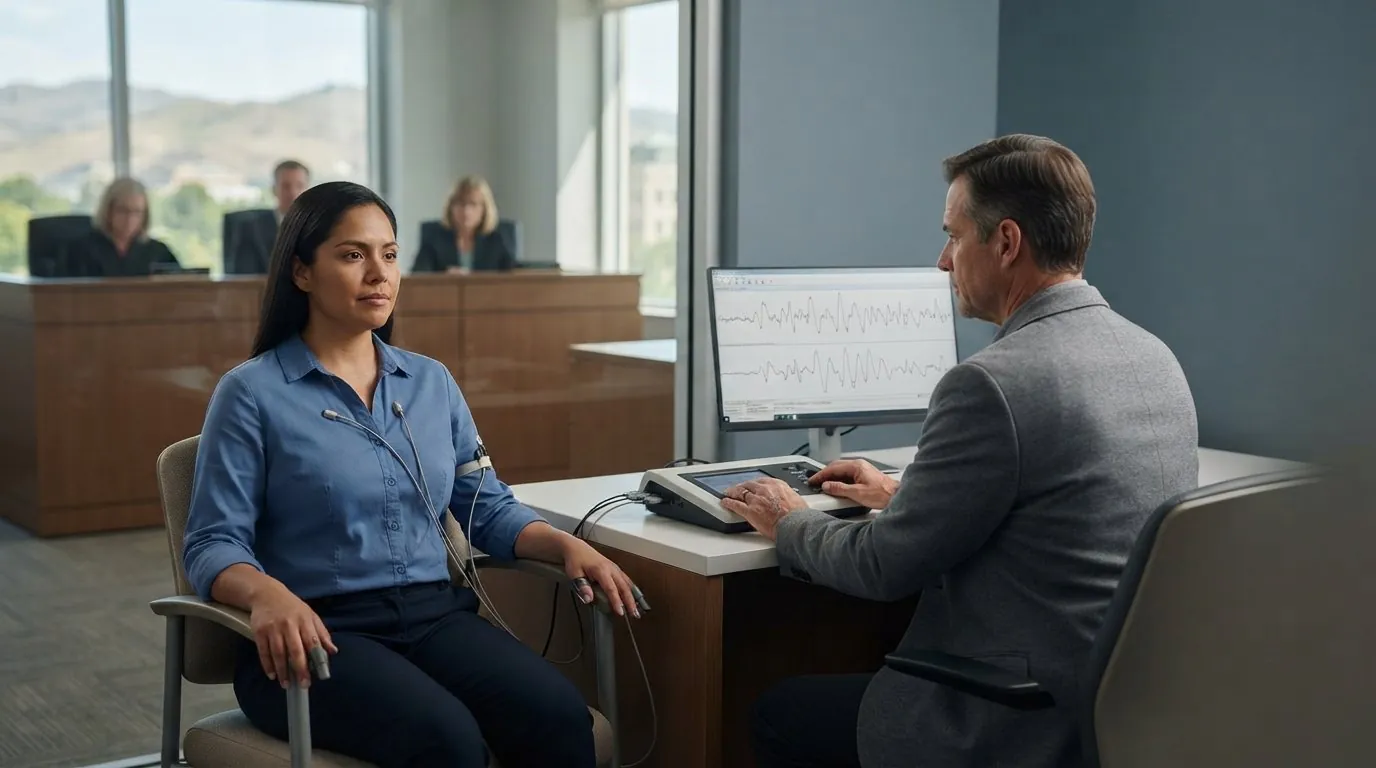
Can an independent examination substantiate your rehabilitation when commissioners remain deeply skeptical? Standing before the Idaho Commission of Pardons and Parole often means confronting scrutiny that personal statements alone cannot dispel. When your future depends on demonstrating genuine compliance, utilizing a Boise polygraph for parole board hearings provides an objective, empirical method to corroborate your account. You already understand the anxiety of facing institutional doubt, especially when fear of exam failure or improper questioning adds to the pressure of an upcoming hearing.
This 2026 guide explains how certified polygraph examinations influence parole board determinations, how commissioners evaluate testing reports, and how you can prepare effectively without anxiety skewing your results. You will learn the critical differences between mandatory PCSOT monitoring and voluntary defense testing, the specific standards required for examiner credentials in Idaho, and the exact process for securing a credible, court-recognized examination in Boise.
Key Takeaways
- Understand how the Idaho Commission of Pardons and Parole evaluates administrative polygraph evidence to assess rehabilitation and community risk.
- Differentiate between state-mandated Post-Conviction Sex Offender Testing (PCSOT) compliance monitoring and voluntary defense examinations designed to support your release.
- Discover why standardized American Polygraph Association protocols are necessary to ensure your test results carry legitimate weight before board commissioners.
- Learn the structured three-phase testing procedure and how proper mental preparation prevents nervous reactions from causing inconclusive readings.
- Identify the mandatory state licensing and Idaho SOMB credentials required when scheduling a court-recognized Boise polygraph for parole board hearings.
Understanding Polygraphs in Idaho Parole Board Hearings
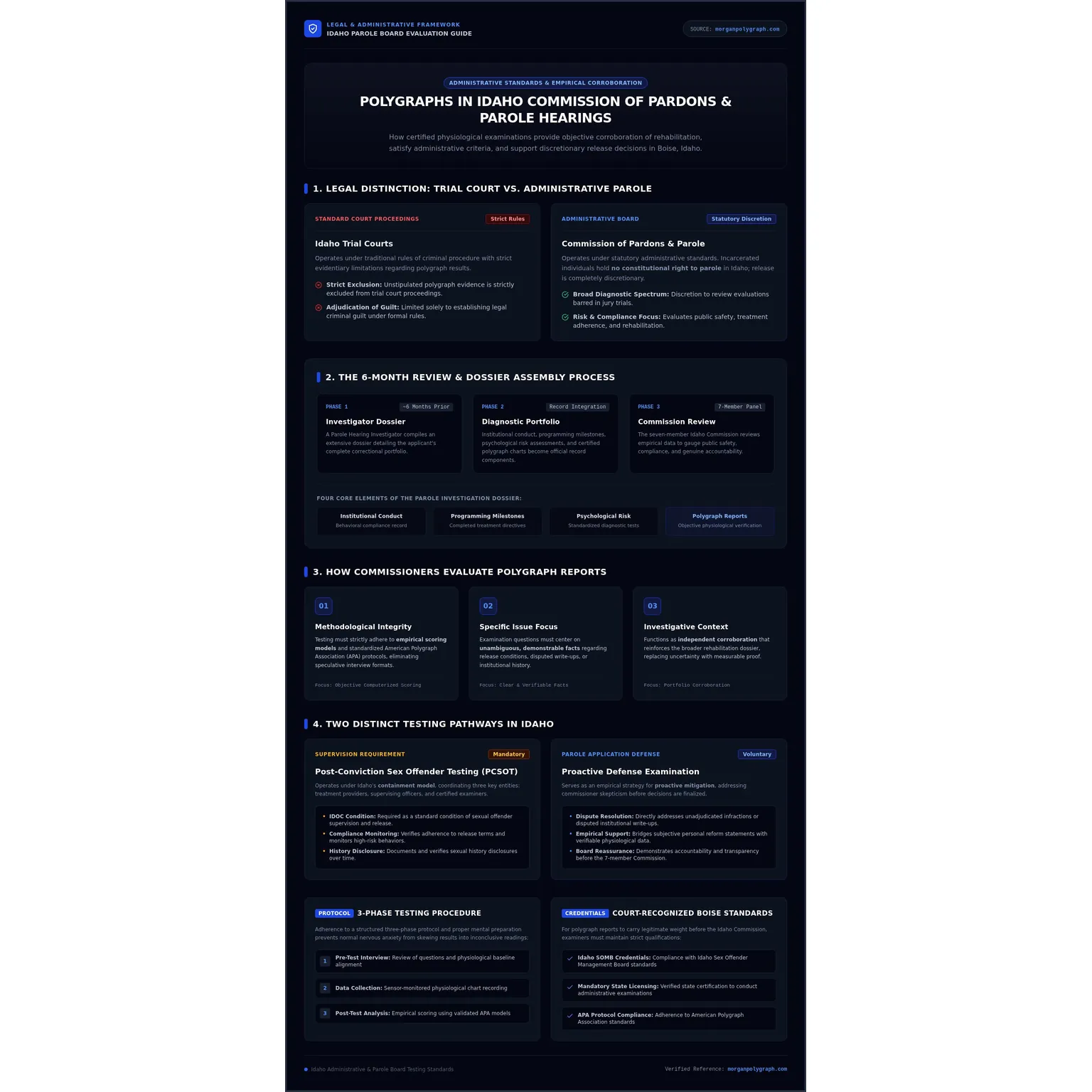
Parole hearings operate under an administrative framework distinct from standard courtroom proceedings. While Idaho trial courts strictly exclude unstipulated polygraph evidence under traditional rules of criminal procedure, administrative bodies function under separate legal standards. Incarcerated individuals hold no constitutional right to parole in Idaho. Because release is entirely discretionary, the Idaho Commission of Pardons and Parole reviews a broad spectrum of diagnostic evaluations to gauge public safety and institutional compliance.
A certified Boise polygraph for parole board hearings provides objective, empirical corroboration of personal statements. Commission panels rely on these specialized assessments to verify whether an applicant has adhered to treatment directives and release prerequisites. Independent testing bridges the gap between subjective claims of reform and verifiable behavioral data, delivering clear documentation that commissioners can evaluate directly.
The Role of Polygraph Evidence in Parole Decisions
Administrative decision-makers possess statutory discretion to review material that would normally be barred in a jury trial. Rather than attempting to establish criminal guilt, the parole board reviews polygraph examinations to assess risk management and supervise compliance. When applicants face intense scrutiny regarding disputed institutional events or historical conduct, a standardized physiological examination provides non-verbal verification. These empirical reports offer measurable reassurance to commissioners, demonstrating that an applicant has embraced accountability and maintained transparency throughout their correctional programming.
The Idaho Commission of Pardons and Parole Framework
The seven-member Commission focuses squarely on public safety, accountability, and demonstrable rehabilitation. Approximately six months prior to a scheduled hearing, a Parole Hearing Investigator compiles an extensive dossier covering institutional conduct, programming milestones, and psychological risk assessments. Polygraph evaluations conducted by qualified practitioners become formal components of this official record. Commissioners systematically evaluate these reports using specific diagnostic criteria:
- Methodological Integrity: Testing must adhere strictly to empirical scoring models rather than speculative interview formats.
- Specific Issue Focus: Questions center on unambiguous, demonstrable facts regarding release conditions or institutional history.
- Investigative Context: The examination functions as independent corroboration, reinforcing the applicant’s broader rehabilitation portfolio.
Scheduling a Boise polygraph for parole board hearings ensures your documentation satisfies the administrative standards demanded by state authorities. By presenting objective, computerized chart analysis from recognized specialists, applicants replace uncertainty with measurable proof of compliance.
Mandatory vs. Voluntary Polygraph Testing for Idaho Parolees
Understanding why an examination is scheduled determines how questions are structured, scored, and delivered. In Idaho, individuals interact with polygraph testing through two distinct legal pathways: state-enforced supervision requirements or independent defense strategy. Differentiating between these channels is vital when organizing a Boise polygraph for parole board hearings, as the procedural goals and reporting paths differ significantly.
Mandated Post-Conviction Sex Offender Testing (PCSOT)
Mandatory testing operates under Idaho’s containment model, uniting treatment providers, supervising officers, and certified examiners. The Idaho Department of Correction requires individuals under sexual offender supervision to submit to periodic testing as a condition of release. These assessments verify compliance with release terms, monitor high-risk behaviors, and document sexual history disclosures. For specific statutory context on compliance requirements, consult our guide on The Idaho Sex Offender Registry. Within this framework, testing monitors supervision compliance rather than litigating new guilt.
Voluntary Polygraphs to Support Parole Applications
Voluntary testing serves an entirely different purpose: proactive mitigation. Applicants frequently face commission skepticism regarding disputed institutional write-ups, unadjudicated infractions, or lingering questions about past accountability. In these scenarios, an applicant commissions an independent exam to substantiate truthfulness on contested matters. While federal guidance establishes strict evidentiary Standards for Admissible Results in formal trials, the Idaho parole board has wide discretion to review voluntary empirical charts that corroborate an applicant’s honesty and rehabilitation.
Addressing Revocation Allegations with Objective Data
Parole officers sometimes pursue revocation based on ambiguous circumstances, technical allegations, or unverified community complaints. When release status is threatened by inaccurate accusations, an independent examination delivers concrete factual refutation. Defense attorneys routinely introduce verified test charts during revocation proceedings to challenge false claims and demonstrate ongoing compliance. Coordinating an independent evaluation through Morgan Polygraph provides the objective physiological documentation needed to resolve disputed violations before the board.
Standards and Protocols That Ensure Board-Admissible Results
Parole commissioners scrutinize examination methodology closely before assigning evidentiary weight to any test findings. Submitting an informal or improperly scored examination can backfire, inviting skepticism from investigators and panel members. Securing a defensible Boise polygraph for parole board hearings requires strict compliance with validated scientific protocols, standardized instrumentation, and transparent scoring models.
American Polygraph Association (APA) Examination Protocols
The American Polygraph Association sets the empirical benchmark for evidentiary examinations. Validated testing protocols require examiners to restrict questions to narrow, demonstrable facts rather than subjective attitudes or ambiguous feelings. Standardized testing records multiple channels of autonomic activity simultaneously:
- Thoracic and Abdominal Respiration: Dual pneumograph components monitor respiration stability and baseline movement.
- Electrodermal Activity: Galvanic skin sensors track minute changes in skin conductance and sweat gland activity.
- Cardiovascular Response: A continuous blood pressure cuff records relative blood volume changes and pulse rate.
Examinations structured around these parameters ensure high diagnostic accuracy. To explore the empirical research behind testing precision, review our detailed guide: Are Polygraphs Accurate?
Objective Scoring and Computerized Instrumentation
Modern computerized polygraph systems remove subjective interpretation from the assessment. State-of-the-art sensors capture physiological responses in real time, digitizing wave activity for dual-track analysis. First, the practitioner conducts systematic numerical hand-scoring using validated seven-position or three-position models. Second, proprietary computerized algorithms independently assess the physiological data, calculating the exact statistical probability of deception. This twin-layer approach generates clean, unassailable records that peer reviewers and regulatory bodies can verify without ambiguity.
Coordinating Directly with Boise Defense Counsel
Maximizing the legal utility of an evaluation requires close collaboration with an applicant’s defense counsel. Experienced attorneys retain examiners directly, ensuring all preliminary intake disclosures, chart recordings, and preliminary determinations remain protected under attorney work-product privilege. This framework guarantees confidentiality while legal counsel determines the optimal timing for submitting the report to the parole commission.
Attorneys frequently align testing with specialized clinical risk assessments. You can review how diagnostic testing integrates with treatment protocols in our guide on Psychosexual Evaluation. Coordinating an independent Boise polygraph for parole board hearings several months ahead of the hearing date ensures completed documentation arrives in time for the Parole Hearing Investigator’s preliminary review.
Preparing for a Parole Polygraph Examination in Boise
Facing an evaluation naturally triggers stress, but general nervousness does not cause an exam failure. Standardized polygraph testing measures differential reactivity between baseline inquiries and relevant target questions, not ambient nervousness. Knowing what to expect ahead of time stabilizes your physiological baseline and prevents inconclusive chart readings. A certified Boise polygraph for parole board hearings adheres to a clear three-stage procedure designed to eliminate surprises.
The Pre-Test Interview and Question Formulation
The examination begins with a comprehensive pre-test interview. Your examiner reviews the operational mechanics of each sensor component, answering questions to dispel unfounded anxieties. The most critical aspect of this initial phase involves reviewing every single test question word for word. No surprise questions ever occur during data collection. Questions remain direct, concise, and structured strictly for definitive yes-or-no answers. To see how each stage of this clinical interview unfolds, explore our guide on Polygraph Examination: Complete Guide.
Physiological Data Collection and Chart Analysis
Data collection takes place in a quiet, distraction-free examination room. Examinees sit comfortably upright while computerized sensors continuously record involuntary autonomic signals. The testing phase involves running multiple charts, repeating the finalized question sequence several times to verify response consistency. Examiners maintain an objective, neutral demeanor throughout chart collection, applying mathematical scoring models to evaluate autonomic variations across each tracing.
What to Avoid: Debunking Countermeasure Myths
Online forums often suggest physical or cognitive countermeasures, such as controlled breathing, muscle clenching, or tongue biting. These techniques do not work. Modern computerized instruments feature specialized motion-sensor pads placed beneath the examinee to detect subtle physical manipulations instantly. Attempting deliberate maneuvers generates atypical physiological artifacts that examiners easily spot, frequently resulting in an immediate finding of purposeful non-cooperation. Follow these fundamental preparation steps to ensure valid recordings:
- Rest Well: Obtain adequate sleep the night prior to testing to maintain autonomic stability.
- Follow Prescriptions: Take all regularly scheduled prescription medications as directed by your physician.
- Avoid Stimulants: Refrain from consuming excessive caffeine, energy drinks, or unprescribed supplements beforehand.
- Maintain Candor: Answer pre-test interview questions with complete transparency to maintain psychological calm.
Truthful cooperation delivers the clearest physiological tracings. If you or your legal team need to verify compliance before an upcoming hearing, schedule an examination with Morgan Polygraph to establish your objective record.
Choosing a Court-Recognized Boise Polygraph Examiner for Parole
Parole commissioners routinely dismiss assessments conducted by unqualified practitioners. An evaluation carries evidentiary weight only when the examiner behind the report possesses recognized credentials, rigorous empirical training, and demonstrable courtroom experience. When scheduling a Boise polygraph for parole board hearings, selecting an accredited specialist ensures your testing documentation withstands administrative scrutiny.
The Value of Board-Recognized Credentials
Commission panels look closely at who conducted the evaluation before reviewing the charts. Formal credentials signal that the practitioner follows strict standards of practice and completes mandatory continuing education. In Idaho, post-conviction testing requires formal certification through the Idaho Sexual Offender Management Board (SOMB), alongside a valid license administered by the Idaho Bureau of Occupational Licenses. Key qualifications to verify include:
- Professional Affiliations: Active membership in the American Polygraph Association or state-level polygraph associations.
- Specialized Certifications: Advanced training in Post-Conviction Sex Offender Testing (PCSOT) and evidentiary testing protocols.
- Courtroom Track Record: Prior qualification as an expert witness in state or federal administrative and judicial proceedings.
Practitioners familiar with Idaho parole procedures understand how commissioners review documentation. That institutional familiarity ensures the final report addresses the specific factual questions commissioners care about most.
Confidential Examinations at Morgan Polygraph in Boise
Morgan Polygraph provides certified, court-recognized examinations tailored to legal defense and administrative parole matters. Conveniently located at 6126 W. State Street in Boise, the firm serves legal teams and individuals across the entire Treasure Valley. The clinical office offers a discreet, quiet environment designed to put examinees at ease, helping reduce situational tension so autonomic readings remain clear. Utilizing modern computerized polygraph instrumentation, every examination adheres to empirical standards that deliver legally defensible results.
Next Steps for Legal Counsel and Parole Candidates
Timing plays a vital role in parole advocacy. Coordinating an evaluation several months before your hearing ensures the completed report arrives before the preliminary investigatory packet is assembled. Legal counsel and the examiner should collaborate early to define the testing issues, finalize question structure, and protect test materials under applicable legal privileges.
Taking proactive steps now replaces uncertainty with verifiable physiological data. Contact Morgan Polygraph to schedule a confidential Boise polygraph for parole board hearings and build an objective foundation for your release.
Take Control of Your Parole Review with Verifiable Data
Approaching an administrative parole hearing requires a proactive strategy and concrete documentation. While personal statements are essential, presenting a Boise polygraph for parole board hearings substantiates your rehabilitation and resolves lingering skepticism before commissioners cast their votes. Strict adherence to American Polygraph Association protocols ensures your examination charts deliver the empirical reliability decision-makers demand.
Morgan Polygraph provides decades of specialized experience in criminal defense evaluations and post-conviction testing. Located conveniently on W. State Street in Boise, our nationally certified and court-recognized examiners conduct discreet, standardized evaluations that hold up under administrative review. You don’t have to face the commission with unaddressed doubts. Schedule a Certified Parole Polygraph in Boise Today and give your hearing presentation the credible corroboration it deserves.
Frequently Asked Questions
Can the Idaho Commission of Pardons and Parole consider polygraph results?
Yes, the Idaho Commission of Pardons and Parole possesses full administrative discretion to review polygraph reports. While trial courts strictly exclude unstipulated testing, administrative bodies evaluate physiological reports to assess rehabilitation progress and community safety risk. Submitting an examination conducted by a board-recognized specialist provides empirical corroboration of an applicant’s statements, helping commissioners resolve lingering doubts regarding institutional compliance.
Are polygraph examinations mandatory for all parolees in Idaho?
No, polygraphs are not universally mandated for all Idaho parolees. Mandatory testing applies primarily to individuals supervised under Post-Conviction Sex Offender Testing (PCSOT) protocols or those with explicit supervision conditions established by the sentencing court or parole commission. Other parole candidates choose voluntary testing strategically with their attorneys to refute contested disciplinary allegations or demonstrate genuine personal reform.
Can an examinee fail a parole polygraph simply due to severe nervousness?
No, situational nervousness alone will not cause you to fail an examination. Validated testing protocols evaluate the physiological differences between baseline inquiries and relevant target questions, accounting for general stress levels. When completing a Boise polygraph for parole board hearings, certified examiners review every question beforehand during the pre-test interview, ensuring nervous tension doesn’t distort your chart analysis.
How far in advance of a Boise parole hearing should a polygraph be scheduled?
You should schedule your examination at least three to four months before your hearing date. A Parole Hearing Investigator compiles the comprehensive offender dossier months in advance of the formal proceedings. Completing testing early allows your legal counsel sufficient time to review the empirical findings, formulate legal strategy, and submit the final documentation before docket deadlines close.
What happens if a voluntary polygraph examination produces an inconclusive result?
An inconclusive outcome simply indicates that physiological charts did not show a clear statistical divergence between truthful and deceptive responses. Because voluntary testing remains protected under attorney work-product privilege, an inconclusive report isn’t submitted to the commission. The examiner and your legal counsel can analyze potential contributing factors such as physical fatigue, clarify question wording, and conduct a re-test.
Can defense attorneys attend the polygraph examination in Boise?
Defense attorneys cannot sit inside the testing room during active data collection, though they may consult during pre-test preparation. Standard American Polygraph Association protocols mandate an isolated environment to prevent third-party distractions from skewing autonomic nervous system recordings. However, counsel routinely coordinates with the examiner to formulate target questions and receives the complete technical report once scoring concludes.
Does passing a polygraph guarantee parole approval in Idaho?
No test result guarantees release, because Idaho law grants commissioners complete discretion during parole reviews. While completing a Boise polygraph for parole board hearings verifies truthfulness regarding specific factual disputes, the panel evaluates your entire history, institutional conduct, and release plan. A successful polygraph provides powerful, objective corroboration that substantially reinforces your broader petition for release.