

Could a lie detector settle a disputed will? Not by itself. For families considering a lie detector for will and testament challenges Nampa, a polygraph may examine a specific, clearly framed account, but it can’t determine whether a will is legally valid or independently prove undue influence, lack of capacity, or fraud.
When accounts conflict and an estate is at stake, it’s understandable to want a clear answer. But a polygraph result isn’t automatically accepted as courtroom evidence. In Idaho, results are generally inadmissible unless all parties agree in writing beforehand. A professionally conducted civil-case examination may still help clarify a disputed account, while the probate evidence and legal standards remain central.
This article explains what a polygraph can and can’t contribute, why careful question development and realistic expectations matter, and what to discuss with your attorney and examiner. Before testing, define the specific statement at issue and discuss whether a written agreement about potential use is relevant to your case. You’ll also learn how Boise-based Morgan Polygraph conducts civil-case examinations and prepares professional reports intended for legal proceedings, giving Nampa-area readers a discreet, informed starting point.
Key Takeaways
- A polygraph may help clarify a specific disputed account, but it can’t determine whether a will is legally valid.
- Consider how a lie detector for will and testament challenges Nampa may fit alongside testimony and written records, not replace them.
- Separate what you directly know from assumptions and second-hand information before defining questions for an examination.
- Discuss the possible use of results with your attorney, since a polygraph report isn’t automatically accepted as court evidence.
- Learn how Boise-based Morgan Polygraph conducts civil-case examinations and prepares professional reports intended for legal proceedings.
Lie Detectors in Nampa Will Challenges: Can and Cannot Do
A contested will can leave family members unsure about what was said, what instructions were given, and whose account to trust. A polygraph offers a structured way to examine a specific disputed account, but it cannot resolve the legal dispute on its own. The examination measures responses to questions; its potential significance depends on the facts and applicable court rules.
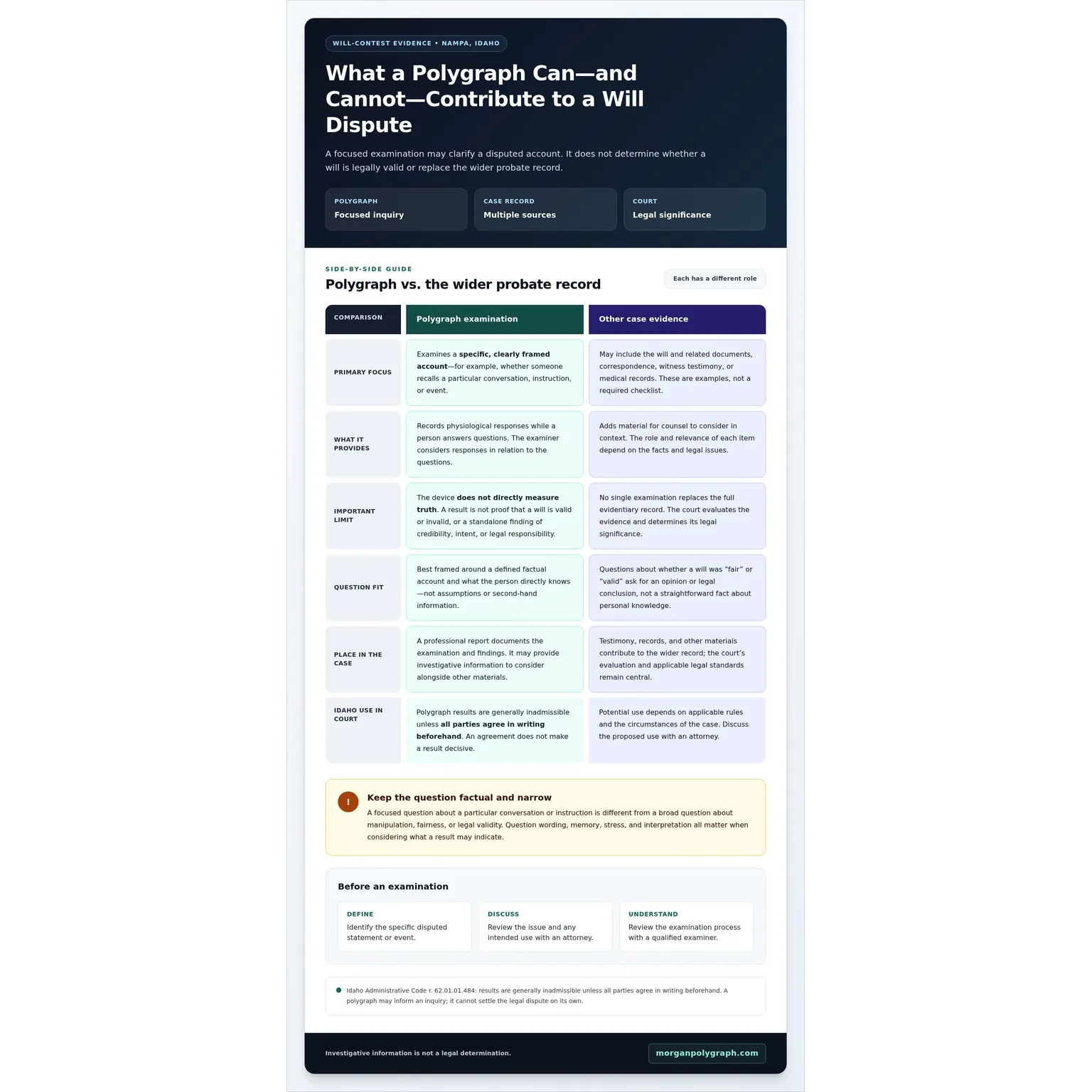
A polygraph records physiological responses while a person answers questions. The examiner considers those responses in relation to carefully framed questions; the device does not directly measure truth. The Polygraph overview describes the technique and its debated scientific standing, a useful reminder to interpret results carefully. In a will dispute, a result may provide investigative information, not an automatic answer about the will or the people involved.
What questions might arise in a disputed will?
A focused examination may address a defined factual account, such as whether someone recalls a particular conversation about the will, received specific instructions, or was present for an event. These are examples of topics, not conclusions about legal capacity, undue influence, fraud, or any other legal issue. An attorney can identify which issues matter in the individual case and how a disputed account fits with other evidence.
Scope matters. Broad questions about whether someone “manipulated” a relative or whether a will is “fair” can combine opinions, interpretations, and multiple events. Questions about specific facts are clearer to examine and easier to compare with records or testimony.
What a polygraph result should not be treated as
A result should not be treated as proof that a will is valid or invalid, or as a standalone determination of credibility, intent, or legal responsibility. Stress, memory, interpretation, and question wording all matter when considering what a result may indicate. The result must be viewed in context, alongside the full record.
A polygraph can provide investigative information about a defined account; the court evaluates the evidence and decides its legal significance. In Idaho, polygraph results are generally inadmissible unless all parties agree in writing beforehand to their admission, under Idaho Administrative Code r. 62.01.01.484. That rule does not make a result decisive even when parties stipulate. Anyone considering a lie detector for will and testament challenges Nampa should discuss the proposed examination and any intended use with their attorney before proceeding.
How a Polygraph Examination Relates to Will-Contest Evidence
In a will dispute, a polygraph examination is one focused inquiry into a person’s account, not a substitute for building the probate case. The examiner reviews the issue and develops questions around specific, relevant facts before testing begins. This preparation keeps the examination within a defined scope instead of turning it into a broad inquiry into family disagreements or legal conclusions.
Narrowing a disputed statement into a factual question
Question development starts by identifying what the person directly knows and which event or statement is disputed. For example, a question might address whether someone recalls giving a particular instruction or having a specific conversation. Neutral, precise wording helps distinguish a firsthand account from assumptions, interpretations, or information heard from someone else.
Questions such as “Was the will fair?” or “Was the will valid?” ask for an opinion or legal conclusion, not a straightforward fact about personal knowledge. They aren’t interchangeable with questions about what someone said, heard, or did. Whether a proposed topic is suitable for examination depends on the case facts and the examiner’s professional process. An attorney can help identify which factual issues relate to the legal dispute.
Understanding the report’s place in the record
An examiner’s professional report documents the examination and its findings. Counsel may consider it alongside other case materials, such as the will and related documents, correspondence, witness testimony, or medical records. These are examples, not a checklist required in every dispute. Each item has a different role, and its relevance depends on the facts and legal issues involved.
No single examination substitutes for the full evidentiary record or the court’s evaluation of the case. A report is distinct from an attorney’s legal arguments and from a probate court’s decisions. The U.S. Department of Justice’s overview of the admissibility of polygraph examination results discusses legal considerations in federal proceedings. It offers background, but doesn’t determine how a particular Idaho probate matter will be handled. Legal significance depends on applicable rules and the circumstances of the case.
For anyone considering a lie detector for will and testament challenges Nampa, a practical next step is to discuss the disputed facts and potential use of an examination with counsel, then review the examination process with a qualified examiner. Morgan Polygraph provides civil-case polygraph examinations and prepares reports intended for legal proceedings. Learn more about civil-case polygraph examinations as one possible investigative resource to consider alongside the wider evidentiary record.
Polygraph vs. Other Evidence: Addressing the Biggest Will-Challenge Concern
A polygraph report is one kind of information that may arise in a will dispute. It doesn’t guarantee courtroom acceptance or determine the outcome. Documents, testimony, and legal analysis serve different purposes, and their relevance depends on the facts and applicable rules.
| Information | What it may document | Limits | Who evaluates relevance |
|---|---|---|---|
| Polygraph report | The examination process and the examiner’s professional findings about responses to defined questions. | Doesn’t independently prove a will’s validity, establish credibility, or guarantee admissibility or a decisive result. | The attorney considers its potential role; the court applies relevant rules. |
| Witness testimony | A witness’s recollection of conversations, events, or observations. | May be limited by memory, perspective, or what the witness personally observed. | Attorneys and, where applicable, the court assess its relevance and weight. |
| Written records | Information recorded in documents, correspondence, or other written materials. | A document may not capture the full context or resolve disagreements about what it means. | Attorneys and the court consider its connection to the disputed issues. |
| Legal advice | Analysis of legal issues, procedure, and possible case strategy. | Advice isn’t itself proof of disputed facts and doesn’t determine how a court will rule. | An attorney advises the client; the court makes decisions in the proceeding. |
Can a polygraph be used in an Idaho probate case?
Whether a polygraph result may be considered, and what weight it could receive, depends on applicable law and the circumstances of the case. Cornell Law School’s legal analysis of polygraph tests offers general U.S. legal context, but it can’t answer how a particular Idaho probate court will handle a specific report. Discuss admissibility and strategy with your attorney. Morgan Polygraph conducts examinations and prepares reports, but doesn’t provide legal advice or determine how a court will rule.
Why the wider record still matters
Different materials may address different questions. A witness may describe a conversation, a document may show what was recorded, and other relevant records may provide context. A polygraph examines responses to defined questions; it doesn’t replace those sources or rank them. For broader context on examination limits, consult the article’s discussion of polygraph accuracy.
For readers researching a lie detector for will and testament challenges Nampa, the useful question isn’t whether a polygraph can settle the dispute. It’s whether an examination of a specific account could add relevant investigative information when considered alongside the complete record and legal advice.
How to Prepare for a Will-Related Polygraph: A Practical Sequence
Preparation begins with clarity, not accusations. A measured approach helps distinguish a specific account that may be examined from wider family conflict, assumptions, or legal questions that require an attorney’s analysis. In complex inheritance conflicts, taking the time to explore family law principles alongside qualified counsel can help parties better understand their rights and broader legal standing.
Before scheduling an examination
Discuss the possibility of an examination with your attorney before relying on one in a probate case. Your attorney can advise on legal strategy and potential use of results. Testing should not be used to pressure another family member; approach participation respectfully and don’t treat a result as a verdict.
Use this sequence to organize the issue:
- 1. Define the disputed fact. State the specific conversation, instruction, or event you want to clarify, without drawing conclusions about someone’s motives or the will’s validity.
- 2. Separate firsthand knowledge from other information. Note what you personally saw or heard, what someone else told you, and what you’re inferring. Keep family disagreements distinct from the factual account.
- 3. Make a neutral timeline. Record relevant events in order and identify the source for each detail. Mark uncertainty rather than filling gaps with assumptions.
- 4. Discuss the issue with counsel and the examiner. Share relevant context so the examiner can assess whether the issue can be framed as clear, suitable questions. Leave legal conclusions and case strategy to your attorney.
- 5. Review the questions and intended next steps. Understand what will be asked and discuss with counsel how the examination and report might fit into the broader case.
What to expect from a professional examination
A professional process generally includes an initial discussion of the issue, review and development of questions, the examination itself, and reporting of the examiner’s findings. A clear account and relevant context help the examiner assess whether the questions are suitable. During the examination, listen carefully and answer directly. If a question is unclear, say so rather than guessing. A calm, respectful exchange supports clear communication, though it can’t guarantee a particular outcome.
For more detail on the stages, read the complete guide to the polygraph examination process. Afterward, discuss the report and any proposed use with your attorney. That conversation can help keep the examination in perspective as one source of information, not a replacement for legal advice or the wider case record.
If you’re considering a civil-case examination, discuss a legal or civil case examination with Morgan Polygraph.
Morgan Polygraph for Nampa-Area Will and Testament Challenges
For families researching a lie detector for will and testament challenges Nampa, Morgan Polygraph provides legal and civil case polygraph examinations from its Boise location. An examination may be one investigative step to consider, not a way to decide a probate dispute.
A professional, case-focused examination
Morgan Polygraph’s nationally certified, court-recognized examiners conduct examinations and prepare professional reports intended for legal proceedings. In a sensitive civil matter, the process begins with understanding the defined issue and developing questions focused on relevant facts. An examination may address a specific account, but the examiner doesn’t decide whether a will is valid, determine legal responsibility, or resolve a family disagreement.
Credentials and a professionally prepared report don’t guarantee that a result will be admissible or decisive in a particular case. Legal significance depends on applicable court rules and circumstances. An attorney can advise on case strategy, evidence, and any potential use of a report. The examiner’s role is to conduct the examination and report professional findings, not to provide legal counsel.
Next steps for families near Nampa
Before arranging an examination, discuss the disputed facts and legal strategy with your family’s attorney. Identify the account you want clarified, separate firsthand knowledge from assumptions or second-hand information, and consider how an examination might fit alongside documents and testimony. This preparation helps keep expectations realistic and the process focused.
Families who want to understand the examination itself can also consult the existing guide to finding a certified polygraph service near the reader. Use that information to learn about professional credentials and process, while remembering that no examiner can promise how a probate court will treat a result.
Morgan Polygraph provides a professional setting for discussing a civil-case examination and relevant factual context. For a discreet conversation about the examination process, Contact Morgan Polygraph.
Take a Clear, Measured Next Step
A polygraph may help examine a specific disputed account, but it can’t determine whether a will is valid or settle a probate challenge. Its potential value depends on clearly framed factual questions, the wider evidence, and applicable court rules. Consider a report as one source of investigative information, not automatic proof or a replacement for legal advice.
If you’re weighing a lie detector for will and testament challenges Nampa, first discuss the case strategy and possible use of an examination with your attorney. Morgan Polygraph is based in Boise and provides legal and civil case examinations. Its nationally certified, court-recognized examiners prepare professional reports intended for legal proceedings, without guaranteeing that a particular result will be admitted or decisive.
For a discreet conversation about the examination process and a defined disputed account, discuss a legal or civil case examination with Morgan Polygraph. With clear expectations and the right guidance, you can take a thoughtful next step.
Frequently Asked Questions
Can a lie detector test help with a will contest in Idaho?
It may help examine a specific disputed account, but it can’t decide whether a will is valid or resolve the contest. A carefully framed examination might provide investigative information about what a person says they remember or did. Its potential value depends on the facts, the questions, and how the information fits with documents, testimony, and legal analysis. Discuss the proposed role of a test with your attorney before proceeding.
Is a polygraph result admissible in an Idaho probate case?
Idaho generally excludes polygraph results from court unless all parties agree in writing beforehand to their admission. That general rule doesn’t guarantee a report will be accepted or given particular weight in a specific probate case. Court rules and case circumstances matter. Before relying on a result, ask your attorney to assess the applicable Idaho requirements and explain how any proposed agreement could affect your case.
What questions can a polygraph address in a will and testament challenge?
A polygraph may address specific factual questions about a person’s own account, such as whether they recall a particular conversation or gave a stated instruction. Questions should be clear, neutral, and tied to relevant facts. Broad questions like “Was the will fair?” or “Was it valid?” ask for opinions or legal conclusions, not focused factual responses. An examiner assesses question suitability through a professional process, with case context shared as appropriate.
Does a lie detector test prove that someone influenced a will?
No. A polygraph result doesn’t independently prove that someone influenced a will, establish intent, or determine legal responsibility. It records physiological responses while a person answers questions, and the examiner reports professional findings. Any account needs to be considered in the context of other relevant information and applicable legal standards. An attorney can explain what evidence may matter to the specific dispute and how the court evaluates it.
Can a beneficiary be required to take a polygraph test?
A family member’s request alone doesn’t mean a beneficiary must take a polygraph. Whether a person can be compelled to participate in a particular legal situation is a case-specific question, and a polygraph examiner can’t determine the legal obligations involved. Don’t use testing to pressure or threaten a relative. If participation, court procedure, or consequences are in question, consult an attorney familiar with the case.
How should I prepare for a polygraph related to a disputed will?
Start by discussing the examination and its possible use with your attorney. Write a neutral timeline of relevant events, then separate what you personally saw or heard from assumptions, family conflict, and second-hand accounts. Identify the specific statement or event in dispute and share relevant context during preliminary discussion. Review the questions carefully, ask for clarification if needed, and answer directly during the examination.
Where can I find a polygraph examiner near Nampa, Idaho?
Morgan Polygraph is based in Boise, Idaho, and provides legal and civil case polygraph examinations for readers searching around Nampa. Its nationally certified, court-recognized examiners conduct examinations and prepare professional reports intended for legal proceedings. A report doesn’t guarantee courtroom admissibility or determine the outcome of a will contest. Discuss legal strategy with your attorney, then contact Morgan Polygraph to discuss the examination process and relevant case context.