

Could a polygraph clarify a disputed fact in an insurance claim without proving the insurer acted in bad faith? That distinction matters when considering a polygraph for insurance bad faith claims Meridian policyholders may be involved in. An examination may provide investigative information about a person’s responses, but it cannot determine whether an insurer’s conduct was unreasonable or replace the records showing how a claim was handled.
When a claim is disputed, it’s understandable to want a clear answer. Polygraph results aren’t a shortcut to a legal finding, and they shouldn’t be mistaken for documentary evidence or legal advice. Their possible role depends on the specific question, the person examined, and the broader facts of the dispute.
This article explains what a civil-case polygraph may help clarify, what its limits are in an Idaho bad-faith matter, and why claim records remain central. You’ll also learn how to prepare for a professional examination in the Meridian area and what to expect from its structure and reporting.
Key Takeaways
- A polygraph can address a focused factual question, not decide whether an insurer acted in bad faith.
- Carefully framed questions help keep a civil-case examination focused on a specific disputed issue.
- Compare examination findings with policy language, claim correspondence, timelines, and other records.
- Before an examination, organize a concise chronology and relevant documents to discuss with your legal representative.
- Morgan Polygraph conducts professional civil-case examinations and prepares reports for legal matters involving disputes in Meridian and elsewhere in Idaho.
Polygraph for insurance bad faith claims in Meridian: what question can it address?
A disputed insurance claim can raise several distinct questions: what happened, what information was provided, how the insurer evaluated the claim, and whether the policy covers the loss. A polygraph examination may address a narrow question about a person’s account of events. It cannot determine whether the insurer acted in bad faith, interpret the policy, or decide who is legally responsible.
What does an insurance bad faith dispute generally involve?
In general terms, an insurance bad faith dispute concerns how an insurer handled a claim. A disagreement over coverage, the amount offered, or the time taken to reach a decision does not by itself establish bad faith. An allegation about the insurer’s conduct is a separate issue. Qualified counsel should assess Idaho-specific legal definitions and standards based on the facts and current law.
What can a polygraph contribute to a civil case?
A polygraph records physiological responses as a person answers questions during a structured examination. A general overview of polygraphs explains the method and its broader context. Any examination result still needs careful interpretation. It is not a direct measurement of truth, intent, or legal liability.
For example, if a policyholder’s account of a specific event is disputed, an examination might address a clearly stated factual question about that person’s account. It cannot establish that an insurer mishandled the claim just because the policyholder’s responses are assessed as truthful. An examination of one person also cannot establish what another person knew, what an organization intended, or whether a claim decision complied with the policy and applicable law.
A polygraph may provide investigative information about a focused question; it is not a legal finding or a coverage decision. Its relevance depends on the issue, the person examined, and the reason for the examination. A broad question such as “Was this claim handled in bad faith?” asks for a legal judgment, not a testable account of a specific event. A more focused question could concern a person’s knowledge or actions in a defined situation, if the issue is suitable for examination.
Before arranging a polygraph for insurance bad faith claims Meridian, identify the disputed fact the examination could address and how the result might inform the wider case. Don’t treat the result in isolation. Claim correspondence, policy terms, records, and other evidence may be essential to understanding the dispute. The complete guide to the polygraph examination process explains how structured questions and examination steps fit together. Decisions about legal strategy or how to use results belong with the appropriate legal representative.
How an Idaho civil-case polygraph is framed around a disputed fact
A useful civil-case examination starts with a defined factual issue, not a conclusion about who is legally right. In an insurance dispute, the issue might be a person’s account of a particular conversation, statement, or event. The examination can then focus on that issue, while legal questions about coverage, claim handling, or bad faith remain outside the examiner’s role.
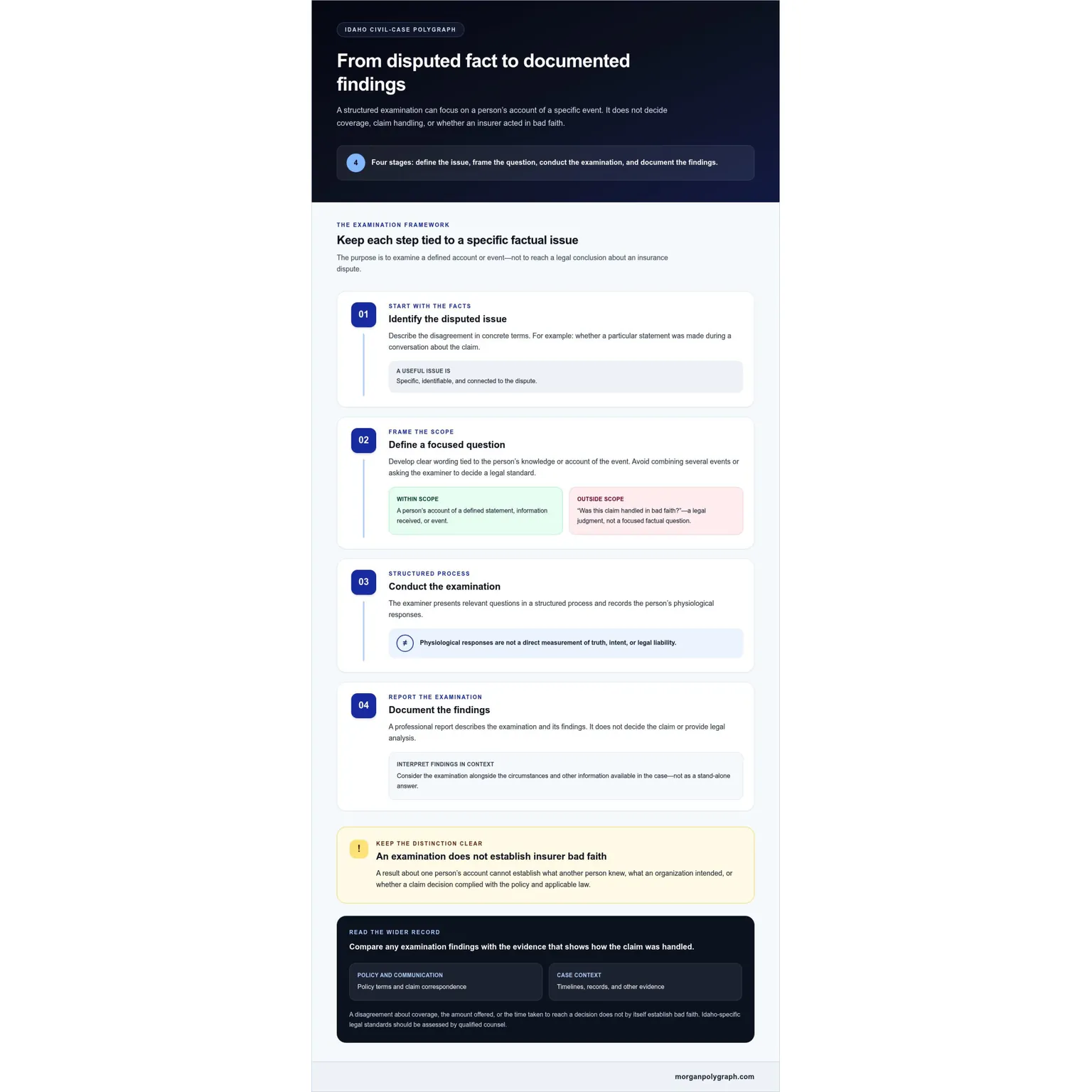
A general framework looks like this:
- Identify the disputed issue. Describe the disagreement in concrete terms, such as whether a specific statement was made during a conversation about the claim.
- Define a focused question. Develop wording tied to the person’s knowledge or account of that event. Don’t ask an examiner to decide whether an insurer acted in bad faith.
- Conduct the examination. The examiner uses a structured process to present relevant questions and record physiological responses.
- Document the findings. A professional report describes the examination and its findings. It does not decide the claim or provide a legal analysis.
Which disputed facts may warrant careful examination?
A potentially relevant issue may concern whether a person recalls making a particular statement, receiving information, or taking part in a defined event. The issue needs to be identifiable and connected to the dispute. A general disagreement about a claim’s value or coverage may not translate into a suitable examination question, and polygraph testing is not appropriate for every claim conflict.
How does an examiner keep the examination focused?
Before testing, the examiner reviews the issue and develops clear, relevant questions within the examination’s scope. Careful wording avoids combining several events or asking for an opinion on a legal standard. The process and report should describe the examination accurately, without promising a particular result or legal effect.
For more context on what an examination can and cannot establish, Morgan Polygraph’s factual review of polygraph accuracy and limitations offers further information. Results should be interpreted alongside the circumstances of the examination and other information available in the case, rather than treated as a stand-alone answer.
A focused factual issue gives an examination a defined purpose; a broad legal conclusion asks it to do work it cannot do. Morgan Polygraph conducts civil-case examinations and prepares professional reports, but does not make claim decisions or provide legal analysis. For readers considering a polygraph for insurance bad faith claims Meridian, Morgan Polygraph civil-case examinations use a professional, structured process.
Polygraph results versus claim records: limits Meridian readers should understand
A civil insurance dispute can involve different kinds of information, each with a different role. A polygraph report may document an examination concerning a specific person and issue. Claim records can show what information was submitted, what actions followed, and when decisions were communicated. Neither a test result nor a single document should be treated as a complete account of the dispute.
| Information source | What it may contribute | Important limit |
|---|---|---|
| Policy language | Terms relevant to coverage, exclusions, or claim requirements | Applying the wording to a particular dispute involves interpretation beyond a polygraph examiner’s role. |
| Correspondence and claim files | A record of requests, responses, evaluations, and stated reasons | Records may need context and comparison with other evidence. |
| Timelines | A sequence of reported events and claim-handling steps | A timeline alone may not explain why an action occurred. |
| Witness accounts | Descriptions of conversations or events from people involved | Accounts may differ and should be assessed alongside other information. |
| Polygraph report | Findings from a structured examination focused on a defined issue | It does not independently prove an insurer’s intent or conduct, or decide coverage or liability. |
Why claim documentation remains central
Dated letters, emails, claim notes, and requests for information can help establish the sequence of events. For example, a file may show when a document was requested and when a response was recorded. That chronology can help a legal representative assess the broader record, but it doesn’t automatically explain the reason for each decision or resolve a disagreement.
Policy terms and claim documents need to be interpreted in context. An examiner’s report describes the examination and its findings; it does not interpret the policy or determine whether claim handling met a legal standard. A careful review considers multiple sources rather than treating any one item as decisive.
Can polygraph results be used in court or claim negotiations?
Use depends on applicable rules, the circumstances of the case, and the decision-maker. Idaho-specific admissibility questions should be reviewed with qualified counsel. Idaho Administrative Code r. 62.01.01.484 addresses polygraph evidence and generally requires a written stipulation by all parties for admission. Counsel should confirm how the current rule applies to a particular civil matter before anyone relies on that provision.
A report is not a court ruling, a legal opinion, or an insurer’s determination. Whether it may be considered in a negotiation is also case-specific, not something an examination can guarantee. For anyone considering a polygraph for insurance bad faith claims Meridian, keep the report in its proper evidentiary context and have legal questions reviewed by counsel.
Preparing for a civil polygraph examination near Meridian, Idaho
Preparation starts with clarity, not rehearsed answers. If you’re considering a polygraph for insurance bad faith claims Meridian, first identify the specific event or statement at issue and discuss the matter with your legal representative. Morgan Polygraph conducts civil-case examinations from Boise for clients in Meridian and across Idaho. Its examiners prepare professional reports, but don’t provide legal advice or decide insurance claims.
What information can help clarify the examination scope?
A brief, factual outline can make an initial discussion more productive. Note the event in question, its approximate date, the people involved, and why the detail matters to the dispute. Keep the summary neutral. Separate what you personally remember from what you inferred or learned from someone else.
- List key dates and the order of relevant events.
- Identify the specific conversation, statement, or action being disputed.
- Gather potentially relevant correspondence or claim documents for discussion.
- Mark details you’re unsure about rather than filling gaps with assumptions.
This preparation helps distinguish a focused factual issue from broader questions about coverage or legal strategy. Your attorney should guide decisions about which records matter to the case, how the examination fits any legal strategy, and whether specific documents should be shared. An examiner can address the examination process and its scope, but not advise you on your legal position.
What should a participant expect on examination day?
Expect a professional, structured interaction. The examiner will explain the examination’s purpose, instructions, and question scope as part of the process. Listen carefully, ask for clarification if a question or instruction is unclear, and answer truthfully. Don’t rehearse responses or try to influence the recorded results. The examination is intended to assess a defined issue, not reward a polished account.
Tell the examiner about relevant health concerns, medications, or other testing-related circumstances that may affect your participation. Follow the examiner’s instructions about preparation and the examination itself. If you’re unsure whether a concern is relevant, raise it directly rather than withholding information or assuming how it may affect the examination.
For additional background on credentials and selecting a professional, the guide to finding a certified polygraph examiner offers related guidance. Organized notes and a candid account can help the examiner understand the issue without turning preparation into coaching.
If a civil-case examination may help clarify a specific disputed fact, discuss arranging an examination with Morgan Polygraph. A focused conversation about the issue, examination process, and reporting can help you understand the practical steps while leaving legal decisions to your attorney.
Discuss an Idaho insurance dispute examination with Morgan Polygraph
A civil-case polygraph may be worth discussing when an insurance dispute includes a specific factual issue that can be examined. Morgan Polygraph provides criminal and civil case examinations from Boise, Idaho, for clients in Meridian and across Idaho. Its nationally certified, court-recognized examiners use a methodical process and prepare professional reports for legal matters. An examination can provide information about a defined issue, but it cannot determine whether a claim should be paid or guarantee a legal outcome.
What Morgan Polygraph brings to a civil-case examination
Morgan Polygraph conducts professional examinations and prepares reports for civil matters. The process is structured around the issue being examined, with careful attention to the questions and clear documentation of findings. Sensitive matters are handled discreetly and with respect for the people involved.
The service is examination and reporting, not legal advice or representation. An examiner doesn’t interpret policy language, assess whether an insurer acted unlawfully, or advise on litigation strategy. Those questions belong with your attorney. A court-recognized examiner’s report also doesn’t guarantee that a court will admit or rely on it.
How to take the next step from Meridian
Before reaching out, prepare a short description of the disputed fact and what you hope an examination may clarify. A concise summary can identify:
- The specific statement, conversation, or event at issue.
- Who was involved and the relevant dates, if known.
- The examination’s intended purpose in the civil matter.
Keep legal questions separate. Discuss with your attorney whether an examination fits your case, how a report might be used, and what evidence should be shared. This helps keep the examination’s role clear and prevents it from being mistaken for a legal opinion or claim decision.
If you’re considering a polygraph for insurance bad faith claims Meridian, share the general issue with Morgan Polygraph to discuss a civil-case examination. The conversation can focus on the examination process and the disputed fact, without treating a test result as a promised resolution.
Discuss a civil-case polygraph examination with Morgan Polygraph in a discreet, professional conversation.
Choose a clear next step for your insurance dispute
Before deciding whether an examination belongs in your next steps, consider what you need to understand better. Start with a concise description of the unresolved factual issue and the purpose an examination could serve. Keep decisions about legal strategy and evidence use with your attorney.
For anyone considering a polygraph for insurance bad faith claims Meridian, the goal isn’t to force a complex dispute into a simple answer. It’s to assess whether a defined issue may be explored through a professional civil-case examination, with expectations grounded in what the process can provide.
Morgan Polygraph provides civil-case examinations and professional reporting through nationally certified, court-recognized examiners, serving Idaho from its Boise base. A discreet conversation can help you understand the examination process and how to describe the issue clearly.
Discuss a civil-case polygraph examination with Morgan Polygraph and take the next step with greater clarity.
Frequently Asked Questions
Can an insurance company require someone to take a polygraph test?
Whether an insurer can require a polygraph depends on the policy, the circumstances, and applicable law. A request to participate isn’t automatically the same as a binding requirement, and declining may raise questions that should be considered carefully. Before agreeing or refusing, review the request and your policy with an attorney. Don’t assume a private examination, a policy-based request, and a court-ordered procedure have the same rules or consequences.
Does a polygraph test prove that an insurance company acted in bad faith?
No. A polygraph can’t establish an insurer’s intent or determine whether its claim handling meets a legal standard. In a polygraph for insurance bad faith claims Meridian matter, an examination might concern a person’s account of a particular event, but it doesn’t decide what the insurer did or why. A result about one person’s recollection can’t replace review of the insurer’s communications, policy terms, and decision records.
Are polygraph results automatically admissible in Idaho courts?
No. Under Idaho Administrative Code r. 62.01.01.484, polygraph results and related testimony are generally inadmissible unless all parties agree in a written stipulation. Whether the rule applies to a particular proceeding, and what steps are needed, are legal questions for counsel. An examination report does not mean a court will accept it as evidence or an insurer must rely on it in a claim discussion.
Can stress affect responses during a polygraph examination?
Yes. Stress, discomfort, fatigue, or other circumstances can affect a person’s physiological responses, which is why results need professional interpretation and shouldn’t be read as a simple measure of truth. If you’re anxious about the process, say so rather than trying to hide it or manage your reactions. Also disclose relevant health concerns, medications, or testing circumstances to the examiner, and follow the instructions provided.
Is a polygraph examination the same as an insurance examination under oath?
No. A polygraph examination uses instrumentation to record physiological responses while a person answers structured questions. An examination under oath is a separate insurance-claim procedure in which a person answers questions under oath, typically as part of the insurer’s information-gathering process. One doesn’t substitute for the other. If you receive a request for an examination under oath, ask your attorney what it means under your policy and how to prepare.
Should I bring insurance claim documents to a polygraph examination?
Ask your attorney which records are appropriate to bring or share, and follow the examiner’s instructions about materials relevant to the examination. Useful documents might include a specific letter or email tied to the event being discussed, but the examiner doesn’t interpret policy coverage or provide legal analysis. Keep originals secure, and don’t assume every document in the claim file should be presented during the examination.