

Last Tuesday, a client named Mark walked into our office convinced that his elevated heart rate would automatically trigger a deceptive result and lead to a parole violation. This specific fear is common, but it’s often based on a misunderstanding of how modern truth verification technology operates. You likely share this concern, worrying that your natural nerves might be misinterpreted during your upcoming supervision requirements. Understanding what to expect during a PCSOT exam is the most effective way to replace that anxiety with a sense of informed control.
We agree that the high stakes of post-conviction testing make these appointments feel incredibly intimidating. This guide promises to demystify the process by detailing the exact phases, question structures, and professional standards our experts, who share over 40 years of combined experience, follow. We’ll preview the sequence of events, the difference between sexual history and maintenance tests, and how we use American Polygraph Association standards to ensure accuracy. By the end of this article, you’ll have the clarity needed to approach your appointment with a calm and prepared mindset.
Key Takeaways
- Learn how PCSOT serves as a vital forensic tool within the “Containment Model” to support successful supervision and community safety.
- Gain clarity on what to expect during a PCSOT exam by exploring the four professional stages of a standard 90-to-180-minute session.
- Distinguish between sexual history disclosures and maintenance testing to understand how different exams verify truth at various stages of the recovery process.
- Reduce anxiety with actionable preparation tips, focusing on the necessity of absolute honesty and basic physical readiness for accurate results.
- Discover the benefits of working with court-recognized experts in Boise who combine decades of experience with a compassionate, discreet approach to truth verification.
Understanding PCSOT: Why Post-Conviction Testing is Required
PCSOT stands for Post-Conviction Sex Offender Testing. It is a specialized forensic tool designed specifically for the management and treatment of individuals after a conviction. When you prepare for what to expect during a PCSOT exam, you’ll see that the process is structured to promote transparency rather than just catch mistakes. This testing is a fundamental part of the “Containment Model,” a multi-agency approach used to monitor individuals residing in the community.
In Idaho, the Sexual Offender Management Board (SOMB) and state courts require these regular evaluations to maintain a high standard of public supervision. These tests don’t just look backward at the original offense. They focus on current compliance and risk management. There’s been a clear shift in the industry from purely “investigative” testing to “therapeutic” goals. This evolution means the examiner works in tandem with treatment providers to support long-term success and behavioral change.
A foundational step in this process involves Understanding the Polygraph as a tool for truth verification. While the technology measures physiological responses, its application in a post-conviction setting is about building a complete picture of an individual’s life under supervision. Knowing what to expect during a PCSOT exam helps reduce the stress of the situation, allowing the client to focus on the goal of honesty.
The Purpose of the Test: Accountability and Treatment
Test results help therapists identify high-risk behaviors before they lead to a re-offense. By uncovering secret behaviors or violations of supervision, the polygraph acts as an early warning system. It ensures the individual follows every specific condition of their parole or probation. PCSOT is a vital tool for public safety and offender rehabilitation that bridges the gap between community supervision and clinical support.
Who is Involved in the PCSOT Process?
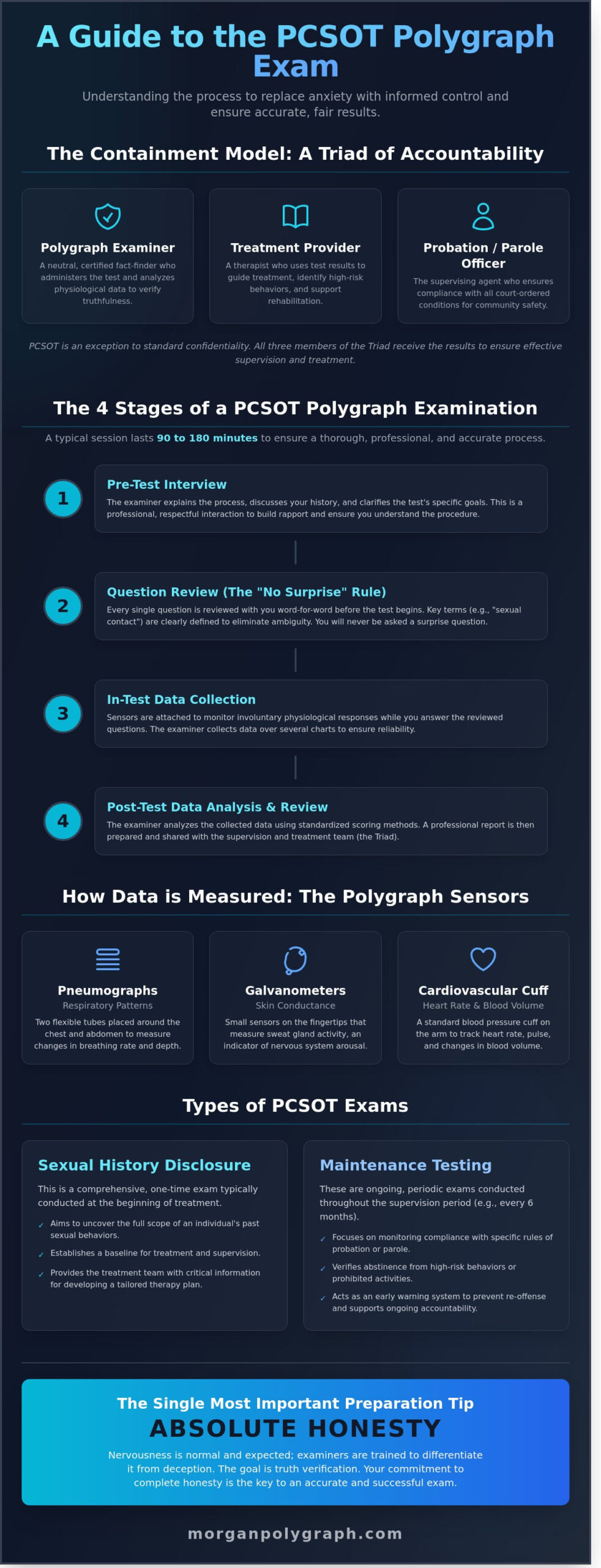
The process uses a “Triad” approach, which is the gold standard for supervision. This team consists of the polygraph examiner, the treatment provider, and the probation or parole officer. Because the primary goal is community safety, PCSOT is a major exception to standard polygraph confidentiality. Every member of the Triad receives the results to coordinate their efforts effectively. It’s essential to work with a certified examiner who understands these specific legal and therapeutic boundaries with professional precision.
The 4 Main Stages of a PCSOT Polygraph Examination
A standard PCSOT examination is a detailed, methodical process that requires a significant time commitment. Most sessions last between 90 and 180 minutes, depending on the complexity of the specific case. This isn’t a rushed procedure. The examiner ensures every detail is addressed in a private, distraction-free environment to maintain the highest levels of accuracy. Throughout this time, the examiner maintains a role as a neutral fact-finder, focusing solely on the data and the truth verification process.
Professional equipment is used to monitor your body’s involuntary responses. These sensors include:
- Pneumographs: Two tubes placed around the chest and abdomen to monitor respiratory patterns.
- Galvanometers: Small attachments on the fingertips that measure sweat gland activity, also known as skin conductance.
- Cardiovascular Cuff: A standard blood pressure cuff used to track heart rate and blood volume changes.
Stage 1 & 2: The Pre-Test Interview and Question Review
The initial phase focuses on communication. The examiner gathers your history and discusses the specific goals of the current test. It’s a time for professional, respectful interaction where you can clarify any concerns. A core component of understanding what to expect during a PCSOT exam is the “No Surprise” rule. We never ask a question during the test that hasn’t been reviewed with you first. This transparency helps reduce situational anxiety that isn’t related to the truthfulness of your answers.
During this stage, we define specific terms. If a question involves “sexual contact,” we’ll discuss the exact legal or clinical definition used for your supervision. This ensures you aren’t guessing at the meaning while the sensors are active. Clear definitions are essential for a fair result. It’s about precision and clarity, not tricking the examinee.
Stage 3 & 4: Data Collection and Post-Test Discussion
The “In-test” phase is when the actual physiological data is recorded. You’ll be asked to sit still and answer the pre-reviewed questions with a simple “yes” or “no.” The examiner runs the charts multiple times to ensure consistency across the data sets. Once the sensors are removed, the examiner carefully analyzes the physiological charts for significant reactions that may indicate deception or stress. Knowing what to expect during a PCSOT exam can help you stay calm during this quiet, focused period.
The final stage is the post-test discussion. This is your opportunity to discuss the results or explain why a specific question may have caused a physiological reaction. It’s a transparent part of the process designed to provide context to the data. If you have questions about the specialized technology used in Idaho for these tests, you can talk with our experts to learn more. We aim to make the process as straightforward and professional as possible for everyone involved.
Types of PCSOT Exams: Sexual History vs. Maintenance Testing
Post-Conviction Sex Offender Testing (PCSOT) isn’t a one-size-fits-all process. Different exams serve specific roles within the containment model, which includes the polygraph examiner, the treatment provider, and the supervision officer. Each test is tailored to a client’s current stage in their rehabilitation and legal supervision. Understanding these distinct categories helps clarify what to expect during a PCSOT exam and why certain questions are being asked.
The “Instant Offense” exam is usually the first step. This test focuses exclusively on the crime of conviction. The examiner verifies the details found in the official police reports and court records. The goal is to ensure the individual takes full responsibility for their actions without minimizing the harm or omitting critical facts. If a client can’t be honest about the crime they were already convicted of, it’s difficult to move forward with effective treatment.
Sexual History Disclosure: Looking at the Past
This exam is often the most intensive part of the process. It’s designed to uncover the full scope of a person’s past behaviors, often going back to childhood. It’s typically divided into two sections. Part I focuses on victim selection and grooming behaviors. Part II examines broader patterns of sexual deviancy and high-risk habits. This comprehensive look is vital for creating an accurate psychosexual evaluation.
The primary goal here is “clearing the deck.” If a therapist doesn’t know the full history, they can’t treat the person effectively. Bringing every past behavior into the light removes the burden of secrets. It allows the treatment team to address the actual root causes of the behavior rather than just the symptoms of the conviction itself.
Maintenance and Monitoring: Checking the Present
Once a baseline of honesty is established, the focus shifts to current compliance. Maintenance and monitoring exams typically occur every 6 to 12 months. These tests act as a safety net for the community and a tool for the supervision officer. When considering what to expect during a PCSOT exam of this type, you’ll find the questions are strictly focused on the time period since the last test.
Common areas of inquiry include:
- Possession of prohibited materials or unauthorized internet use.
- Direct or indirect contact with minors or previous victims.
- Undisclosed romantic or sexual relationships.
- Travel violations or proximity to restricted areas like schools or parks.
- Verifying honesty with the treatment provider and parole officer.
These exams provide an objective layer of accountability. They help confirm that the client is being truthful with their support team. This verification is essential for maintaining trust and ensuring the safety of the public.
How to Prepare for Your Exam: Managing Stress and Expectations
The single most important rule for a successful PCSOT exam is absolute honesty. It’s the foundation of the entire process. If you’re wondering what to expect during a PCSOT exam, you should prioritize transparency above all else. Your examiner isn’t looking for perfection; they’re looking for the truth. Attempting to hide even small details often creates more physiological distress than the facts themselves. This internal conflict is what the equipment detects.
Physical readiness plays a vital role in your performance. Aim for 7 to 8 hours of sleep the night before your appointment. Fatigue can lead to erratic physiological readings that make the data harder to interpret. Eat a balanced meal before you arrive to maintain stable blood sugar levels. If you take prescribed medications for blood pressure, anxiety, or other medical conditions, don’t skip them. Just ensure you inform the examiner about what you’ve taken during the pre-test interview. This information helps us accurately interpret your physiological data without guesswork.
Mindset and Honesty
In the context of post-conviction testing, an omission is often viewed the same as a direct lie. Withholding information creates the same physiological “spike” as a blatant falsehood. Full disclosure provides a significant psychological benefit, especially in a therapeutic setting. It allows you to move forward without the weight of secrets held back from your treatment team. Understanding what to expect during a PCSOT exam involves realizing that the equipment tracks autonomic responses like sweat gland activity and heart rate; it doesn’t measure “nerves” or general anxiety themselves.
Common Misconceptions and Myths
Many people believe they can use “countermeasures” like physical movements or mental distractions to beat the test. Research from the American Polygraph Association indicates these tactics are easily detected by modern sensors and experienced examiners. Attempting them is a fast track to a “deception indicated” result. You should also understand the difference between a standard polygraph test and a PCSOT exam. While a standard test might focus on a single criminal incident, PCSOT is a specialized tool used for long term supervision and monitoring treatment compliance.
If an examiner suggests you’re manipulating the test, stay calm. They’re often observing specific movements or shallow breathing patterns that interfere with the sensors. Simply follow their instructions to sit still and breathe naturally. This clarity ensures your results are based on your answers rather than accidental physical movements. For professional guidance through this process, contact Morgan Polygraph to discuss your upcoming evaluation with a court-recognized expert.
Professional PCSOT Services in Boise: The Morgan Polygraph Difference
Morgan Polygraph stands as a leader in truth verification, backed by over 40 years of combined experience in high-stakes testing. Our examiners are not only nationally certified but are also recognized as court experts within the Idaho judicial system. We don’t just rely on legacy techniques. We utilize the latest innovations in the field, including AI-driven deception detection tools that analyze behavioral speech patterns and facial microexpressions. This technological edge allows us to provide results with a level of accuracy that traditional methods alone cannot match. Despite our scientific focus, we maintain a commitment to compassionate and respectful interactions. We understand that this process is often stressful, and our goal is to provide a neutral, professional environment where you feel heard and respected while you learn what to expect during a PCSOT exam.
Compliance with Idaho SOMB and APA Standards
Working with an examiner who understands the intricacies of the Idaho sex offender registry is essential for successful supervision. We follow the American Polygraph Association (APA) Model Policy without exception. This adherence ensures that your results meet the rigorous standards required by the Idaho Sexual Offender Management Board (SOMB). Our reports are designed to be useful for both defense attorneys and supervision officers, offering a clear window into compliance and treatment progress. By choosing a local expert, you ensure your testing aligns perfectly with Idaho law and local supervision requirements.
Next Steps: Scheduling Your Examination
Coordinating your exam is a straightforward process. First, speak with your probation officer or treatment provider to verify which type of PCSOT you need. This ensures we prepare the correct question sets for your specific case. When you’re ready, call our office to talk with Chip Morgan. He can provide clarity on what to expect during a PCSOT exam and address any logistical concerns you have. Preparation is the key to a successful session. On the day of your appointment, remember to bring the following items:
- A valid government-issued photo ID.
- Your current treatment documents or supervision paperwork.
- A list of any medications you’ve taken in the last 24 hours.
- Any specific instructions provided by your attorney or officer.
We’re here to guide you through every step with the expertise and discretion you deserve. Our methodical approach ensures that the process is transparent and that all parties receive the most accurate data possible.
Take Proactive Control of Your Supervision Journey
Navigating the four structured stages of post-conviction testing requires a blend of preparation and transparency. Understanding what to expect during a PCSOT exam ensures you can approach the pre-test interview and data collection phases with confidence. These examinations serve as essential tools for demonstrating your compliance and commitment to community safety. By focusing on honest disclosure during sexual history or maintenance testing, you provide the clarity needed for effective supervision.
Our team at Morgan Polygraph brings over 40 years of combined experience to every session. As court-recognized experts in Idaho, we utilize cutting-edge AI-powered truth verification technology to provide the most accurate and reliable results. We maintain a professional, compassionate environment where your privacy is always the top priority. You don’t have to navigate this complex process alone or in a state of uncertainty.
Schedule your professional PCSOT exam with Chip Morgan today to ensure your testing is handled by industry leaders. Taking this step shows a commitment to your future and provides the professional support you need to succeed.
Frequently Asked Questions
Is a PCSOT exam different from a regular lie detector test?
Yes, PCSOT exams use specialized protocols approved by the American Polygraph Association specifically for post-conviction supervision. While a standard test might focus on a single criminal incident, these exams evaluate sexual history, current compliance with court orders, or specific behavioral allegations. Our Boise office uses these structured truth verification methods to provide clear data for treatment providers and probation officers. It’s a more comprehensive process than a typical pre-employment or investigative polygraph.
Can I fail the PCSOT polygraph if I am just nervous?
You won’t fail the exam simply because you’re nervous; our examiners expect a high level of stress from every client. The process includes a pre-test phase where the expert establishes your physiological baseline. This baseline allows the examiner to distinguish between general anxiety and the specific physiological changes that indicate deception. We use cutting-edge technology to ensure your natural jitters don’t interfere with the accuracy of the final results.
What happens if the polygraph results show “Deception Indicated”?
A result of Deception Indicated means the physiological data suggests you weren’t truthful during the testing phase. When this occurs, the examiner typically conducts a post-test interview to discuss the specific areas where the sensors detected a reaction. This is a critical part of what to expect during a PCSOT exam because the final report goes directly to your supervision team. This report can influence your treatment requirements or your current probation status.
How long does a PCSOT exam typically take in the Boise office?
A typical PCSOT exam in our Boise office takes between 90 and 180 minutes to complete. This timeframe provides enough room for a thorough pre-test interview, the actual data collection phase, and a brief post-test discussion. Chip Morgan’s 40 years of combined experience ensures the process is methodical and professional without being rushed. We ask all clients to arrive 15 minutes early to complete paperwork and ensure the schedule remains on track.
Do I have to pay for my own court-ordered PCSOT exam?
The examinee is responsible for the cost of a court-ordered exam in almost all Idaho jurisdictions. While the court or a probation officer mandates the testing, they don’t provide the funding for private truth verification services. We offer a full range of testing at competitive rates to help you meet these legal obligations. You should confirm payment arrangements with your attorney or your probation officer before you arrive for your scheduled appointment.
Are the results of my PCSOT exam admissible in an Idaho court?
Polygraph results are generally not admissible as direct evidence in Idaho criminal trials based on the 1989 State v. Fain ruling. However, they’re frequently used in post-conviction settings, such as probation violation hearings or treatment progress reviews. Even if the results aren’t used in a jury trial, they remain a vital tool for the court to monitor your compliance. This makes the accuracy of our expert truth verification essential for your ongoing legal standing.
Can I bring my attorney or therapist into the exam room with me?
You cannot have an attorney, therapist, or any other third party in the room during the actual examination. To maintain the integrity of the physiological data, the testing environment must stay strictly controlled and free from outside distractions. This policy follows American Polygraph Association guidelines to ensure the highest level of accuracy for every client. Your representatives are welcome to wait in the reception area or discuss the process with the examiner before the session begins.
What should I do if I disagree with the examiner’s findings?
If you disagree with the findings, you have the right to request a formal quality control review of your charts. This involves another certified professional reviewing the data collected during your session to ensure the original conclusion was scientifically sound. We adhere to strict professional standards, and our methodical approach is designed to be transparent. Seeking a second opinion from an independent, certified expert is also a common step for those questioning the initial results.