

What if the most intimidating part of a truth verification exam isn’t the sensors, but the fear that an examiner will ask about your private life? Many people walk into our offices feeling vulnerable; they worry they’ll be “tricked” into failing or forced to disclose personal secrets that have nothing to do with the case. It’s a valid concern because your privacy is protected by strict federal guidelines. Knowing exactly what questions are not allowed in a polygraph is the best way to replace that anxiety with confident preparation.
We agree that a professional exam should never feel like an interrogation into your personal beliefs or private history. This guide details the legal and technical boundaries that govern every certified examination, specifically focusing on protections under the Employee Polygraph Protection Act of 1988. You’ll learn the specific “no-go” zones for examiners, how to handle the pre-test interview with ease, and the red flags that signal an unethical professional. By the end of this article, you’ll feel ready to approach your appointment with a clear understanding of your legal rights and the expert standards we uphold.
Key Takeaways
- Learn about the specific legal protections and ethical standards that safeguard examinees from intrusive or inappropriate questioning.
- Understand the technical science of truth verification and discover exactly what questions are not allowed in a polygraph to ensure a valid result.
- Discover why professional examiners prohibit “fishing expeditions” into a person’s entire past during sensitive relationship or family testing.
- Debunk common myths by learning why surprise “gotcha” questions are strictly forbidden to maintain the psychological integrity of the exam.
- Identify how to ensure a fair examination in Boise by selecting a court-recognized expert who integrates innovative technology with compassionate, ethical practices.
The Legal Framework: Questions Prohibited by Law and Ethics
Understanding what questions are not allowed in a polygraph is essential for any examinee. Truth verification is a regulated science. It isn’t a tool for personal intrusion. Legal frameworks and ethical codes protect the dignity of the examinee. They also ensure the accuracy of the results. Organizations like the American Polygraph Association (APA), founded in 1966, set strict guidelines for their members. These guidelines prohibit examiners from asking about personal beliefs or lifestyle choices that have no bearing on the investigation. This Polygraph overview explains how the technology measures physiological responses. Maintaining a focused, relevant question set is vital for a valid exam. Rules differ depending on the context. Criminal investigations allow for more leeway in case-specific details. Private-sector employment tests are the most restricted.
The Employee Polygraph Protection Act (EPPA)
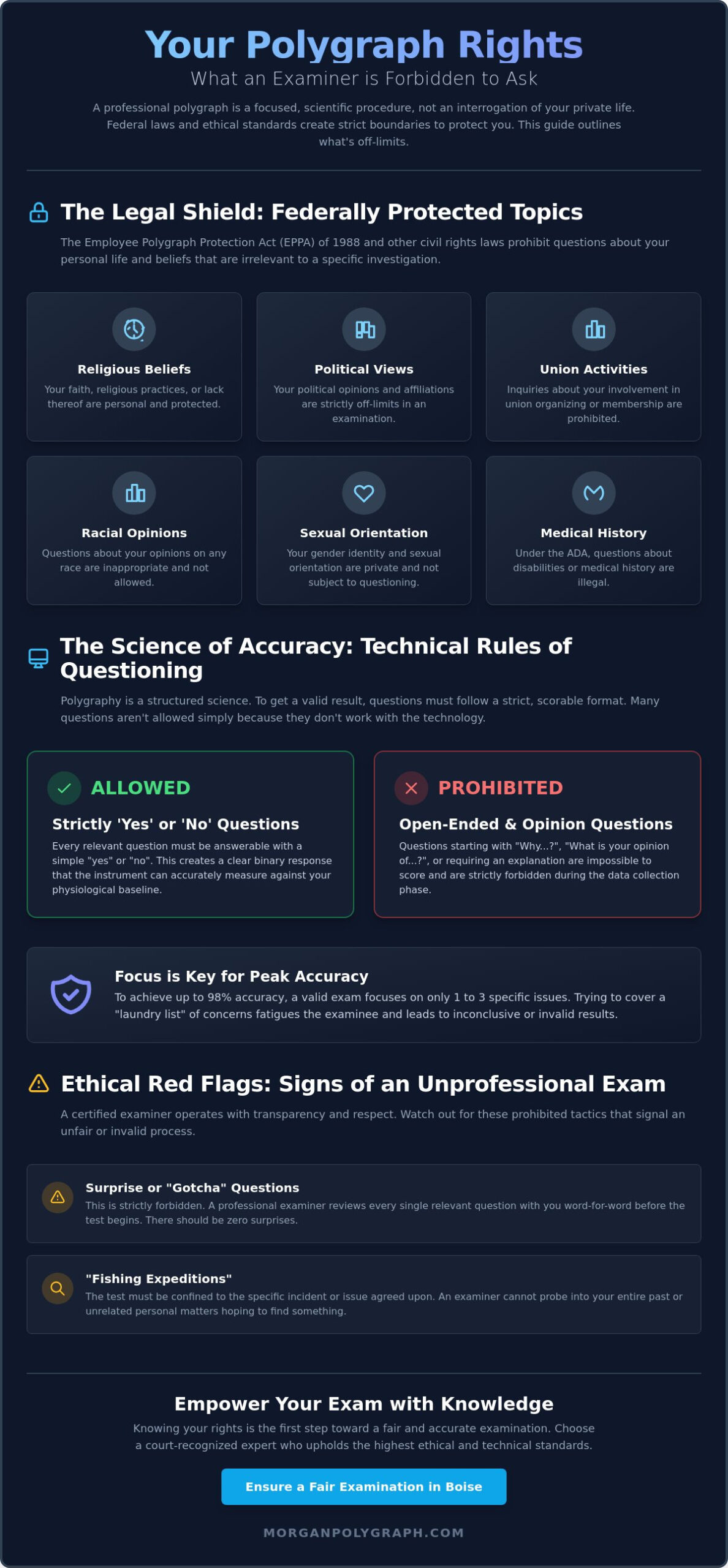
The Employee Polygraph Protection Act (EPPA) of 1988 serves as the primary federal shield for private-sector employees. This law strictly limits pre-employment questioning. It ensures that most workers aren’t subjected to tests as a condition of hiring. Under federal law, specific topics are strictly off-limits. These include religious beliefs, political affiliations, and union activities. Knowing what questions are not allowed in a polygraph helps employees recognize when their rights are being violated. Examiners cannot ask about racial opinions or any matter not related to a specific economic loss or injury to the employer. This legislation transformed the industry by prioritizing worker privacy over broad corporate curiosity.
Civil Rights and Privacy Protections
Modern ethical standards expand these protections to include deeply personal identity factors. Questions regarding sexual orientation or gender identity are prohibited in professional examinations. The Americans with Disabilities Act of 1990 makes it illegal to ask about an examinee’s medical history or disability status during a polygraph. In Idaho, state law further reinforces these privacy protections. Idaho Code § 44-701 prevents employers from requiring lie detector tests as a condition of employment in many private sectors. Professional examiners focus solely on the facts of the case. They respect the boundaries of the law and the privacy of the individual. This methodical approach ensures that the process remains professional and focused on the specific issue at hand.
Technical Constraints: Why Format Dictates What Is Not Allowed
The science of polygraphy relies on the body’s involuntary physiological responses to specific stimuli. It’s a structured forensic procedure, not a casual interview. Because the technology measures changes in blood pressure, respiration, and skin conductivity, the format of the exam is strictly controlled. When people ask what questions are not allowed in a polygraph, they often expect a list of forbidden topics. While certain subjects are legally off-limits, many questions are disallowed simply because they are technically impossible to score accurately. For instance, questions starting with “why” are strictly prohibited. These questions probe internal motivations and complex reasoning, which don’t produce the clear, binary physiological “spike” required for truth verification.
A valid examination consists of three specific question types: relevant, comparison, and irrelevant. Relevant questions address the core issue. Irrelevant questions, such as “Is today Tuesday?”, establish a baseline. Comparison questions help the examiner distinguish between general anxiety and specific deception. If a client provides a “laundry list” of twenty different concerns, a professional examiner will reject it. Over-testing leads to physical fatigue and “habituation,” where the body stops reacting to stimuli. Most exams conducted by court-recognized experts focus on one to three specific issues to maintain 98% accuracy levels. Beyond the technical limits, certain topics like religious beliefs or political affiliations are prohibited by the Employee Polygraph Protection Act of 1988 in most workplace settings.
The “Yes or No” Rule: Avoiding Open-Ended Questions
Every question during the data-collection phase must be answerable with a simple “yes” or “no.” This is a non-negotiable rule in modern psychophysiology. Open-ended questions require the examinee to speak at length, which creates “noise” in the physiological data. The act of thinking through a narrative and moving the muscles required for speech contaminates the charts, often leading to inconclusive results. To ensure clarity, questions must be direct, short, and free of legal jargon. If a question is too long or complex, the subject’s brain processes different parts of the sentence at different times, making it impossible for the examiner to pin a reaction to a specific word or thought.
Narrowing the Scope: The “Issue vs. Detail” Rule
Effective testing focuses on actions rather than intent. Questions about what someone was “thinking about” or their “future plans” are generally disallowed because the polygraph cannot verify a person’s state of mind. Similarly, “compound questions” that ask about two different things at once are rejected. For example, asking “Did you take the money and the keys?” is invalid; if the person took the money but not the keys, their “no” is partially true and partially false, which confuses the physiological output. At Morgan Polygraph, we work closely with clients to refine broad “issues” into testable, concrete questions that meet professional standards. If you’re unsure how to phrase your concerns, you can talk with Chip to ensure your exam remains legally and technically sound.
Ethical Boundaries in Private and Relationship Testing
Private polygraph examinations, particularly those involving family or romantic partners, require a high level of sensitivity. These tests often occur during moments of extreme personal crisis. A professional examiner doesn’t just run a machine; they manage a human experience. Maintaining a compassionate and respectful environment is essential for obtaining valid results. If an examinee feels attacked or judged, their baseline physiological readings become erratic, making the data difficult to interpret accurately. Our goal is truth verification, not psychological intimidation.
One of the most critical ethical rules involves avoiding “fishing expeditions.” This refers to broad, open-ended inquiries into a person’s entire romantic or sexual history. Such questions lack the specificity required for a clear physiological response. To ensure clarity, questions must be time-bound. For example, asking about specific actions “since the date of the marriage” or “within the last 12 months” provides the brain with a concrete window of time to scan for memories. This precision is what separates a professional examination from a standard interrogation. Understanding what questions are not allowed in a polygraph is vital for maintaining the test’s integrity and protecting the dignity of everyone involved.
Infidelity Testing: What is Off-Limits?
When clients seek an accurate infidelity test, they’re often looking for closure. However, there are strict rules regarding what questions are not allowed in a polygraph during these sessions. Examiners must refuse to ask about “lurid details” or specific sexual acts that don’t serve the core issue of the betrayal. These details are often requested out of hurt or curiosity, but they don’t help determine the truth of the incident itself.
Additionally, questions about “love,” “attraction,” or “feelings” are strictly prohibited. These concepts are entirely subjective. A person might feel a flicker of attraction without ever intending to act on it. Because the polygraph measures the body’s reaction to the fear of detection regarding a specific fact, it can’t quantify an emotion. We focus on physical acts, such as sexual contact or secret meetings, to maintain the scientific validity of the results. This focus prevents the test from devolving into a subjective debate about personal intent.
The Role of the Pre-Test Interview
Transparency is the foundation of a credible polygraph. Every examinee must see and approve every single question before the sensors are even attached to their body. This happens during the pre-test interview, a phase that often lasts between 45 and 60 minutes. During this time, the examiner and the examinee review the wording together to ensure there’s no ambiguity. If a question is confusing, it’s rewritten until it’s clear and direct.
There’s a hard prohibition against “surprise” questions. Once the recording phase begins, the examiner cannot deviate from the agreed-upon list. This transparency builds the trust necessary for the examinee to remain focused on the facts. It also ensures that any physiological spike is a reaction to a specific memory of deception, not a reaction to being startled by a new topic. This methodical approach is a hallmark of the 40 years of combined experience we bring to every Idaho case, ensuring that every interaction remains professional and discreet.
Why “Trick Questions” and Surprises are Prohibited
Cinema and television often depict the polygraph as a psychological trap where a surprise “gotcha” question forces an immediate confession. This is a total myth. In professional practice, surprise is the enemy of accuracy. Every question must be reviewed word-for-word with the examinee before the test begins. This protocol isn’t just about fairness; it’s about the physiological science of truth verification. When a person is surprised, their body undergoes a “startle response” that mimics the physiological signs of lying. This makes the data useless for a valid analysis.
When determining what questions are not allowed in a polygraph, anything unscripted or unreviewed is at the top of the list. Professional examiners prioritize a controlled environment where the only variable is the examinee’s truthfulness regarding the specific incident under review. This methodical approach is why polygraph results maintain high levels of reliability when conducted by experts following established standards.
The Myth of the “Unexpected” Question
Professional standards require that no question be asked that wasn’t previously reviewed. Surprise causes an immediate spike in heart rate and skin conductivity. These reactions are indistinguishable from deception. To get a clean reading, the examiner must eliminate the “startle” factor entirely. A fair test is a predictable test for the examinee. This transparency allows the examinee to focus solely on the facts of the case rather than worrying about a hidden agenda or a sudden shift in the line of questioning.
Handling Ambiguity and Misunderstandings
Linguistic clarity is vital for a successful exam. If an examinee doesn’t fully understand a term, like “sexual contact” or “unauthorized access,” their brain may “search” for answers, causing a false positive. Certified examiners spend 45 to 60 minutes in the pre-test phase defining every term used in the questions. This ensures there’s no confusion once the sensors are active.
- Definition of Terms: Every verb and noun is vetted to match the examinee’s vocabulary and education level.
- Linguistic Clarity: Questions are kept short and direct to avoid cognitive overload or confusion.
- Outside Issue Protocol: Examiners ask if any external stressors, like a separate legal battle or a family emergency, are weighing on the examinee’s mind to ensure they don’t interfere with the results.
By addressing these “outside issues” before the test starts, the examiner can isolate the physiological responses to the relevant questions. This meticulous preparation is a hallmark of a professional exam. If you need a professional, expert evaluation that follows these strict ethical protocols, contact Morgan Polygraph to schedule a consultation.
Navigating Your Polygraph in Boise: Ensuring a Fair Examination
Boise residents seeking truth verification deserve a process that respects both the law and personal dignity. Morgan Polygraph bridges the gap between decades of traditional experience and the latest scientific advancements. Chip Morgan has built a reputation over 40 years for conducting examinations that adhere to strict ethical standards. This is especially critical when determining what questions are not allowed in a polygraph under Idaho and federal regulations. Choosing a court-recognized expert ensures that your examination remains professional and legally defensible.
Innovation Meets Tradition: AI and Fairness
We integrate cutting-edge AI-powered deception detection tools to enhance the fairness of every test. These systems include behavioral speech analysis and facial microexpression recognition. By using these tools, we significantly reduce the risk of examiner bias. Modern technology makes it harder for unethical or irrelevant questions to slip through the process. These AI systems act as a digital safeguard, ensuring the test stays within strict ethical bounds. This combination of 40 years of experience and new technology provides a layer of protection that traditional methods cannot match.
Your Rights as an Examinee
You aren’t just a subject in a chair. You are an individual with specific legal protections and rights. If you feel an examiner is veering into prohibited territory, you have the authority to stop the process. It’s vital to understand what questions are not allowed in a polygraph before you begin. At Morgan Polygraph, we prioritize professional and respectful interactions. We maintain a methodical approach to ensure every examinee feels heard and protected.
- The right to terminate: You can end the exam at any time if you feel uncomfortable or if the examiner becomes unprofessional.
- The right to respect: You deserve a compassionate and respectful interaction, regardless of the nature of the test.
- The right to review: You should be informed of all questions before the actual testing phase begins.
If you have specific concerns about your upcoming test or the legalities involved, you should contact Chip Morgan to discuss your situation privately. We handle all inquiries with the utmost discretion. Our goal is to provide truth verification that is accurate, ethical, and confidential.
To schedule a professional examination, call our Boise office. We offer a full range of testing services at competitive pricing. Please be patient as we coordinate a time that ensures your absolute privacy. Your path to clarity starts with an expert who respects the boundaries of the law and the rights of the individual.
Securing Truth Through Ethical Standards
Navigating the complexities of truth verification requires more than just equipment; it demands a deep understanding of legal and ethical boundaries. You’ve learned that examinations must focus on specific, relevant facts rather than personal beliefs or prohibited topics like religious affiliations and political leanings. Knowing exactly what questions are not allowed in a polygraph ensures your rights stay protected while maintaining the integrity of the results. Professional testing relies on clear, pre-approved questions that eliminate surprises and focus strictly on the issue at hand.
Morgan Polygraph brings over 40 years of combined polygraph testing experience to every case we handle. As nationally certified and court-recognized experts, we don’t just follow the standard; we set it by integrating innovative AI-powered deception detection tools into our workflow. This blend of traditional expertise and forward-thinking technology provides a level of accuracy you can trust. We understand the stress involved in these situations and prioritize professional, compassionate interactions with every client who walks through our doors.
Talk with Chip Morgan today for a confidential consultation to get the clarity and peace of mind you deserve. We’re ready to help you move forward with confidence and respect.
Frequently Asked Questions
Can a polygraph examiner ask about my past drug use?
An examiner can ask about drug use, but the scope is usually limited by the purpose of the test. In employment screenings, the Employee Polygraph Protection Act of 1988 restricts questions to illegal acts relevant to the position. Most professional exams focus on drug activity within the last 3 to 5 years. This ensures the data stays relevant to your current reliability and professional standing.
Are they allowed to ask about my religious or political beliefs?
No, examiners are strictly prohibited from asking about your religious affiliations or political leanings. Under federal law and American Polygraph Association ethics, these topics are off-limits because they don’t relate to a person’s honesty. If an examiner probes into your 2024 voting choices or your church attendance, they’ve crossed a legal boundary. These inquiries are considered discriminatory and have no place in a professional truth verification session.
What happens if I refuse to answer a specific question during the test?
You have the legal right to refuse any question, but doing so usually ends the examination. Because the polygraph relies on a complete data set to reach an accuracy level of 90% or higher, an unanswered question makes the results “inconclusive.” In Idaho and other states, a refusal is often documented as a failure to cooperate with the testing protocol. It’s best to discuss any concerns during the pre-test interview.
Can the examiner ask me “trick” questions to see if I am lying?
Professional examiners don’t use trick questions; every single query must be reviewed with you word-for-word before the test begins. If you’re wondering what questions are not allowed in a polygraph, any question that wasn’t part of your pre-test review is the primary answer. Surprise questions violate 2023 ASTM International standards. They trigger a “startle response” that ruins the physiological data, making the entire test invalid for expert analysis.
Is it legal for an employer to ask about my medical history during a polygraph?
It’s generally illegal for an employer to probe your medical history during a test under the Americans with Disabilities Act of 1990. An examiner may ask if you’re taking medications that affect your heart rate or blood pressure to ensure test accuracy. However, they can’t ask about specific diagnoses or mental health conditions. Federal law protects 100% of examinees from being forced to disclose private medical records during these sessions.
Are there questions that are always asked in every polygraph test?
Yes, every standard exam includes “control” or “comparison” questions to establish your physiological baseline. These are broad questions about your past, such as “Before the age of 21, did you ever take something that didn’t belong to you?” The examiner uses your reaction to these minor, common life events to calibrate the equipment. This process allows the expert to accurately compare your baseline responses against the relevant questions about the specific incident.
Can an examiner ask about my sexual orientation or preferences?
No, questions about sexual orientation, preferences, or private lifestyle choices are strictly forbidden. The Equal Employment Opportunity Commission and the EPPA protect individuals from these intrusive inquiries in all 50 states. Unless the polygraph is part of a specific criminal investigation into a sex crime, these topics are legally irrelevant. A certified examiner will never ask about your private life, as it doesn’t impact truthfulness or professional integrity.
What should I do if the examiner asks a question we didn’t review in the pre-test?
You should immediately stop the exam and inform the examiner that the question wasn’t reviewed. Professional ethics require that you’re 100% aware of every question before the sensors start recording. If an examiner persists with unreviewed questions, you’ve the right to terminate the session. You can then report the incident to the American Polygraph Association or the relevant state licensing board to protect your rights and ensure professional accountability.