

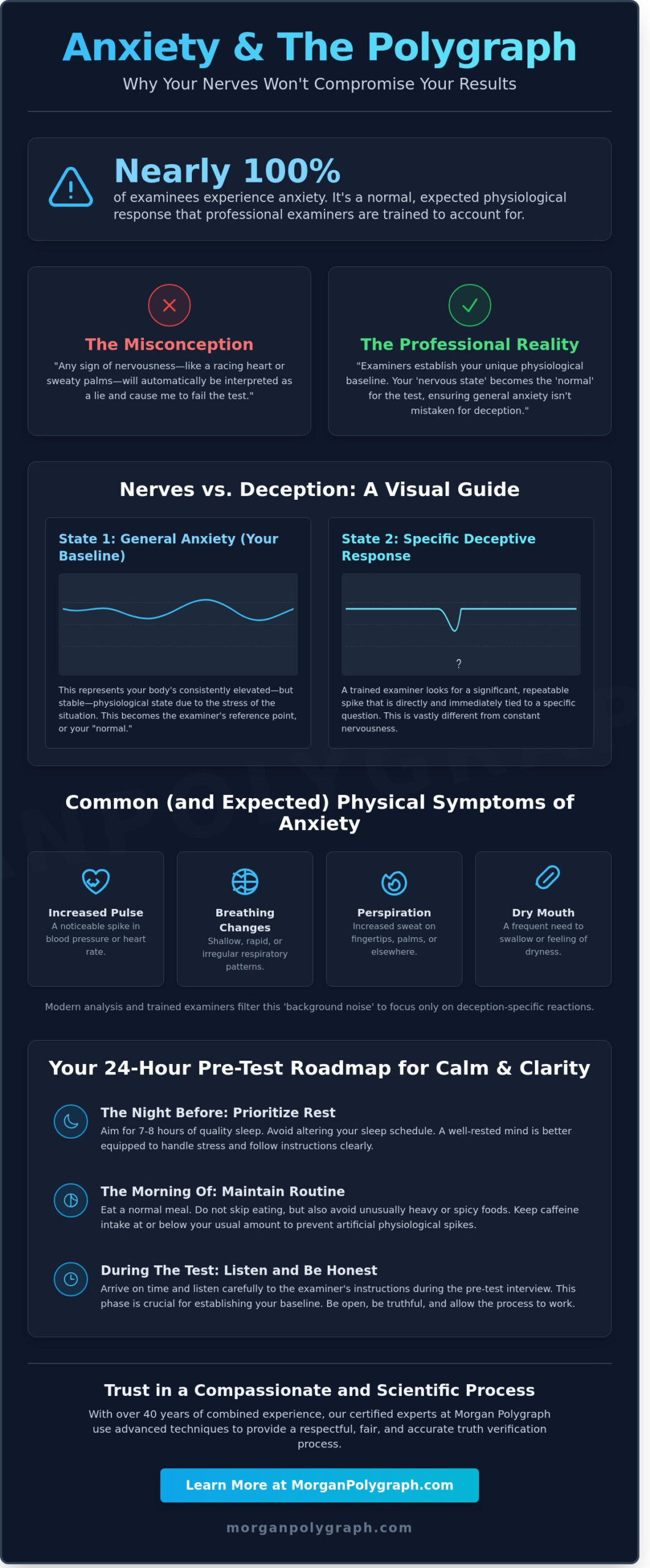
Feeling your heart hammer against your ribs doesn’t mean you are going to fail your polygraph. In fact, nearly 100% of examinees experience significant anxiety before a lie detector test, regardless of whether they are telling the truth. It is a common misconception that a spike in blood pressure or a bead of sweat automatically signals deception. Professional examiners are trained to account for these physiological responses from the moment you walk into the room.
We understand that the fear of being wrongly accused feels overwhelming when your body seems to be working against you. This guide will show you how our team uses over 40 years of combined experience to distinguish between normal stress and actual deception, ensuring your results are accurate. You will learn about the examiner’s role in filtering out “test jitters” and find actionable tips to help you remain calm during the procedure. We are here to provide the clarity and reassurance you need to approach your truth verification with confidence.
Key Takeaways
- Understand why experiencing anxiety before a lie detector test is a standard physiological response that expert examiners are trained to distinguish from actual deception.
- Learn how the Comparison Question Technique (CQT) provides a scientific baseline to ensure your natural nerves do not interfere with the accuracy of your results.
- Discover the professional safeguards and advanced behavioral analysis tools used by certified experts to prevent false positives caused by stress.
- Get a practical 24-hour roadmap covering sleep and nutrition to help you arrive at your examination feeling physically prepared and calm.
- Explore how the compassionate approach at Morgan Polygraph leverages over 40 years of experience to provide a respectful and accurate truth verification process.
Understanding Anxiety Before a Lie Detector Test
Feeling a surge of adrenaline or a knot in your stomach is a standard part of the truth verification process. In Idaho and across the country, professional examiners consider anxiety before a lie detector test to be the most frequent reaction encountered during an appointment. It’s a natural response to a high-stakes environment. We recognize that even the most honest individuals feel a level of apprehension when their integrity is being examined. Our team at Morgan Polygraph approaches every session with the understanding that nerves are expected, not penalized.
The polygraph doesn’t measure “lies” in a vacuum. Instead, it monitors your Autonomic Nervous System (ANS). This system controls involuntary functions like your heart rate, respiratory patterns, and sweat gland activity. To ensure accuracy, examiners distinguish between “situational anxiety,” which is the general stress of being in an exam room, and a “deceptive response,” which is a specific, localized reaction to a particular question. For a detailed Polygraph overview, one can see how these physiological markers have been studied for over 100 years to refine detection methods. We expect a baseline level of stress from every honest person who walks through our doors.
The ‘Nervous Truth-Teller’ Myth
Many clients worry that a racing heart signifies an automatic failure. This is a common misconception that creates unnecessary anxiety before a lie detector test. Truth verification isn’t a binary pass-fail outcome based on a single spike in your pulse. Professional examiners establish a baseline of your normal stress levels during the pre-test phase. We look for significant, repeatable deviations from that baseline, not just general nervousness. If your heart rate stays consistently high because you’re worried about the process, that becomes your “normal” for the duration of the test. Our experts are trained to identify the difference between a person who is simply jittery and one who is attempting to conceal the truth.
Common Physical Symptoms of Polygraph Anxiety
Anxiety manifests through several predictable physical channels that we see in almost every session. You might experience some of the following behaviors:
- Increased perspiration on the fingertips or palms.
- Shallow, rapid, or irregular breathing patterns.
- A noticeable spike in blood pressure or pulse rate.
- Dry mouth or a frequent need to swallow.
Sensors like pneumograph tubes and galvanometers track these changes with high precision. However, modern analysis techniques, often enhanced by cutting-edge AI-powered tools, filter out this background noise. We focus on the specific physiological shifts that occur only when a deceptive person perceives a threat to their well-being. Your general jitters won’t be mistaken for a lie because they don’t follow the specific patterns of deception. We use a methodical approach to ensure your physical symptoms are interpreted with compassion and scientific rigor.
The Science of Polygraphy: Nerves vs. Deception
A polygraph exam doesn’t measure lies directly; it monitors physiological changes triggered by the autonomic nervous system. When you experience anxiety before a lie detector test, your heart rate, blood pressure, and sweat gland activity may increase naturally. Certified examiners use the Comparison Question Technique (CQT) to distinguish between these general nerves and the specific physiological spikes caused by deception. Modern 2026 protocols rely on psychological science on polygraphs to ensure that your results are based on objective data. The technology used today involves sophisticated sensors, including dual pneumographs to monitor breathing and high-sensitivity galvanometers to track skin conductance, ensuring every nuance of your body’s response is captured accurately.
How the Baseline Protects You
Every exam at Morgan Polygraph begins with a detailed calibration phase to ensure the equipment is tuned to your specific body chemistry. This process allows the examiner to establish your physiological baseline. Your physiological baseline is your unique “normal” state of physical arousal while under the inherent stress of the testing environment. We don’t compare your readings to a universal average or a “perfectly calm” person. Instead, the examiner uses “control questions” to gauge your honest nervous response to non-threatening topics. This creates a customized map of how your body reacts when telling the truth, protecting you from being penalized for simply being a naturally anxious person.
Specific Reactions vs. General Stress
Professional examiners are trained to identify the difference between tonic and phasic responses. Tonic reactions represent your overall level of anxiety before a lie detector test; this is the consistent, long-term stress that stays with you throughout the entire session. Phasic reactions are short-term, sharp spikes that occur only when a specific stimulus, such as a direct question about the incident, is presented.
General anxiety is like background noise on a radio. A skilled examiner tunes out that static to listen for the specific signal of a deceptive reaction. Because these protocols are standardized and validated by decades of research, your general “jittery” feeling won’t be mistaken for a lie. The examiner looks for a cluster of reactions that occur within a specific five-second window following a question. If those reactions don’t appear in a consistent, repeatable pattern, the data doesn’t support a finding of deception. If you have concerns about how your specific medical history or stress levels might impact the sensors, you can talk with Chip to get professional clarity before your appointment begins.
Why Your Nerves Won’t Cause a False Positive
Experiencing anxiety before a lie detector test is a standard physiological response that professional examiners encounter every day. You aren’t the first person to feel your heart race in the exam chair, and you won’t be the last. Modern truth verification relies on sophisticated safeguards designed specifically to separate general nervous tension from the physiological shifts triggered by deception. Examiners at Morgan Polygraph bring over 40 years of combined experience to every session, utilizing behavioral speech analysis and facial micro-expression recognition to ensure the highest levels of accuracy.
While psychological science on polygraph tests acknowledges that stress can elevate heart rate or perspiration, a certified examiner doesn’t view these spikes in isolation. They look for specific, repeatable patterns that occur only when a subject is being untruthful. Many people wonder are polygraphs accurate when the subject is terrified; the answer is yes, because the methodology accounts for the human emotional spectrum. The equipment measures your unique baseline, meaning the test is calibrated to your specific level of “nervous” before the actual questioning begins.
The Role of the Pre-Test Interview
The pre-test interview is the most critical phase for managing anxiety. It typically lasts 30 to 45 minutes and serves to remove the “surprise” factor that often leads to false positives. During this time, the examiner reviews every single question with you word-for-word. There are no trick questions or sudden reveals during the actual exam. By building rapport, the examiner lowers your perceived threat level, transforming the environment from a perceived interrogation into a professional evaluation. Being transparent about your fears helps the examiner understand your baseline physiological state more clearly.
Addressing Anxiety Disorders and Medications
If you live with clinical anxiety or PTSD, don’t worry that your diagnosis will automatically fail you. You should inform your examiner about your condition and any prescribed medications during the intake process. Common prescriptions like SSRIs or beta-blockers are noted in the final report but rarely invalidate the test data. However, you should never attempt to suppress your nerves with unprescribed substances or alcohol. These choices create irregular physiological patterns that are easily detected by modern sensors and often lead to an inconclusive result or a requirement for a re-test.
Practical Tips to Manage Polygraph Anxiety
Managing the physiological spikes associated with anxiety before a lie detector test starts with a structured 24-hour plan. Your goal isn’t to eliminate every trace of nervousness. Instead, you want to ensure your body remains in a stable, baseline state so the examiner can clearly distinguish between general stress and specific reactions. Professional examiners expect a certain level of apprehension and use the pre-test interview to establish your normal physiological baseline.
The Night Before: Preparation and Rest
Physical readiness is the foundation of a successful examination. You should aim for 7 to 8 hours of sleep. Sleep deprivation destabilizes the Autonomic Nervous System, which can lead to erratic physiological readings that make the charts harder to interpret. On the morning of your appointment, stick to your normal routine but avoid excessive caffeine or unusual stimulants. If you usually drink one cup of coffee, don’t have three. High doses of stimulants can mimic the physical signs of stress and lead to unnecessary restlessness. We recommend arriving at our Boise office at least 15 minutes early. This buffer prevents “rush” anxiety from bleeding into the start of your session, allowing you to settle into the environment before the sensors are attached.
During the Test: Mindset and Breathing
One of the most common mistakes is trying to “help” the technology by over-performing or exaggerating your responses. This usually backfires. The most effective strategy is to rely on the “Truth-Teller’s Advantage.” Modern forensic psychology indicates that telling the truth requires significantly less cognitive effort than fabrication. When you’re honest, your brain doesn’t have to manage the mental load of maintaining a lie, which naturally keeps your heart rate and respiration more stable.
Follow these practical steps during the process to maintain composure:
- Follow all directions: Listen closely to the examiner’s instructions regarding movement and posture. Staying still is vital for chart clarity.
- Avoid “countermeasure” research: Don’t spend time online looking for ways to beat the test. Most of that information is based on outdated myths that actually increase your stress levels and can lead to a “deceptive” result because of your intentional physical interference.
- Breathe naturally: Maintain a steady, natural breathing pattern. Trying to manually control your breath often creates the very irregularities the machine is designed to flag.
If you want full transparency about the process, read our complete guide to the polygraph test. Understanding the science behind the sensors helps demystify the experience. At Morgan Polygraph, we use cutting-edge tools to ensure accuracy, but your cooperation is the most important variable. You don’t need to be perfectly calm to pass; you just need to be honest.
Professional Truth Verification in Boise, Idaho
Choosing the right examiner changes your entire experience. At Morgan Polygraph, we don’t just run tests; we provide clarity through a professional, compassionate, and respectful process. Our Boise office is a neutral space designed to help you feel at ease. We understand that managing anxiety before a lie detector test is a significant hurdle for many people. That’s why we focus on creating an environment of calm, collected confidence from the moment you walk through our doors.
Chip Morgan brings over 40 years of combined polygraph experience to the table. He’s handled thousands of high-stress cases, ranging from criminal investigations to sensitive private matters. To ensure the highest level of accuracy, we integrate cutting-edge AI-powered deception detection tools into our practice. These systems utilize behavioral speech analysis and facial microexpression recognition to support traditional polygraph data. We don’t just follow the future of truth verification; we help shape it by using every scientific tool available to confirm the facts.
Expertise You Can Trust
Reliability is the cornerstone of our business. Chip Morgan is a court-recognized expert and holds national certification, which serves as a symbol of his authority in the polygraph community. We maintain strict discretion in every case. This is especially vital for clients seeking an infidelity test to resolve personal disputes. Our goal is always truth verification, not “trapping” the examinee. We use a methodical, scientific approach to ensure the results are defensible and accurate.
Next Steps: Scheduling Your Exam in Boise
The path to peace of mind starts with a direct conversation. You can reach out to Chip Morgan via email at Lieguy@gmail.com or call our office for a preliminary discussion. Every client receives a patient and respectful interaction. We take the time to explain the equipment and the questioning process, which often helps lower anxiety before a lie detector test. Knowing what to expect is half the battle. Don’t let uncertainty or nerves keep you from finding the answers you need.
Schedule your confidential polygraph test in Boise today and work with a seasoned expert who values your privacy and the truth.
Take Control of Your Truth Verification
Understanding that anxiety before a lie detector test is a standard physiological response helps demystify the entire process. Modern polygraph science focuses on identifying specific patterns of deception that differ significantly from ordinary stress. With over 40 years of combined polygraph experience, our team ensures that your nervous system doesn’t dictate your results. We utilize state-of-the-art AI-powered deception detection tools, including behavioral speech analysis, to provide the most accurate readings possible in the industry today.
Our nationally certified and court-recognized experts prioritize a professional and compassionate environment for every client. We’ve spent decades refining techniques that separate human emotion from factual data. You can rely on our proven track record of integrity and precision to handle your case with the discretion it deserves. Don’t let uncertainty hold you back when professional help is available right here in Boise.
Ease your mind and verify the truth; contact Morgan Polygraph in Boise today.
You’re in capable hands, and we’re here to guide you through every step of the process with confidence.
Frequently Asked Questions
Can being nervous make you fail a lie detector test?
Being nervous won’t cause you to fail because examiners establish a physiological baseline before the actual questioning begins. According to the American Polygraph Association, professional testing reaches accuracy levels between 87% and 90% by comparing your responses to this steady state. We look for specific deviations from your normal resting patterns, not just a high heart rate. Your anxiety before a lie detector test is an expected variable that we account for during the initial 60 minute calibration phase.
What happens if I have a panic attack during the polygraph?
If you experience a panic attack, the examiner will immediately stop the session and provide a cooling-off period. Our goal is truth verification through a stable physiological state, so we’ll wait until your vitals return to your established baseline. Chip Morgan’s 40 years of experience ensures that the environment remains respectful and professional. We won’t resume the process until you’re physically capable of providing clear and consistent responses.
Do examiners think everyone who is nervous is lying?
No, examiners assume that every person sitting for a test is experiencing significant stress. Statistics from the polygraph community suggest that 100% of innocent subjects show some level of apprehension during the procedure. We’re trained to distinguish between general situational anxiety and the specific physiological signatures of deception. Our use of AI-powered tools helps filter out background noise caused by simple nerves, ensuring a fair and accurate result for every client.
Should I take anti-anxiety medication before my polygraph?
You should take your prescribed medications exactly as directed by your physician, but you must disclose them during the pre-test interview. About 13% of American adults use antidepressant medications according to 2020 CDC reports. These substances don’t hide lies; they simply shift your physiological baseline. We document all medications to ensure the chart analysis is performed with the correct context of your body’s specific chemical and physical capabilities.
How do I stop my heart from racing during the test?
You don’t need to stop your heart from racing, as we expect your pulse to be elevated from the moment you arrive. Trying to manually suppress your heart rate can actually create irregular patterns that look like intentional countermeasures. Instead, focus on following the examiner’s instructions and breathing naturally. Managing your anxiety before a lie detector test is easier when you realize the equipment is calibrated to your specific heart rate at that exact moment.
Can a polygraph detect the difference between a lie and a ‘white lie’ told out of nerves?
Yes, the polygraph distinguishes between nervous reactions and deceptive responses by comparing your reactions to control questions versus relevant questions. A white lie about a minor detail produces a different physiological spike than a lie about the 3 or 4 primary issues being investigated. Our behavioral speech analysis tools provide a second layer of verification. This ensures that minor verbal stumbles or nervous clarifications don’t affect the final report.
What if I am naturally a very anxious person?
Being a naturally anxious person won’t skew the results because the test is tailored to your individual physiology. We spend the first 45 minutes of the appointment getting to know your normal state through a detailed interview. Whether your resting heart rate is 60 or 95 beats per minute, that number becomes the zero point for our data. Modern facial microexpression recognition technology helps us see if your anxiety is constant or specifically triggered by certain topics.
Is it normal to feel guilty even if I am innocent?
It’s very common for innocent people to feel guilty or worried they’ll be wrongly accused during a high-stakes exam. This is known as the Othello Error, a concept identified by researcher Paul Ekman in his 1985 studies. An innocent person might fear they won’t be believed, which creates a stress response. Our examiners are court-recognized experts who know how to identify this fear. We use methodical procedures to ensure your honest concern isn’t mistaken for deception.