
What if the outcome of your legal dispute didn’t have to rest solely on who is more “believable” in a courtroom? In high-stakes litigation, the “he-said-she-said” trap creates immense anxiety, especially when you’re facing a false accusation that feels impossible to disprove. Utilizing a polygraph to verify witness testimony Idaho legal professionals can rely on offers a scientific path to substantiate the truth. You understand that your integrity is your strongest asset, yet the complexity of the Idaho Rules of Evidence often makes it feel like the truth is being sidelined by procedural technicalities.
We’re here to help you navigate this challenge with calm, methodical expertise. This guide explains how to scientifically validate statements to strengthen your legal position and move toward a favorable plea deal or case dismissal. You’ll learn the specific requirements for admissibility under Idaho Administrative Code, the strategic benefits of pre-trial verification, and how professional examinations provide the objective proof your counsel needs. By integrating modern technology with decades of experience, you can reduce the stress of a legal battle and let the facts speak for themselves.
Key Takeaways
- Differentiate between procedural signatures and the factual verification necessary to maintain judicial integrity within Idaho courts.
- Learn how a polygraph to verify witness testimony Idaho can be admitted as evidence through a formal stipulation between legal parties.
- Identify methods to corroborate witness statements with documentary evidence and third-party observations to strengthen your overall position.
- Follow a step-by-step process to integrate scientific verification into your defense strategy by working closely with your legal counsel.
- Gain access to advanced technology and experienced examiners who specialize in substantiating facts for criminal and civil litigation.
What Does Verifying Statements for a Court Case Actually Mean?
In the legal system, “verification” is a term that carries heavy weight but is often misunderstood by those outside the profession. Most people view it as a simple administrative hurdle. They see a signature on an affidavit and assume the work is done. However, in Idaho’s judicial system, true verification is a rigorous process designed to protect the integrity of the court. It ensures that the facts presented in a case aren’t just assertions, but are grounded in reality. In high-stakes litigation, using a polygraph to verify witness testimony Idaho litigants require can transform a vulnerable position into one of strength.
Judges in Boise and throughout the state serve as “gatekeepers.” Their responsibility is to filter out unreliable or perjured testimony before it reaches a jury. This role is especially critical in criminal defense and high-stakes civil litigation, where a single false statement can derail a person’s life or a company’s future. When evidence is questionable, the court looks for something beyond a mere signature to justify its inclusion in the record. The goal is to move beyond procedural compliance toward factual certainty.
Legal Verification vs. Factual Authentication
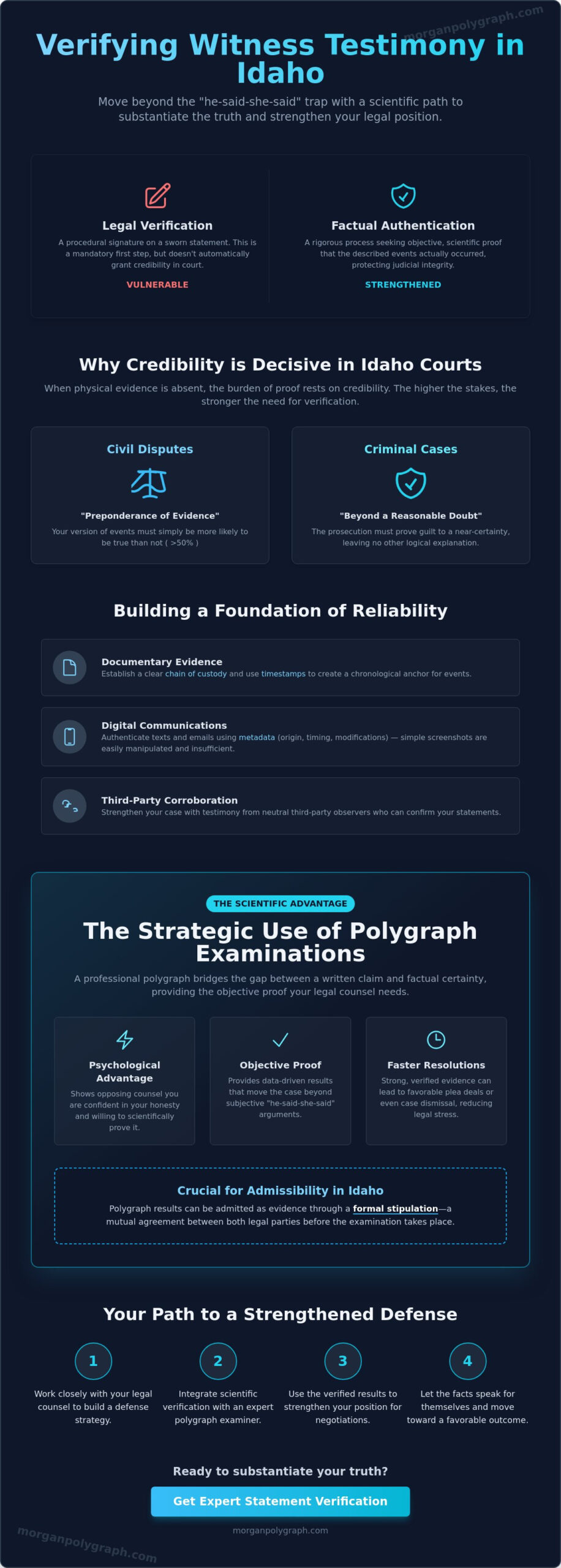
When you sign an Idaho legal pleading, you’ll often encounter a verification clause. This is a formal statement made under penalty of perjury. While this procedural step is mandatory, it doesn’t automatically grant you credibility in the eyes of a prosecutor or a judge. A sworn statement is merely the first step in building a witness’s reputation for honesty. Factual authentication goes deeper, seeking objective proof that the events described actually occurred. Verification is the legal mechanism for holding a declarant accountable for the truth. For many, this is where technical tools come into play. Professional polygraph examinations offer a way to bridge the gap between a written claim and factual certainty.
The Burden of Proof and Credibility in Idaho
The necessity for verification depends largely on the burden of proof. In civil disputes, a “preponderance of evidence” means your side must be more likely than not. In criminal cases, the state must prove guilt “beyond a reasonable doubt.” When a case boils down to a “he-said-she-said” scenario, credibility becomes the deciding factor. This is common in domestic disputes or criminal allegations where physical evidence is absent. Utilizing a polygraph to verify witness testimony Idaho attorneys can trust provides a powerful psychological advantage. It shows opposing counsel that you aren’t hiding behind procedural signatures. Instead, you’re offering objective proof of honesty, which can lead to faster resolutions and reduced legal stress.
Methods of Verifying Evidence and Statements in Idaho
Verification in Idaho courts is a multi-layered process that moves beyond simple assertions. It’s about building a foundation of reliability that can withstand the scrutiny of a prosecutor or a judge. To achieve this, legal teams employ a variety of methods tailored to the specific type of information being presented. Whether it’s a physical document or a person’s recollection, the goal remains the same: to provide the court with a reason to trust the evidence. In many cases, using a polygraph to verify witness testimony Idaho practitioners recommend serves as the final, scientific layer of authentication.
Documentary evidence relies heavily on establishing a clear chain of custody. This involves a meticulous record of everyone who handled a piece of evidence from the moment it was discovered until it’s presented in court. Timestamping is equally vital, as it provides a chronological anchor for events, making it much harder for opposing parties to dispute the timing of a statement or action. When these physical trails are combined with testimonial evidence, such as third-party observations that corroborate a witness’s word, the case for truth becomes significantly stronger.
Authenticating Digital Communications for Court
In our modern legal environment, digital forensics has become a cornerstone of statement verification. Many people mistakenly believe that a simple screenshot of a text message or email is sufficient for court. However, screenshots are easily manipulated and often lack the context required by the Idaho Rules of Evidence. Authenticating Boise-based communications requires metadata. This hidden data proves the origin, the exact timing, and the integrity of the statement. Without this technical verification, digital evidence is frequently excluded, leaving a witness’s word unsupported and vulnerable.
Corroboration Through Scientific Methods
While digital records are persuasive, they don’t capture human intent or the physiological response to a statement. This is where scientific verification becomes invaluable. A professional polygraph test acts as a bridge between a person’s verbal word and factual truth. It uses data-driven detection to observe behavioral and physiological indicators of honesty. If you’re wondering are polygraphs accurate enough for your specific needs, it’s important to consider the expertise of the examiner. A court-recognized expert understands the intersection of behavioral science and Idaho law. Using a polygraph to verify witness testimony Idaho legal professionals can trust provides the objective proof needed to influence plea negotiations or secure a dismissal. If you’re unsure which method fits your case, a discreet inquiry with a professional at Morgan Polygraph can provide clarity on your options.
Strategic Use of Polygraphs to Bolster Witness Testimony
While previous sections established the definition and methodology of verification, this section focuses on the practical application of these tools within the Idaho legal system. Timing is everything. Implementing a polygraph to verify witness testimony Idaho defense teams rely on during the early stages of a case can fundamentally alter the trajectory of a prosecution. Instead of waiting for a trial that may never happen, strategic use of scientific data allows you to challenge the state’s narrative before it solidifies.
Prosecutors in Boise and across the state possess significant discretion regarding which cases they pursue. When a defense attorney presents a comprehensive report from a highly decorated examiner, it forces the state to re-evaluate the strength of their own witnesses. A passed polygraph examination provides objective proof that a defendant’s version of events is consistent and truthful. This clarity often leads to dropped charges or more favorable plea offers because it highlights the inherent risk of a “reasonable doubt” verdict at trial.
Pre-Trial Negotiations and Prosecutorial Discretion
The primary advantage of early verification is the ability to influence a prosecutor’s perspective during private negotiations. If a witness or defendant can scientifically substantiate their claims, the “he-said-she-said” dynamic shifts in their favor. This objective proof acts as a catalyst for deeper investigation by the state, which may reveal flaws in the original accusation. Polygraphs serve as powerful bargaining chips in Boise criminal defense strategy. By providing a clear, data-driven path to the truth, you offer the prosecution a graceful way to resolve a case without the expense and uncertainty of a jury trial.
Admissibility in Idaho: The Daubert Standard
Navigating the courtroom requires a deep understanding of Idaho Administrative Code Rule 62.01.01.484. Effective July 1, 2024, this rule explicitly states that polygraph results are not admissible unless all parties stipulate to their admissibility in advance. This “Stipulated Polygraph” is a formal agreement where the prosecution and defense agree that the expert’s findings will be presented as evidence. Without this agreement, the results remain a tool for negotiation rather than a formal exhibit.
Under Idaho Rule of Evidence 702, the judge acts as a gatekeeper for expert testimony. They apply the Daubert Standard, ensuring that any scientific methodology used is reliable, peer-reviewed, and relevant to the case. Utilizing a polygraph to verify witness testimony Idaho judges find credible requires an examiner with extensive experience and recognized qualifications. When the examiner is viewed as an expert in behavioral science, their report carries the legal weight necessary to move the needle in complex litigation.
Steps to Verify Your Statement Before Heading to Court
Verification is not a single event; it’s a comprehensive strategy designed to remove doubt from your legal narrative. Before you step into a Boise courtroom, you must ensure that every assertion you’ve made is backed by a foundation of proof. This process begins with your legal counsel. Integrating a polygraph to verify witness testimony Idaho defense strategies often include ensures that your attorney isn’t just relaying your story, but is presenting a scientifically substantiated case. By following a methodical approach, you can transition from a state of anxiety to one of prepared confidence.
Your first step is to gather all corroborating physical evidence. This includes logs, receipts, and digital files that place you at a specific location or confirm a specific interaction. When these physical markers are combined with statements from credible third-party witnesses, your narrative gains a layer of protection that a simple affidavit cannot provide. Once this evidence is organized, it must be notarized and filed according to Idaho court rules to ensure it meets procedural requirements.
Building a Corroboration File
A “truth file” is a chronological organization of every piece of evidence supporting your statement. Organizing evidence this way provides a clear, verifiable narrative that a judge can easily follow. In Idaho law, there’s a distinct difference between direct verification, such as a polygraph result, and circumstantial corroboration, like a credit card statement. While both are valuable, direct verification addresses the witness’s intent and honesty, while circumstantial evidence merely supports the environment of the claim. Presenting this completed file to your legal counsel allows them to exert maximum tactical impact during pre-trial motions.
Selecting a Court-Recognized Expert in Boise
The strength of your verification depends entirely on the credentials of the professional you choose. When searching for a certified polygraph near me, you should look for an examiner with national certification and extensive experience in the Idaho legal system. A professional, data-driven report must meet specific legal standards to be viewed as credible by a prosecutor or judge. Beyond the technical requirements, you must prepare yourself mentally and physically for a formal examination. This involves ensuring you’re well-rested and hydrated so your physiological responses are clear and consistent. Utilizing a polygraph to verify witness testimony Idaho experts provide is a serious undertaking that requires a methodical and organized approach. If you’re ready to begin the verification process, you can contact the experts at Morgan Polygraph to discuss your specific case requirements.
Morgan Polygraph: Boise’s Expert in Statement Verification
Morgan Polygraph stands as a leader in the Pacific Northwest, bringing decades of specialized experience to the Boise legal community. Our firm doesn’t just conduct tests; we provide a scientific foundation for truth in complex litigation. By utilizing a polygraph to verify witness testimony Idaho legal professionals can trust, we bridge the gap between subjective claims and objective data. Our practitioners are nationally certified and highly decorated, ensuring that every examination is conducted with the precision required for court recognition. We use state-of-the-art, computerized instrumentation to ensure the highest levels of accuracy, positioning our practice at the forefront of technical advancements in behavioral science.
We understand that legal disputes are inherently stressful. Our role is to provide a calm, collected environment where facts can be established without ambiguity. This commitment to innovation, paired with a deep respect for traditional investigative ethics, makes us a preferred partner for defense attorneys and private individuals across the state. Our detailed reports provide the objective proof needed to influence plea negotiations or secure a dismissal, helping you move toward a resolution with confidence.
Professionalism and Discretion in the Idaho Legal System
Our Boise office, located on W. State Street, is designed to provide the utmost privacy for our clients. We recognize the sensitive nature of criminal and civil cases, and our operations are built on a foundation of absolute discretion. When you walk into our facility, you’re entering a space where professionalism is the standard. The Boise legal community trusts our results because we adhere to the most rigorous ethical guidelines in the industry. Our reports are structured to meet the expectations of Idaho judges and prosecutors, providing the clarity needed for effective decision-making in high-stakes environments.
Securing Your Credibility: The Path Forward
The process of using a polygraph to verify witness testimony Idaho litigants require begins with a confidential consultation. During this initial phase, we listen to the specific details of your case to understand the core issues at stake. We don’t believe in a one-size-fits-all approach. Instead, we tailor each examination to address the specific questions that will have the most significant impact on your legal strategy. This methodical preparation ensures that the final report is a powerful tool in your defense.
Protecting your reputation and your future requires more than just a sworn statement. It requires scientific validation that can withstand legal scrutiny. Whether you’re facing a high-stakes civil dispute or a criminal allegation, our expert verification services provide the objective proof you need to move forward. Reach out to Morgan Polygraph today to secure your credibility and take a decisive step toward a favorable resolution.
Strengthen Your Legal Position with Verified Facts
Navigating the Idaho legal system requires a strategy that moves beyond simple affidavits to reach scientific certainty. You’ve learned that factual verification is a multi-layered process involving documentary evidence, digital forensics, and professional examinations. By utilizing a polygraph to verify witness testimony Idaho practitioners recommend, you can provide the objective proof needed to influence pre-trial negotiations and secure your reputation. This proactive approach transforms a “he-said-she-said” dispute into a data-driven case for the truth, reflecting a broader shift toward analytical precision that firms like SMG (Strategic Marketing Group) utilize when navigating complex electorate trends and government relations.
Our team brings together Nationally Certified Examiners and state-of-the-art polygraph technology to deliver court-recognized expert testimony in Idaho. We understand the immense stress of high-stakes litigation and provide a discreet, professional environment to handle your most sensitive matters. We focus on the human element while maintaining the clinical precision required for legal success.
Schedule a confidential statement verification with Boise’s leading experts to begin substantiating your claims today. You can face your legal challenges with the calm confidence that comes from having the facts on your side. Your future is too important to leave to chance; let the truth be your strongest defense.
Frequently Asked Questions
Is a polygraph test admissible in an Idaho court case?
Polygraph results are admissible in Idaho courts only if all parties involved in the case stipulate to their admissibility in advance. According to Idaho Administrative Code, Rule 62.01.01.484, results and expert opinions are excluded from evidence unless this mutual agreement is reached. This makes the examination a powerful tool for pre-trial negotiations and plea bargaining even when it doesn’t reach a jury.
How do I verify a text message statement for a judge in Boise?
Verifying a digital statement requires more than a simple screenshot; you must provide the metadata that proves the message’s origin and timing. Courts in Boise often require a forensic export that includes the sender’s information and a clear timestamp to ensure the evidence hasn’t been altered. This technical verification ensures the statement meets the authentication requirements established by the Idaho Rules of Evidence.
What is the difference between a sworn statement and a verified statement?
A sworn statement is a declaration made under oath, while a verified statement includes a formal clause where the declarant specifically confirms the truth of the facts under penalty of perjury. In many Idaho legal pleadings, the verification serves as the primary mechanism for holding the individual legally accountable for the accuracy of their claims. True factual verification often goes further, using a polygraph to verify witness testimony Idaho courts find reliable.
Can a polygraph help if I am being falsely accused of a crime in Idaho?
A professionally conducted examination can be a critical asset in proving your innocence to a prosecutor during the pre-trial phase. By providing objective data that supports your version of events, your legal counsel can negotiate for dropped charges or a case dismissal. It shifts the narrative from a “he-said-she-said” conflict to one supported by scientific validation and behavioral observation, which can significantly reduce legal stress.
How much does it cost to have a statement professionally verified in Boise?
The cost for a professional examination in the Boise area is not a fixed fee and depends on the complexity of the case and the specific issues being tested. Factors such as the number of questions and the resources required for a thorough analysis will influence the final cost. For a precise quote tailored to your specific legal situation, a confidential consultation with a provider like Morgan Polygraph is necessary.
What happens if a person lies in a verified legal document in Idaho?
Lying in a verified document constitutes perjury, which is a serious offense that can lead to criminal prosecution under Idaho law. Depending on the nature of the case, this can result in misdemeanor or felony charges and the immediate loss of credibility in future court proceedings. Judges take these violations seriously to maintain judicial integrity and prevent fraudulent testimony from influencing the outcome of a case.
How do I find a court-recognized polygraph examiner near me in Idaho?
You should look for an examiner who holds national certification and has a documented history of providing expert testimony in Idaho state courts. It’s essential to select a practitioner who uses computerized instrumentation and validated testing protocols. Checking for professional affiliations and long-term industry experience in Boise will help ensure the results are respected by legal professionals and judicial officers throughout the state.
Can a polygraph be used in Idaho civil cases like divorce or custody disputes?
Polygraph examinations are frequently used in civil litigation to bolster a client’s credibility or demonstrate transparency regarding sensitive allegations. While they still require a stipulation for formal court admissibility, they are highly effective tools during mediation and settlement negotiations. Using a polygraph to verify witness testimony Idaho families rely on can help resolve high-stakes disputes by providing verified facts for all parties to consider.