
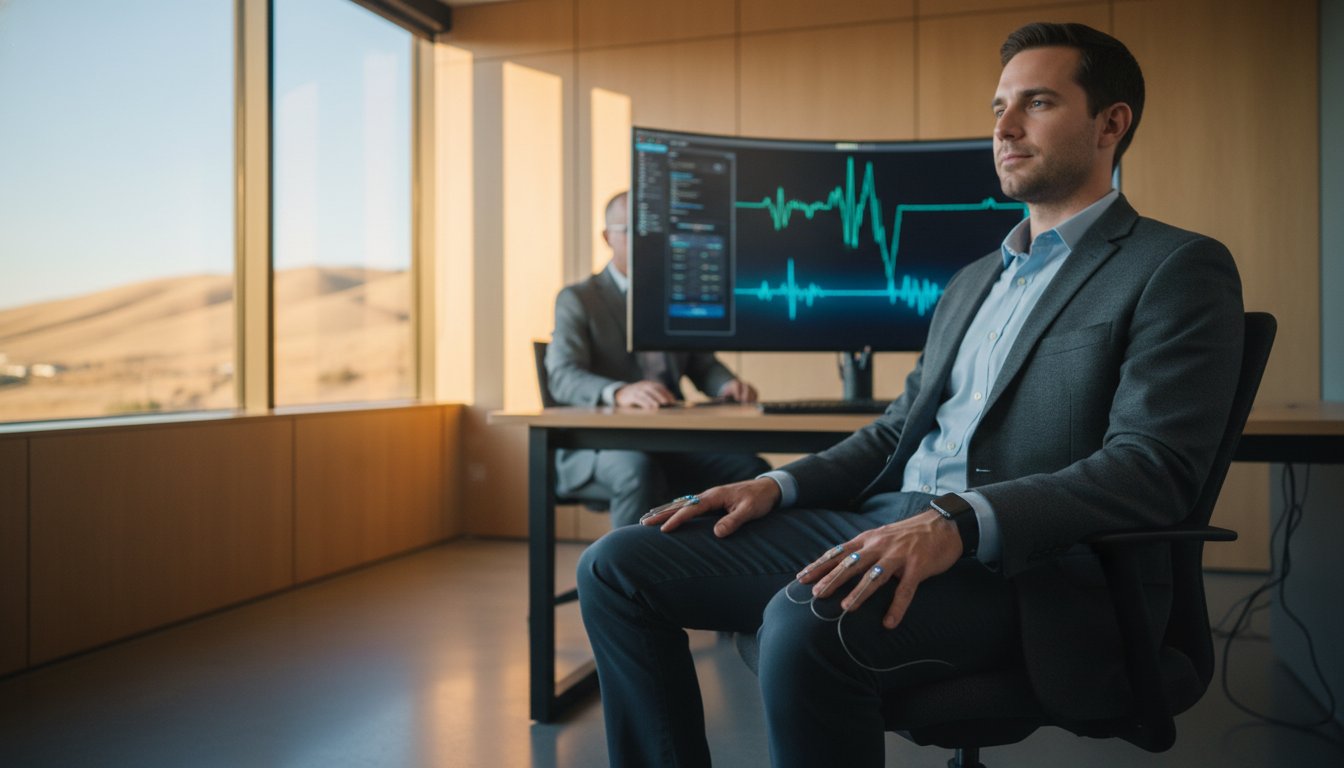
A polygraph examiner isn’t actually looking for a lie. Instead, they’re monitoring the involuntary “fight-or-flight” response that occurs when a person feels threatened by a specific question. If you’ve ever wondered exactly what do polygraph examiners look for, the answer lies in the subtle shifts of your autonomic nervous system. While many people fear that simple nervousness will lead to a false result, modern forensic psychophysiology is designed to differentiate between general anxiety and the specific physiological signatures of deception. We understand that sitting for a test can feel overwhelming, especially when you’re concerned about subjective judgment or “mind-reading” technology.
It’s natural to feel a sense of trepidation when entering a professional examination environment. You’re likely worried that a racing heart or sweaty palms will be misinterpreted as guilt. This guide will help you understand the specific physiological markers, including respiratory activity and electrodermal responses, that professional examiners analyze to determine the truth. You’ll also learn how to prepare mentally for the professional environment of a Boise polygraph lab, ensuring you feel confident in a process that values data-driven accuracy and personal discretion.
Key Takeaways
- Understand how examiners monitor autonomic nervous system arousal to identify significant deviations from your physiological baseline.
- Gain insight into what do polygraph examiners look for by examining the hardware used to track respiratory, electrodermal, and cardiovascular activity.
- Learn why the diagnostic process starts when you arrive and how a thorough pre-test interview prevents misunderstandings.
- Move beyond the myth of subjective judgment to understand how standardized numerical scoring systems provide objective results.
- See why professional certification and innovative technology are essential for reliable criminal, civil, or relationship examinations.
The Science of Detection: What Polygraph Examiners Look For
A polygraph isn’t a mind-reading machine; it’s a sophisticated diagnostic tool used to measure autonomic nervous system (ANS) arousal. When clients ask what do polygraph examiners look for, they’re often surprised to learn it isn’t a specific “lie” signal. Instead, we monitor physiological shifts that occur when a person perceives a question as a direct threat to their well-being. This process is grounded in forensic psychophysiology, providing a data-driven approach to truth verification. For a comprehensive Polygraph overview, one can see how these instruments have evolved into the precision tools currently used in criminal and civil case polygraphs.
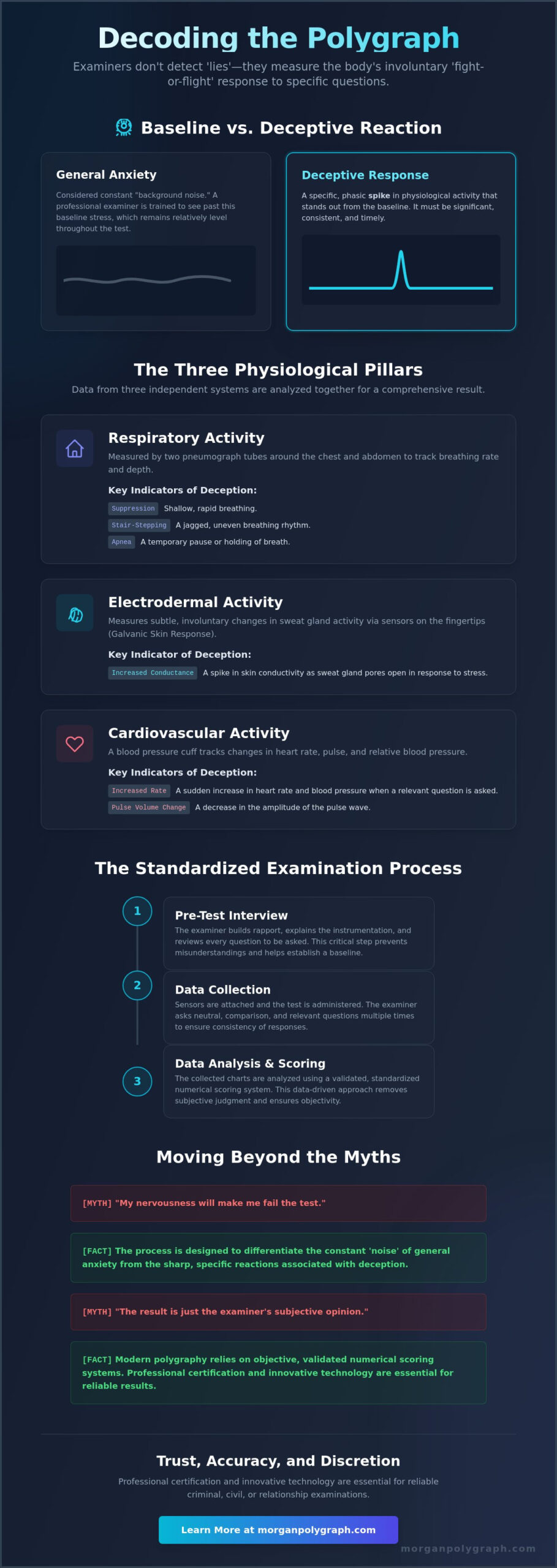
The primary goal during an examination is to identify “significant and consistent” deviations from a person’s baseline. We recognize that every examinee feels some level of stress. In our professional environment, we treat nervousness as a constant “background noise” that stays relatively level throughout the session. Deception, however, creates a specific, phasic spike in activity that stands out from that background. This distinction is critical for ensuring that natural anxiety isn’t mistaken for a lack of candor.
The Autonomic Nervous System (ANS) Response
The sympathetic nervous system manages our involuntary reactions to stress. When a person chooses to be deceptive, their brain recognizes the risk of detection, which triggers a cascade of physiological changes. These markers are entirely involuntary; you can’t consciously control the sweat gland activity in your fingertips or the minute changes in your heart rate. The ANS is the body’s automatic response to perceived danger. By tracking these internal “fight-or-flight” signals, examiners gain an objective view of the examinee’s psychological state during the testing process.
Baseline vs. Deceptive Reaction
Understanding what do polygraph examiners look for requires a look at the Comparison Question Technique (CQT). Before the actual test, the examiner establishes a “normal” or baseline physiological state for the individual. This is done through a series of neutral and comparison questions. During the exam, we look for “salience,” which is a disproportionate physiological focus on specific relevant questions. Professional examiners look for several key indicators:
- Consistency: The reaction must appear every time the specific topic is addressed.
- Significance: The shift must be noticeably larger than the baseline reactions.
- Timing: The response must occur in immediate proximity to the question asked.
This methodology relies on the concept of the “Psychological Set.” This theory suggests that a person’s brain will automatically focus its physiological resources on the question that poses the greatest threat. For an innocent person, the comparison questions about general character are often more threatening. For someone being deceptive about a specific incident, the relevant questions about that event will trigger the most significant response.
The Three Physiological Pillars of a Polygraph Exam
Modern computerized polygraphs provide a level of precision that older analog models simply couldn’t match. When determining what do polygraph examiners look for, we rely on a trio of sensors that track the body’s internal reactions in real-time. It’s vital to understand that no single sensor dictates the final result. Instead, we analyze the aggregate of all data streams to form a complete picture of the examinee’s responses. We also utilize specialized motion sensors to identify physical countermeasures or deliberate attempts to skew the data, ensuring the integrity of every examination.
Respiratory Activity (Pneumograph Tubes)
Two rubber pneumograph tubes are placed across the chest and abdomen to monitor the rate and depth of your breathing. While simple in appearance, they reveal complex patterns that go beyond basic inhalation. Examiners look for specific indicators like respiratory suppression, where the breath becomes shallow and rapid, or “stair-stepping,” where the breathing rhythm takes on a jagged, uneven appearance on the chart. A temporary state of apnea, or holding one’s breath, during a relevant question is a significant red flag. These changes suggest the brain is trying to “quiet” the body’s physical movements during a moment of high cognitive load or perceived threat.
Electrodermal Activity (Sweat Gland Response)
Often called the galvanic skin response (GSR), electrodermal activity measures minute changes in the sweat gland activity of your fingertips. This is widely considered the most sensitive indicator of deception because sweat glands are directly controlled by the sympathetic nervous system. In the data, we look for a sharp visual “spike” or a sustained rise in the EDA chart immediately following a question. This reaction occurs long before a person can consciously attempt to mask their response. Understanding the DOJ polygraph technique shows how critical these involuntary markers are to federal investigative standards.
Cardiovascular Metrics (Heart Rate and Blood Pressure)
A standard blood pressure cuff is used to track heart rate and changes in blood volume. When a person is being deceptive, we often see a distinct “baseline shift” in blood pressure. This isn’t just a temporary pulse increase; it’s a sustained rise in the overall blood pressure level that lasts through the duration of the response. If you’re nervous, your heart rate might be high throughout the entire session. However, when considering what do polygraph examiners look for, we are specifically searching for a localized reaction to a single question that stands out from that elevated baseline. If you’re seeking clarity in a personal matter, our team provides expert relationship and infidelity testing in a discreet environment.
Beyond the Sensors: Behavioral Observations and the Pre-Test
The diagnostic process begins long before the sensors are attached to the examinee. In our Boise office, the examination starts the moment you walk through the door. While the digital charts are the primary source of truth, professional examiners also maintain a keen awareness of behavioral consistency. We observe how an individual interacts in a neutral setting compared to how they respond under the pressure of the instrument. This holistic approach ensures that the final result is based on a comprehensive set of data points rather than a single, isolated reaction. Each interaction is handled with the utmost discretion and respect.
Professionalism requires that examiners remain objective and neutral. We don’t rely on “gut feelings” or personal bias. Instead, we use the pre-test phase to understand the unique communication style of each examinee. When people ask what do polygraph examiners look for during this initial stage, they are often surprised to find it is about establishing a comfortable, clear baseline of understanding. Our goal is to create an environment where the truth can emerge without the interference of unnecessary environmental stress. This methodical approach is essential for criminal, civil, and relationship testing alike.
The Critical Role of the Pre-Test Interview
Surprise is the enemy of a valid polygraph. During the pre-test interview, we review every single question that will be asked during the exam. This ensures the examinee understands the terminology and eliminates the risk of a “false positive” caused by confusion or shock. It’s a structured conversation designed to build clarity. For those seeking a deeper understanding of these steps, we recommend reviewing our complete guide to the polygraph process. This phase allows the examiner to address any concerns before the sensors are activated, which helps in differentiating between general anxiety and specific deceptive reactions.
Non-Verbal Cues and Behavioral Trends
While the charts provide the definitive score, an examiner’s notes often include observations of non-verbal cues. These trends help contextualize the physiological data gathered by the instrument. We look for behavioral markers such as over-explaining simple answers, defensive posturing, or grooming gestures like adjusting clothes or hair. These cues are not used to fail a person; they are auxiliary observations that help the examiner understand what do polygraph examiners look for in terms of a person’s stress management. For instance, verbal mirroring, where an examinee repeats the question back to buy time, is a common behavioral trend noted in professional reports. We also watch for spotting, where an individual attempts to monitor the examiner’s reactions or the computer screen to gauge their own performance.
Analyzing the Data: How Examiners Score Your Charts
The transition from raw physiological data to a final result is a methodical, mathematical process. Standardized numerical scoring is now the industry benchmark, moving the field far beyond the era of subjective “gut feelings.” Today, we utilize evidence-based protocols to ensure every examination is objective, transparent, and reproducible. When considering what do polygraph examiners look for during the analysis phase, the focus is on the specific mathematical relationship between different types of questions. We use the Empirical Scoring System (ESS) to assign values to the physiological reactions recorded on the digital charts.
This system relies on comparing the magnitude of a response between “Control” questions and “Relevant” questions. A control question typically addresses general character or past behaviors, while a relevant question focuses on the specific issue at hand. If the reaction to the relevant question is significantly larger and more consistent, it receives a negative score. If the control question produces the larger reaction, it receives a positive score. These scores are not arbitrary; they’re based on established physiological features like the duration of a heart rate shift or the height of an electrodermal spike. For a deeper look at how this data translates into real-world reliability, read our analysis on are polygraphs accurate.
Numerical Scoring Systems
The ESS and other modern systems use a specific +/- scale to quantify the body’s responses. A total score falling below a negative threshold results in a “Deception Indicated” (DI) finding. Conversely, a score above a specific positive threshold indicates “No Deception Indicated” (NDI). Sometimes, the data gathered doesn’t meet the required mathematical threshold for a definitive result. In these cases, the examiner issues an “Inconclusive” result. This isn’t a failure of the test; rather, it’s a professional acknowledgement that the physiological data was not clear enough to make a high-confidence determination. This commitment to data integrity is why our results are trusted in sensitive legal environments.
Identifying Countermeasures and Manipulations
Some individuals attempt to influence the outcome by using “countermeasures.” These are deliberate physical or mental actions, such as tongue biting, toe pressing, or controlled breathing, designed to artificially create physiological reactions. However, what do polygraph examiners look for includes these very attempts at manipulation. Modern computerized systems are equipped with specialized sensors, including pressure-sensitive seat pads, that detect even the slightest muscle contractions or shifts in weight. Attempting to “fool” the instrument is often more obvious on the digital chart than the deception itself. These forced reactions lack the natural, involuntary signature of a genuine autonomic nervous system response, making them easily identifiable to a trained eye.
If you require a high-stakes examination for a legal or personal matter, we provide expert criminal and civil case polygraphs using these advanced, data-driven scoring methodologies.
Why Professional Expertise Matters in Polygraph Examination
While the technology behind deception detection is grounded in science, the validity of any report depends heavily on the person administering the test. A machine provides data, but a human expert provides the interpretation. Beyond the digital tracings, what do polygraph examiners look for to ensure a valid result is rooted in their professional training and adherence to strict ethical standards. An experienced examiner understands how to navigate the complexities of human stress, ensuring that the results are both accurate and unbiased. This level of expertise is particularly vital in sensitive matters like infidelity testing, where the emotional stakes are high and discretion is paramount.
Choosing a professional who understands what do polygraph examiners look for in terms of data quality ensures that your sensitive issue is handled with the precision it deserves. In Boise, Idaho, we combine decades of traditional experience with the latest innovations in forensic psychophysiology. This balance of experience and technology allows us to provide reports that stand up to the highest levels of scrutiny in both criminal and civil cases. We treat every client with compassion and respect, recognizing the vulnerability that often comes with truth verification.
Certified vs. Uncertified Examiners
The risks of using uncertified or “discount” polygraph services are significant. These practitioners may lack the rigorous training required to become a certified polygraph examiner, which can lead to misread charts or inconclusive results. Professional examiners maintain membership in organizations like the American Polygraph Association (APA). According to APA standards, practicing examiners must complete 30 hours of continuing education every two years to stay current with the latest methodologies. Additionally, APA standards limit examiners to a maximum of five examinations per day to prevent fatigue and maintain the highest levels of accuracy. Using an uncertified service often means these critical quality controls are ignored.
The Morgan Polygraph Standard in Boise
Our Boise location at 6126 W. State Street serves as a hub for professional Idaho polygraphy. We provide a quiet, controlled environment specifically designed to eliminate external distractions that could interfere with physiological data. Every aspect of our facility is organized to ensure the highest data quality and client privacy. We follow a methodical, step-by-step process that prioritizes your comfort while maintaining the integrity of the examination. If you’re ready to resolve a sensitive issue with the help of a seasoned expert, schedule a consultation with Morgan Polygraph today. We’re here to provide the clarity you need through a reliable, data-driven approach.
Secure the Truth with Professional Deception Detection
Understanding what do polygraph examiners look for is the first step toward approaching your examination with confidence. By focusing on involuntary physiological markers rather than subjective impressions, modern forensic psychophysiology provides a reliable path to the truth. Whether you’re dealing with a sensitive relationship matter or a complex legal case, the combination of standardized numerical scoring and state-of-the-art computerized technology ensures your results are based on objective data. We’ve seen how the integration of behavioral observation and the Empirical Scoring System creates a comprehensive diagnostic environment that minimizes the risk of false positives.
Choosing a nationally certified and court-recognized examiner is vital for obtaining a report that carries weight and credibility. At our discreet Boise, Idaho location, we prioritize your privacy and handle every case with the utmost compassion and respect. If you’re ready to find the answers you need, Contact Morgan Polygraph for a Professional Consultation today. You don’t have to navigate these stressful situations alone. Our team is dedicated to providing the clarity and expertise you deserve in a highly professional environment.
Frequently Asked Questions
Can an examiner tell if I am just nervous?
Yes, professional examiners expect every person to be nervous and treat this state as a consistent baseline. When considering what do polygraph examiners look for, they search for specific, significant spikes in physiological activity that occur only when a relevant question is asked. These temporary shifts differ from the steady, elevated heart rate or general perspiration associated with situational anxiety. Modern scoring systems effectively filter out this background stress.
What behaviors indicate lying to a polygraph examiner?
Examiners watch for behavioral trends that deviate from a person’s neutral communication style established during the pre-test. Common indicators include over-explaining answers, using verbal mirroring to delay responses, or exhibiting defensive posturing. While these cues are noted in the professional report, they serve as contextual observations. The final determination of truthfulness always relies on the objective physiological data recorded by the computerized instrument.
Do examiners look at body language during the test?
Yes, examiners observe body language during both the interview and the examination to ensure data integrity. They watch for grooming gestures, lack of eye contact, or “spotting,” where an examinee tries to monitor the computer screen. However, these observations are strictly secondary. The primary focus remains on the involuntary reactions of the autonomic nervous system, which cannot be consciously manipulated like external body language.
How do examiners distinguish between anxiety and actual deception?
Distinction is achieved through the Comparison Question Technique (CQT), which compares reactions between control and relevant questions. An anxious but truthful person will typically react more strongly to general questions about their character. A deceptive person’s brain will prioritize the threat posed by the specific relevant question. This methodical comparison allows examiners to filter out general anxiety and pinpoint the physiological signatures of deception.
What happens if I have an irregular heart rate or medical condition?
You should disclose any known medical conditions or medications during the pre-test interview so the examiner can account for them. Because the examiner is looking for a specific change from your established baseline, a consistent irregular heart rate won’t necessarily invalidate the test. The examiner analyzes how your specific system responds to stimuli, ensuring your unique physiological profile is factored into the final numerical scoring.
Can an examiner “trick” me into failing the polygraph?
No, a professional examiner cannot trick you because every question is reviewed and finalized before the sensors are even activated. There are no surprise questions in a certified examination. This transparency is a core part of what do polygraph examiners look for to maintain a controlled, scientific environment. Standardized scoring systems further ensure that results are based on data rather than an examiner’s personal tactics.