

A polygraph examination is not a simple pass or fail opinion; it’s a data-driven classification of your physiological stability versus reaction. It’s natural to feel a surge of anxiety while waiting for your report, especially if you’re worried that nerves might trigger a false positive. You’re likely asking yourself what do polygraph results mean when they’re distilled into technical acronyms like NDI or DI. We understand these findings carry significant weight, whether they’re intended for a criminal case, a relationship matter, or a professional screening.
This guide provides a comprehensive breakdown of professional terminology and the scientific scoring used to reach a final conclusion. You’ll learn the specific differences between No Deception Indicated (NDI) and Deception Indicated (DI), and why an Inconclusive result isn’t a definitive failure. We’ll also cover the re-testing process and how to effectively present these findings to an attorney or a partner. By understanding the methodology behind the data, you can move forward with the clarity and confidence your situation requires.
Key Takeaways
- Recognize that polygraph findings are data-driven classifications—such as NDI and DI—rather than subjective pass or fail grades.
- Identify the three physiological systems—respiratory, sweat, and cardiovascular—that examiners monitor using state-of-the-art computerized scoring.
- Understand that an Inconclusive finding acts as a critical safety valve to maintain the integrity of the examination when data is not definitive.
- Learn exactly what do polygraph results mean in the context of Idaho law, including how written stipulations affect admissibility in local courts.
- Determine the professional steps to take after receiving your final report, from reviewing examiner commentary to coordinating with your legal representative.
Decoding the Language: NDI, DI, and Inconclusive Explained
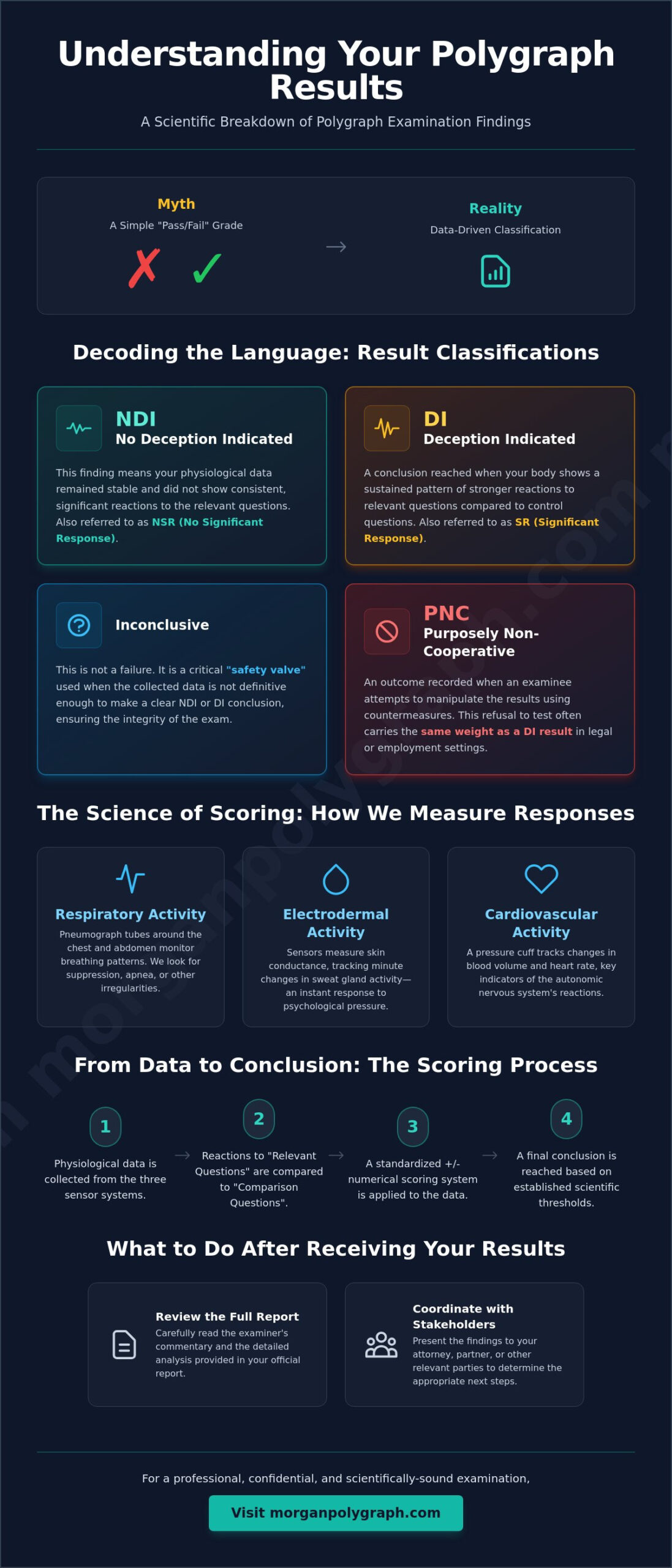
A Polygraph examination provides a scientific snapshot of physiological activity. When people ask what do polygraph results mean, they’re often surprised to learn that we don’t use a simple pass or fail grade. Instead, we use standardized classifications that reflect the stability or volatility of your body’s responses. These categories ensure that every report is based on measurable data rather than an examiner’s gut feeling. By moving away from judgmental language, the process remains objective and focused on the data provided by the sensors.
NDI and NSR: What Truthfulness Looks Like on Paper
NDI stands for No Deception Indicated. This is the standard finding when an examinee’s physiological data doesn’t show consistent, significant reactions to the relevant questions. In many modern reports, you might also see NSR, or No Significant Response. While NDI is the formal conclusion, NSR describes the clinical data. It means your heart rate, skin conductivity, and respiration remained stable when you answered the core questions of the exam. A Morgan Polygraph report clearly states these findings to provide peace of mind for relationship testing or clarity for legal counsel in criminal and civil cases.
DI and SR: Understanding the Indicators of Deception
To understand what do polygraph results mean in a negative context, we must look at the patterns. Deception Indicated (DI) is the conclusion reached when an examinee’s body reacts consistently to relevant questions more than comparison questions. The term Significant Response (SR) refers to the specific physiological spikes recorded on the charts. It’s a common misconception that a single deep breath or a nervous twitch causes a DI result. Examiners look for a sustained pattern across multiple charts. We compare your reaction to control questions, which are designed to provoke a baseline response, against the questions that actually matter to the case. If the reactions to the relevant questions are significantly and consistently higher, a DI result is recorded.
Sometimes, an examination cannot be completed because the examinee attempts to manipulate the results. This is labeled as Purposely Non-Cooperative (PNC). This isn’t a failed test in the traditional sense. It’s a refusal to follow instructions or an attempt to use countermeasures to distort the data. Because the integrity of the data is compromised, a PNC result is treated as a refusal to test. This outcome often carries the same weight as a DI result in legal or employment contexts because it suggests a lack of transparency and a deliberate attempt to obstruct the truth-seeking process.
The Science of Scoring: How Examiners Read the Charts
Understanding what do polygraph results mean requires a look at the physiological data collected during the testing phase. Modern technology doesn’t measure “lies” directly. Instead, it records the autonomic nervous system’s reaction to the stress of deception. A professional polygraph examination tracks three specific body systems to create a comprehensive data set for analysis. This process combines high-tech sensors with specialized scoring algorithms to ensure the final report is as objective as possible.
The Three Body Systems Monitored
We monitor respiratory activity using pneumograph tubes placed around the chest and abdomen. Examiners look for specific changes such as breathing suppression or apnea, which often occur when an individual is attempting to “steady” themselves during a difficult question. The second system is electrodermal activity, which measures skin conductance. This tracks minute changes in sweat gland activity. Even if you don’t feel “sweaty,” your nervous system triggers these responses instantly when you’re under pressure. Finally, we monitor cardiovascular activity through a pressure cuff. This tracks changes in blood volume and heart rate. While the National Academies’ National Research Council has historically noted the complexities of using these markers for broad security screenings, they remain the gold standard for specific-issue testing when applied by a trained expert.
Numerical Scoring and Thresholds
Once the charts are recorded, we move to the numerical scoring phase. Examiners use a standardized +/- system to evaluate the reactions. We compare the responses from “relevant” questions to “comparison” questions. If the reaction to a relevant question is significantly stronger, it receives a negative score. If the comparison question yields a stronger reaction, it receives a positive score. These points are totaled to determine the final classification.
What do polygraph results mean if they fall into the “Inconclusive” range? This occurs when the total score doesn’t reach the required mathematical threshold for a definitive NDI or DI finding. It’s essentially a “gray zone” where the data isn’t clear enough to make a professional call. At Morgan Polygraph, we utilize empirically validated scoring systems to minimize these results. If you have questions about a specific report, you can contact our office for a professional consultation regarding the data. This rigorous approach ensures that every conclusion is backed by science rather than simple observation.
When Results Aren’t Clear: Dealing with Inconclusive Findings
An Inconclusive result is one of the most misunderstood outcomes of an examination. It occurs when the recorded physiological data does not clearly lean toward truthfulness or deception. While it may feel frustrating to receive a report without a definitive NDI or DI classification, this outcome serves as a vital safety valve for the accuracy of polygraphs. It indicates that the examiner has prioritized scientific integrity over a forced conclusion. Understanding what do polygraph results mean when they are inconclusive requires looking at the data as a neutral finding rather than a failure on the part of the examinee.
The most common concern we hear from clients is that their personal anxiety caused an inconclusive result. It’s important to understand that general nervousness is a baseline factor. Examiners are trained to distinguish between the constant hum of “test jitters” and the specific, localized physiological spikes that occur during relevant questions. When we ask what do polygraph results mean in an inconclusive context, we’re usually looking at a chart where those spikes aren’t consistent enough to score, or where the comparison questions didn’t provide a strong enough contrast.
The ‘Buffer Zone’ Philosophy
Professional examiners operate under a strict ethical requirement to only provide a conclusive result when the data is overwhelming and clear. This “buffer zone” ensures that we don’t issue a false positive or a false negative due to ambiguous readings. We prefer to report an Inconclusive result rather than speculate on a chart that doesn’t meet the mathematical thresholds for NDI or DI. An inconclusive result is a neutral finding that simply means the test did not produce a readable outcome on that specific day.
External Factors: Medication, Health, and Fatigue
Several external variables can “flatten” a physiological chart, making it difficult to score. Certain medications, such as beta-blockers for blood pressure or specific anti-anxiety prescriptions, can dampen the body’s natural stress responses. Physical pain or extreme fatigue can also interfere with the quality of the data. When Evaluating Investigative Polygraph Results, professionals must account for these biological hurdles. Morgan Polygraph conducts a thorough pre-test interview to identify these factors before the sensors are even attached. If you’re managing a health condition or taking regular medication, disclosing this information is a critical step in ensuring the most reliable data possible.
Legal vs. Private Contexts: How Results Are Used in Idaho
In Boise and across the state, the application of an examination varies significantly based on whether the case is legal or private. When individuals ask what do polygraph results mean in a courtroom setting, the answer is often dictated by a written stipulation. Under Idaho Rule of Evidence 702 and the precedent set by State v. Fain (1989), results are generally inadmissible unless both the prosecution and defense agree to their admission before the test is conducted. This formal agreement is a critical step for anyone using an examination for criminal defense or civil litigation.
Even when results aren’t intended for trial, they serve as a powerful strategic tool. In 2023, approximately 15% of pre-file cases in the Treasure Valley that involved professional polygraph evidence resulted in dismissed investigations or significantly reduced charges. Defense attorneys frequently use NDI results to negotiate with prosecutors during the pre-trial phase. By providing objective data early in the process, a defendant can often shift the direction of an investigation before formal charges are even filed.
Polygraphs in the Idaho Legal System
Idaho also maintains specific standards for Post-Conviction Sex Offender Testing (PCSOT). These examinations are managed under the certification standards of the Idaho Sexual Offender Management Board (SOMB). Examiners conducting these tests must hold specialized credentials to ensure the results meet state requirements for probation and parole supervision. Data from 2025 showed that 22% of failed maintenance tests for individuals on probation resulted in modified supervision terms rather than immediate incarceration, demonstrating how these findings are used to manage risk and treatment progress.
Private and Relationship Testing Results
In contrast, infidelity tests are private matters designed to provide clarity within a relationship or therapeutic setting. These reports are handled with extreme discretion and compassion. When a DI result occurs in a relationship context, it is often used as a starting point for a “Full Disclosure” process in recovery or counseling. The reporting for these tests focuses on providing clear answers to specific relevant questions that the partners have agreed upon in advance.
For those conducting polygraph near me searches in the Boise area, it is essential to select a court-recognized expert. The expertise required for a high-stakes legal exam is the same level of precision you should expect for a personal matter. If you are facing a legal challenge or a sensitive personal issue, contact Morgan Polygraph to ensure your examination is conducted by a recognized professional who understands Idaho’s specific regulatory landscape.
Next Steps: What to Do After Receiving Your Results
Receiving your final report is a pivotal moment that requires a calm and methodical approach. You should begin by reviewing the entire document carefully, paying close attention to the “comments” or “examiner notes” sections. These areas often contain technical nuances or observations about your physiological stability that provide deeper context than the NDI or DI classification alone. When you consider what do polygraph results mean for your future, it’s essential to view the report as a professional data set rather than a personal judgment. We recommend sharing these findings immediately with your legal counsel or therapist to discuss the implications for your specific case or relationship recovery plan.
Maintaining a professional demeanor is critical, regardless of the outcome. If the results were not what you hoped for, reacting with hostility or immediate defensiveness can complicate legal proceedings or therapeutic progress. Instead, use the report as a tool for transparency. An authoritative report from a recognized expert provides a foundation for facts, allowing all parties involved to move away from speculation and toward a resolution based on recorded data.
Handling a DI (Deception Indicated) Result
A DI result can be emotionally taxing, but it also serves as a significant opportunity for honest dialogue in private and relationship matters. It’s a common mistake for examinees to attempt “countermeasures”—physical or mental tricks intended to “beat the test.” In reality, these efforts usually create erratic physiological spikes that lead directly to a DI or PNC result. If you receive a DI classification, you may request a post-test interview. This allows you to clarify specific reactions and discuss any external stressors that may have influenced the charts. In a therapeutic setting, this transparency is often the first step toward rebuilding trust.
When to Request a Re-Examination
If you receive an Inconclusive finding, a re-test may be the most appropriate path forward. However, it’s vital to respect a standard waiting period to avoid “exam fatigue,” which occurs when the body becomes desensitized to the testing process. This break allows your autonomic nervous system to return to a baseline state, ensuring the next set of charts is clear and scorable. During a follow-up, the examiner may adjust the question set to better target the specific issues that caused the initial ambiguity.
What do polygraph results mean if they are part of a larger legal requirement? In some cases, a follow-up or a specialized psychosexual evaluation may be necessary to satisfy court or probation mandates. If you need to schedule a follow-up examination or require a more comprehensive assessment, contact Morgan Polygraph to discuss the next steps in your professional evaluation process.
Moving Forward with Scientific Clarity
Navigating the complexities of a polygraph report requires an understanding that these findings are data-driven classifications rather than subjective opinions. By decoding the specific differences between NDI, DI, and Inconclusive results, you gain the clarity needed to make informed decisions. It’s essential to remember that what do polygraph results mean is ultimately rooted in the stability of your physiological data as measured by advanced sensors. The integration of modern methodologies ensures that your results are measured against the highest standards of data analysis. This objective evidence provides a reliable foundation for legal negotiations, relationship healing, or professional screenings.
At Morgan Polygraph, we combine decades of industry experience with state-of-the-art technology to deliver results you can trust. Our nationally certified examiners operate from a confidential and discreet Boise office, providing the expertise required for court-recognized testimony. In the specific regulatory environment of Idaho, having an expert who understands the nuances of stipulated evidence is invaluable. We’re dedicated to handling every case with the utmost respect and precision, ensuring that your sensitive issues are managed by seasoned professionals.
Contact Morgan Polygraph for a Professional Consultation in Boise.
Taking the next step toward the truth is a significant move. We are committed to guiding you through this process with calm, collected confidence.
Frequently Asked Questions
Can being nervous cause me to fail my polygraph test?
No, general nervousness does not lead to a failed result. Examiners establish a physiological baseline for your “test jitters” during the pre-test phase. We look for specific, significant reactions that deviate from that baseline only when relevant questions are asked. This differentiation ensures that the standard anxiety anyone feels during an exam is not misinterpreted as deception.
What is the difference between NDI and NSR?
NDI (No Deception Indicated) is the formal conclusion of the report, while NSR (No Significant Response) is a technical descriptor of the data. NDI means the examiner has officially classified the examinee as truthful based on the scoring. NSR simply means the sensors did not record any meaningful physiological activity during the relevant portions of the test. Both indicate a successful, truthful outcome.
If my result is ‘Inconclusive,’ do I have to pay for another test?
Re-testing fees are standard because the examiner’s professional time and specialized equipment are utilized for every session. An inconclusive result is a neutral finding that indicates the data was not scorable, but the full clinical process was still performed. You should consult with our office directly to discuss the specific logistical policies regarding follow-up appointments and subsequent examinations.
Can medication affect my polygraph results?
Certain medications, particularly beta-blockers or anti-anxiety drugs, can flatten your physiological responses and change what do polygraph results mean on a clinical level. It’s critical to disclose all medications during the pre-test interview. This allows the examiner to account for these biological factors when scoring your charts and ensures the final conclusion is based on a clear understanding of your body’s capabilities.
How long does it take to get the final results from Morgan Polygraph?
A formal written report is typically finalized and delivered within 24 to 48 hours after the examination is completed. This unhurried timeframe is necessary for the examiner to conduct a meticulous review of the data-driven detection and behavioral observation patterns. This rigorous quality control ensures that the final report you receive is accurate, professional, and ready for use in legal or private matters.
What happens if the examiner says I used countermeasures?
If an examiner detects attempts to manipulate the data, the result is classified as Purposely Non-Cooperative (PNC). This outcome is treated as a refusal to test and often carries the same weight as a “Deception Indicated” result in legal or employment contexts. Modern AI-powered tools and behavioral speech analysis are highly effective at identifying these attempts to obstruct the truth-seeking process.
Are polygraph results admissible in Idaho courts?
Results are only admissible in Idaho courts if both the prosecution and defense sign a written stipulation before the test is conducted. This is based on the 1989 Idaho Supreme Court case State v. Fain. Without this formal agreement, the findings are generally excluded from trial, although they remain a powerful strategic tool for defense attorneys during plea bargaining and pre-trial negotiations.
Can a polygraph result be ‘wrong’?
Modern polygraph technology has an accuracy rate between 85% and 95% as of 2026. While errors are rare, the process is not 100% infallible, which is why we use state-of-the-art computerized scoring and empirically validated methods. Factors like health issues or extreme fatigue can impact data quality, making the experience and credentials of your examiner the most important factor in ensuring a reliable result.