
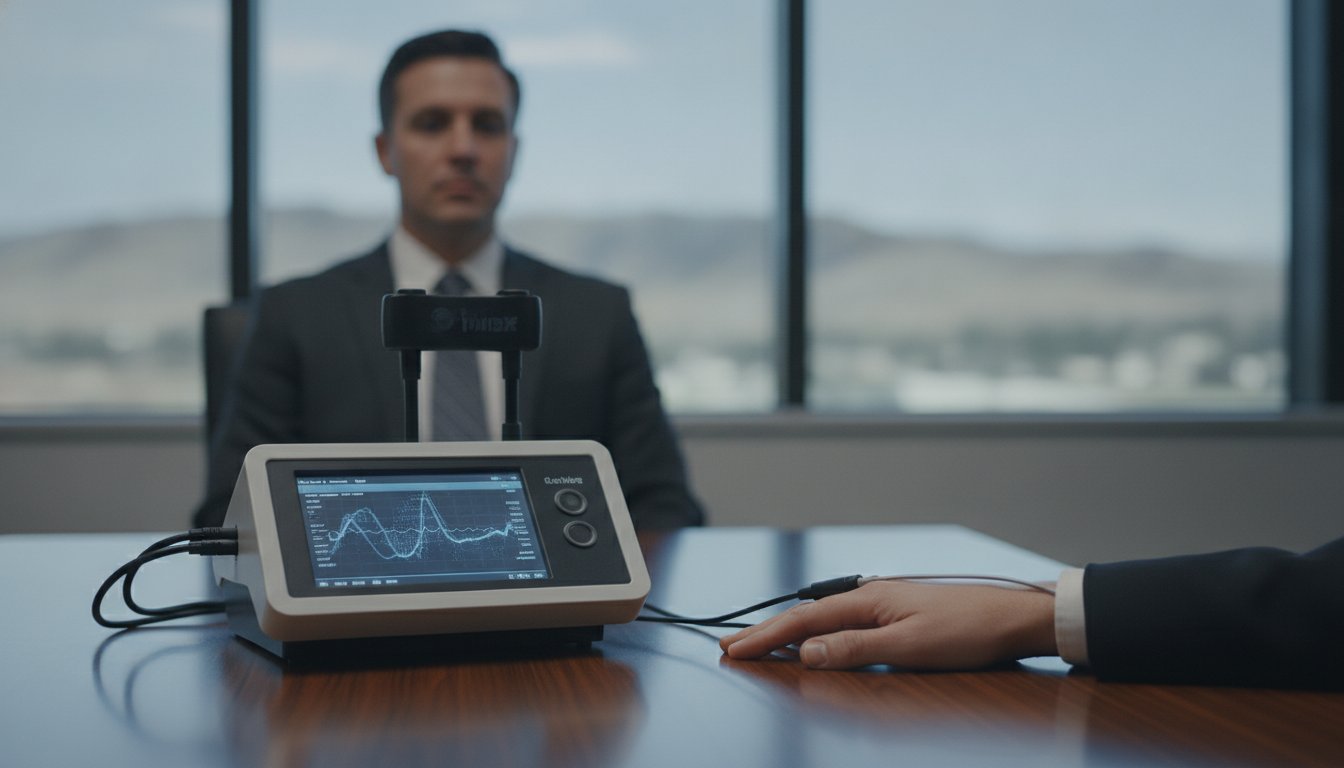
What if a voluntary admission isn’t the final resolution but rather a starting point that requires scientific validation to be truly credible? You likely understand the profound weight of a confession, yet you may still struggle with the lingering uncertainty of whether the full truth has been revealed. In legal and private matters, the emotional distress caused by incomplete statements or the liability of false admissions can be overwhelming. Utilizing a professional polygraph to confirm a confession provides an objective layer of verification that transforms a simple statement into a validated fact. By applying modern, data-driven detection methods, you can secure the objective confirmation necessary for sound defense strategies or personal closure.
This article explores how professional examinations serve as a vital safeguard against the ambiguity of human testimony. You’ll discover the innovative methodologies used in 2026 to ensure admissions are both voluntary and complete. We will provide a clear overview of how these specialized assessments offer the legal clarity and peace of mind you require when navigating sensitive disputes or complex litigation.
Key Takeaways
- Understand how modern forensic psychophysiology uses the “Confession Criterion” to ensure physiological responses remain diagnostic even after a verbal admission.
- Learn to identify and mitigate the risks of coerced admissions through ethical, voluntary participation and objective, data-driven detection.
- Discover the essential steps for utilizing a professional polygraph to confirm a confession, including the development of non-ambiguous questions and comprehensive pre-test interviews.
- Explore how methodical, forward-thinking verification services provide the necessary clarity to resolve sensitive legal and personal disputes with confidence.
The Role of Polygraphy in Confirming or Refuting a Confession
The “Confession Verification” exam in 2026 represents a specialized application of psychophysiological technology. Unlike traditional investigative testing aimed at identifying a suspect, this process doesn’t focus on discovery but on validating the integrity of a statement already provided. It shifts the focus from an adversarial interrogation to a methodical, data-driven validation. Attorneys frequently utilize a polygraph to confirm a confession when they need to demonstrate that their client’s admission is voluntary, accurate, and complete. This objective layer of proof can be a decisive factor in legal strategy, helping to distinguish between a genuine admission and one that might be the product of external pressure or coercion.
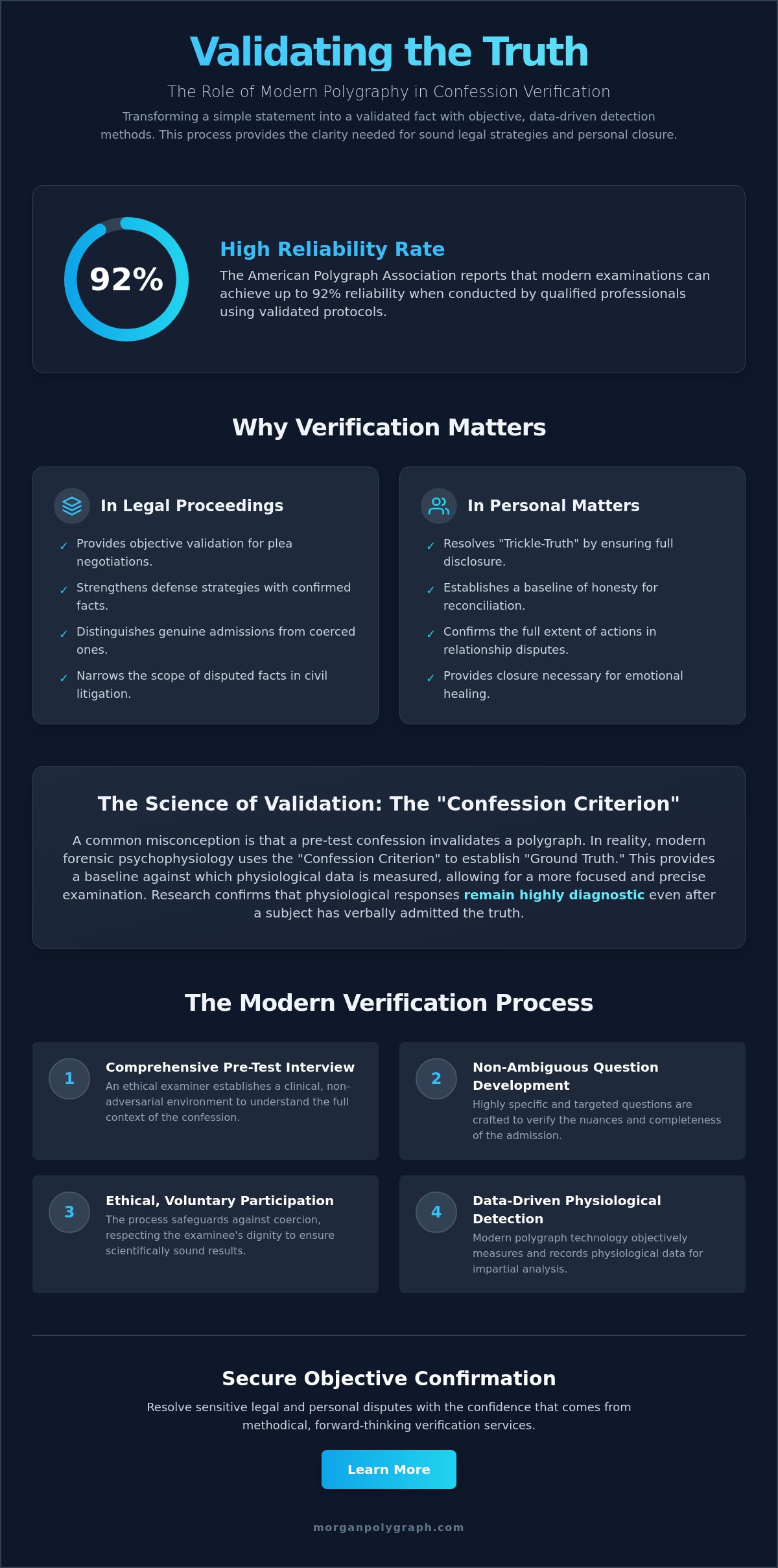
A comprehensive Polygraph overview reveals that while the technology measures physiological changes, the modern examiner’s role is to act as a neutral observer of data. This impartiality is critical. Professional examiners in 2026 have moved away from high-pressure tactics, favoring a clinical environment that respects the examinee’s dignity while ensuring the results remain scientifically sound. The American Polygraph Association reports that modern examinations can achieve 92% reliability when conducted by qualified professionals using validated protocols. This high level of accuracy provides the confidence needed to move forward in sensitive matters.
Why Verification Matters in Legal Proceedings
Legal professionals often require a polygraph examination as a strategic prerequisite before entering plea negotiations. By providing an objective validation of a client’s statement, a defense team can negotiate from a position of transparency. This process helps streamline civil litigation by narrowing the scope of disputed facts. An impartial examiner provides a level of verification that self-reported statements lack, ensuring that all parties can proceed based on a foundation of confirmed truth rather than mere assertion. It’s a tool that protects the legal system from the liabilities of false admissions.
The Private Sector: Moving Beyond “Trickle-Truth”
In personal matters, such as relationship disputes, the primary obstacle to reconciliation is often “trickle-truth,” where information is revealed in small, painful increments. This pattern of partial disclosure is frequently more damaging than the initial incident because it destroys the possibility of trust. Using a polygraph to confirm a confession in these scenarios ensures that a partner has disclosed the full extent of their actions. It establishes a baseline of honesty, allowing both individuals to move forward with the certainty that no more surprises will emerge. This methodical approach provides the closure necessary for emotional healing and future stability.
Does a Pre-Test Confession Change Polygraph Accuracy?
A common misconception suggests that once a verbal admission is made, the utility of a polygraph vanishes. In reality, modern forensic psychophysiology relies on what is known as the “Confession Criterion” to validate the accuracy of testing methodologies. This criterion helps establish “Ground Truth,” providing a baseline against which physiological data can be measured. When using a polygraph to confirm a confession, the examiner isn’t looking for a surprise revelation but is instead verifying that the details of the admission align with the subject’s physiological responses. Research indicates that these responses remain highly diagnostic even after the subject has spoken the truth aloud.
A study on the Polygraph examinations of criminal suspects published by the U.S. Department of Justice underscores that the reliability of the technique holds firm when proper protocols are followed. The presence of a pre-test confession actually allows for a more focused examination. It permits the examiner to construct highly specific questions that target the nuances of the admission, ensuring that no partial disclosures remain. This level of precision is especially valuable in legal contexts where every detail of a statement must be beyond reproach.
The Science of Physiological Validation
Physiological systems like respiration and electrodermal activity don’t simply shut off because a person has decided to be honest. The “Confession Criterion” in 2026 is defined as the methodological use of confirmed admissions to adjust for sample inflation and ensure the diagnostic integrity of polygraph scoring models. Many believe that “knowing the answer” makes the test easier to beat, but the opposite is often true. When a subject is being truthful, their physiological data typically shows a lack of significant reaction to relevant questions, a pattern that remains consistent regardless of their verbal statements. This data-driven detection provides a layer of certainty that verbal testimony alone cannot match.
Are Results Still Reliable?
Statistical analysis shows that accuracy rates for those who have already confessed are comparable to those for non-confessors. Modern scoring algorithms are designed to handle confession-based data sets with high precision. For those questioning the underlying science, our guide on are polygraphs accurate provides a deeper dive into these reliability metrics. By integrating state-of-the-art technology with traditional forensic methods, practitioners can offer a verified account of events that stands up to scrutiny. If you need to establish this level of certainty for a legal or private matter, considering a professional verification exam is a logical next step.
Addressing the Risk of False or Coerced Confessions
False confessions remain a significant concern within the legal system. Coercive tactics don’t just produce unreliable statements; they undermine the integrity of the entire investigative process. When utilizing a polygraph to confirm a confession, the primary objective must be validation, not extraction. Unlike an adversarial interrogation, a professional examination is a scientific procedure that requires the examinee’s willing cooperation. At Morgan Polygraph, we adhere strictly to the American Polygraph Association (APA) standards. These protocols are specifically designed to eliminate the psychological pressure that often leads to wrongful admissions, ensuring the data remains objective and untainted.
Misleading an examinee or using “trickery” is not only unethical but also destroys the scientific validity of the data. Historically, some have viewed the Polygraph (Lie-Detector) Technique primarily as an interrogative tool to elicit admissions. However, in a modern, clinical setting, the focus is on data-driven detection. If an examiner uses deceptive practices during the test, the resulting physiological data becomes contaminated by the subject’s stress or confusion. This renders the results useless for legal or defensive purposes. A true professional understands that their role is to provide an impartial layer of verification, not to act as a second interrogator.
The Danger of “Interrogation masquerading as Testing”
You should be aware of specific red flags in an examiner’s methodology. These include the use of aggressive language, promises of leniency, or ignoring an examinee’s obvious signs of fatigue. A genuine test is methodical and calm. We record every session to ensure total transparency for legal review. This practice is essential for preventing “confession-seeking” bias, where an examiner might subconsciously push for a specific outcome rather than following where the data leads. Transparency protects both the examinee and the integrity of the final report.
Ensuring the Confession is Truly Voluntary
Consent is the cornerstone of a valid exam. The pre-test interview serves as a critical phase where the examiner establishes that the subject is participating without duress. If a confession was coerced before the test, the subject’s physiological responses will often appear “Inconclusive” when the data is scored properly. This happens because the conflict between the forced statement and the subject’s internal truth creates erratic data patterns that don’t meet the threshold for a “truthful” result. Protecting the examinee’s rights isn’t just a legal obligation; it’s a prerequisite for obtaining a result that can actually be used as a polygraph to confirm a confession with confidence.
Best Practices for Validating an Admission via Polygraph
Establishing a rigorous framework is essential when utilizing a polygraph to confirm a confession. A scientific approach ensures that the resulting data is both diagnostic and defensible in a legal or private setting. The process must be methodical, moving from a broad understanding of the circumstances to a precise, data-driven conclusion. This structured path prevents the ambiguity that often plagues unverified verbal statements. By following established forensic protocols, examiners can provide the objective layer of truth necessary for complex decision-making.
A professional examination typically follows a five-step quality control process:
- Step 1: Establishing clear, non-ambiguous questions based specifically on the details of the confession.
- Step 2: Conducting a thorough pre-test interview to define the scope of the admission and ensure the examinee’s psychological suitability for testing.
- Step 3: Utilizing validated testing formats, such as the Utah Zone Comparison Test (ZCT) or the Directed Lie Control Test (DLCT), which are recognized for their high reliability.
- Step 4: Ensuring the examiner is nationally certified and holds the necessary credentials to be recognized by legal authorities.
- Step 5: Implementing independent scoring and quality control of the charts to eliminate any potential for examiner bias.
Structuring the Examination Questions
Precision in question formulation is the most critical component of a successful exam. We generally recommend a “single-issue” format when using a polygraph to confirm a confession, as this focuses the subject’s physiological attention on one specific event. This approach prevents “double-barreled” questions that combine multiple actions, which often confuse the data and lead to inconclusive results. In sensitive matters, such as an infidelity test, we work closely with the client to address “I don’t remember” responses during the pre-test phase. This ensures that the final questions cover the full extent of the issue, effectively putting an end to the damaging cycle of “trickle-truth.”
Choosing a Certified Examiner
Because Idaho does not have a state-specific licensing requirement for polygraph examiners, residents must prioritize practitioners who hold national certifications and court recognition. It’s vital to verify an examiner’s standing with the American Polygraph Association (APA) to ensure they adhere to modern ethical and scientific standards. For cases involving specific legal mandates, look for experts with advanced training in Post-Conviction Sex Offender Testing (PCSOT), as this reflects a high level of specialized skill. Selecting a seasoned professional ensures your sensitive issues are handled with the utmost confidentiality and technical precision. If you’re ready to proceed with a validation exam, you can schedule a professional consultation to discuss your specific needs.
Expert Confession Verification Services in Boise, Idaho
Morgan Polygraph provides a sanctuary of professional clarity for those navigating the complexities of legal admissions and personal disputes. In the heart of Boise, we serve a diverse clientele ranging from high-stakes defense attorneys to private citizens seeking resolution in sensitive family matters. When you require a polygraph to confirm a confession, the expertise of your examiner is the most critical factor. Our practice bridges the gap between traditional forensic experience and futuristic technology, ensuring that every result is backed by rigorous, data-driven detection methods. We understand the human stress involved in these sessions and maintain an environment defined by calm, collected confidence.
Our commitment to the Boise community is built on a foundation of discretion and technical precision. Whether the matter is criminal, civil, or deeply personal, we provide an objective layer of verification that transforms uncertainty into actionable truth. By integrating the latest advancements in psychophysiological recording, we offer a service that is both innovative and rooted in established scientific protocols. This methodical approach ensures that every confession verified in our office stands up to the highest levels of scrutiny.
Why Choose Morgan Polygraph in Boise?
Our local expertise is well-recognized within Southern Idaho courts and the broader legal community. We understand that while Idaho doesn’t have state-specific licensing, the weight of a report depends entirely on the examiner’s credentials and standing with organizations like the American Polygraph Association. Our lead practitioners bring a compassionate yet methodical approach to every case, ensuring that examinees feel respected while the data remains clinical and untainted. Every report we produce is characterized by academic gravitas, providing a clear and authoritative record that can be used to solidify defense strategies or facilitate personal reconciliation.
Scheduling Your Confidential Examination
Preparing for a session at our Boise office is a straightforward, organized process. We provide clear, step-by-step instructions to ensure that both the client and the examinee understand the physical environment and the procedural requirements. You can expect a professional, unhurried atmosphere designed to minimize anxiety and maximize the accuracy of the physiological data. To prepare, we recommend that examinees arrive well-rested and prepared to engage in a transparent pre-test interview. This phase is essential for defining the scope of the admission and ensuring that the final results are beyond reproach. If you are ready to secure the objective confirmation you need, Contact Morgan Polygraph to schedule a professional verification and take the first step toward definitive clarity.
Securing Definitive Clarity in Legal and Private Matters
The transition from a verbal admission to a scientifically validated fact requires a methodical approach that prioritizes objective data over psychological pressure. You now understand how modern forensic psychophysiology provides a necessary layer of protection, ensuring that statements are both voluntary and complete. Utilizing a polygraph to confirm a confession is not just about discovery; it’s about establishing a foundation of truth that can withstand legal scrutiny and facilitate personal healing. By adhering to strict ethical standards and leveraging state-of-the-art technology, you can eliminate the damaging cycle of partial disclosures and move forward with total confidence.
Morgan Polygraph remains dedicated to providing this level of precision for the Boise legal community and private citizens. Our nationally certified and court-recognized examiners offer a compassionate and discreet service, ensuring your sensitive issues are handled with the clinical expertise they deserve. Whether you are building a defense strategy or seeking closure in a personal dispute, our team is here to guide you through the process with unhurried professionalism. Schedule a Professional Polygraph in Boise to begin the process of validating the truth. You deserve the peace of mind that only verified facts can provide.
Frequently Asked Questions
Can a polygraph test prove a confession was forced?
A polygraph examination doesn’t directly prove legal coercion, but it identifies whether the examinee’s physiological responses align with the truth of their statement. If an admission was forced, the subject’s internal truth often conflicts with their verbal statement, frequently resulting in “Inconclusive” or “Deception Indicated” results. This technical data provides an objective layer of evidence that defense attorneys use to challenge the validity of a suspect’s admission during legal proceedings.
What happens if someone confesses during the pre-test interview?
The examiner will transition the session into a verification format to ensure the new admission is complete and accurate. This is a common occurrence when using a polygraph to confirm a confession, as the pre-test interview is designed to encourage transparency. The examiner then modifies the question set to target the specific details of the new statement, ensuring no “trickle-truth” or partial disclosures remain unaddressed before the data collection phase begins.
Are polygraph results admissible in Idaho courts to confirm a confession?
Polygraph results are admissible in Idaho courts only if all parties involved in the case stipulate to their admission beforehand. This means the prosecution and the defense must reach a formal agreement before the test results can be introduced as evidence. While not automatically admissible, many legal professionals in Boise use these examinations to facilitate plea negotiations or to provide a foundation for defense strategies outside of the courtroom.
How long does a confession verification test usually take?
A standard confession verification examination typically requires between two and three hours to complete. This duration allows for a comprehensive pre-test interview, the attachment of medical-grade sensors, and multiple rounds of data collection. A methodical, unhurried pace is essential for maintaining the clinical integrity of the results. This time also ensures the examinee fully understands each question, which is a prerequisite for obtaining clear and diagnostic physiological charts.
Can a polygraph distinguish between a full confession and a partial truth?
Modern forensic psychophysiology is highly effective at identifying partial truths through the use of targeted, single-issue questions. If an examinee provides a “half-truth,” their physiological responses to specific, exclusionary questions will typically trigger a deceptive reaction. By focusing on the nuances of the statement, a professional examiner can determine if the subject is withholding additional information, providing the clarity needed to resolve complex relationship or legal disputes.
What should I do if a polygraph examiner says I failed but I am telling the truth?
You should request an independent quality control review of the charts by a separate, certified professional. Errors are rare in modern testing, but a second opinion ensures that the scoring was performed objectively and without bias. Professional firms like Morgan Polygraph prioritize accuracy by utilizing secondary reviews and state-of-the-art algorithms, which help protect truthful examinees from the risks of a “false positive” result in high-stakes situations.
Is it possible to fail a polygraph due to the stress of confessing?
It’s not possible to fail simply due to the emotional stress of the situation, as modern scoring models differentiate between general anxiety and the specific physiological signatures of deception. While confessing is inherently stressful, the polygraph measures the body’s reaction to the act of lying, not the examinee’s overall nervousness. Truthful subjects, even those who are visibly upset, typically produce charts that indicate a lack of deceptive reaction to the relevant questions.
How much does a professional confession verification test cost in 2026?
The cost of a professional examination in 2026 depends on the complexity of the case and whether it involves criminal, civil, or private matters. Single-issue forensic tests require a high level of specialized skill and the use of advanced technology, which is reflected in the professional fee. While we don’t provide fixed pricing without a consultation, we ensure our rates remain competitive within the Boise legal community while maintaining the highest standards of clinical precision.